

azure::1.0.0::cache::redis, with backend choices shown together. Read how Tensor9 estimates service-adapter costs for price scope and capacity qualification, or return to additional services.
Azure Cache for Redis allocated cache capacity → ElastiCache
Origin API:azure::1.0.0::cache::redis. Target backend: aws::1.0.0::elasticache.
Designed mapping. This cost model describes an intended adapter. Its estimated price does not establish a delivered or selectable backend.
Azure Cache for Redis allocated cache capacity · Redis key reads per second
Feature: Azure Cache for Redis allocated cache capacity. Estimated monthly service charges by Redis key reads per second. Adapter hosting and Tensor9 fees are excluded. Source: eastus; target: us-east-1; currency: USD.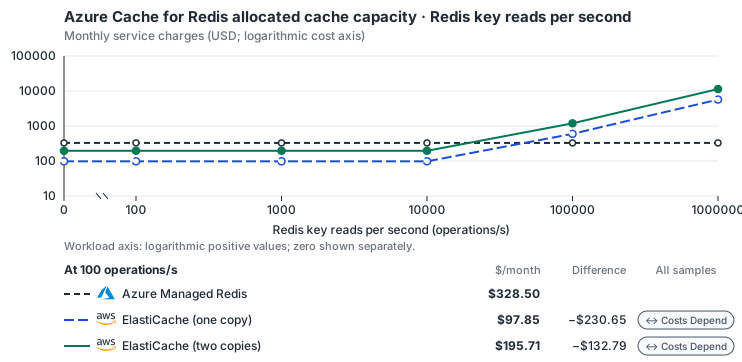
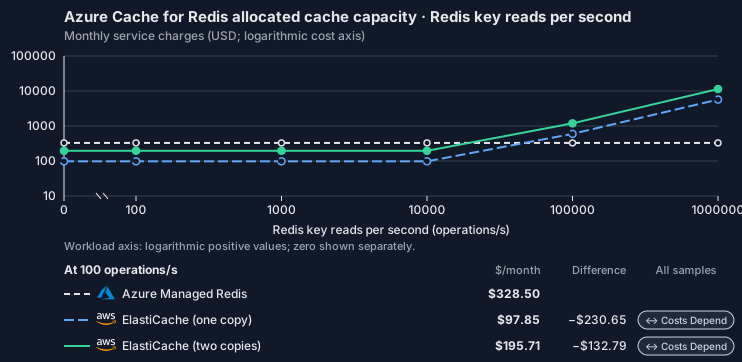
Estimated allocation, not benchmark calibrated: sized from 2 vCPU, 8 GiB memory and 0 GiB SSD at 0 operations/s to 3 nodes of 64 vCPU, 155 GiB memory and 0 GiB SSD each at 1,000,000 operations/s.
Curve assumptions
- Only the selected native meter varies; other usage quantities and assumptions retain their displayed defaults. Other native meters and workload assumptions retain their explicitly displayed default quantities. Workload translation and capacity assumptions are not benchmark measurements.
- Native monthly usage priced at the cited provider list prices; listed target allowances apply where present, excluding invoice credits, taxes and negotiated discounts. Rates as of 2026-10-22: eastus → us-east-1, USD/month.
- Source prices are reference charges, not an invoice. Target lines cover selected service usage/configuration only; adapter hosting and Tensor9 fees are excluded.
- Samples of explicit prices are not performance measurements or capacity qualification. No interpolation or break-even guarantee is implied.
- Variant assumptions show the first axis sample; any axis-dependent configuration is described by this curve’s workload note.
- Rates are cited provider list prices, editable for discounts, commitments or another region. Workload translation and capacity coefficients remain editable planning assumptions, not benchmark measurements or a commercial quote.
- Default-zero rates are explicit assumptions, not evidence that the deployed service or resource is free.
- Provisioned-unit minimums use an editable approximate allocation floor. Modeled target service cost is max(usage/allocation, minimum), with billable network, durable staging and dependent sinks added separately; actual RU/TU sizing, scaling increments and throughput remain unqualified.
- Durable staging is priced once: provisioned targets include adapter state in their selected allocation; native targets add a separate staging allocation when required. Adapter hosting is a separate allocation and must exclude resources already priced as staging, workers or target capacity.
- A declared adapter mapping and cost model do not establish implementation availability or service equivalence.
- This exact directed mapping has a design profile. Cost modeling does not establish an implemented or deployable adapter.
- Origin unit prices are cited provider list prices; capacity coefficients are editable authored planning guesses, not measured capacity.
- The origin is the exact registered azure::1.0.0::cache::redis identity. Renamed products and future aliases require explicit mapping updates.
- Source allocated CPU-hours and memory-hours establish independent minimum target allocation. Neither management API requests nor a key-operation count is an instance count.
- Peak weighted key-operation work and resident data can promote the allocation above those minima. CPU rounds to whole cores and RAM to quarter GiB.
- CPU and RAM are aggregate resources over 730 hours. Selected backend prices own replica count, availability configuration and actual instance shapes.
- A multi-core estimate assumes the workload can be partitioned. Redis command execution, hot keys, cross-key transactions and clustering can prevent linear scale.
- Zero allocated resources and zero workload do not prove target scale-to-zero; the selected backend may retain a provisioned minimum.
- Azure Cache for Redis bills per cache size; cache-hours times the size’s memory set the RAM minimum and CPU follows the selected memory shape.
- ElastiCache for Redis OSS node-based clusters bill whole nodes per hour; the capacity rate is cache.r7g.large’s price per GiB, and each replica is another full-price node. Valkey nodes list 20% lower (cache.r7g.large 0.1752 per hour, 0.0134047 per GiB-hour); ElastiCache Serverless is not selected. The CPU rate is zero because capacity GiB is the billed quantity, and the billed capacity is the cache family’s selected RAM rather than the generic planning CPU tier’s RAM; key-operation CPU demand raises cost only through the family’s RAM-per-CPU shape, which approximates managed throughput growing with capacity and is not a measured fit. The capacity charge and the minimum compare using their maximum, not their sum.
- Cache storedGiB represents resident RAM footprint, not billable SSD. Persistence, snapshots and backup disks require a separate explicit allocation.
- Row-store throughput (capacityOpsPerVcpuSecond, default 1500) is measured-by-tensor9 as a lower bound: the DynamoDB adapter on Cloud SQL db-custom-2-7680 (2 vCPU, PostgreSQL 16, us-west1) served 2,974 ops/s of YCSB-A at 16 threads without recorded saturation (src/main/kotlin/t9/prime/equiv/generated/eval/CloudsqlPostgresqlYcsbAT16GoYcsbV1_0_0.kt). Published CPU-bound pgbench reaches 3,101 read-write transactions and 20,289 point reads per vCPU-second (AWS z1d.2xlarge, PostgreSQL 14.5), so actual capacity is likely higher. Reads and writes share one coefficient: at the same adapter version, read-only YCSB-C was not faster than 50%-update YCSB-A.
- Log-broker throughput (capacityStreamMiBPerVcpuSecond 20 at 0.5 utilization, 4 GiB RAM per vCPU) is provider-documented by Google Managed Service for Apache Kafka sizing (https://docs.cloud.google.com/managed-service-for-apache-kafka/docs/plan-cluster-size): write-equivalent bytes are replicated writes plus a quarter of reads. Producer batches below 10 KB lower per-CPU throughput; that penalty is not modeled.
- Disk utilization 0.8 is provider-documented headroom below Cloud SQL automatic storage increase, which triggers near 91-95% full (https://docs.cloud.google.com/sql/docs/postgres/instance-settings). The 20 GiB reserve exceeds PostgreSQL’s 1 GB default max_wal_size; the remainder of that reserve is unmeasured.
- CPU tiers double from 2 vCPUs to the target’s largest node at 4 GiB per vCPU; each target’s documented largest node bounds CPU, RAM, RAM per vCPU and disk, and the durable staging database uses Cloud SQL Enterprise (96 vCPU, 6.5 GiB per vCPU, 624 GiB, 64 TiB). Targets billed per capacity unit or throughput unit are sized by their backend instead.
- No public evidence: peak/mean work (2) and the RAM working-set fraction (0.1). Proposed measurements: the p99 one-minute rate over the monthly mean from customer CloudWatch metrics; the buffer hit ratio while stepping RAM under a fixed YCSB-B load.
- Node bounds: cache.r7g.16xlarge has 64 vCPUs and 419.09 GiB (https://docs.aws.amazon.com/AmazonElastiCache/latest/dg/CacheNodes.SupportedTypes.html); cluster mode shards up to 500 nodes (https://docs.aws.amazon.com/AmazonElastiCache/latest/dg/Shards.html).
- Stored GiB already includes the origin family’s physical footprint assumptions; no second storage amplification is applied.
- The workload family already selected resource-hours; the throughput coefficient is not applied again.
- Copies and allocation fractions change cost only; they do not increase modeled primary capacity.
- Cache resident GiB is RAM provenance. Family-selected RAM-hours cover the working set;
- no SSD allocation is modeled. Persistence, snapshots and backup disks remain excluded.
- Azure Retail Prices API: https://prices.azure.com/api/retail/prices
- AWS Price List API: https://pricing.us-east-1.amazonaws.com/offers/v1.0/aws/AmazonElastiCache/current/us-east-1/index.json
- AWS Price List API, AWSDataTransfer: https://pricing.us-east-1.amazonaws.com/offers/v1.0/aws/AWSDataTransfer/current/us-east-1/index.json
- Replication traffic, snapshots, persistence write IOPS, network egress, cluster management premiums, licenses and migration.
- Command-specific complexity, Lua/scripts, module behavior, eviction/expiry churn, blocking commands, multi-key locality and benchmark-qualified latency.
- Taxes, discounts, credits and free-tier allowances not explicitly listed by this model.
- Unmodeled dependent services, task execution and operations outside the selected workload family.
plan-6f38d8e2054ca3166dde937a9c647167e1adeb1e / 2026-10-22.planning.2. Curve: workload-1.
Sources: Azure Retail Prices API, AWS Price List API, AWS Price List API, AWSDataTransfer.
Azure Cache for Redis allocated cache capacity · Redis key writes per second
Feature: Azure Cache for Redis allocated cache capacity. Estimated monthly service charges by Redis key writes per second. Adapter hosting and Tensor9 fees are excluded. Source: eastus; target: us-east-1; currency: USD.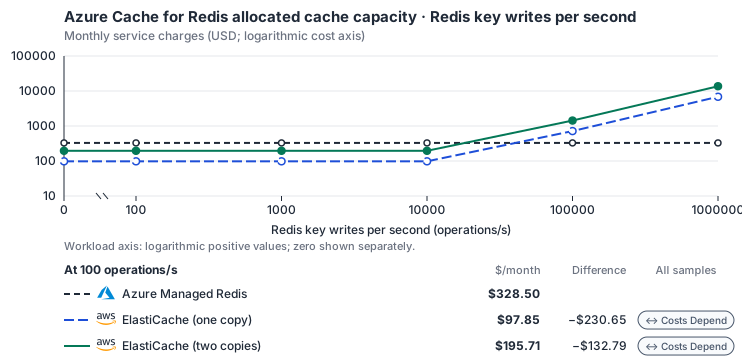
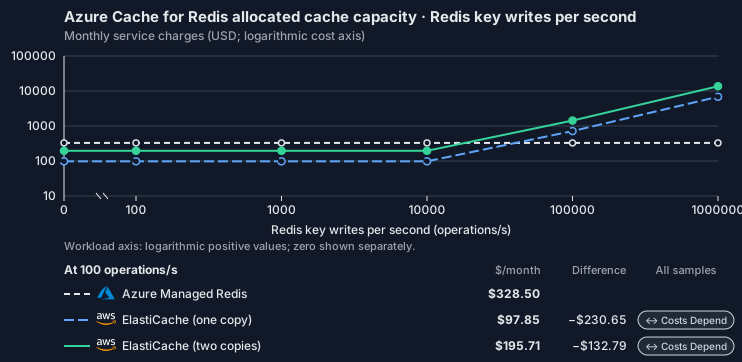
Estimated allocation, not benchmark calibrated: sized from 2 vCPU, 8 GiB memory and 0 GiB SSD at 0 operations/s to 3 nodes of 64 vCPU, 186.5 GiB memory and 0 GiB SSD each at 1,000,000 operations/s.
Curve assumptions
- Only the selected native meter varies; other usage quantities and assumptions retain their displayed defaults. Other native meters and workload assumptions retain their explicitly displayed default quantities. Workload translation and capacity assumptions are not benchmark measurements.
- Native monthly usage priced at the cited provider list prices; listed target allowances apply where present, excluding invoice credits, taxes and negotiated discounts. Rates as of 2026-10-22: eastus → us-east-1, USD/month.
- Source prices are reference charges, not an invoice. Target lines cover selected service usage/configuration only; adapter hosting and Tensor9 fees are excluded.
- Samples of explicit prices are not performance measurements or capacity qualification. No interpolation or break-even guarantee is implied.
- Variant assumptions show the first axis sample; any axis-dependent configuration is described by this curve’s workload note.
- Rates are cited provider list prices, editable for discounts, commitments or another region. Workload translation and capacity coefficients remain editable planning assumptions, not benchmark measurements or a commercial quote.
- Default-zero rates are explicit assumptions, not evidence that the deployed service or resource is free.
- Provisioned-unit minimums use an editable approximate allocation floor. Modeled target service cost is max(usage/allocation, minimum), with billable network, durable staging and dependent sinks added separately; actual RU/TU sizing, scaling increments and throughput remain unqualified.
- Durable staging is priced once: provisioned targets include adapter state in their selected allocation; native targets add a separate staging allocation when required. Adapter hosting is a separate allocation and must exclude resources already priced as staging, workers or target capacity.
- A declared adapter mapping and cost model do not establish implementation availability or service equivalence.
- This exact directed mapping has a design profile. Cost modeling does not establish an implemented or deployable adapter.
- Origin unit prices are cited provider list prices; capacity coefficients are editable authored planning guesses, not measured capacity.
- The origin is the exact registered azure::1.0.0::cache::redis identity. Renamed products and future aliases require explicit mapping updates.
- Source allocated CPU-hours and memory-hours establish independent minimum target allocation. Neither management API requests nor a key-operation count is an instance count.
- Peak weighted key-operation work and resident data can promote the allocation above those minima. CPU rounds to whole cores and RAM to quarter GiB.
- CPU and RAM are aggregate resources over 730 hours. Selected backend prices own replica count, availability configuration and actual instance shapes.
- A multi-core estimate assumes the workload can be partitioned. Redis command execution, hot keys, cross-key transactions and clustering can prevent linear scale.
- Zero allocated resources and zero workload do not prove target scale-to-zero; the selected backend may retain a provisioned minimum.
- Azure Cache for Redis bills per cache size; cache-hours times the size’s memory set the RAM minimum and CPU follows the selected memory shape.
- ElastiCache for Redis OSS node-based clusters bill whole nodes per hour; the capacity rate is cache.r7g.large’s price per GiB, and each replica is another full-price node. Valkey nodes list 20% lower (cache.r7g.large 0.1752 per hour, 0.0134047 per GiB-hour); ElastiCache Serverless is not selected. The CPU rate is zero because capacity GiB is the billed quantity, and the billed capacity is the cache family’s selected RAM rather than the generic planning CPU tier’s RAM; key-operation CPU demand raises cost only through the family’s RAM-per-CPU shape, which approximates managed throughput growing with capacity and is not a measured fit. The capacity charge and the minimum compare using their maximum, not their sum.
- Cache storedGiB represents resident RAM footprint, not billable SSD. Persistence, snapshots and backup disks require a separate explicit allocation.
- Row-store throughput (capacityOpsPerVcpuSecond, default 1500) is measured-by-tensor9 as a lower bound: the DynamoDB adapter on Cloud SQL db-custom-2-7680 (2 vCPU, PostgreSQL 16, us-west1) served 2,974 ops/s of YCSB-A at 16 threads without recorded saturation (src/main/kotlin/t9/prime/equiv/generated/eval/CloudsqlPostgresqlYcsbAT16GoYcsbV1_0_0.kt). Published CPU-bound pgbench reaches 3,101 read-write transactions and 20,289 point reads per vCPU-second (AWS z1d.2xlarge, PostgreSQL 14.5), so actual capacity is likely higher. Reads and writes share one coefficient: at the same adapter version, read-only YCSB-C was not faster than 50%-update YCSB-A.
- Log-broker throughput (capacityStreamMiBPerVcpuSecond 20 at 0.5 utilization, 4 GiB RAM per vCPU) is provider-documented by Google Managed Service for Apache Kafka sizing (https://docs.cloud.google.com/managed-service-for-apache-kafka/docs/plan-cluster-size): write-equivalent bytes are replicated writes plus a quarter of reads. Producer batches below 10 KB lower per-CPU throughput; that penalty is not modeled.
- Disk utilization 0.8 is provider-documented headroom below Cloud SQL automatic storage increase, which triggers near 91-95% full (https://docs.cloud.google.com/sql/docs/postgres/instance-settings). The 20 GiB reserve exceeds PostgreSQL’s 1 GB default max_wal_size; the remainder of that reserve is unmeasured.
- CPU tiers double from 2 vCPUs to the target’s largest node at 4 GiB per vCPU; each target’s documented largest node bounds CPU, RAM, RAM per vCPU and disk, and the durable staging database uses Cloud SQL Enterprise (96 vCPU, 6.5 GiB per vCPU, 624 GiB, 64 TiB). Targets billed per capacity unit or throughput unit are sized by their backend instead.
- No public evidence: peak/mean work (2) and the RAM working-set fraction (0.1). Proposed measurements: the p99 one-minute rate over the monthly mean from customer CloudWatch metrics; the buffer hit ratio while stepping RAM under a fixed YCSB-B load.
- Node bounds: cache.r7g.16xlarge has 64 vCPUs and 419.09 GiB (https://docs.aws.amazon.com/AmazonElastiCache/latest/dg/CacheNodes.SupportedTypes.html); cluster mode shards up to 500 nodes (https://docs.aws.amazon.com/AmazonElastiCache/latest/dg/Shards.html).
- Stored GiB already includes the origin family’s physical footprint assumptions; no second storage amplification is applied.
- The workload family already selected resource-hours; the throughput coefficient is not applied again.
- Copies and allocation fractions change cost only; they do not increase modeled primary capacity.
- Cache resident GiB is RAM provenance. Family-selected RAM-hours cover the working set;
- no SSD allocation is modeled. Persistence, snapshots and backup disks remain excluded.
- Azure Retail Prices API: https://prices.azure.com/api/retail/prices
- AWS Price List API: https://pricing.us-east-1.amazonaws.com/offers/v1.0/aws/AmazonElastiCache/current/us-east-1/index.json
- AWS Price List API, AWSDataTransfer: https://pricing.us-east-1.amazonaws.com/offers/v1.0/aws/AWSDataTransfer/current/us-east-1/index.json
- Replication traffic, snapshots, persistence write IOPS, network egress, cluster management premiums, licenses and migration.
- Command-specific complexity, Lua/scripts, module behavior, eviction/expiry churn, blocking commands, multi-key locality and benchmark-qualified latency.
- Taxes, discounts, credits and free-tier allowances not explicitly listed by this model.
- Unmodeled dependent services, task execution and operations outside the selected workload family.
plan-6f38d8e2054ca3166dde937a9c647167e1adeb1e / 2026-10-22.planning.2. Curve: workload-2.
Sources: Azure Retail Prices API, AWS Price List API, AWS Price List API, AWSDataTransfer.
Azure Cache for Redis allocated cache capacity · Resident logical cache data
Feature: Azure Cache for Redis allocated cache capacity. Estimated monthly service charges by Resident logical cache data. Adapter hosting and Tensor9 fees are excluded. Source: eastus; target: us-east-1; currency: USD.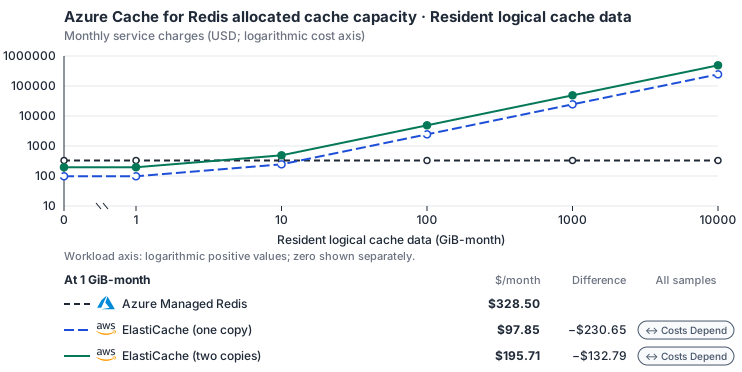
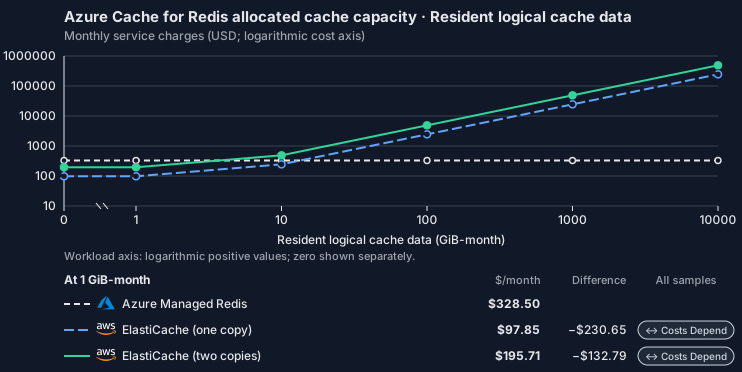
Estimated allocation, not benchmark calibrated: sized from 2 vCPU, 8 GiB memory and 0 GiB SSD at 0 GiB-month to 48 nodes of 64 vCPU, 416.75 GiB memory and 0 GiB SSD each at 10,000 GiB-month.
Curve assumptions
- Only the selected native meter varies; other usage quantities and assumptions retain their displayed defaults. Other native meters and workload assumptions retain their explicitly displayed default quantities. Workload translation and capacity assumptions are not benchmark measurements.
- Native monthly usage priced at the cited provider list prices; listed target allowances apply where present, excluding invoice credits, taxes and negotiated discounts. Rates as of 2026-10-22: eastus → us-east-1, USD/month.
- Source prices are reference charges, not an invoice. Target lines cover selected service usage/configuration only; adapter hosting and Tensor9 fees are excluded.
- Samples of explicit prices are not performance measurements or capacity qualification. No interpolation or break-even guarantee is implied.
- Variant assumptions show the first axis sample; any axis-dependent configuration is described by this curve’s workload note.
- Rates are cited provider list prices, editable for discounts, commitments or another region. Workload translation and capacity coefficients remain editable planning assumptions, not benchmark measurements or a commercial quote.
- Default-zero rates are explicit assumptions, not evidence that the deployed service or resource is free.
- Provisioned-unit minimums use an editable approximate allocation floor. Modeled target service cost is max(usage/allocation, minimum), with billable network, durable staging and dependent sinks added separately; actual RU/TU sizing, scaling increments and throughput remain unqualified.
- Durable staging is priced once: provisioned targets include adapter state in their selected allocation; native targets add a separate staging allocation when required. Adapter hosting is a separate allocation and must exclude resources already priced as staging, workers or target capacity.
- A declared adapter mapping and cost model do not establish implementation availability or service equivalence.
- This exact directed mapping has a design profile. Cost modeling does not establish an implemented or deployable adapter.
- Origin unit prices are cited provider list prices; capacity coefficients are editable authored planning guesses, not measured capacity.
- The origin is the exact registered azure::1.0.0::cache::redis identity. Renamed products and future aliases require explicit mapping updates.
- Source allocated CPU-hours and memory-hours establish independent minimum target allocation. Neither management API requests nor a key-operation count is an instance count.
- Peak weighted key-operation work and resident data can promote the allocation above those minima. CPU rounds to whole cores and RAM to quarter GiB.
- CPU and RAM are aggregate resources over 730 hours. Selected backend prices own replica count, availability configuration and actual instance shapes.
- A multi-core estimate assumes the workload can be partitioned. Redis command execution, hot keys, cross-key transactions and clustering can prevent linear scale.
- Zero allocated resources and zero workload do not prove target scale-to-zero; the selected backend may retain a provisioned minimum.
- Azure Cache for Redis bills per cache size; cache-hours times the size’s memory set the RAM minimum and CPU follows the selected memory shape.
- ElastiCache for Redis OSS node-based clusters bill whole nodes per hour; the capacity rate is cache.r7g.large’s price per GiB, and each replica is another full-price node. Valkey nodes list 20% lower (cache.r7g.large 0.1752 per hour, 0.0134047 per GiB-hour); ElastiCache Serverless is not selected. The CPU rate is zero because capacity GiB is the billed quantity, and the billed capacity is the cache family’s selected RAM rather than the generic planning CPU tier’s RAM; key-operation CPU demand raises cost only through the family’s RAM-per-CPU shape, which approximates managed throughput growing with capacity and is not a measured fit. The capacity charge and the minimum compare using their maximum, not their sum.
- Cache storedGiB represents resident RAM footprint, not billable SSD. Persistence, snapshots and backup disks require a separate explicit allocation.
- Row-store throughput (capacityOpsPerVcpuSecond, default 1500) is measured-by-tensor9 as a lower bound: the DynamoDB adapter on Cloud SQL db-custom-2-7680 (2 vCPU, PostgreSQL 16, us-west1) served 2,974 ops/s of YCSB-A at 16 threads without recorded saturation (src/main/kotlin/t9/prime/equiv/generated/eval/CloudsqlPostgresqlYcsbAT16GoYcsbV1_0_0.kt). Published CPU-bound pgbench reaches 3,101 read-write transactions and 20,289 point reads per vCPU-second (AWS z1d.2xlarge, PostgreSQL 14.5), so actual capacity is likely higher. Reads and writes share one coefficient: at the same adapter version, read-only YCSB-C was not faster than 50%-update YCSB-A.
- Log-broker throughput (capacityStreamMiBPerVcpuSecond 20 at 0.5 utilization, 4 GiB RAM per vCPU) is provider-documented by Google Managed Service for Apache Kafka sizing (https://docs.cloud.google.com/managed-service-for-apache-kafka/docs/plan-cluster-size): write-equivalent bytes are replicated writes plus a quarter of reads. Producer batches below 10 KB lower per-CPU throughput; that penalty is not modeled.
- Disk utilization 0.8 is provider-documented headroom below Cloud SQL automatic storage increase, which triggers near 91-95% full (https://docs.cloud.google.com/sql/docs/postgres/instance-settings). The 20 GiB reserve exceeds PostgreSQL’s 1 GB default max_wal_size; the remainder of that reserve is unmeasured.
- CPU tiers double from 2 vCPUs to the target’s largest node at 4 GiB per vCPU; each target’s documented largest node bounds CPU, RAM, RAM per vCPU and disk, and the durable staging database uses Cloud SQL Enterprise (96 vCPU, 6.5 GiB per vCPU, 624 GiB, 64 TiB). Targets billed per capacity unit or throughput unit are sized by their backend instead.
- No public evidence: peak/mean work (2) and the RAM working-set fraction (0.1). Proposed measurements: the p99 one-minute rate over the monthly mean from customer CloudWatch metrics; the buffer hit ratio while stepping RAM under a fixed YCSB-B load.
- Node bounds: cache.r7g.16xlarge has 64 vCPUs and 419.09 GiB (https://docs.aws.amazon.com/AmazonElastiCache/latest/dg/CacheNodes.SupportedTypes.html); cluster mode shards up to 500 nodes (https://docs.aws.amazon.com/AmazonElastiCache/latest/dg/Shards.html).
- Stored GiB already includes the origin family’s physical footprint assumptions; no second storage amplification is applied.
- The workload family already selected resource-hours; the throughput coefficient is not applied again.
- Copies and allocation fractions change cost only; they do not increase modeled primary capacity.
- Cache resident GiB is RAM provenance. Family-selected RAM-hours cover the working set;
- no SSD allocation is modeled. Persistence, snapshots and backup disks remain excluded.
- Azure Retail Prices API: https://prices.azure.com/api/retail/prices
- AWS Price List API: https://pricing.us-east-1.amazonaws.com/offers/v1.0/aws/AmazonElastiCache/current/us-east-1/index.json
- AWS Price List API, AWSDataTransfer: https://pricing.us-east-1.amazonaws.com/offers/v1.0/aws/AWSDataTransfer/current/us-east-1/index.json
- Replication traffic, snapshots, persistence write IOPS, network egress, cluster management premiums, licenses and migration.
- Command-specific complexity, Lua/scripts, module behavior, eviction/expiry churn, blocking commands, multi-key locality and benchmark-qualified latency.
- Taxes, discounts, credits and free-tier allowances not explicitly listed by this model.
- Unmodeled dependent services, task execution and operations outside the selected workload family.
plan-6f38d8e2054ca3166dde937a9c647167e1adeb1e / 2026-10-22.planning.2. Curve: workload-3.
Sources: Azure Retail Prices API, AWS Price List API, AWS Price List API, AWSDataTransfer.
Azure Cache for Redis allocated cache capacity · Allocated source cache-hours
Feature: Azure Cache for Redis allocated cache capacity. Estimated monthly service charges by Allocated source cache-hours. Adapter hosting and Tensor9 fees are excluded. Source: eastus; target: us-east-1; currency: USD.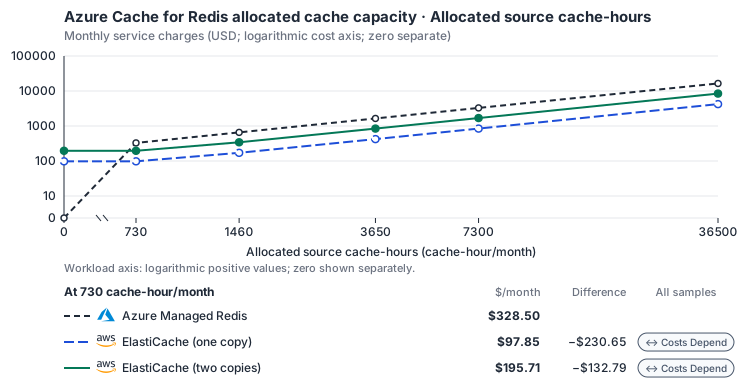
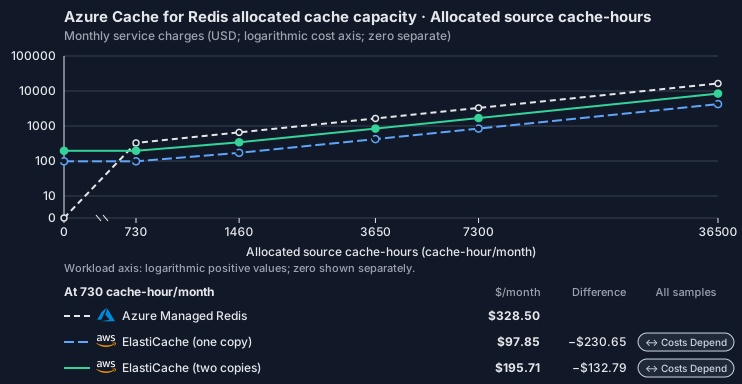
Estimated allocation, not benchmark calibrated: sized from 2 vCPU, 8 GiB memory and 0 GiB SSD at 0 cache-hour/month to 64 vCPU, 345 GiB memory and 0 GiB SSD at 36,500 cache-hour/month.
Curve assumptions
- Only the selected native meter varies; other usage quantities and assumptions retain their displayed defaults. Other native meters and workload assumptions retain their explicitly displayed default quantities. Workload translation and capacity assumptions are not benchmark measurements.
- Native monthly usage priced at the cited provider list prices; listed target allowances apply where present, excluding invoice credits, taxes and negotiated discounts. Rates as of 2026-10-22: eastus → us-east-1, USD/month.
- Source prices are reference charges, not an invoice. Target lines cover selected service usage/configuration only; adapter hosting and Tensor9 fees are excluded.
- Samples of explicit prices are not performance measurements or capacity qualification. No interpolation or break-even guarantee is implied.
- Variant assumptions show the first axis sample; any axis-dependent configuration is described by this curve’s workload note.
- Rates are cited provider list prices, editable for discounts, commitments or another region. Workload translation and capacity coefficients remain editable planning assumptions, not benchmark measurements or a commercial quote.
- Default-zero rates are explicit assumptions, not evidence that the deployed service or resource is free.
- Provisioned-unit minimums use an editable approximate allocation floor. Modeled target service cost is max(usage/allocation, minimum), with billable network, durable staging and dependent sinks added separately; actual RU/TU sizing, scaling increments and throughput remain unqualified.
- Durable staging is priced once: provisioned targets include adapter state in their selected allocation; native targets add a separate staging allocation when required. Adapter hosting is a separate allocation and must exclude resources already priced as staging, workers or target capacity.
- A declared adapter mapping and cost model do not establish implementation availability or service equivalence.
- This exact directed mapping has a design profile. Cost modeling does not establish an implemented or deployable adapter.
- Origin unit prices are cited provider list prices; capacity coefficients are editable authored planning guesses, not measured capacity.
- The origin is the exact registered azure::1.0.0::cache::redis identity. Renamed products and future aliases require explicit mapping updates.
- Source allocated CPU-hours and memory-hours establish independent minimum target allocation. Neither management API requests nor a key-operation count is an instance count.
- Peak weighted key-operation work and resident data can promote the allocation above those minima. CPU rounds to whole cores and RAM to quarter GiB.
- CPU and RAM are aggregate resources over 730 hours. Selected backend prices own replica count, availability configuration and actual instance shapes.
- A multi-core estimate assumes the workload can be partitioned. Redis command execution, hot keys, cross-key transactions and clustering can prevent linear scale.
- Zero allocated resources and zero workload do not prove target scale-to-zero; the selected backend may retain a provisioned minimum.
- Azure Cache for Redis bills per cache size; cache-hours times the size’s memory set the RAM minimum and CPU follows the selected memory shape.
- ElastiCache for Redis OSS node-based clusters bill whole nodes per hour; the capacity rate is cache.r7g.large’s price per GiB, and each replica is another full-price node. Valkey nodes list 20% lower (cache.r7g.large 0.1752 per hour, 0.0134047 per GiB-hour); ElastiCache Serverless is not selected. The CPU rate is zero because capacity GiB is the billed quantity, and the billed capacity is the cache family’s selected RAM rather than the generic planning CPU tier’s RAM; key-operation CPU demand raises cost only through the family’s RAM-per-CPU shape, which approximates managed throughput growing with capacity and is not a measured fit. The capacity charge and the minimum compare using their maximum, not their sum.
- Cache storedGiB represents resident RAM footprint, not billable SSD. Persistence, snapshots and backup disks require a separate explicit allocation.
- Row-store throughput (capacityOpsPerVcpuSecond, default 1500) is measured-by-tensor9 as a lower bound: the DynamoDB adapter on Cloud SQL db-custom-2-7680 (2 vCPU, PostgreSQL 16, us-west1) served 2,974 ops/s of YCSB-A at 16 threads without recorded saturation (src/main/kotlin/t9/prime/equiv/generated/eval/CloudsqlPostgresqlYcsbAT16GoYcsbV1_0_0.kt). Published CPU-bound pgbench reaches 3,101 read-write transactions and 20,289 point reads per vCPU-second (AWS z1d.2xlarge, PostgreSQL 14.5), so actual capacity is likely higher. Reads and writes share one coefficient: at the same adapter version, read-only YCSB-C was not faster than 50%-update YCSB-A.
- Log-broker throughput (capacityStreamMiBPerVcpuSecond 20 at 0.5 utilization, 4 GiB RAM per vCPU) is provider-documented by Google Managed Service for Apache Kafka sizing (https://docs.cloud.google.com/managed-service-for-apache-kafka/docs/plan-cluster-size): write-equivalent bytes are replicated writes plus a quarter of reads. Producer batches below 10 KB lower per-CPU throughput; that penalty is not modeled.
- Disk utilization 0.8 is provider-documented headroom below Cloud SQL automatic storage increase, which triggers near 91-95% full (https://docs.cloud.google.com/sql/docs/postgres/instance-settings). The 20 GiB reserve exceeds PostgreSQL’s 1 GB default max_wal_size; the remainder of that reserve is unmeasured.
- CPU tiers double from 2 vCPUs to the target’s largest node at 4 GiB per vCPU; each target’s documented largest node bounds CPU, RAM, RAM per vCPU and disk, and the durable staging database uses Cloud SQL Enterprise (96 vCPU, 6.5 GiB per vCPU, 624 GiB, 64 TiB). Targets billed per capacity unit or throughput unit are sized by their backend instead.
- No public evidence: peak/mean work (2) and the RAM working-set fraction (0.1). Proposed measurements: the p99 one-minute rate over the monthly mean from customer CloudWatch metrics; the buffer hit ratio while stepping RAM under a fixed YCSB-B load.
- Node bounds: cache.r7g.16xlarge has 64 vCPUs and 419.09 GiB (https://docs.aws.amazon.com/AmazonElastiCache/latest/dg/CacheNodes.SupportedTypes.html); cluster mode shards up to 500 nodes (https://docs.aws.amazon.com/AmazonElastiCache/latest/dg/Shards.html).
- Stored GiB already includes the origin family’s physical footprint assumptions; no second storage amplification is applied.
- The workload family already selected resource-hours; the throughput coefficient is not applied again.
- Copies and allocation fractions change cost only; they do not increase modeled primary capacity.
- Cache resident GiB is RAM provenance. Family-selected RAM-hours cover the working set;
- no SSD allocation is modeled. Persistence, snapshots and backup disks remain excluded.
- Azure Retail Prices API: https://prices.azure.com/api/retail/prices
- AWS Price List API: https://pricing.us-east-1.amazonaws.com/offers/v1.0/aws/AmazonElastiCache/current/us-east-1/index.json
- AWS Price List API, AWSDataTransfer: https://pricing.us-east-1.amazonaws.com/offers/v1.0/aws/AWSDataTransfer/current/us-east-1/index.json
- Replication traffic, snapshots, persistence write IOPS, network egress, cluster management premiums, licenses and migration.
- Command-specific complexity, Lua/scripts, module behavior, eviction/expiry churn, blocking commands, multi-key locality and benchmark-qualified latency.
- Taxes, discounts, credits and free-tier allowances not explicitly listed by this model.
- Unmodeled dependent services, task execution and operations outside the selected workload family.
plan-6f38d8e2054ca3166dde937a9c647167e1adeb1e / 2026-10-22.planning.2. Curve: workload-4.
Sources: Azure Retail Prices API, AWS Price List API, AWS Price List API, AWSDataTransfer.
Azure Cache for Redis allocated cache capacity → Memorystore for Redis
Origin API:azure::1.0.0::cache::redis. Target backend: google::1.0.0::memorystore::redis.
Designed mapping. This cost model describes an intended adapter. Its estimated price does not establish a delivered or selectable backend.
Azure Cache for Redis allocated cache capacity · Redis key reads per second
Feature: Azure Cache for Redis allocated cache capacity. Estimated monthly service charges by Redis key reads per second. Adapter hosting and Tensor9 fees are excluded. Source: eastus; target: us-central1; currency: USD.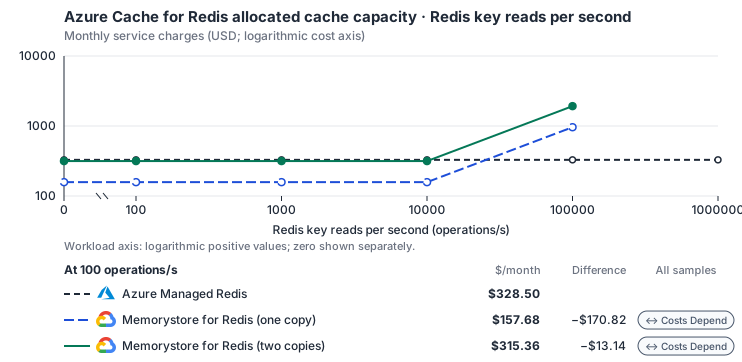
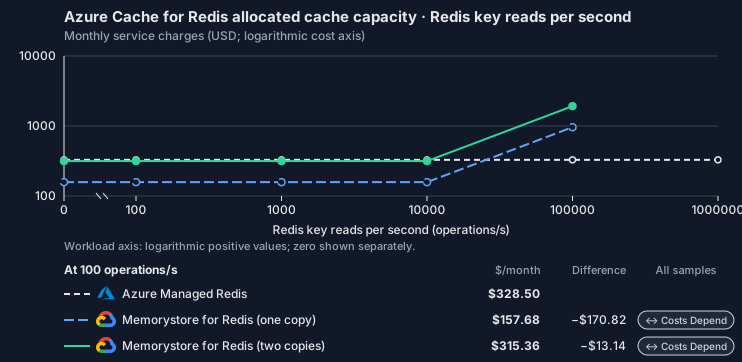
Estimated allocation, not benchmark calibrated: sized from 2 vCPU, 8 GiB memory and 0 GiB SSD at 0 operations/s to 16 vCPU, 48.75 GiB memory and 0 GiB SSD at 100,000 operations/s. From 1,000,000 operations/s the workload exceeds the planning range and the target is unpriced.
Curve assumptions
- Only the selected native meter varies; other usage quantities and assumptions retain their displayed defaults. Other native meters and workload assumptions retain their explicitly displayed default quantities. Workload translation and capacity assumptions are not benchmark measurements.
- Native monthly usage priced at the cited provider list prices; listed target allowances apply where present, excluding invoice credits, taxes and negotiated discounts. Rates as of 2026-10-22: eastus → us-central1, USD/month.
- Source prices are reference charges, not an invoice. Target lines cover selected service usage/configuration only; adapter hosting and Tensor9 fees are excluded.
- Samples of explicit prices are not performance measurements or capacity qualification. No interpolation or break-even guarantee is implied.
- Variant assumptions show the first axis sample; any axis-dependent configuration is described by this curve’s workload note.
- Rates are cited provider list prices, editable for discounts, commitments or another region. Workload translation and capacity coefficients remain editable planning assumptions, not benchmark measurements or a commercial quote.
- Default-zero rates are explicit assumptions, not evidence that the deployed service or resource is free.
- Provisioned-unit minimums use an editable approximate allocation floor. Modeled target service cost is max(usage/allocation, minimum), with billable network, durable staging and dependent sinks added separately; actual RU/TU sizing, scaling increments and throughput remain unqualified.
- Durable staging is priced once: provisioned targets include adapter state in their selected allocation; native targets add a separate staging allocation when required. Adapter hosting is a separate allocation and must exclude resources already priced as staging, workers or target capacity.
- A declared adapter mapping and cost model do not establish implementation availability or service equivalence.
- This exact directed mapping has a design profile. Cost modeling does not establish an implemented or deployable adapter.
- Origin unit prices are cited provider list prices; capacity coefficients are editable authored planning guesses, not measured capacity.
- The origin is the exact registered azure::1.0.0::cache::redis identity. Renamed products and future aliases require explicit mapping updates.
- Source allocated CPU-hours and memory-hours establish independent minimum target allocation. Neither management API requests nor a key-operation count is an instance count.
- Peak weighted key-operation work and resident data can promote the allocation above those minima. CPU rounds to whole cores and RAM to quarter GiB.
- CPU and RAM are aggregate resources over 730 hours. Selected backend prices own replica count, availability configuration and actual instance shapes.
- A multi-core estimate assumes the workload can be partitioned. Redis command execution, hot keys, cross-key transactions and clustering can prevent linear scale.
- Zero allocated resources and zero workload do not prove target scale-to-zero; the selected backend may retain a provisioned minimum.
- Azure Cache for Redis bills per cache size; cache-hours times the size’s memory set the RAM minimum and CPU follows the selected memory shape.
- Google Cloud bills Memorystore for Redis per provisioned capacity GiB-hour in 1-second increments with no separate CPU charge. In us-central1 Basic tier lists USD 0.049 (M1, 1-4 GiB), 0.027 (M2, 5-10 GiB), 0.023 (M3), 0.019 (M4) and 0.016 (M5) per GiB-hour; Standard tier lists 0.064, 0.054, 0.046, 0.035 and 0.03 (https://cloud.google.com/memorystore/docs/redis/pricing). The rate is Basic M2; the two-copy variant equals Standard M2. Other capacity tiers, read replicas and committed-use discounts change the rate. Memorystore has only private endpoints, so selected network is priced at the listed inter-region egress within North America. The CPU rate is zero because capacity GiB is the billed quantity, and the billed capacity is the cache family’s selected RAM rather than the generic planning CPU tier’s RAM; key-operation CPU demand raises cost only through the family’s RAM-per-CPU shape, which approximates managed throughput growing with capacity and is not a measured fit. The capacity charge and the minimum compare using their maximum, not their sum.
- Cache storedGiB represents resident RAM footprint, not billable SSD. Persistence, snapshots and backup disks require a separate explicit allocation.
- Row-store throughput (capacityOpsPerVcpuSecond, default 1500) is measured-by-tensor9 as a lower bound: the DynamoDB adapter on Cloud SQL db-custom-2-7680 (2 vCPU, PostgreSQL 16, us-west1) served 2,974 ops/s of YCSB-A at 16 threads without recorded saturation (src/main/kotlin/t9/prime/equiv/generated/eval/CloudsqlPostgresqlYcsbAT16GoYcsbV1_0_0.kt). Published CPU-bound pgbench reaches 3,101 read-write transactions and 20,289 point reads per vCPU-second (AWS z1d.2xlarge, PostgreSQL 14.5), so actual capacity is likely higher. Reads and writes share one coefficient: at the same adapter version, read-only YCSB-C was not faster than 50%-update YCSB-A.
- Log-broker throughput (capacityStreamMiBPerVcpuSecond 20 at 0.5 utilization, 4 GiB RAM per vCPU) is provider-documented by Google Managed Service for Apache Kafka sizing (https://docs.cloud.google.com/managed-service-for-apache-kafka/docs/plan-cluster-size): write-equivalent bytes are replicated writes plus a quarter of reads. Producer batches below 10 KB lower per-CPU throughput; that penalty is not modeled.
- Disk utilization 0.8 is provider-documented headroom below Cloud SQL automatic storage increase, which triggers near 91-95% full (https://docs.cloud.google.com/sql/docs/postgres/instance-settings). The 20 GiB reserve exceeds PostgreSQL’s 1 GB default max_wal_size; the remainder of that reserve is unmeasured.
- CPU tiers double from 2 vCPUs to the target’s largest node at 4 GiB per vCPU; each target’s documented largest node bounds CPU, RAM, RAM per vCPU and disk, and the durable staging database uses Cloud SQL Enterprise (96 vCPU, 6.5 GiB per vCPU, 624 GiB, 64 TiB). Targets billed per capacity unit or throughput unit are sized by their backend instead.
- No public evidence: peak/mean work (2) and the RAM working-set fraction (0.1). Proposed measurements: the p99 one-minute rate over the monthly mean from customer CloudWatch metrics; the buffer hit ratio while stepping RAM under a fixed YCSB-B load.
- Node bounds: Basic and Standard instances hold up to 300 GB and do not shard (https://docs.cloud.google.com/memorystore/docs/redis/redis-tiers); Google publishes no vCPU count, so the 96 vCPU planning bound applies.
- Stored GiB already includes the origin family’s physical footprint assumptions; no second storage amplification is applied.
- The workload family already selected resource-hours; the throughput coefficient is not applied again.
- Copies and allocation fractions change cost only; they do not increase modeled primary capacity.
- Cache resident GiB is RAM provenance. Family-selected RAM-hours cover the working set;
- no SSD allocation is modeled. Persistence, snapshots and backup disks remain excluded.
- Azure Retail Prices API: https://prices.azure.com/api/retail/prices
- Memorystore for Redis pricing: https://cloud.google.com/memorystore/docs/redis/pricing
- Replication traffic, snapshots, persistence write IOPS, network egress, cluster management premiums, licenses and migration.
- Command-specific complexity, Lua/scripts, module behavior, eviction/expiry churn, blocking commands, multi-key locality and benchmark-qualified latency.
- Taxes, discounts, credits and free-tier allowances not explicitly listed by this model.
- Unmodeled dependent services, task execution and operations outside the selected workload family.
plan-88d38420bfbc627f193029e781b7a9e0c528e6fb / 2026-10-22.planning.2. Curve: workload-1.
Sources: Azure Retail Prices API, Memorystore for Redis pricing.
Azure Cache for Redis allocated cache capacity · Redis key writes per second
Feature: Azure Cache for Redis allocated cache capacity. Estimated monthly service charges by Redis key writes per second. Adapter hosting and Tensor9 fees are excluded. Source: eastus; target: us-central1; currency: USD.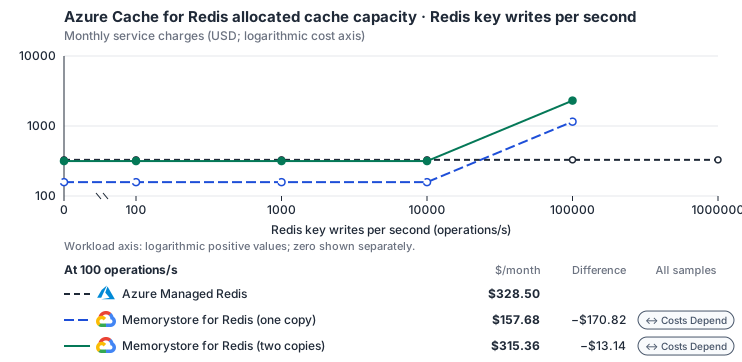
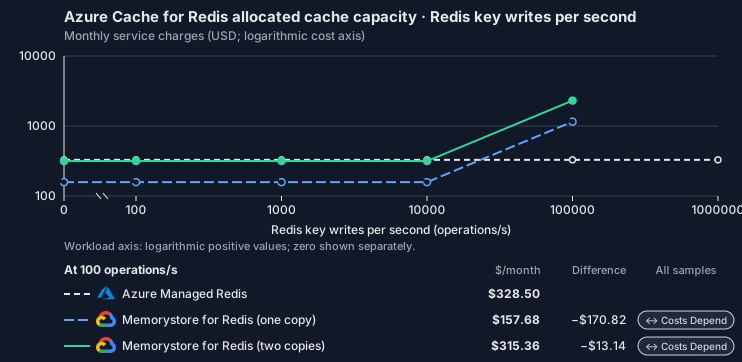
Estimated allocation, not benchmark calibrated: sized from 2 vCPU, 8 GiB memory and 0 GiB SSD at 0 operations/s to 32 vCPU, 58.5 GiB memory and 0 GiB SSD at 100,000 operations/s. From 1,000,000 operations/s the workload exceeds the planning range and the target is unpriced.
Curve assumptions
- Only the selected native meter varies; other usage quantities and assumptions retain their displayed defaults. Other native meters and workload assumptions retain their explicitly displayed default quantities. Workload translation and capacity assumptions are not benchmark measurements.
- Native monthly usage priced at the cited provider list prices; listed target allowances apply where present, excluding invoice credits, taxes and negotiated discounts. Rates as of 2026-10-22: eastus → us-central1, USD/month.
- Source prices are reference charges, not an invoice. Target lines cover selected service usage/configuration only; adapter hosting and Tensor9 fees are excluded.
- Samples of explicit prices are not performance measurements or capacity qualification. No interpolation or break-even guarantee is implied.
- Variant assumptions show the first axis sample; any axis-dependent configuration is described by this curve’s workload note.
- Rates are cited provider list prices, editable for discounts, commitments or another region. Workload translation and capacity coefficients remain editable planning assumptions, not benchmark measurements or a commercial quote.
- Default-zero rates are explicit assumptions, not evidence that the deployed service or resource is free.
- Provisioned-unit minimums use an editable approximate allocation floor. Modeled target service cost is max(usage/allocation, minimum), with billable network, durable staging and dependent sinks added separately; actual RU/TU sizing, scaling increments and throughput remain unqualified.
- Durable staging is priced once: provisioned targets include adapter state in their selected allocation; native targets add a separate staging allocation when required. Adapter hosting is a separate allocation and must exclude resources already priced as staging, workers or target capacity.
- A declared adapter mapping and cost model do not establish implementation availability or service equivalence.
- This exact directed mapping has a design profile. Cost modeling does not establish an implemented or deployable adapter.
- Origin unit prices are cited provider list prices; capacity coefficients are editable authored planning guesses, not measured capacity.
- The origin is the exact registered azure::1.0.0::cache::redis identity. Renamed products and future aliases require explicit mapping updates.
- Source allocated CPU-hours and memory-hours establish independent minimum target allocation. Neither management API requests nor a key-operation count is an instance count.
- Peak weighted key-operation work and resident data can promote the allocation above those minima. CPU rounds to whole cores and RAM to quarter GiB.
- CPU and RAM are aggregate resources over 730 hours. Selected backend prices own replica count, availability configuration and actual instance shapes.
- A multi-core estimate assumes the workload can be partitioned. Redis command execution, hot keys, cross-key transactions and clustering can prevent linear scale.
- Zero allocated resources and zero workload do not prove target scale-to-zero; the selected backend may retain a provisioned minimum.
- Azure Cache for Redis bills per cache size; cache-hours times the size’s memory set the RAM minimum and CPU follows the selected memory shape.
- Google Cloud bills Memorystore for Redis per provisioned capacity GiB-hour in 1-second increments with no separate CPU charge. In us-central1 Basic tier lists USD 0.049 (M1, 1-4 GiB), 0.027 (M2, 5-10 GiB), 0.023 (M3), 0.019 (M4) and 0.016 (M5) per GiB-hour; Standard tier lists 0.064, 0.054, 0.046, 0.035 and 0.03 (https://cloud.google.com/memorystore/docs/redis/pricing). The rate is Basic M2; the two-copy variant equals Standard M2. Other capacity tiers, read replicas and committed-use discounts change the rate. Memorystore has only private endpoints, so selected network is priced at the listed inter-region egress within North America. The CPU rate is zero because capacity GiB is the billed quantity, and the billed capacity is the cache family’s selected RAM rather than the generic planning CPU tier’s RAM; key-operation CPU demand raises cost only through the family’s RAM-per-CPU shape, which approximates managed throughput growing with capacity and is not a measured fit. The capacity charge and the minimum compare using their maximum, not their sum.
- Cache storedGiB represents resident RAM footprint, not billable SSD. Persistence, snapshots and backup disks require a separate explicit allocation.
- Row-store throughput (capacityOpsPerVcpuSecond, default 1500) is measured-by-tensor9 as a lower bound: the DynamoDB adapter on Cloud SQL db-custom-2-7680 (2 vCPU, PostgreSQL 16, us-west1) served 2,974 ops/s of YCSB-A at 16 threads without recorded saturation (src/main/kotlin/t9/prime/equiv/generated/eval/CloudsqlPostgresqlYcsbAT16GoYcsbV1_0_0.kt). Published CPU-bound pgbench reaches 3,101 read-write transactions and 20,289 point reads per vCPU-second (AWS z1d.2xlarge, PostgreSQL 14.5), so actual capacity is likely higher. Reads and writes share one coefficient: at the same adapter version, read-only YCSB-C was not faster than 50%-update YCSB-A.
- Log-broker throughput (capacityStreamMiBPerVcpuSecond 20 at 0.5 utilization, 4 GiB RAM per vCPU) is provider-documented by Google Managed Service for Apache Kafka sizing (https://docs.cloud.google.com/managed-service-for-apache-kafka/docs/plan-cluster-size): write-equivalent bytes are replicated writes plus a quarter of reads. Producer batches below 10 KB lower per-CPU throughput; that penalty is not modeled.
- Disk utilization 0.8 is provider-documented headroom below Cloud SQL automatic storage increase, which triggers near 91-95% full (https://docs.cloud.google.com/sql/docs/postgres/instance-settings). The 20 GiB reserve exceeds PostgreSQL’s 1 GB default max_wal_size; the remainder of that reserve is unmeasured.
- CPU tiers double from 2 vCPUs to the target’s largest node at 4 GiB per vCPU; each target’s documented largest node bounds CPU, RAM, RAM per vCPU and disk, and the durable staging database uses Cloud SQL Enterprise (96 vCPU, 6.5 GiB per vCPU, 624 GiB, 64 TiB). Targets billed per capacity unit or throughput unit are sized by their backend instead.
- No public evidence: peak/mean work (2) and the RAM working-set fraction (0.1). Proposed measurements: the p99 one-minute rate over the monthly mean from customer CloudWatch metrics; the buffer hit ratio while stepping RAM under a fixed YCSB-B load.
- Node bounds: Basic and Standard instances hold up to 300 GB and do not shard (https://docs.cloud.google.com/memorystore/docs/redis/redis-tiers); Google publishes no vCPU count, so the 96 vCPU planning bound applies.
- Stored GiB already includes the origin family’s physical footprint assumptions; no second storage amplification is applied.
- The workload family already selected resource-hours; the throughput coefficient is not applied again.
- Copies and allocation fractions change cost only; they do not increase modeled primary capacity.
- Cache resident GiB is RAM provenance. Family-selected RAM-hours cover the working set;
- no SSD allocation is modeled. Persistence, snapshots and backup disks remain excluded.
- Azure Retail Prices API: https://prices.azure.com/api/retail/prices
- Memorystore for Redis pricing: https://cloud.google.com/memorystore/docs/redis/pricing
- Replication traffic, snapshots, persistence write IOPS, network egress, cluster management premiums, licenses and migration.
- Command-specific complexity, Lua/scripts, module behavior, eviction/expiry churn, blocking commands, multi-key locality and benchmark-qualified latency.
- Taxes, discounts, credits and free-tier allowances not explicitly listed by this model.
- Unmodeled dependent services, task execution and operations outside the selected workload family.
plan-88d38420bfbc627f193029e781b7a9e0c528e6fb / 2026-10-22.planning.2. Curve: workload-2.
Sources: Azure Retail Prices API, Memorystore for Redis pricing.
Azure Cache for Redis allocated cache capacity · Resident logical cache data
Feature: Azure Cache for Redis allocated cache capacity. Estimated monthly service charges by Resident logical cache data. Adapter hosting and Tensor9 fees are excluded. Source: eastus; target: us-central1; currency: USD.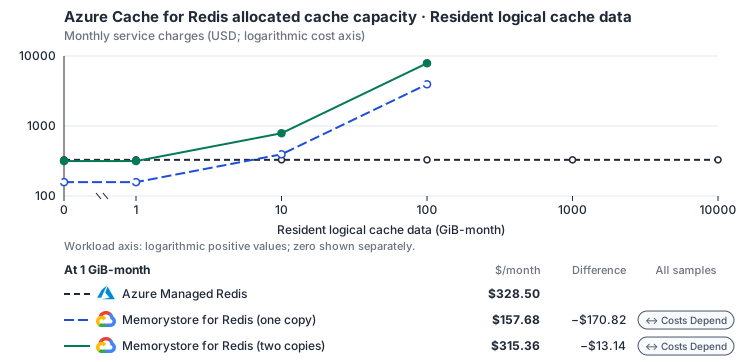
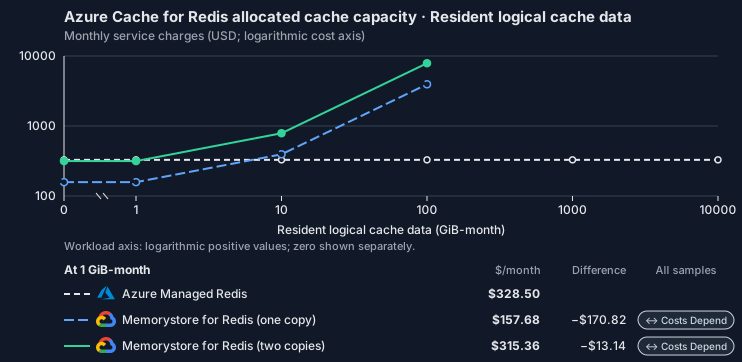
Estimated allocation, not benchmark calibrated: sized from 2 vCPU, 8 GiB memory and 0 GiB SSD at 0 GiB-month to 32 vCPU, 200 GiB memory and 0 GiB SSD at 100 GiB-month. From 1,000 GiB-month the workload exceeds the planning range and the target is unpriced.
Curve assumptions
- Only the selected native meter varies; other usage quantities and assumptions retain their displayed defaults. Other native meters and workload assumptions retain their explicitly displayed default quantities. Workload translation and capacity assumptions are not benchmark measurements.
- Native monthly usage priced at the cited provider list prices; listed target allowances apply where present, excluding invoice credits, taxes and negotiated discounts. Rates as of 2026-10-22: eastus → us-central1, USD/month.
- Source prices are reference charges, not an invoice. Target lines cover selected service usage/configuration only; adapter hosting and Tensor9 fees are excluded.
- Samples of explicit prices are not performance measurements or capacity qualification. No interpolation or break-even guarantee is implied.
- Variant assumptions show the first axis sample; any axis-dependent configuration is described by this curve’s workload note.
- Rates are cited provider list prices, editable for discounts, commitments or another region. Workload translation and capacity coefficients remain editable planning assumptions, not benchmark measurements or a commercial quote.
- Default-zero rates are explicit assumptions, not evidence that the deployed service or resource is free.
- Provisioned-unit minimums use an editable approximate allocation floor. Modeled target service cost is max(usage/allocation, minimum), with billable network, durable staging and dependent sinks added separately; actual RU/TU sizing, scaling increments and throughput remain unqualified.
- Durable staging is priced once: provisioned targets include adapter state in their selected allocation; native targets add a separate staging allocation when required. Adapter hosting is a separate allocation and must exclude resources already priced as staging, workers or target capacity.
- A declared adapter mapping and cost model do not establish implementation availability or service equivalence.
- This exact directed mapping has a design profile. Cost modeling does not establish an implemented or deployable adapter.
- Origin unit prices are cited provider list prices; capacity coefficients are editable authored planning guesses, not measured capacity.
- The origin is the exact registered azure::1.0.0::cache::redis identity. Renamed products and future aliases require explicit mapping updates.
- Source allocated CPU-hours and memory-hours establish independent minimum target allocation. Neither management API requests nor a key-operation count is an instance count.
- Peak weighted key-operation work and resident data can promote the allocation above those minima. CPU rounds to whole cores and RAM to quarter GiB.
- CPU and RAM are aggregate resources over 730 hours. Selected backend prices own replica count, availability configuration and actual instance shapes.
- A multi-core estimate assumes the workload can be partitioned. Redis command execution, hot keys, cross-key transactions and clustering can prevent linear scale.
- Zero allocated resources and zero workload do not prove target scale-to-zero; the selected backend may retain a provisioned minimum.
- Azure Cache for Redis bills per cache size; cache-hours times the size’s memory set the RAM minimum and CPU follows the selected memory shape.
- Google Cloud bills Memorystore for Redis per provisioned capacity GiB-hour in 1-second increments with no separate CPU charge. In us-central1 Basic tier lists USD 0.049 (M1, 1-4 GiB), 0.027 (M2, 5-10 GiB), 0.023 (M3), 0.019 (M4) and 0.016 (M5) per GiB-hour; Standard tier lists 0.064, 0.054, 0.046, 0.035 and 0.03 (https://cloud.google.com/memorystore/docs/redis/pricing). The rate is Basic M2; the two-copy variant equals Standard M2. Other capacity tiers, read replicas and committed-use discounts change the rate. Memorystore has only private endpoints, so selected network is priced at the listed inter-region egress within North America. The CPU rate is zero because capacity GiB is the billed quantity, and the billed capacity is the cache family’s selected RAM rather than the generic planning CPU tier’s RAM; key-operation CPU demand raises cost only through the family’s RAM-per-CPU shape, which approximates managed throughput growing with capacity and is not a measured fit. The capacity charge and the minimum compare using their maximum, not their sum.
- Cache storedGiB represents resident RAM footprint, not billable SSD. Persistence, snapshots and backup disks require a separate explicit allocation.
- Row-store throughput (capacityOpsPerVcpuSecond, default 1500) is measured-by-tensor9 as a lower bound: the DynamoDB adapter on Cloud SQL db-custom-2-7680 (2 vCPU, PostgreSQL 16, us-west1) served 2,974 ops/s of YCSB-A at 16 threads without recorded saturation (src/main/kotlin/t9/prime/equiv/generated/eval/CloudsqlPostgresqlYcsbAT16GoYcsbV1_0_0.kt). Published CPU-bound pgbench reaches 3,101 read-write transactions and 20,289 point reads per vCPU-second (AWS z1d.2xlarge, PostgreSQL 14.5), so actual capacity is likely higher. Reads and writes share one coefficient: at the same adapter version, read-only YCSB-C was not faster than 50%-update YCSB-A.
- Log-broker throughput (capacityStreamMiBPerVcpuSecond 20 at 0.5 utilization, 4 GiB RAM per vCPU) is provider-documented by Google Managed Service for Apache Kafka sizing (https://docs.cloud.google.com/managed-service-for-apache-kafka/docs/plan-cluster-size): write-equivalent bytes are replicated writes plus a quarter of reads. Producer batches below 10 KB lower per-CPU throughput; that penalty is not modeled.
- Disk utilization 0.8 is provider-documented headroom below Cloud SQL automatic storage increase, which triggers near 91-95% full (https://docs.cloud.google.com/sql/docs/postgres/instance-settings). The 20 GiB reserve exceeds PostgreSQL’s 1 GB default max_wal_size; the remainder of that reserve is unmeasured.
- CPU tiers double from 2 vCPUs to the target’s largest node at 4 GiB per vCPU; each target’s documented largest node bounds CPU, RAM, RAM per vCPU and disk, and the durable staging database uses Cloud SQL Enterprise (96 vCPU, 6.5 GiB per vCPU, 624 GiB, 64 TiB). Targets billed per capacity unit or throughput unit are sized by their backend instead.
- No public evidence: peak/mean work (2) and the RAM working-set fraction (0.1). Proposed measurements: the p99 one-minute rate over the monthly mean from customer CloudWatch metrics; the buffer hit ratio while stepping RAM under a fixed YCSB-B load.
- Node bounds: Basic and Standard instances hold up to 300 GB and do not shard (https://docs.cloud.google.com/memorystore/docs/redis/redis-tiers); Google publishes no vCPU count, so the 96 vCPU planning bound applies.
- Stored GiB already includes the origin family’s physical footprint assumptions; no second storage amplification is applied.
- The workload family already selected resource-hours; the throughput coefficient is not applied again.
- Copies and allocation fractions change cost only; they do not increase modeled primary capacity.
- Cache resident GiB is RAM provenance. Family-selected RAM-hours cover the working set;
- no SSD allocation is modeled. Persistence, snapshots and backup disks remain excluded.
- Azure Retail Prices API: https://prices.azure.com/api/retail/prices
- Memorystore for Redis pricing: https://cloud.google.com/memorystore/docs/redis/pricing
- Replication traffic, snapshots, persistence write IOPS, network egress, cluster management premiums, licenses and migration.
- Command-specific complexity, Lua/scripts, module behavior, eviction/expiry churn, blocking commands, multi-key locality and benchmark-qualified latency.
- Taxes, discounts, credits and free-tier allowances not explicitly listed by this model.
- Unmodeled dependent services, task execution and operations outside the selected workload family.
plan-88d38420bfbc627f193029e781b7a9e0c528e6fb / 2026-10-22.planning.2. Curve: workload-3.
Sources: Azure Retail Prices API, Memorystore for Redis pricing.
Azure Cache for Redis allocated cache capacity · Allocated source cache-hours
Feature: Azure Cache for Redis allocated cache capacity. Estimated monthly service charges by Allocated source cache-hours. Adapter hosting and Tensor9 fees are excluded. Source: eastus; target: us-central1; currency: USD.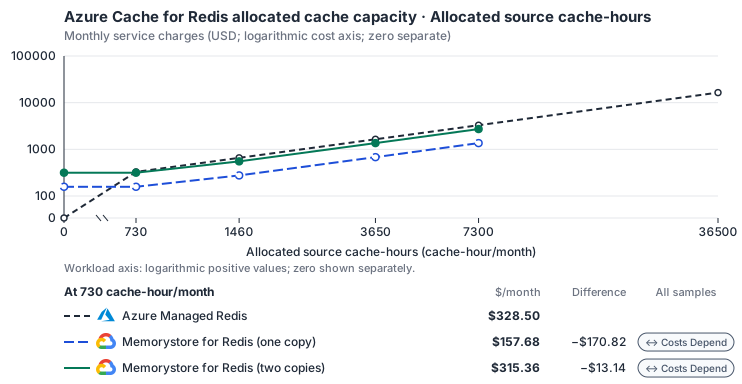
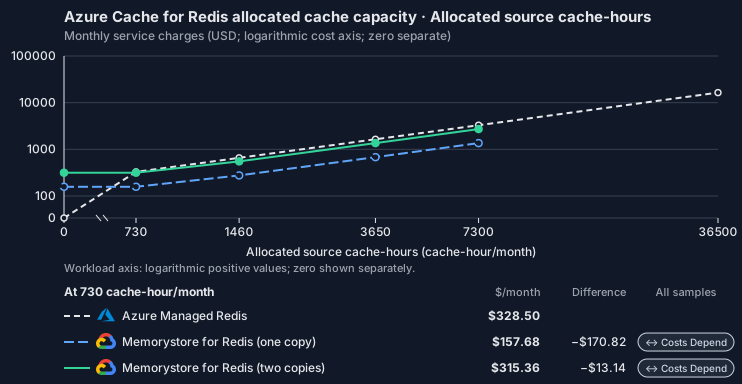
Estimated allocation, not benchmark calibrated: sized from 2 vCPU, 8 GiB memory and 0 GiB SSD at 0 cache-hour/month to 16 vCPU, 69 GiB memory and 0 GiB SSD at 7,300 cache-hour/month. From 36,500 cache-hour/month the workload exceeds the planning range and the target is unpriced.
Curve assumptions
- Only the selected native meter varies; other usage quantities and assumptions retain their displayed defaults. Other native meters and workload assumptions retain their explicitly displayed default quantities. Workload translation and capacity assumptions are not benchmark measurements.
- Native monthly usage priced at the cited provider list prices; listed target allowances apply where present, excluding invoice credits, taxes and negotiated discounts. Rates as of 2026-10-22: eastus → us-central1, USD/month.
- Source prices are reference charges, not an invoice. Target lines cover selected service usage/configuration only; adapter hosting and Tensor9 fees are excluded.
- Samples of explicit prices are not performance measurements or capacity qualification. No interpolation or break-even guarantee is implied.
- Variant assumptions show the first axis sample; any axis-dependent configuration is described by this curve’s workload note.
- Rates are cited provider list prices, editable for discounts, commitments or another region. Workload translation and capacity coefficients remain editable planning assumptions, not benchmark measurements or a commercial quote.
- Default-zero rates are explicit assumptions, not evidence that the deployed service or resource is free.
- Provisioned-unit minimums use an editable approximate allocation floor. Modeled target service cost is max(usage/allocation, minimum), with billable network, durable staging and dependent sinks added separately; actual RU/TU sizing, scaling increments and throughput remain unqualified.
- Durable staging is priced once: provisioned targets include adapter state in their selected allocation; native targets add a separate staging allocation when required. Adapter hosting is a separate allocation and must exclude resources already priced as staging, workers or target capacity.
- A declared adapter mapping and cost model do not establish implementation availability or service equivalence.
- This exact directed mapping has a design profile. Cost modeling does not establish an implemented or deployable adapter.
- Origin unit prices are cited provider list prices; capacity coefficients are editable authored planning guesses, not measured capacity.
- The origin is the exact registered azure::1.0.0::cache::redis identity. Renamed products and future aliases require explicit mapping updates.
- Source allocated CPU-hours and memory-hours establish independent minimum target allocation. Neither management API requests nor a key-operation count is an instance count.
- Peak weighted key-operation work and resident data can promote the allocation above those minima. CPU rounds to whole cores and RAM to quarter GiB.
- CPU and RAM are aggregate resources over 730 hours. Selected backend prices own replica count, availability configuration and actual instance shapes.
- A multi-core estimate assumes the workload can be partitioned. Redis command execution, hot keys, cross-key transactions and clustering can prevent linear scale.
- Zero allocated resources and zero workload do not prove target scale-to-zero; the selected backend may retain a provisioned minimum.
- Azure Cache for Redis bills per cache size; cache-hours times the size’s memory set the RAM minimum and CPU follows the selected memory shape.
- Google Cloud bills Memorystore for Redis per provisioned capacity GiB-hour in 1-second increments with no separate CPU charge. In us-central1 Basic tier lists USD 0.049 (M1, 1-4 GiB), 0.027 (M2, 5-10 GiB), 0.023 (M3), 0.019 (M4) and 0.016 (M5) per GiB-hour; Standard tier lists 0.064, 0.054, 0.046, 0.035 and 0.03 (https://cloud.google.com/memorystore/docs/redis/pricing). The rate is Basic M2; the two-copy variant equals Standard M2. Other capacity tiers, read replicas and committed-use discounts change the rate. Memorystore has only private endpoints, so selected network is priced at the listed inter-region egress within North America. The CPU rate is zero because capacity GiB is the billed quantity, and the billed capacity is the cache family’s selected RAM rather than the generic planning CPU tier’s RAM; key-operation CPU demand raises cost only through the family’s RAM-per-CPU shape, which approximates managed throughput growing with capacity and is not a measured fit. The capacity charge and the minimum compare using their maximum, not their sum.
- Cache storedGiB represents resident RAM footprint, not billable SSD. Persistence, snapshots and backup disks require a separate explicit allocation.
- Row-store throughput (capacityOpsPerVcpuSecond, default 1500) is measured-by-tensor9 as a lower bound: the DynamoDB adapter on Cloud SQL db-custom-2-7680 (2 vCPU, PostgreSQL 16, us-west1) served 2,974 ops/s of YCSB-A at 16 threads without recorded saturation (src/main/kotlin/t9/prime/equiv/generated/eval/CloudsqlPostgresqlYcsbAT16GoYcsbV1_0_0.kt). Published CPU-bound pgbench reaches 3,101 read-write transactions and 20,289 point reads per vCPU-second (AWS z1d.2xlarge, PostgreSQL 14.5), so actual capacity is likely higher. Reads and writes share one coefficient: at the same adapter version, read-only YCSB-C was not faster than 50%-update YCSB-A.
- Log-broker throughput (capacityStreamMiBPerVcpuSecond 20 at 0.5 utilization, 4 GiB RAM per vCPU) is provider-documented by Google Managed Service for Apache Kafka sizing (https://docs.cloud.google.com/managed-service-for-apache-kafka/docs/plan-cluster-size): write-equivalent bytes are replicated writes plus a quarter of reads. Producer batches below 10 KB lower per-CPU throughput; that penalty is not modeled.
- Disk utilization 0.8 is provider-documented headroom below Cloud SQL automatic storage increase, which triggers near 91-95% full (https://docs.cloud.google.com/sql/docs/postgres/instance-settings). The 20 GiB reserve exceeds PostgreSQL’s 1 GB default max_wal_size; the remainder of that reserve is unmeasured.
- CPU tiers double from 2 vCPUs to the target’s largest node at 4 GiB per vCPU; each target’s documented largest node bounds CPU, RAM, RAM per vCPU and disk, and the durable staging database uses Cloud SQL Enterprise (96 vCPU, 6.5 GiB per vCPU, 624 GiB, 64 TiB). Targets billed per capacity unit or throughput unit are sized by their backend instead.
- No public evidence: peak/mean work (2) and the RAM working-set fraction (0.1). Proposed measurements: the p99 one-minute rate over the monthly mean from customer CloudWatch metrics; the buffer hit ratio while stepping RAM under a fixed YCSB-B load.
- Node bounds: Basic and Standard instances hold up to 300 GB and do not shard (https://docs.cloud.google.com/memorystore/docs/redis/redis-tiers); Google publishes no vCPU count, so the 96 vCPU planning bound applies.
- Stored GiB already includes the origin family’s physical footprint assumptions; no second storage amplification is applied.
- The workload family already selected resource-hours; the throughput coefficient is not applied again.
- Copies and allocation fractions change cost only; they do not increase modeled primary capacity.
- Cache resident GiB is RAM provenance. Family-selected RAM-hours cover the working set;
- no SSD allocation is modeled. Persistence, snapshots and backup disks remain excluded.
- Azure Retail Prices API: https://prices.azure.com/api/retail/prices
- Memorystore for Redis pricing: https://cloud.google.com/memorystore/docs/redis/pricing
- Replication traffic, snapshots, persistence write IOPS, network egress, cluster management premiums, licenses and migration.
- Command-specific complexity, Lua/scripts, module behavior, eviction/expiry churn, blocking commands, multi-key locality and benchmark-qualified latency.
- Taxes, discounts, credits and free-tier allowances not explicitly listed by this model.
- Unmodeled dependent services, task execution and operations outside the selected workload family.
plan-88d38420bfbc627f193029e781b7a9e0c528e6fb / 2026-10-22.planning.2. Curve: workload-4.
Sources: Azure Retail Prices API, Memorystore for Redis pricing.
See the service catalog for operation coverage, supported directions and backend limitations.