

Supported environments
- Akamai
- Azure
- DigitalOcean
- Google Cloud
- OCI
- Private Kubernetes
- Scaleway
How the backends compare
Each row compares a capability of SQS (Simple Queue Service, Classic) with its adaptation on each backend. A dash means this profile does not state the capability for that backend.Cloud Adapter
On Akamai, Azure, DigitalOcean, OCI, Private Kubernetes, and Scaleway
PostgreSQL
PostgreSQL hosting
Tensor9 operates CloudNativePG inside the customer’s Kubernetes cluster. Queue data is stored on that cluster’s volumes and does not survive a full cluster rebuild. Plan recovery and message cutover before replacing the cluster. Tensor9 operates the queue schema and adapter. Queues start empty; existing SQS messages are not migrated. Drain the source or coordinate dual writes before cutover.Persistent queue management and total cost
Cloud Adapter retains a persistent PostgreSQL store for the queue catalog, tenancy and lifecycle/control state, normally shared with the Cloud Adapter deployment. Native broker or Cosmos message storage does not remove this resource. Include its allocated compute, storage, backups and selected HA costs alongside adapter and message-backend charges; an idle or serverless message backend does not imply a zero total installation floor. Backend-only curves omit these shared allocations unless their assumptions explicitly include them. This control store is distinct from the SQS-owned message database. PostgreSQL-authority FIFO composites add recoverable message bodies, receipts, deduplication and outbox state to an explicitly configured SQS message database; they do not store messages in the shared control catalog. A separate logical database and login provide data/permission separation, but still share server CPU, storage, IOPS, WAL and connection limits when hosted on the same instance. Dedicated physical server/instance capacity is a separate allocation and cost decision.Database placement and recovery
CloudNativePG keeps message tables on your Kubernetes cluster’s persistent volumes. Tensor9 operates the database and adapter. Replacing the cluster requires an explicit data recovery or drained cutover procedure; a new empty cluster is not a recovery of the old queues. This placement shares cluster resources with the application.Capacity and queue workload
The default shared message database holds multiple queues, each with its own table. Dedicated physical server/instance capacity isolates compute and I/O from other server workloads; a separate logical database alone does not. HA changes recovery, commit latency and price rather than FIFO semantics. Neither choice creates an unlimited queue service. Size connection pools, storage, IOPS and WAL for accepted sends, receives, deletes, visibility changes, retries and cleanup together. Long polls wait outside database transactions. Classic queues have no application-visible group ordering. Concurrent receivers claim different visible rows, but a slow consumer may continue processing an earlier copy after its visibility expires. Use idempotent consumer effects and include empty polls and redelivery in database load estimates. Requested live counts scan the message population even for a single requested counter. Frequent depth polling over a large backlog competes for database I/O and pool capacity; receipt classification can change index/heap work. Price those queries separately from sends and completed message cycles. A fall in depth can reflect purge, expiry or dead-letter transfer rather than application completion. The portable Standard-queue benchmark does not establish the capacity of this host, its HA configuration or a FIFO workload. Payload sizes, active-group skew, settlement time, backlog growth and matched native measurements determine whether a proposed size fits. Missing measurements leave capacity unknown.Retries, batches and application changes
The application keeps its SQS SDK and uses the adapter’s configured endpoint and authentication. Backend IAM, database schema permissions and TLS identity belong to the deployment; an AWS ARN or policy is not automatically a target-cloud authorization grant. Scope identities to the customer resources and keep rotated credentials out of message bodies and receipt handles. A batch response reports each entry separately. Retry only failed entries whose outcome is known; a request timeout can follow a committed send or delete. A retried Classic send without deduplication can create another message. Duplicate enqueue suppression does not make consumer side effects exactly once. SDK retries and adapter retries share one bounded deadline, with backoff for provider throttling. An expired observer deadline does not prove a still-running native operation was cancelled. Visibility expiration permits another delivery while an earlier worker can still be executing. Consumers use idempotent writes, choose a visibility duration that covers normal processing and handle stale receipt errors. Retention can expire a message in flight. Queues start empty: drain the source before cutover or coordinate duplicate-safe dual writes. Queue recreation and purge must invalidate old claims independently of public names; data cleanup can continue after logical retirement. Database or broker backup is a resource recovery mechanism, not an automatic replay of application side effects.PostgreSQL queue behavior
Your application keeps its SQS SDK and uses the authenticated Cloud Adapter endpoint configured for the install. The adapter performsSendMessage and ReceiveMessage in the SQS-owned PostgreSQL message database and returns SQS responses, error codes and MD5 checksums. Its message-data login is separate from other services and the shared control catalog.
Each queue is a PostgreSQL table with one row per message. Sending, receiving, deleting, delays, visibility, dead-letter delivery and message counts all work on those rows. Standard queues provide at-least-once delivery with best-effort ordering.


The application keeps its SQS SDK. The adapter stores each queue in a PostgreSQL table.
Architecture
The adapter keeps all queue state in PostgreSQL, including messages and receipt handles, so adapter instances can restart or scale out without losing track of in-flight messages. On Cloud SQL and Azure Flexible Server it signs in with short-lived Cloud SQL IAM or Microsoft Entra tokens used as database passwords, so no static secret is stored. When the stack is deployed, Tensor9 creates one database per Cloud Adapter deployment and one table per declared queue. Each row holds the message body and attributes, its message group, its visibility time, its receipt handle, its receive count and the time it was sent. A Standard queue hands out messages in arrival order, with best-effort ordering under concurrent traffic. A dead-letter queue is another queue table, and a background task deletes messages older than the queue’s retention period. CloudNativePG, Cloud SQL for PostgreSQL, Azure Flexible Server and Scaleway use the same adapter code and tables. They differ in where the data lives: the managed servers run outside your Kubernetes cluster, while CloudNativePG runs inside it. See the rebuild limitation below.

Each queue, including each dead-letter queue, is a PostgreSQL table. The same adapter runs on every supported PostgreSQL host.
Receiving messages
One database step selects messages whose visibility timeout has passed, oldest first, up to the requested batch size. In the same step it gives each a new receipt handle, hides it for the visibility timeout, adds one to its receive count and returns it. Messages another receiver is taking at that moment are skipped. Standard queues provide best-effort ordering. When the visibility timeout passes, the message can be delivered again; that does not stop a worker still processing the earlier copy.ApproximateReceiveCount is the actual number of receives, not an estimate. The MD5 checksums of the body and attributes are recomputed, so your SDK’s checks pass. DelaySeconds sets when a message first becomes visible. Long polling waits up to WaitTimeSeconds (at most 20 seconds) and returns as soon as a message is available. SendMessageBatch inserts all entries at once and reports a result for each entry. Message bodies are stored in the queue table.


Two receivers never get the same message at the same time. ApproximateReceiveCount is the actual receive count.
Receipt handles & visibility
Each receive saves a new receipt handle with the message.DeleteMessage and ChangeMessageVisibility find the message by that handle, including after an adapter restart or through another adapter instance.
A delete or visibility change whose handle matches no message returns ReceiptHandleIsInvalid. That includes a message already deleted, or received again under a newer handle. The visibility timeout defaults to 30 seconds. ChangeMessageVisibility can extend it with no lock-duration maximum, and zero makes the message available again immediately. Retention can delete a message while it is in flight.


Receipt handles are saved with messages, so they still work after an adapter restart. Visibility has no lock-duration limit.
Dead-letter & retention
When source and DLQ belong to the same supported SQS-owned message database transaction, receive moves messages atmaxReceiveCount atomically with claiming the rest. Both changes commit or neither does. Cross-database/store transfers are unsupported: sharing a provider, physical server or control log is not a shared message transaction, and no other service’s tables are used. The DLQ retains ordinary queue operations and cleanup. A moved message keeps its MessageId and SentTimestamp, gains DeadLetterQueueSourceArn, and its ApproximateReceiveCount keeps counting receives on both queues. A redrive policy on the DLQ itself counts only receives on the DLQ, and the DLQ’s retention runs from the original send time.
A background task deletes messages sent longer ago than the queue’s retention period, including messages in flight; receiving does not reset that time. The retention period defaults to four days and is kept between 60 seconds and 14 days, so a missing or too-short value cannot delete new messages straight away. One worker per database removes expired messages in batches, pauses during database maintenance, and continues if one queue fails. Limits on rows per pass and time per batch cap the load.


Atomic DLQ moves require the same supported SQS-owned database transaction. Cross-store moves are unsupported. Retention cleanup removes aged messages.
FIFO queues
For strict per-message-group ordering and five-minute duplicate-send suppression, use SQS FIFO. Standard queues provide at-least-once delivery with best-effort ordering.Limitations
Where SQS and the PostgreSQL adapter differ- Throughput behaves differently: one PostgreSQL server serves every queue. All of a Cloud Adapter deployment’s queues share one server, so its capacity bounds peak throughput and a heavy queue can affect the others. In Tensor9’s round-trip test of a moderate-rate Standard queue, the adapter matched SQS throughput (about 300 vs 286 ops/s) with a lower p99 (140 ms vs 172 ms) but a slower median (p50 24 ms vs 15 ms). That is not a measured ceiling, and it does not cover FIFO queues or every host.
- Recovery follows the database placement. CloudNativePG keeps queue data on the Cloud Adapter deployment cluster’s volumes. Rebuilding the cluster requires explicit data recovery or a drained cutover.
- Messages are limited to 256 KiB by default. The adapter’s default limit is 262144 bytes, while native SQS now accepts up to 1 MiB. Sends are checked against the queue’s declared limit.
- Stale receipt handles behave differently: they return an error.
DeleteMessageandChangeMessageVisibilityreturnReceiptHandleIsInvalidwhen no message matches the handle. - Retention behaves differently: expired messages are removed periodically. An expired message can remain until the next cleanup pass. Retention is kept between 60 seconds and 14 days; a too-short value is raised to 60 seconds so that new messages are not deleted.
- Counts observe queue state, not application completion. Requested message counts read the message database: eligible messages are visible, future-visible messages with a receipt are in flight, and future-visible messages without a receipt are initially delayed. These categories share one query snapshot and can change immediately afterward. Metadata-only reads do not require a message-table count. An unavailable requested count returns an explicit unsupported result rather than zero. Purge, expiry and dead-letter movement can reduce depth without completing the application’s work.
- Queue creation behaves differently: queues are created when the stack is deployed. Tensor9 creates the database and each queue’s table, and its dead-letter table, at deploy time.
CreateQueue,DeleteQueueandSetQueueAttributesact on those tables. Switching a queue between Standard and FIFO is rejected, because it would replace the queue.
Other considerations
- Moving from AWS. The database and queue tables start empty, and existing SQS messages are not migrated. Drain the source queue, or write to both queues during the transition.
- Removing queues. Each queue is created in one step, so a crash never leaves a half-created queue. When a queue is removed from the stack, Tensor9 deletes only queues it created; any other queue is detached and left in place. A queue that still holds messages is not deleted unless deletion is forced.
- Who operates what. On the managed hosts, the provider operates the database’s durability, backups and high availability, and Tensor9 operates the adapter. On CloudNativePG, Tensor9 operates the database inside your cluster.
Example monthly charges
This Tensor9 Cloud Adapter scenario estimates service charges for the named origin and target services. Adapter hosting and commercial Tensor9 fees need separate allocations. How Tensor9 estimates costs explains the method and what the estimates include.SQS Standard · SQS request billing units
Feature: SQS Standard. Estimated monthly service charges by SQS request billing units. Adapter hosting and Tensor9 fees are excluded. Source: us-east-1; target: us-central1; currency: USD.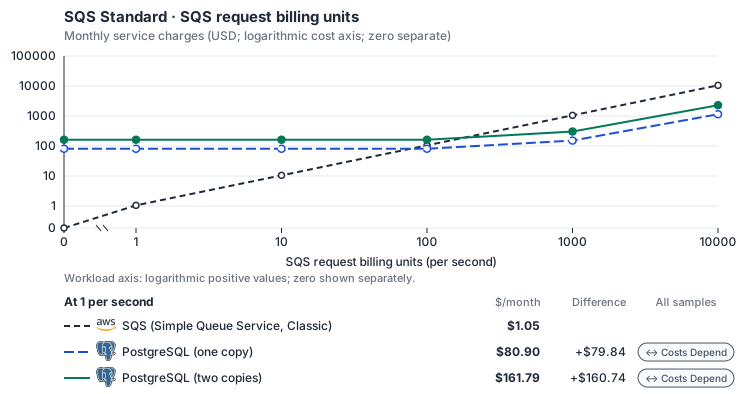
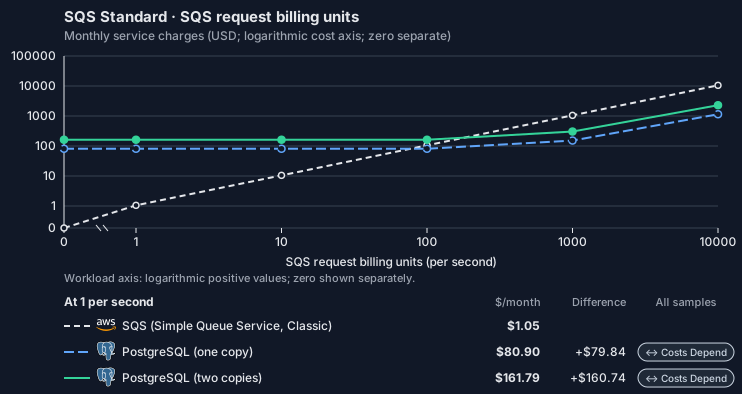
- 1-KiB messages, unbatched send/receive/delete; actual batch and delivery assumptions stay visible. Other native meters and workload assumptions retain their explicitly displayed default quantities. Workload translation and capacity assumptions are not benchmark measurements.
- Native monthly usage priced at the cited provider list prices; listed target allowances apply where present, excluding invoice credits, taxes and negotiated discounts. Rates as of 2026-10-22: us-east-1 → us-central1, USD/month.
- Source prices are reference charges, not an invoice. Target lines cover selected service usage/configuration only; adapter hosting and Tensor9 fees are excluded.
- Samples of explicit prices are not performance measurements or capacity qualification. No interpolation or break-even guarantee is implied.
- Variant assumptions show the first axis sample; any axis-dependent configuration is described by this curve’s workload note.
- Rates are cited provider list prices, editable for discounts, commitments or another region. Workload translation and capacity coefficients remain editable planning assumptions, not benchmark measurements or a commercial quote.
- Default-zero rates are explicit assumptions, not evidence that the deployed service or resource is free.
- Provisioned-unit minimums use an editable approximate allocation floor. Modeled target service cost is max(usage/allocation, minimum), with billable network, durable staging and dependent sinks added separately; actual RU/TU sizing, scaling increments and throughput remain unqualified.
- Durable staging is priced once: provisioned targets include adapter state in their selected allocation; native targets add a separate staging allocation when required. Adapter hosting is a separate allocation and must exclude resources already priced as staging, workers or target capacity.
- A declared adapter mapping and cost model do not establish implementation availability or service equivalence.
- This is a declared directed mapping; a planning estimate does not establish deployment or request-serving support.
- Authored planning assumptions, not measured adapter capacity. Origin rates are cited first-tier list prices, before free allowances and discounts.
- A cost scenario does not establish backend availability, protocol fidelity or production readiness. Registry serving status remains independent.
- Storage follows resident original messages, not every monthly message. Broker delivery bytes include redeliveries.
- FIFO estimates do not qualify dedup support, group throughput or single-group latency; backend limitations remain applicable.
- Self-hosted target: PostgreSQL (PostgreSQL License, https://www.postgresql.org/about/licence/). Selected CPU, RAM and physical disk allocation grow with workload; no per-operation price is assumed. No vendor charge: the target runs on the customer’s Kubernetes nodes, so CPU, RAM and disk bill at the Kubernetes node reference rates, Compute Engine N2 in us-central1 (USD 0.031611/vCPU-hour, 0.004237/GiB-hour) with pd-balanced disk (0.10/GiB-month) and Premium Tier egress. The cost-optimized E2 series lists 0.02181159/vCPU-hour and 0.00292353/GiB-hour; AWS m6i/r6i and Azure D2s v5/E2s v5 both decompose to 0.033/vCPU-hour and 0.00375/GiB-hour. Requested CPU and RAM are billed; node bin-packing waste, system reservations and the cluster control-plane fee are not.
- Row-store throughput (capacityOpsPerVcpuSecond, default 1500) is measured-by-tensor9 as a lower bound: the DynamoDB adapter on Cloud SQL db-custom-2-7680 (2 vCPU, PostgreSQL 16, us-west1) served 2,974 ops/s of YCSB-A at 16 threads without recorded saturation (src/main/kotlin/t9/prime/equiv/generated/eval/CloudsqlPostgresqlYcsbAT16GoYcsbV1_0_0.kt). Published CPU-bound pgbench reaches 3,101 read-write transactions and 20,289 point reads per vCPU-second (AWS z1d.2xlarge, PostgreSQL 14.5), so actual capacity is likely higher. Reads and writes share one coefficient: at the same adapter version, read-only YCSB-C was not faster than 50%-update YCSB-A.
- Log-broker throughput (capacityStreamMiBPerVcpuSecond 20 at 0.5 utilization, 4 GiB RAM per vCPU) is provider-documented by Google Managed Service for Apache Kafka sizing (https://docs.cloud.google.com/managed-service-for-apache-kafka/docs/plan-cluster-size): write-equivalent bytes are replicated writes plus a quarter of reads. Producer batches below 10 KB lower per-CPU throughput; that penalty is not modeled.
- Disk utilization 0.8 is provider-documented headroom below Cloud SQL automatic storage increase, which triggers near 91-95% full (https://docs.cloud.google.com/sql/docs/postgres/instance-settings). The 20 GiB reserve exceeds PostgreSQL’s 1 GB default max_wal_size; the remainder of that reserve is unmeasured.
- CPU tiers double from 2 vCPUs to the target’s largest node at 4 GiB per vCPU; each target’s documented largest node bounds CPU, RAM, RAM per vCPU and disk, and the durable staging database uses Cloud SQL Enterprise (96 vCPU, 6.5 GiB per vCPU, 624 GiB, 64 TiB). Targets billed per capacity unit or throughput unit are sized by their backend instead.
- No public evidence: peak/mean work (2) and the RAM working-set fraction (0.1). Proposed measurements: the p99 one-minute rate over the monthly mean from customer CloudWatch metrics; the buffer hit ratio while stepping RAM under a fixed YCSB-B load.
- Node bounds: Compute Engine n2-highmem-128 has 128 vCPUs and 864 GB (https://docs.cloud.google.com/compute/docs/general-purpose-machines); a Persistent Disk volume holds up to 64 TiB (https://docs.cloud.google.com/compute/docs/disks/persistent-disks).
- Stored GiB already includes the origin family’s physical footprint assumptions; no second storage amplification is applied.
- The operations/vCPU coefficient supplies the compute requirement alongside explicit resource-hour minima.
- Copies and allocation fractions change cost only; they do not increase modeled primary capacity.
- AWS Price List API, AWSQueueService offer: https://pricing.us-east-1.amazonaws.com/offers/v1.0/aws/AWSQueueService/current/us-east-1/index.json
- Compute Engine general-purpose machine pricing: https://cloud.google.com/products/compute/pricing/general-purpose
- Disk and image pricing: https://cloud.google.com/compute/disks-image-pricing
- Network pricing: https://cloud.google.com/vpc/network-pricing
- Additional network transfer, backups, KMS, one-time migration and operational labor unless an explicit meter includes them.
- Destination application execution and separately billed downstream services; supply those allocations separately.
- Taxes, discounts, credits and free-tier allowances not explicitly listed by this model.
- Unmodeled dependent services, task execution and operations outside the selected workload family.
plan-a5003d6d1b075ed4d7688651bd5e72c32088cf9c / 2026-10-22.planning.2. Curve: workload-1.
Sources: AWS Price List API, AWSQueueService offer, Compute Engine general-purpose machine pricing, Disk and image pricing, Network pricing.
SQS Standard → PostgreSQL: Authored native-usage planning example. Native monthly usage priced at the cited provider list prices; listed target allowances apply where present, excluding invoice credits, taxes and negotiated discounts.
Scenario source region: us-east-1. Scenario target region: us-central1. Currency: USD.
- Additional network transfer, backups, KMS, one-time migration and operational labor unless an explicit meter includes them.
- Destination application execution and separately billed downstream services; supply those allocations separately.
- Taxes, discounts, credits and free-tier allowances not explicitly listed by this model.
- Unmodeled dependent services, task execution and operations outside the selected workload family.
- Translated reads: 0 operations.
- Translated writes: 0 operations.
- Translated resident physical data: 0 GiB-month.
- Native provider operations: 0 operations.
- Published payload: 0 GiB.
- Delivered payload: 0 GiB.
- Allocated execution CPU: 0 vCPU-hour.
- Allocated execution RAM: 0 GiB-hour.
- Independent resource allocation: 0 resource-hour.
- Independent inventory: 0 resource-month.
- Input tokens: 0 tokens.
- Output tokens: 0 tokens.
- Billable network: 0 GiB.
- Dependent object sink retained data: 0 GiB-month.
- Dependent object sink writes: 0 writes.
- Rates are cited provider list prices, editable for discounts, commitments or another region. Workload translation and capacity coefficients remain editable planning assumptions, not benchmark measurements or a commercial quote.
- Default-zero rates are explicit assumptions, not evidence that the deployed service or resource is free.
- Provisioned-unit minimums use an editable approximate allocation floor. Modeled target service cost is max(usage/allocation, minimum), with billable network, durable staging and dependent sinks added separately; actual RU/TU sizing, scaling increments and throughput remain unqualified.
- Durable staging is priced once: provisioned targets include adapter state in their selected allocation; native targets add a separate staging allocation when required. Adapter hosting is a separate allocation and must exclude resources already priced as staging, workers or target capacity.
- A declared adapter mapping and cost model do not establish implementation availability or service equivalence.
- This is a declared directed mapping; a planning estimate does not establish deployment or request-serving support.
- Authored planning assumptions, not measured adapter capacity. Origin rates are cited first-tier list prices, before free allowances and discounts.
- A cost scenario does not establish backend availability, protocol fidelity or production readiness. Registry serving status remains independent.
- Storage follows resident original messages, not every monthly message. Broker delivery bytes include redeliveries.
- FIFO estimates do not qualify dedup support, group throughput or single-group latency; backend limitations remain applicable.
- Self-hosted target: PostgreSQL (PostgreSQL License, https://www.postgresql.org/about/licence/). Selected CPU, RAM and physical disk allocation grow with workload; no per-operation price is assumed. No vendor charge: the target runs on the customer’s Kubernetes nodes, so CPU, RAM and disk bill at the Kubernetes node reference rates, Compute Engine N2 in us-central1 (USD 0.031611/vCPU-hour, 0.004237/GiB-hour) with pd-balanced disk (0.10/GiB-month) and Premium Tier egress. The cost-optimized E2 series lists 0.02181159/vCPU-hour and 0.00292353/GiB-hour; AWS m6i/r6i and Azure D2s v5/E2s v5 both decompose to 0.033/vCPU-hour and 0.00375/GiB-hour. Requested CPU and RAM are billed; node bin-packing waste, system reservations and the cluster control-plane fee are not.
- Row-store throughput (capacityOpsPerVcpuSecond, default 1500) is measured-by-tensor9 as a lower bound: the DynamoDB adapter on Cloud SQL db-custom-2-7680 (2 vCPU, PostgreSQL 16, us-west1) served 2,974 ops/s of YCSB-A at 16 threads without recorded saturation (src/main/kotlin/t9/prime/equiv/generated/eval/CloudsqlPostgresqlYcsbAT16GoYcsbV1_0_0.kt). Published CPU-bound pgbench reaches 3,101 read-write transactions and 20,289 point reads per vCPU-second (AWS z1d.2xlarge, PostgreSQL 14.5), so actual capacity is likely higher. Reads and writes share one coefficient: at the same adapter version, read-only YCSB-C was not faster than 50%-update YCSB-A.
- Log-broker throughput (capacityStreamMiBPerVcpuSecond 20 at 0.5 utilization, 4 GiB RAM per vCPU) is provider-documented by Google Managed Service for Apache Kafka sizing (https://docs.cloud.google.com/managed-service-for-apache-kafka/docs/plan-cluster-size): write-equivalent bytes are replicated writes plus a quarter of reads. Producer batches below 10 KB lower per-CPU throughput; that penalty is not modeled.
- Disk utilization 0.8 is provider-documented headroom below Cloud SQL automatic storage increase, which triggers near 91-95% full (https://docs.cloud.google.com/sql/docs/postgres/instance-settings). The 20 GiB reserve exceeds PostgreSQL’s 1 GB default max_wal_size; the remainder of that reserve is unmeasured.
- CPU tiers double from 2 vCPUs to the target’s largest node at 4 GiB per vCPU; each target’s documented largest node bounds CPU, RAM, RAM per vCPU and disk, and the durable staging database uses Cloud SQL Enterprise (96 vCPU, 6.5 GiB per vCPU, 624 GiB, 64 TiB). Targets billed per capacity unit or throughput unit are sized by their backend instead.
- No public evidence: peak/mean work (2) and the RAM working-set fraction (0.1). Proposed measurements: the p99 one-minute rate over the monthly mean from customer CloudWatch metrics; the buffer hit ratio while stepping RAM under a fixed YCSB-B load.
- Node bounds: Compute Engine n2-highmem-128 has 128 vCPUs and 864 GB (https://docs.cloud.google.com/compute/docs/general-purpose-machines); a Persistent Disk volume holds up to 64 TiB (https://docs.cloud.google.com/compute/docs/disks/persistent-disks).
- Stored GiB already includes the origin family’s physical footprint assumptions; no second storage amplification is applied.
- The operations/vCPU coefficient supplies the compute requirement alongside explicit resource-hour minima.
- Copies and allocation fractions change cost only; they do not increase modeled primary capacity.
plan-a5003d6d1b075ed4d7688651bd5e72c32088cf9c / 2026-10-22.planning.2. Scenario: planning-example.
Sources: AWS Price List API, AWSQueueService offer, Compute Engine general-purpose machine pricing, Disk and image pricing, Network pricing.
On Azure
Azure Queue Storage
Persistent queue management and total cost
Cloud Adapter retains a persistent PostgreSQL store for the queue catalog, tenancy and lifecycle/control state, normally shared with the Cloud Adapter deployment. Native broker or Cosmos message storage does not remove this resource. Include its allocated compute, storage, backups and selected HA costs alongside adapter and message-backend charges; an idle or serverless message backend does not imply a zero total installation floor. Backend-only curves omit these shared allocations unless their assumptions explicitly include them. This control store is distinct from the SQS-owned message database. PostgreSQL-authority FIFO composites add recoverable message bodies, receipts, deduplication and outbox state to an explicitly configured SQS message database; they do not store messages in the shared control catalog. A separate logical database and login provide data/permission separation, but still share server CPU, storage, IOPS, WAL and connection limits when hosted on the same instance. Dedicated physical server/instance capacity is a separate allocation and cost decision.Small Classic workload and lifecycle
This is the native small-message Classic design. The 64-KiB limit applies to the encoded native message: base64 alone leaves at most 48 KiB of raw bytes, and the SQS attribute envelope reduces that further. Validate the complete encoded value before sending. There is no implicit Blob payload store or larger-body mode, FIFO contract or native dead-letter transfer. An application that needs poison-message routing must implement it explicitly or choose another backend. Receive returns a pop receipt and dequeue count. An unchanged current native receipt permits Receive→Delete across adapter restarts. ChangeMessageVisibility rotates the native token, while SQS returns no replacement handle. Preserving the old SQS handle then requires a qualified retained alias-to-current-token authority over the supported replica/restart scope. That mechanism is not specified by this native design, so the visibility-change capability is conditional: without that qualification, the supported contract refuses the change before native effects. Do not rely on arbitrary-replica post-update settlement or a stateless alias. After a lost send/delete response, the native result can be uncertain; do not treat a timeout as proof that nothing happened. At-least-once consumers make external side effects idempotent. Bind each logical queue incarnation to a new native physical queue or a fresh, never-reused binding. Reusing only the public queue name must not admit old messages into a replacement. Cloud Adapter stores supported defaults and tags separately from message storage. Management permissions for physical lifecycle remain distinct from permission to send and receive. Cost includes transaction counts, retained bytes, retries and a separate native round trip for each batch entry. Compare the actual encoded-size distribution and poison-handling cost, rather than choosing solely from a low per-operation price. The displayed cost scenario does not establish a measured payload distribution or maximum sustainable transaction rate.How it works
Your application keeps its SQS SDK and uses the authenticated Cloud Adapter endpoint configured for the install. The adapter translatesSendMessage and ReceiveMessage to Queue Storage operations and returns SQS responses, error codes and MD5 checksums.
Each declared Classic queue uses a Queue Storage queue. Current receipt tokens and receive counts come from native pop receipts and dequeue counts; post-visibility-update SQS receipt portability is conditional as described below. Bodies are base64-encoded with an attribute envelope, leaving at most 48 KiB raw before envelope/attributes. Poison handling is application-owned. FIFO requires another backend.


Your application keeps its SQS SDK. The adapter turns its calls into Azure Queue Storage operations.
Architecture
A current nativepop_receipt can authorize deletion from another process, including after adapter restart. A successful visibility update rotates that token. Keeping the application’s original SQS handle usable afterward requires a qualified retained mapping across the supported replica/restart scope; this native design does not specify that authority. Without that qualification, the supported contract refuses the visibility update before effects. AKS Workload Identity avoids static account keys. Microsoft operates storage durability, replication and availability; no point-in-time message restore is implied.
Terraform creates one storage account and one queue per declared SQS queue. Azure queue names must be lowercase, so the Azure name is derived from the SQS name: characters outside a-z, 0-9 and hyphen become hyphens, and names over 63 characters are shortened with a hash suffix. A name shorter than three characters after that change is rejected. Each queue message holds the base64-encoded body and, when supplied, a JSON wrapper with MessageAttributes.
- Queue Storage keeps message state. An unchanged current pop receipt supports Receive→Delete across adapter restart. Post-update receipt aliasing needs a separate qualified mechanism; stateless arbitrary-replica settlement is not promised.
- One storage account, one queue per declared SQS queue, no keys. Access uses the customer’s AKS Workload Identity.


Queue Storage keeps the messages, receipt tokens, receive counts and visibility times. The adapter keeps no message data of its own.
Receiving messages
AReceiveMessage is a long poll of at most 20 seconds, the SQS maximum for WaitTimeSeconds. Queue Storage has no long polling of its own, so the adapter checks the queue once straight away and then about every 300 ms while it is empty, until the wait time runs out. The 300 ms is a fixed check interval, not a latency figure. Each check takes up to 10 messages: Queue Storage would return up to 32, but the SQS limit of 10 applies.
The visibility timeout you pass on a receive is used as given, except that zero becomes one second. SQS’s 12-hour maximum is well under Queue Storage’s 7-day ceiling, so no value is cut short.
The adapter builds the SQS receipt handle from each message’s pop_receipt and sets ApproximateReceiveCount from its dequeue count, which starts at 1 and goes up on each redelivery. It decodes the body and attributes and recomputes their MD5 checksums. Delivery is at least once, with best-effort ordering. DelaySeconds keeps a new message hidden for that long. Use Azure monitoring for measured receive latency and throughput.


A receive is a long poll that returns Queue Storage’s own pop_receipt ; there is no lock to renew. ApproximateReceiveCount is Queue Storage’s dequeue count, starting at 1.
Receipt handles & visibility
The native receipt can be encoded with the queue and message identity for Receive→Delete. It remains portable only while it is Azure’s current token. A visibility update returns a replacement native token, while SQSChangeMessageVisibility returns no replacement handle to the application. A stateless encoding cannot maintain that alias by itself. Post-update deletion and further visibility updates are conditional on a qualified retained mapping, including its replica and restart guarantees.
Cloud Adapter stores the queue’s default receive visibility and applies it to receives. Queue Storage’s duration range accommodates SQS’s maximum, but that does not solve token rotation. Without qualified alias authority the supported visibility-change contract is refusal before native effects. Use initial receive visibility suitable for the work, or choose a backend with durable current-claim state when visibility extensions are required. A stale native token must never settle another consumer’s newer claim.


An unchanged current pop receipt survives adapter restart. Duration compatibility alone does not preserve SQS receipt identity after a visibility update.
Payload size and dead-letter delivery
Queue Storage message text must be safe for XML and UTF-8, so the adapter base64-encodes each body. The complete 64-KiB encoded ceiling leaves at most 48 KiB raw before envelope/attributes. Admission checks the complete value and rejects oversize sends. Select another backend for larger messages; this native design does not add a Blob payload protocol. Queue Storage does not move messages to a dead-letter queue. The adapter returns the dequeue count asApproximateReceiveCount, and your application uses it to decide when to move a message to a separately provisioned <queue>-poison queue. Copying the message there and deleting the original are two separate operations, so plan for an interruption between them. The Cosmos DB and Service Bus backends do dead-letter delivery for you.


Base64 alone permits at most 48 KiB raw before envelope/attributes. Queue Storage has no automatic dead-letter delivery; the application owns poison-message routing.
Limitations
Where SQS and Queue Storage differ- FIFO queues are not supported. Queue Storage has no ordering, message groups or deduplication, so a
.fifoqueue is mapped to Service Bus when the stack is built. FIFO traffic that still reaches this backend, through a pre-declared queue or a hand-written URL, is rejected on send, receive, create and purge. - Message size behaves differently: roughly 48 KiB. Base64 encoding makes the body about a third larger, and attributes also count toward Queue Storage’s 64 KiB limit. A send that is too large returns
InvalidParameterValue. - You must move failed messages yourself. Use
ApproximateReceiveCountto decide when to copy a message to<queue>-poisonand delete the original. These are separate operations, so handle retries if one is interrupted. - Batch calls behave differently: one request per entry.
SendMessageBatch,DeleteMessageBatchandChangeMessageVisibilityBatchsend one request per entry and report each entry’s success or failure. - Queue-level delay and dead-letter routes are not supported. With Cloud Adapter, the adapter stores the queue’s visibility and retention defaults and applies them to each message. A nonzero queue-level delay or a dead-letter route is rejected, because this backend cannot apply them to a queue. Per-message delay still works.
- Retention behaves differently: it is set on each message. With Cloud Adapter, the adapter reads the queue’s declared
MessageRetentionPeriodand sends it as each message’smessage_time_to_live, within SQS’s range of 60 seconds to 14 days. Queue Storage’s own shorter lifetimes and-1(never expire) are not SQS retention values. Without it, Queue Storage keeps messages for 7 days. ADelaySecondsat or above the retention period would never become visible, so it is rejected. ApproximateFirstReceiveTimestampis not supported. Queue Storage does not record when a message was first received, so the attribute is left out rather than given a wrong value.SentTimestampcomes from Queue Storage’s insertion time, andApproximateReceiveCountfrom its dequeue count.- Message counts come from Queue Storage.
ApproximateNumberOfMessagesis Queue Storage’s own approximate message count. Use Azure monitoring for request volume and latency. - Queue management behaves differently at Max. Terraform creates the storage account and the initial queues. The Max queue catalog handles queue listings, tags and supported edits, and each change must pass the backend’s policy and message-size checks.
- You get one storage account. The adapter reaches a single storage account through AKS Workload Identity, with no keys.
Other considerations
- Moving from AWS. Your application, SQS SDK and queue declarations stay the same, but existing messages are not moved. New queues start empty, so drain the SQS queues or write to both during the transition.
- Who runs what. Microsoft operates Queue Storage’s durability, backup, replication and availability; Tensor9 operates the adapter. Your application moves failed messages to
<queue>-poisonusingApproximateReceiveCount. - Before going live. Durability is set on the storage account, not on each queue: every queue inherits the account’s redundancy (LRS, ZRS, GRS or GZRS). Pick the level your workload needs before you provision.
- Include idle polls in cost estimates. Queue Storage bills for transactions and stored capacity. A
ReceiveMessagelong poll checks for messages about every 300 ms, so an idle long poll makes several billable requests.
Example monthly charges
This Tensor9 Cloud Adapter scenario estimates service charges for the named origin and target services. Adapter hosting and commercial Tensor9 fees need separate allocations. How Tensor9 estimates costs explains the method and what the estimates include.SQS Standard · SQS request billing units
Feature: SQS Standard. Estimated monthly service charges by SQS request billing units. Adapter hosting and Tensor9 fees are excluded. Source: us-east-1; target: East US; currency: USD.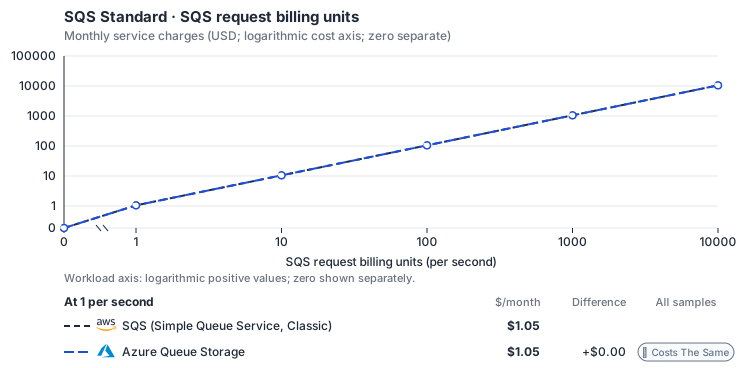
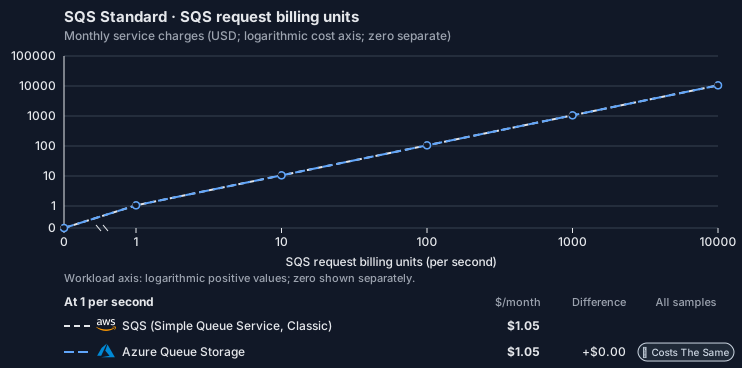
- 1-KiB messages, unbatched send/receive/delete; actual batch and delivery assumptions stay visible. Other native meters and workload assumptions retain their explicitly displayed default quantities. Workload translation and capacity assumptions are not benchmark measurements.
- Native monthly usage priced at the cited provider list prices; listed target allowances apply where present, excluding invoice credits, taxes and negotiated discounts. Rates as of 2026-10-22: us-east-1 → East US, USD/month.
- Source prices are reference charges, not an invoice. Target lines cover selected service usage/configuration only; adapter hosting and Tensor9 fees are excluded.
- Samples of explicit prices are not performance measurements or capacity qualification. No interpolation or break-even guarantee is implied.
- Variant assumptions show the first axis sample; any axis-dependent configuration is described by this curve’s workload note.
- Rates are cited provider list prices, editable for discounts, commitments or another region. Workload translation and capacity coefficients remain editable planning assumptions, not benchmark measurements or a commercial quote.
- Default-zero rates are explicit assumptions, not evidence that the deployed service or resource is free.
- Provisioned-unit minimums use an editable approximate allocation floor. Modeled target service cost is max(usage/allocation, minimum), with billable network, durable staging and dependent sinks added separately; actual RU/TU sizing, scaling increments and throughput remain unqualified.
- Durable staging is priced once: provisioned targets include adapter state in their selected allocation; native targets add a separate staging allocation when required. Adapter hosting is a separate allocation and must exclude resources already priced as staging, workers or target capacity.
- A declared adapter mapping and cost model do not establish implementation availability or service equivalence.
- This is a declared directed mapping; a planning estimate does not establish deployment or request-serving support.
- Authored planning assumptions, not measured adapter capacity. Origin rates are cited first-tier list prices, before free allowances and discounts.
- A cost scenario does not establish backend availability, protocol fidelity or production readiness. Registry serving status remains independent.
- Storage follows resident original messages, not every monthly message. Broker delivery bytes include redeliveries.
- FIFO estimates do not qualify dedup support, group throughput or single-group latency; backend limitations remain applicable.
- Azure Queue Storage (general-purpose v2, Standard LRS) bills every REST operation and stored GB-months. Each managed operation is one queue call; a queue message is at most 64 KiB, so no size multiplier applies. GRS, ZRS and the legacy general-purpose v1 account price differently. Internet egress is billed by Azure networking, not the queue, and the mapped families select none.
- AWS Price List API, AWSQueueService offer: https://pricing.us-east-1.amazonaws.com/offers/v1.0/aws/AWSQueueService/current/us-east-1/index.json
- Azure Retail Prices API: https://prices.azure.com/api/retail/prices
- Additional network transfer, backups, KMS, one-time migration and operational labor unless an explicit meter includes them.
- Destination application execution and separately billed downstream services; supply those allocations separately.
- Taxes, discounts, credits and free-tier allowances not explicitly listed by this model.
- Unmodeled dependent services, task execution and operations outside the selected workload family.
plan-d5bf5eea867ef509a6394c8ab16664bacb37eb07 / 2026-10-22.planning.2. Curve: workload-1.
Sources: AWS Price List API, AWSQueueService offer, Azure Retail Prices API.
SQS Standard → Azure Queue Storage: Authored native-usage planning example. Native monthly usage priced at the cited provider list prices; listed target allowances apply where present, excluding invoice credits, taxes and negotiated discounts.
Scenario source region: us-east-1. Scenario target region: East US. Currency: USD.
- Additional network transfer, backups, KMS, one-time migration and operational labor unless an explicit meter includes them.
- Destination application execution and separately billed downstream services; supply those allocations separately.
- Taxes, discounts, credits and free-tier allowances not explicitly listed by this model.
- Unmodeled dependent services, task execution and operations outside the selected workload family.
- Translated reads: 0 operations.
- Translated writes: 0 operations.
- Translated resident physical data: 0 GiB-month.
- Native provider operations: 0 operations.
- Published payload: 0 GiB.
- Delivered payload: 0 GiB.
- Allocated execution CPU: 0 vCPU-hour.
- Allocated execution RAM: 0 GiB-hour.
- Independent resource allocation: 0 resource-hour.
- Independent inventory: 0 resource-month.
- Input tokens: 0 tokens.
- Output tokens: 0 tokens.
- Billable network: 0 GiB.
- Dependent object sink retained data: 0 GiB-month.
- Dependent object sink writes: 0 writes.
- Rates are cited provider list prices, editable for discounts, commitments or another region. Workload translation and capacity coefficients remain editable planning assumptions, not benchmark measurements or a commercial quote.
- Default-zero rates are explicit assumptions, not evidence that the deployed service or resource is free.
- Provisioned-unit minimums use an editable approximate allocation floor. Modeled target service cost is max(usage/allocation, minimum), with billable network, durable staging and dependent sinks added separately; actual RU/TU sizing, scaling increments and throughput remain unqualified.
- Durable staging is priced once: provisioned targets include adapter state in their selected allocation; native targets add a separate staging allocation when required. Adapter hosting is a separate allocation and must exclude resources already priced as staging, workers or target capacity.
- A declared adapter mapping and cost model do not establish implementation availability or service equivalence.
- This is a declared directed mapping; a planning estimate does not establish deployment or request-serving support.
- Authored planning assumptions, not measured adapter capacity. Origin rates are cited first-tier list prices, before free allowances and discounts.
- A cost scenario does not establish backend availability, protocol fidelity or production readiness. Registry serving status remains independent.
- Storage follows resident original messages, not every monthly message. Broker delivery bytes include redeliveries.
- FIFO estimates do not qualify dedup support, group throughput or single-group latency; backend limitations remain applicable.
- Azure Queue Storage (general-purpose v2, Standard LRS) bills every REST operation and stored GB-months. Each managed operation is one queue call; a queue message is at most 64 KiB, so no size multiplier applies. GRS, ZRS and the legacy general-purpose v1 account price differently. Internet egress is billed by Azure networking, not the queue, and the mapped families select none.
plan-d5bf5eea867ef509a6394c8ab16664bacb37eb07 / 2026-10-22.planning.2. Scenario: planning-example.
Sources: AWS Price List API, AWSQueueService offer, Azure Retail Prices API.
Azure Service Bus
Persistent queue management and total cost
Cloud Adapter retains a persistent PostgreSQL store for the queue catalog, tenancy and lifecycle/control state, normally shared with the Cloud Adapter deployment. Native broker or Cosmos message storage does not remove this resource. Include its allocated compute, storage, backups and selected HA costs alongside adapter and message-backend charges; an idle or serverless message backend does not imply a zero total installation floor. Backend-only curves omit these shared allocations unless their assumptions explicitly include them. This control store is distinct from the SQS-owned message database. PostgreSQL-authority FIFO composites add recoverable message bodies, receipts, deduplication and outbox state to an explicitly configured SQS message database; they do not store messages in the shared control catalog. A separate logical database and login provide data/permission separation, but still share server CPU, storage, IOPS, WAL and connection limits when hosted on the same instance. Dedicated physical server/instance capacity is a separate allocation and cost decision.Service Bus capacity and queue lifetime
Standard and Premium use the same AMQP mapping described below, with different resource isolation, configured message limits and charges. Standard shares namespace capacity; Premium reserves approved messaging units. A messaging unit is not a fixed messages-per-second guarantee. Check actual SKU, entity limits, sessions, duplicate-detection window and credential permissions before binding a queue. A larger native entity does not automatically raise the adapter’s declared message limit. Native receipts belong to broker receiver links. The configured five-minute visibility ceiling and restart limitation remain applicable in this native design. Losing a link or failing to observe settlement leaves an uncertain result; the adapter cannot turn lock loss into a successful delete. A consumer must tolerate redelivery and make external effects idempotent. Cloud Adapter manages logical queues against a predeclared inventory of fresh, exclusively owned native entities. A deleted name recreated later receives a different entity; old work can reach only the retired one. Allocation history is retained, and exhausted inventory refuses a create before messaging effects. This finite inventory constrains cumulative queue churn, including uncertain/failed births, rather than just peak active queues. Provisioning more inventory is an explicit customer resource action. Declared settings and tags are catalog state; live counts need separate management authority and are not fabricated from AMQP traffic.Classic workload and cost
Native Service Bus is useful for Classic workloads that fit the configured entity body size, lock window and broker policy. Include sends, receives, settlement, renewals, retries, redelivery and scheduled work in operation costs; include Premium’s reserved capacity floor where selected. Queue churn adds provisioning and retained-allocation costs even at low message rates. Choose direct Azure PostgreSQL when durable receipts, long visibility or lifecycle churn outweigh the value of native broker integration.How it works
Your application keeps its SQS SDK and uses the authenticated Cloud Adapter endpoint configured for the install. The adapter translatesSendMessage and ReceiveMessage to Azure Service Bus and returns SQS responses, error codes and MD5 checksums. Its messaging identity is scoped separately from resource-provisioning authority.
Each standard queue maps to a Service Bus queue, reached over AMQP 1.0. SendMessage sends to that queue; SQS message attributes become application_properties, and DelaySeconds sets a scheduled delivery time. Receiving locks a message with PeekLock. Deleting completes the message, and changing visibility renews or abandons its lock. Delivery is at least once, with best-effort ordering and no deduplication, as on an SQS standard queue. FIFO queues use a separate mapping built on Service Bus sessions.


Your application keeps its SQS SDK; the adapter turns each call into Azure Service Bus operations.
Architecture
The adapter talks to Service Bus Standard over AMQP 1.0. It signs in with the customer’s AKS Workload Identity and theAzure Service Bus Data Owner role, so no secret is stored. That role allows sending and receiving messages, not creating or configuring queues.
In SQS, ReceiveMessage and DeleteMessage are separate calls linked by the receipt handle. In Service Bus, a message’s lock belongs to the receiver connection that took it, and only that receiver can complete, abandon or renew it. So the adapter keeps one long-lived PeekLock receiver per queue and remembers which receiver holds each receipt handle’s lock. Prefetch is off, so a message’s lock starts only when a consumer asks for it. While you hold a message, the adapter renews its lock for the visibility timeout you asked for, up to Service Bus’s 5-minute lock limit.
Azure Resource Manager provisioning establishes namespace/entity settings and the fresh, exclusively owned entity inventory. Max CreateQueue durably allocates a fresh inventory entry to the new logical incarnation before messaging; exhausted inventory refuses creation. DeleteQueue retires that incarnation and retains its allocation history, so later recreation cannot reuse the entity. The messaging identity does not gain provisioning authority. Microsoft operates broker durability, replication and availability; this is not a backup or point-in-time message-restore promise.


The adapter keeps each message’s lock on the receiver that took it until the message is deleted or the lock expires. The queue’s settings are fixed when it is created.
Receiving messages
ReceiveMessage receives and locks messages with PeekLock. MaxNumberOfMessages is clamped to 1–10 and WaitTimeSeconds to 20 seconds, which becomes Service Bus’s maximum wait. A standard queue has no session to accept first, so an empty queue returns within that wait. For each message, the adapter returns a receipt handle and remembers which receiver holds the lock; deletes and visibility changes go through that same receiver.
Standard queues allow duplicates and provide best-effort ordering. ApproximateReceiveCount uses Service Bus’s delivery_count, starting at 1 and increasing on each redelivery; this count also determines when a failing message is dead-lettered. The adapter recomputes MD5 checksums and reads SentTimestamp from the enqueue time. DelaySeconds schedules delivery up to 900 seconds; larger values return InvalidParameterValue. Batch sends process entries individually and return each entry’s result, including separately scheduled delays.


A receive locks up to ten messages within your long-poll wait. ApproximateReceiveCount is Service Bus’s real delivery_count .
Receipt handles & visibility
A receipt handle has the formsb1 | queue | lock-token. The adapter keeps it paired with the Service Bus receiver that holds the lock, in memory, between ReceiveMessage and the later delete or visibility change.
Receipt handles become invalid when the adapter restarts. A restart drops the receivers and that pairing. A later delete or visibility change with an old handle returns ReceiptHandleIsInvalid. The message stays in Service Bus and becomes available again when its lock expires, within 5 minutes.
A visibility timeout cannot exceed 5 minutes. Service Bus locks last at most 5 minutes, so a longer value on ReceiveMessage or ChangeMessageVisibility returns AWS.SimpleQueueService.UnsupportedOperation (HTTP 501) instead of being shortened, and a queue declared with a longer VisibilityTimeout is rejected. A positive ChangeMessageVisibility renews the lock; zero abandons the message for immediate redelivery. The adapter keeps renewing the lock for the window you asked for.


Receipt handles become invalid after an adapter restart. A visibility timeout above 5 minutes returns an error.
Dead-letter & retention
Service Bus dead-letters a message when its delivery count reaches the queue’s limit, set frommaxReceiveCount. The adapter cannot receive from Service Bus’s built-in dead-letter subqueue, so the queue is created with automatic forwarding to your declared dead-letter queue (DLQ). Expired messages are dead-lettered too, and stay there for inspection or recovery.
Retention, lock duration and dead-letter forwarding are set through Azure Resource Manager when the queue is created, and the messaging role cannot read them. Tensor9 keeps a record of each queue’s declared settings and answers attribute reads from it; live message counts are not available over this connection. Messages in Service Bus are durable. Receivers, active locks and receipt-handle pairings live in the adapter process.


Service Bus forwards a message to your dead-letter queue after maxReceiveCount deliveries.
Limitations
Where SQS standard queues and Service Bus differ- Visibility timeouts longer than 5 minutes are not supported. A longer value returns
AWS.SimpleQueueService.UnsupportedOperationrather than being shortened, which could cause double processing. For long work, extend the timeout with repeatedChangeMessageVisibilitycalls. - Receipt handles behave differently: they become invalid when the adapter restarts. A later delete or visibility change returns
ReceiptHandleIsInvalid, and the message is delivered again after its lock expires, within 5 minutes. Cosmos DB and PostgreSQL handles stay valid across a restart. - Deduplication and strict ordering are not supported on standard queues. Delivery is at least once with best-effort order, as on SQS standard queues. For strict per-group order and duplicate detection, declare a
.fifoqueue, which uses Service Bus sessions (see the FIFO explainer). - Live message counts require a separate authority. AMQP does not provide them. Unavailable requested counts return an explicit unsupported result; metadata reads return declared retention, visibility and dead-letter settings. Use Azure monitoring for broker backlog and request rates.
- Queue management uses finite fresh inventory. Cloud Adapter manages logical listings, tags and supported attributes. Create allocates a fresh entity; delete retires its incarnation and preserves the never-reused allocation. Uncertain births consume inventory too. Physical settings and inventory expansion require provisioning; unsupported retention, queue-delay or new dead-letter settings are rejected.
PurgeQueuebehaves differently. It receives and completes the currently visible messages in a bounded loop; locked and scheduled messages are left, and messages sent during the purge may or may not be removed. SQSPurgeQueuealso removes in-flight messages.
Other considerations
- Moving from AWS. The Service Bus queues start empty; messages still in SQS on AWS are not moved. Switch over once the SQS queue is drained, or send to both until it is.
- Who operates what. Microsoft operates Service Bus durability, replication and availability; Tensor9 operates the adapter. Include the adapter in your application’s monitoring.
- Before going live. Make sure consumers fit within the 5-minute visibility limit and handle
ReceiptHandleIsInvalidafter an adapter restart. Messages not completed stay in Service Bus and are delivered again after their locks expire; retention and dead-letter settings still apply. - Cost. Standard bills per messaging operation; Premium bills per provisioned messaging unit. Count receives, lock renewals and deletes.
Example monthly charges
This Tensor9 Cloud Adapter scenario estimates service charges for the named origin and target services. Adapter hosting and commercial Tensor9 fees need separate allocations. How Tensor9 estimates costs explains the method and what the estimates include.SQS Standard · SQS request billing units
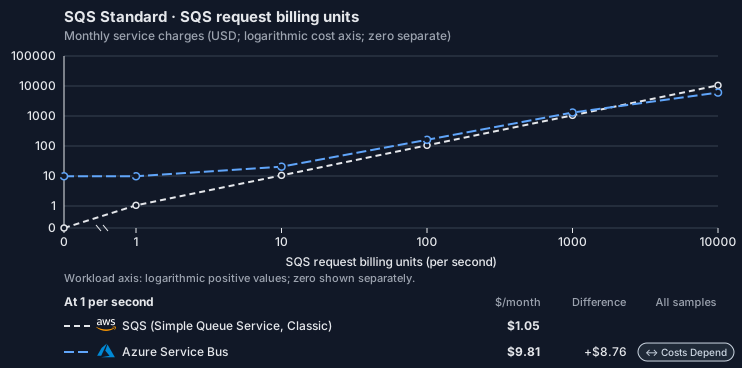
Feature: SQS Standard. Estimated monthly service charges by SQS request billing units. Adapter hosting and Tensor9 fees are excluded. Source: us-east-1; target: East US; currency: USD.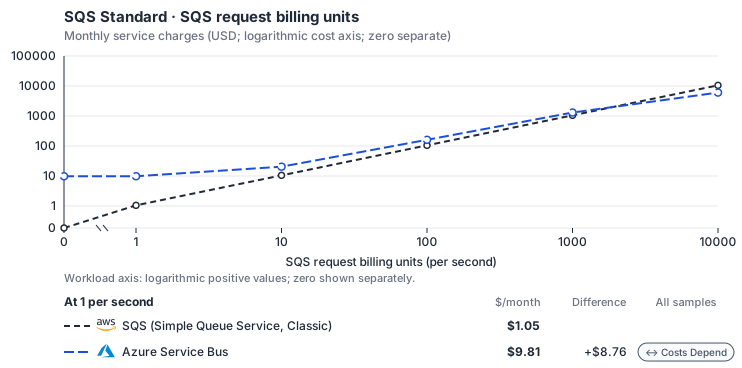
- 1-KiB messages, unbatched send/receive/delete; actual batch and delivery assumptions stay visible. Other native meters and workload assumptions retain their explicitly displayed default quantities. Workload translation and capacity assumptions are not benchmark measurements.
- Native monthly usage priced at the cited provider list prices; listed target allowances apply where present, excluding invoice credits, taxes and negotiated discounts. Rates as of 2026-10-22: us-east-1 → East US, USD/month.
- Source prices are reference charges, not an invoice. Target lines cover selected service usage/configuration only; adapter hosting and Tensor9 fees are excluded.
- Samples of explicit prices are not performance measurements or capacity qualification. No interpolation or break-even guarantee is implied.
- Variant assumptions show the first axis sample; any axis-dependent configuration is described by this curve’s workload note.
- Rates are cited provider list prices, editable for discounts, commitments or another region. Workload translation and capacity coefficients remain editable planning assumptions, not benchmark measurements or a commercial quote.
- Default-zero rates are explicit assumptions, not evidence that the deployed service or resource is free.
- Provisioned-unit minimums use an editable approximate allocation floor. Modeled target service cost is max(usage/allocation, minimum), with billable network, durable staging and dependent sinks added separately; actual RU/TU sizing, scaling increments and throughput remain unqualified.
- Durable staging is priced once: provisioned targets include adapter state in their selected allocation; native targets add a separate staging allocation when required. Adapter hosting is a separate allocation and must exclude resources already priced as staging, workers or target capacity.
- A declared adapter mapping and cost model do not establish implementation availability or service equivalence.
- This is a declared directed mapping; a planning estimate does not establish deployment or request-serving support.
- Authored planning assumptions, not measured adapter capacity. Origin rates are cited first-tier list prices, before free allowances and discounts.
- A cost scenario does not establish backend availability, protocol fidelity or production readiness. Registry serving status remains independent.
- Storage follows resident original messages, not every monthly message. Broker delivery bytes include redeliveries.
- FIFO estimates do not qualify dedup support, group throughput or single-group latency; backend limitations remain applicable.
- Azure Service Bus Standard bills a namespace base charge that includes 13 million operations a month, then graduated per-operation prices: USD 0.80 per million to 100 million, 0.50 to 2,500 million and 0.20 beyond. An operation is any API call (send, receive, complete) per 64 KB of message; the family’s managed operations count calls, not 64 KB units. Standard has no storage charge (queue size quota up to 5 GB is included). More than 1,000 brokered connections bill USD 0.03 per connection-month, which this profile does not model.
- AWS Price List API, AWSQueueService offer: https://pricing.us-east-1.amazonaws.com/offers/v1.0/aws/AWSQueueService/current/us-east-1/index.json
- Azure Retail Prices API: https://prices.azure.com/api/retail/prices
- Additional network transfer, backups, KMS, one-time migration and operational labor unless an explicit meter includes them.
- Destination application execution and separately billed downstream services; supply those allocations separately.
- Taxes, discounts, credits and free-tier allowances not explicitly listed by this model.
- Unmodeled dependent services, task execution and operations outside the selected workload family.
plan-ca45f8cb19ce07ffe770050ff2faf4e2ac2dad0b / 2026-10-22.planning.2. Curve: workload-1.
Sources: AWS Price List API, AWSQueueService offer, Azure Retail Prices API.
SQS Standard → Azure Service Bus: Authored native-usage planning example. Native monthly usage priced at the cited provider list prices; listed target allowances apply where present, excluding invoice credits, taxes and negotiated discounts.
Scenario source region: us-east-1. Scenario target region: East US. Currency: USD.
- Additional network transfer, backups, KMS, one-time migration and operational labor unless an explicit meter includes them.
- Destination application execution and separately billed downstream services; supply those allocations separately.
- Taxes, discounts, credits and free-tier allowances not explicitly listed by this model.
- Unmodeled dependent services, task execution and operations outside the selected workload family.
- Translated reads: 0 operations.
- Translated writes: 0 operations.
- Translated resident physical data: 0 GiB-month.
- Native provider operations: 0 operations.
- Published payload: 0 GiB.
- Delivered payload: 0 GiB.
- Allocated execution CPU: 0 vCPU-hour.
- Allocated execution RAM: 0 GiB-hour.
- Independent resource allocation: 0 resource-hour.
- Independent inventory: 0 resource-month.
- Input tokens: 0 tokens.
- Output tokens: 0 tokens.
- Billable network: 0 GiB.
- Dependent object sink retained data: 0 GiB-month.
- Dependent object sink writes: 0 writes.
- Rates are cited provider list prices, editable for discounts, commitments or another region. Workload translation and capacity coefficients remain editable planning assumptions, not benchmark measurements or a commercial quote.
- Default-zero rates are explicit assumptions, not evidence that the deployed service or resource is free.
- Provisioned-unit minimums use an editable approximate allocation floor. Modeled target service cost is max(usage/allocation, minimum), with billable network, durable staging and dependent sinks added separately; actual RU/TU sizing, scaling increments and throughput remain unqualified.
- Durable staging is priced once: provisioned targets include adapter state in their selected allocation; native targets add a separate staging allocation when required. Adapter hosting is a separate allocation and must exclude resources already priced as staging, workers or target capacity.
- A declared adapter mapping and cost model do not establish implementation availability or service equivalence.
- This is a declared directed mapping; a planning estimate does not establish deployment or request-serving support.
- Authored planning assumptions, not measured adapter capacity. Origin rates are cited first-tier list prices, before free allowances and discounts.
- A cost scenario does not establish backend availability, protocol fidelity or production readiness. Registry serving status remains independent.
- Storage follows resident original messages, not every monthly message. Broker delivery bytes include redeliveries.
- FIFO estimates do not qualify dedup support, group throughput or single-group latency; backend limitations remain applicable.
- Azure Service Bus Standard bills a namespace base charge that includes 13 million operations a month, then graduated per-operation prices: USD 0.80 per million to 100 million, 0.50 to 2,500 million and 0.20 beyond. An operation is any API call (send, receive, complete) per 64 KB of message; the family’s managed operations count calls, not 64 KB units. Standard has no storage charge (queue size quota up to 5 GB is included). More than 1,000 brokered connections bill USD 0.03 per connection-month, which this profile does not model.
plan-ca45f8cb19ce07ffe770050ff2faf4e2ac2dad0b / 2026-10-22.planning.2. Scenario: planning-example.
Sources: AWS Price List API, AWSQueueService offer, Azure Retail Prices API.
Azure Cosmos DB (queue)
Persistent queue management and total cost
Cloud Adapter retains a persistent PostgreSQL store for the queue catalog, tenancy and lifecycle/control state, normally shared with the Cloud Adapter deployment. Native broker or Cosmos message storage does not remove this resource. Include its allocated compute, storage, backups and selected HA costs alongside adapter and message-backend charges; an idle or serverless message backend does not imply a zero total installation floor. Backend-only curves omit these shared allocations unless their assumptions explicitly include them. This control store is distinct from the SQS-owned message database. PostgreSQL-authority FIFO composites add recoverable message bodies, receipts, deduplication and outbox state to an explicitly configured SQS message database; they do not store messages in the shared control catalog. A separate logical database and login provide data/permission separation, but still share server CPU, storage, IOPS, WAL and connection limits when hosted on the same instance. Dedicated physical server/instance capacity is a separate allocation and cost decision.Cosmos capacity and partition choice
Serverless charges consumed request units and suits idle-heavy queues. Manual provisioned throughput suits steady demand; autoscale suits varying provisioned demand. They use the same queue protocol, with different configured RU budgets and minimum charges. Changing RU capacity does not remove transaction, document-size, hot-partition or retained-storage constraints. Throttling and retry-after consume the caller’s time budget. Classic spreads work over hash buckets, rather than imposing FIFO group ordering. Conditional document updates own each receipt. A container’s aggregate RU setting does not establish the capacity of its busiest bucket or prove an atomic cross-partition dead-letter move. Admission validates the actual serialized body, attributes and transaction overhead before effects. The existing article’s declared payload limit is distinct from the larger-body transactional design: the latter must fit the complete 2-MB/100-operation same-partition transaction budget. It never truncates an oversized transaction or splits one atomic acceptance into an unsafe marker-then-body sequence. Compute cost from observed RU per successful operation plus conditional conflicts, retries, count queries, empty polls and cleanup; include stored bytes and the selected capacity floor. Missing body/attribute sizes, backlog, hottest-group fraction or measured index overhead leave storage/RU fit unknown. Serverless-to-provisioned conversion affects the account and is irreversible; it requires an explicit resource decision.Retries, batches and application changes
The application keeps its SQS SDK and uses the adapter’s configured endpoint and authentication. Backend IAM, database schema permissions and TLS identity belong to the deployment; an AWS ARN or policy is not automatically a target-cloud authorization grant. Scope identities to the customer resources and keep rotated credentials out of message bodies and receipt handles. A batch response reports each entry separately. Retry only failed entries whose outcome is known; a request timeout can follow a committed send or delete. A retried Classic send without deduplication can create another message. Duplicate enqueue suppression does not make consumer side effects exactly once. SDK retries and adapter retries share one bounded deadline, with backoff for provider throttling. An expired observer deadline does not prove a still-running native operation was cancelled. Visibility expiration permits another delivery while an earlier worker can still be executing. Consumers use idempotent writes, choose a visibility duration that covers normal processing and handle stale receipt errors. Retention can expire a message in flight. Queues start empty: drain the source before cutover or coordinate duplicate-safe dual writes. Queue recreation and purge must invalidate old claims independently of public names; data cleanup can continue after logical retirement. Database or broker backup is a resource recovery mechanism, not an automatic replay of application side effects.How it works
Your application keeps its SQS SDK and uses the authenticated Cloud Adapter endpoint configured for the install. The adapter performsSendMessage and ReceiveMessage in Cosmos DB and returns SQS responses, error codes and MD5 checksums. Its target-cloud identity is scoped to the customer’s configured resources.
Each queue is a Cosmos DB container with one document per message. Sending, receiving, deleting, delays, visibility, dead-letter delivery and message counts all work on those documents. Standard queues hand out messages in arrival order, with best-effort ordering under concurrent traffic.


The application keeps its SQS SDK. The adapter stores and reads messages in Azure Cosmos DB.
Architecture
The adapter keeps message and receipt state in Cosmos DB, so restarting it does not discard that state. The persistent queue catalog, tenancy and lifecycle/control state remain in the shared PostgreSQL control store. The adapter uses AKS Workload Identity without a static secret. Microsoft operates Cosmos durability and the selected availability/backup configuration; Tensor9 operates the adapter. The default shared serverless allocation uses one Cosmos account and database per Cloud Adapter deployment, with one container per declared queue. Manual provisioned and autoscale allocations are explicit alternatives with their own configured budgets. Each message document holds body, attributes, receive count and visibility time. Classic delivery is at least once, with best-effort ordering and no receiver fairness guarantee. Native per-item TTL cleans expired messages. The diagram shows the default allocation, not a universal capacity limit.

Each queue is one Cosmos DB container and each message a document; a Standard queue hands out messages with best-effort ordering.
Receiving messages
A receive takes the oldest visible message in one conditional write, hides it from other receivers and adds one to its receive count. If another receiver takes it first, the adapter moves on to the next message, so each message goes to one receiver at a time. When the visibility timeout passes, it can be delivered again. Standard queues use at-least-once delivery with best-effort ordering.ApproximateReceiveCount is the actual number of receives, not an estimate, and the MD5 checksums of the body and attributes are recomputed, so your SDK’s checks pass. Standard queues keep a delayed message hidden for its requested DelaySeconds, up to a maximum of 900 seconds. An omitted value means zero; larger values return InvalidParameterValue. SendMessageBatch writes each entry separately and reports a result for each entry.


A receive delivers the oldest visible message to exactly one consumer; if another consumer takes it first, the receive tries the next one. ApproximateReceiveCount is the actual receive count.
Receipt handles & visibility
Your consumer uses the receipt handle to delete a message or change its visibility. Here the handle refers to receive state stored in Cosmos DB, not to anything in the adapter’s memory, so a current handle works the same before and after a restart:DeleteMessage and ChangeMessageVisibility keep working.
A stale handle, for a message already deleted or received again under a newer handle, is accepted and has no effect, both on delete (as on SQS) and on a visibility change. The consumer cannot tell from the response that it no longer has the message. A handle from another queue, or one that cannot be read, is rejected with ReceiptHandleIsInvalid.
ChangeMessageVisibility updates the stored visibility time with no lock-duration maximum, and zero makes the message available again immediately. Retention can expire a message while it is in flight; extending visibility does not extend its lifetime. A visibility timeout does not stop a worker that is still processing an earlier receive.


Receipt handles still work after an adapter restart. Visibility is stored in Cosmos DB and has no lock-duration limit.
FIFO queues
For strict per-message-group ordering and five-minute duplicate-send suppression, use SQS FIFO. Standard queues provide at-least-once delivery with best-effort ordering.Dead-letter queues
A message received more thanmaxReceiveCount times is moved to the declared dead-letter queue. The copy reaches the DLQ before the message is removed from the source, and if the adapter crashes during the move, a retry finishes it. That retry can put a duplicate in the DLQ, so consumers of the DLQ must handle at-least-once delivery.


The adapter finishes interrupted dead-letter moves. Delivery to the DLQ is at least once, so a crash can cause a duplicate.
Limitations
Where SQS and Cosmos DB differ- Approximate counts behave differently: they can lag by about 5 seconds. The adapter caches counts briefly, so recent sends, deletes and expirations may not show at once. Use Azure monitoring to watch counts after deployment.
- Dead-letter delivery behaves differently: it can produce duplicates. A move interrupted by an adapter crash is finished without losing the message, but the DLQ can receive it more than once.
- Container headroom depends on the allocation. The default one-database/container-per-queue arrangement yields about 499 queues only when the account’s 500 total database-and-container allowance is otherwise unused. Existing databases, containers and account-specific quota determine actual headroom. Manual or autoscale RU capacity does not automatically remove that resource-count constraint. Serverless suits idle-heavy messages, while shared control PostgreSQL still has allocated costs.
- Geo-replication is not supported. The account is in a single region, the Cloud Adapter deployment’s region, with no geo-replica.
- Expiry behaves differently: Cosmos DB removes expired messages in the background. Per-item TTL is enforced by Cosmos DB’s background cleanup, and a message can expire while a consumer is processing it.
- Per-message delay is limited to a maximum of 900 seconds. Standard queues honor
DelaySecondsup to 900 seconds; larger values returnInvalidParameterValue. - You must manage the Cosmos DB account, database and containers in Terraform. Separate logical queue management from container provisioning: with Cloud Adapter, queue API calls manage logical queues on the provisioned containers, listings, tags and supported defaults, including retention. Terraform owns the account, database and containers; deleting a logical queue does not delete its container. Nonzero queue-level delay and new dead-letter routes are rejected.
Other considerations
- Moving from AWS. The Cosmos DB account, database and queue containers start empty, and messages in SQS are not migrated. Drain the source queue, or write to both queues, before cutover.
- Who operates what. Tensor9 creates the account, database and one container per declared queue from your queue declarations, and runs the adapter next to your application. Microsoft operates Cosmos DB’s durability, backups and high availability. You operate the Azure subscription, cluster patching and monitoring.
- What to monitor. Use Azure monitoring to track Cosmos DB request units and latency.
- Retention uses whole seconds. Each message’s TTL is set to its remaining retention in whole seconds, at least one second, so Cosmos DB never deletes a message before its retention ends. The adapter runs no cleanup of its own.
Example monthly charges
This Tensor9 Cloud Adapter scenario estimates service charges for the named origin and target services. Adapter hosting and commercial Tensor9 fees need separate allocations. How Tensor9 estimates costs explains the method and what the estimates include.SQS Standard · SQS request billing units
Feature: SQS Standard. Estimated monthly service charges by SQS request billing units. Adapter hosting and Tensor9 fees are excluded. Source: us-east-1; target: East US; currency: USD.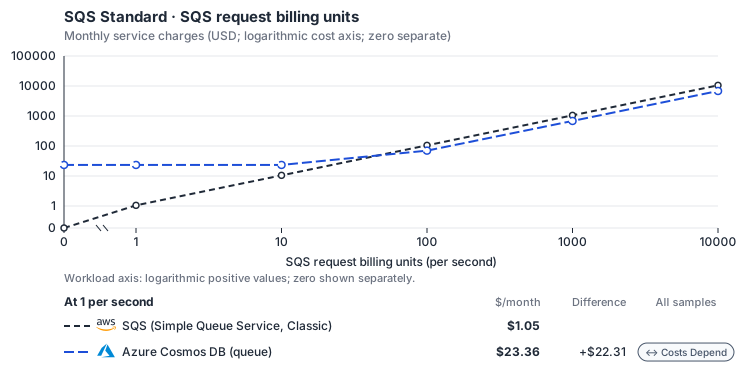
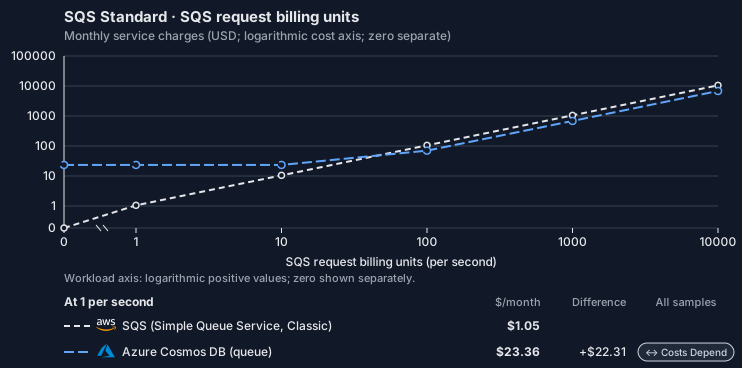
- 1-KiB messages, unbatched send/receive/delete; actual batch and delivery assumptions stay visible. Other native meters and workload assumptions retain their explicitly displayed default quantities. Workload translation and capacity assumptions are not benchmark measurements.
- Native monthly usage priced at the cited provider list prices; listed target allowances apply where present, excluding invoice credits, taxes and negotiated discounts. Rates as of 2026-10-22: us-east-1 → East US, USD/month.
- Source prices are reference charges, not an invoice. Target lines cover selected service usage/configuration only; adapter hosting and Tensor9 fees are excluded.
- Samples of explicit prices are not performance measurements or capacity qualification. No interpolation or break-even guarantee is implied.
- Variant assumptions show the first axis sample; any axis-dependent configuration is described by this curve’s workload note.
- Rates are cited provider list prices, editable for discounts, commitments or another region. Workload translation and capacity coefficients remain editable planning assumptions, not benchmark measurements or a commercial quote.
- Default-zero rates are explicit assumptions, not evidence that the deployed service or resource is free.
- Provisioned-unit minimums use an editable approximate allocation floor. Modeled target service cost is max(usage/allocation, minimum), with billable network, durable staging and dependent sinks added separately; actual RU/TU sizing, scaling increments and throughput remain unqualified.
- Durable staging is priced once: provisioned targets include adapter state in their selected allocation; native targets add a separate staging allocation when required. Adapter hosting is a separate allocation and must exclude resources already priced as staging, workers or target capacity.
- A declared adapter mapping and cost model do not establish implementation availability or service equivalence.
- This is a declared directed mapping; a planning estimate does not establish deployment or request-serving support.
- Authored planning assumptions, not measured adapter capacity. Origin rates are cited first-tier list prices, before free allowances and discounts.
- A cost scenario does not establish backend availability, protocol fidelity or production readiness. Registry serving status remains independent.
- Storage follows resident original messages, not every monthly message. Broker delivery bytes include redeliveries.
- FIFO estimates do not qualify dedup support, group throughput or single-group latency; backend limitations remain applicable.
- Azure Cosmos DB provisioned throughput bills 100-RU/s blocks per hour and stored GB-months; operations within the provisioned RU/s have no separate charge. Blocks are sized from the family’s reads at 1 RU and writes at 5.5 RU (1 KB items, no extra indexing) at full utilization after the planning peak factor, with the 400 RU/s smallest manual allocation as the floor (USD 23.36/month). Larger messages, indexing and query-based receives raise the RU charge; autoscale (USD 0.012 per 100 RU/s-hour) and serverless (USD 0.25 per million RUs) are not selected.
- AWS Price List API, AWSQueueService offer: https://pricing.us-east-1.amazonaws.com/offers/v1.0/aws/AWSQueueService/current/us-east-1/index.json
- Azure Retail Prices API: https://prices.azure.com/api/retail/prices
- Additional network transfer, backups, KMS, one-time migration and operational labor unless an explicit meter includes them.
- Destination application execution and separately billed downstream services; supply those allocations separately.
- Taxes, discounts, credits and free-tier allowances not explicitly listed by this model.
- Unmodeled dependent services, task execution and operations outside the selected workload family.
plan-dad0c8f973de92af6643c3cb9f65340d91c718a5 / 2026-10-22.planning.2. Curve: workload-1.
Sources: AWS Price List API, AWSQueueService offer, Azure Retail Prices API.
SQS Standard → Azure Cosmos DB (queue): Authored native-usage planning example. Native monthly usage priced at the cited provider list prices; listed target allowances apply where present, excluding invoice credits, taxes and negotiated discounts.
Scenario source region: us-east-1. Scenario target region: East US. Currency: USD.
- Additional network transfer, backups, KMS, one-time migration and operational labor unless an explicit meter includes them.
- Destination application execution and separately billed downstream services; supply those allocations separately.
- Taxes, discounts, credits and free-tier allowances not explicitly listed by this model.
- Unmodeled dependent services, task execution and operations outside the selected workload family.
- Translated reads: 0 operations.
- Translated writes: 0 operations.
- Translated resident physical data: 0 GiB-month.
- Native provider operations: 0 operations.
- Published payload: 0 GiB.
- Delivered payload: 0 GiB.
- Allocated execution CPU: 0 vCPU-hour.
- Allocated execution RAM: 0 GiB-hour.
- Independent resource allocation: 0 resource-hour.
- Independent inventory: 0 resource-month.
- Input tokens: 0 tokens.
- Output tokens: 0 tokens.
- Billable network: 0 GiB.
- Dependent object sink retained data: 0 GiB-month.
- Dependent object sink writes: 0 writes.
- Rates are cited provider list prices, editable for discounts, commitments or another region. Workload translation and capacity coefficients remain editable planning assumptions, not benchmark measurements or a commercial quote.
- Default-zero rates are explicit assumptions, not evidence that the deployed service or resource is free.
- Provisioned-unit minimums use an editable approximate allocation floor. Modeled target service cost is max(usage/allocation, minimum), with billable network, durable staging and dependent sinks added separately; actual RU/TU sizing, scaling increments and throughput remain unqualified.
- Durable staging is priced once: provisioned targets include adapter state in their selected allocation; native targets add a separate staging allocation when required. Adapter hosting is a separate allocation and must exclude resources already priced as staging, workers or target capacity.
- A declared adapter mapping and cost model do not establish implementation availability or service equivalence.
- This is a declared directed mapping; a planning estimate does not establish deployment or request-serving support.
- Authored planning assumptions, not measured adapter capacity. Origin rates are cited first-tier list prices, before free allowances and discounts.
- A cost scenario does not establish backend availability, protocol fidelity or production readiness. Registry serving status remains independent.
- Storage follows resident original messages, not every monthly message. Broker delivery bytes include redeliveries.
- FIFO estimates do not qualify dedup support, group throughput or single-group latency; backend limitations remain applicable.
- Azure Cosmos DB provisioned throughput bills 100-RU/s blocks per hour and stored GB-months; operations within the provisioned RU/s have no separate charge. Blocks are sized from the family’s reads at 1 RU and writes at 5.5 RU (1 KB items, no extra indexing) at full utilization after the planning peak factor, with the 400 RU/s smallest manual allocation as the floor (USD 23.36/month). Larger messages, indexing and query-based receives raise the RU charge; autoscale (USD 0.012 per 100 RU/s-hour) and serverless (USD 0.25 per million RUs) are not selected.
plan-dad0c8f973de92af6643c3cb9f65340d91c718a5 / 2026-10-22.planning.2. Scenario: planning-example.
Sources: AWS Price List API, AWSQueueService offer, Azure Retail Prices API.
PostgreSQL Flexible Server
PostgreSQL hosting
Microsoft operates PostgreSQL Flexible Server, including zone-redundant HA and point-in-time recovery backups. The adapter uses short-lived Microsoft Entra tokens as database passwords. Queue data stays outside the customer’s Kubernetes cluster and survives its rebuild. One server and database hold all queues for the deployment, sharing capacity and maintenance; the default server size is fixed because SQS supplies no source instance size. Tensor9 operates the queue schema and adapter. Queues start empty; existing SQS messages are not migrated. Drain the source or coordinate dual writes before cutover.Persistent queue management and total cost
Cloud Adapter retains a persistent PostgreSQL store for the queue catalog, tenancy and lifecycle/control state, normally shared with the Cloud Adapter deployment. Native broker or Cosmos message storage does not remove this resource. Include its allocated compute, storage, backups and selected HA costs alongside adapter and message-backend charges; an idle or serverless message backend does not imply a zero total installation floor. Backend-only curves omit these shared allocations unless their assumptions explicitly include them. This control store is distinct from the SQS-owned message database. PostgreSQL-authority FIFO composites add recoverable message bodies, receipts, deduplication and outbox state to an explicitly configured SQS message database; they do not store messages in the shared control catalog. A separate logical database and login provide data/permission separation, but still share server CPU, storage, IOPS, WAL and connection limits when hosted on the same instance. Dedicated physical server/instance capacity is a separate allocation and cost decision.Database placement and recovery
Azure Database for PostgreSQL Flexible Server is the durable queue database in your Azure subscription. The adapter connects over TLS using short-lived Microsoft Entra database credentials. Microsoft operates the server; choose the required HA and backup configuration explicitly. AKS replacement does not replace the database. Server failover can interrupt connections and leave an in-progress commit’s response uncertain, so consumers retain their ordinary redelivery and retry handling.Capacity and queue workload
The default shared message database holds multiple queues, each with its own table. Dedicated physical server/instance capacity isolates compute and I/O from other server workloads; a separate logical database alone does not. HA changes recovery, commit latency and price rather than FIFO semantics. Neither choice creates an unlimited queue service. Size connection pools, storage, IOPS and WAL for accepted sends, receives, deletes, visibility changes, retries and cleanup together. Long polls wait outside database transactions. Classic queues have no application-visible group ordering. Concurrent receivers claim different visible rows, but a slow consumer may continue processing an earlier copy after its visibility expires. Use idempotent consumer effects and include empty polls and redelivery in database load estimates. Requested live counts scan the message population even for a single requested counter. Frequent depth polling over a large backlog competes for database I/O and pool capacity; receipt classification can change index/heap work. Price those queries separately from sends and completed message cycles. A fall in depth can reflect purge, expiry or dead-letter transfer rather than application completion. The portable Standard-queue benchmark does not establish the capacity of this host, its HA configuration or a FIFO workload. Payload sizes, active-group skew, settlement time, backlog growth and matched native measurements determine whether a proposed size fits. Missing measurements leave capacity unknown.Retries, batches and application changes
The application keeps its SQS SDK and uses the adapter’s configured endpoint and authentication. Backend IAM, database schema permissions and TLS identity belong to the deployment; an AWS ARN or policy is not automatically a target-cloud authorization grant. Scope identities to the customer resources and keep rotated credentials out of message bodies and receipt handles. A batch response reports each entry separately. Retry only failed entries whose outcome is known; a request timeout can follow a committed send or delete. A retried Classic send without deduplication can create another message. Duplicate enqueue suppression does not make consumer side effects exactly once. SDK retries and adapter retries share one bounded deadline, with backoff for provider throttling. An expired observer deadline does not prove a still-running native operation was cancelled. Visibility expiration permits another delivery while an earlier worker can still be executing. Consumers use idempotent writes, choose a visibility duration that covers normal processing and handle stale receipt errors. Retention can expire a message in flight. Queues start empty: drain the source before cutover or coordinate duplicate-safe dual writes. Queue recreation and purge must invalidate old claims independently of public names; data cleanup can continue after logical retirement. Database or broker backup is a resource recovery mechanism, not an automatic replay of application side effects.PostgreSQL queue behavior
Your application keeps its SQS SDK and uses the authenticated Cloud Adapter endpoint configured for the install. The adapter performsSendMessage and ReceiveMessage in the SQS-owned PostgreSQL message database and returns SQS responses, error codes and MD5 checksums. Its message-data login is separate from other services and the shared control catalog.
Each queue is a PostgreSQL table with one row per message. Sending, receiving, deleting, delays, visibility, dead-letter delivery and message counts all work on those rows. Standard queues provide at-least-once delivery with best-effort ordering.
The application keeps its SQS SDK. The adapter stores each queue in a PostgreSQL table.
Architecture
The adapter keeps all queue state in PostgreSQL, including messages and receipt handles, so adapter instances can restart or scale out without losing track of in-flight messages. On Cloud SQL and Azure Flexible Server it signs in with short-lived Cloud SQL IAM or Microsoft Entra tokens used as database passwords, so no static secret is stored. When the stack is deployed, Tensor9 creates one database per Cloud Adapter deployment and one table per declared queue. Each row holds the message body and attributes, its message group, its visibility time, its receipt handle, its receive count and the time it was sent. A Standard queue hands out messages in arrival order, with best-effort ordering under concurrent traffic. A dead-letter queue is another queue table, and a background task deletes messages older than the queue’s retention period. CloudNativePG, Cloud SQL for PostgreSQL, Azure Flexible Server and Scaleway use the same adapter code and tables. They differ in where the data lives: the managed servers run outside your Kubernetes cluster, while CloudNativePG runs inside it. See the rebuild limitation below.Each queue, including each dead-letter queue, is a PostgreSQL table. The same adapter runs on every supported PostgreSQL host.
Receiving messages
One database step selects messages whose visibility timeout has passed, oldest first, up to the requested batch size. In the same step it gives each a new receipt handle, hides it for the visibility timeout, adds one to its receive count and returns it. Messages another receiver is taking at that moment are skipped. Standard queues provide best-effort ordering. When the visibility timeout passes, the message can be delivered again; that does not stop a worker still processing the earlier copy.ApproximateReceiveCount is the actual number of receives, not an estimate. The MD5 checksums of the body and attributes are recomputed, so your SDK’s checks pass. DelaySeconds sets when a message first becomes visible. Long polling waits up to WaitTimeSeconds (at most 20 seconds) and returns as soon as a message is available. SendMessageBatch inserts all entries at once and reports a result for each entry. Message bodies are stored in the queue table.
Two receivers never get the same message at the same time. ApproximateReceiveCount is the actual receive count.
Receipt handles & visibility
Each receive saves a new receipt handle with the message.DeleteMessage and ChangeMessageVisibility find the message by that handle, including after an adapter restart or through another adapter instance.
A delete or visibility change whose handle matches no message returns ReceiptHandleIsInvalid. That includes a message already deleted, or received again under a newer handle. The visibility timeout defaults to 30 seconds. ChangeMessageVisibility can extend it with no lock-duration maximum, and zero makes the message available again immediately. Retention can delete a message while it is in flight.
Receipt handles are saved with messages, so they still work after an adapter restart. Visibility has no lock-duration limit.
Dead-letter & retention
When source and DLQ belong to the same supported SQS-owned message database transaction, receive moves messages atmaxReceiveCount atomically with claiming the rest. Both changes commit or neither does. Cross-database/store transfers are unsupported: sharing a provider, physical server or control log is not a shared message transaction, and no other service’s tables are used. The DLQ retains ordinary queue operations and cleanup. A moved message keeps its MessageId and SentTimestamp, gains DeadLetterQueueSourceArn, and its ApproximateReceiveCount keeps counting receives on both queues. A redrive policy on the DLQ itself counts only receives on the DLQ, and the DLQ’s retention runs from the original send time.
A background task deletes messages sent longer ago than the queue’s retention period, including messages in flight; receiving does not reset that time. The retention period defaults to four days and is kept between 60 seconds and 14 days, so a missing or too-short value cannot delete new messages straight away. One worker per database removes expired messages in batches, pauses during database maintenance, and continues if one queue fails. Limits on rows per pass and time per batch cap the load.
Atomic DLQ moves require the same supported SQS-owned database transaction. Cross-store moves are unsupported. Retention cleanup removes aged messages.
FIFO queues
For strict per-message-group ordering and five-minute duplicate-send suppression, use SQS FIFO. Standard queues provide at-least-once delivery with best-effort ordering.Limitations
Where SQS and the PostgreSQL adapter differ- Throughput behaves differently: one PostgreSQL server serves every queue. All of a Cloud Adapter deployment’s queues share one server, so its capacity bounds peak throughput and a heavy queue can affect the others. In Tensor9’s round-trip test of a moderate-rate Standard queue, the adapter matched SQS throughput (about 300 vs 286 ops/s) with a lower p99 (140 ms vs 172 ms) but a slower median (p50 24 ms vs 15 ms). That is not a measured ceiling, and it does not cover FIFO queues or every host.
- Recovery follows the database placement. The managed database is outside the Cloud Adapter deployment cluster, so replacing that cluster does not replace the queue data. Database availability and recovery still depend on the selected server, HA and backup configuration.
- Messages are limited to 256 KiB by default. The adapter’s default limit is 262144 bytes, while native SQS now accepts up to 1 MiB. Sends are checked against the queue’s declared limit.
- Stale receipt handles behave differently: they return an error.
DeleteMessageandChangeMessageVisibilityreturnReceiptHandleIsInvalidwhen no message matches the handle. - Retention behaves differently: expired messages are removed periodically. An expired message can remain until the next cleanup pass. Retention is kept between 60 seconds and 14 days; a too-short value is raised to 60 seconds so that new messages are not deleted.
- Counts observe queue state, not application completion. Requested message counts read the message database: eligible messages are visible, future-visible messages with a receipt are in flight, and future-visible messages without a receipt are initially delayed. These categories share one query snapshot and can change immediately afterward. Metadata-only reads do not require a message-table count. An unavailable requested count returns an explicit unsupported result rather than zero. Purge, expiry and dead-letter movement can reduce depth without completing the application’s work.
- Queue creation behaves differently: queues are created when the stack is deployed. Tensor9 creates the database and each queue’s table, and its dead-letter table, at deploy time.
CreateQueue,DeleteQueueandSetQueueAttributesact on those tables. Switching a queue between Standard and FIFO is rejected, because it would replace the queue.
Other considerations
- Moving from AWS. The database and queue tables start empty, and existing SQS messages are not migrated. Drain the source queue, or write to both queues during the transition.
- Removing queues. Each queue is created in one step, so a crash never leaves a half-created queue. When a queue is removed from the stack, Tensor9 deletes only queues it created; any other queue is detached and left in place. A queue that still holds messages is not deleted unless deletion is forced.
- Who operates what. On the managed hosts, the provider operates the database’s durability, backups and high availability, and Tensor9 operates the adapter. On CloudNativePG, Tensor9 operates the database inside your cluster.
Example monthly charges
This Tensor9 Cloud Adapter scenario estimates service charges for the named origin and target services. Adapter hosting and commercial Tensor9 fees need separate allocations. How Tensor9 estimates costs explains the method and what the estimates include.SQS Standard · SQS request billing units
Feature: SQS Standard. Estimated monthly service charges by SQS request billing units. Adapter hosting and Tensor9 fees are excluded. Source: us-east-1; target: eastus; currency: USD.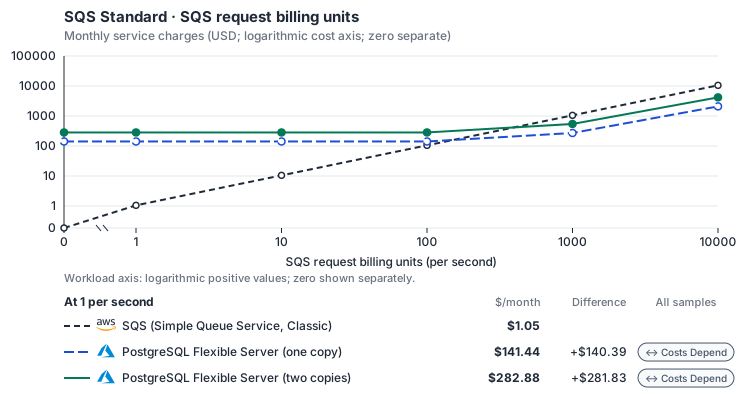
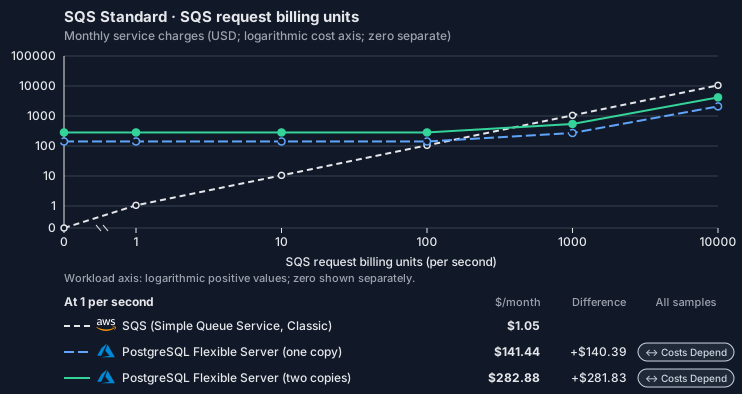
- 1-KiB messages, unbatched send/receive/delete; actual batch and delivery assumptions stay visible. Other native meters and workload assumptions retain their explicitly displayed default quantities. Workload translation and capacity assumptions are not benchmark measurements.
- Native monthly usage priced at the cited provider list prices; listed target allowances apply where present, excluding invoice credits, taxes and negotiated discounts. Rates as of 2026-10-22: us-east-1 → eastus, USD/month.
- Source prices are reference charges, not an invoice. Target lines cover selected service usage/configuration only; adapter hosting and Tensor9 fees are excluded.
- Samples of explicit prices are not performance measurements or capacity qualification. No interpolation or break-even guarantee is implied.
- Variant assumptions show the first axis sample; any axis-dependent configuration is described by this curve’s workload note.
- Rates are cited provider list prices, editable for discounts, commitments or another region. Workload translation and capacity coefficients remain editable planning assumptions, not benchmark measurements or a commercial quote.
- Default-zero rates are explicit assumptions, not evidence that the deployed service or resource is free.
- Provisioned-unit minimums use an editable approximate allocation floor. Modeled target service cost is max(usage/allocation, minimum), with billable network, durable staging and dependent sinks added separately; actual RU/TU sizing, scaling increments and throughput remain unqualified.
- Durable staging is priced once: provisioned targets include adapter state in their selected allocation; native targets add a separate staging allocation when required. Adapter hosting is a separate allocation and must exclude resources already priced as staging, workers or target capacity.
- A declared adapter mapping and cost model do not establish implementation availability or service equivalence.
- This is a declared directed mapping; a planning estimate does not establish deployment or request-serving support.
- Authored planning assumptions, not measured adapter capacity. Origin rates are cited first-tier list prices, before free allowances and discounts.
- A cost scenario does not establish backend availability, protocol fidelity or production readiness. Registry serving status remains independent.
- Storage follows resident original messages, not every monthly message. Broker delivery bytes include redeliveries.
- FIFO estimates do not qualify dedup support, group throughput or single-group latency; backend limitations remain applicable.
- Azure Database for PostgreSQL Flexible Server bills vCores with a fixed memory ratio per series; the vCPU and memory rates decompose the General Purpose and Memory Optimized v5 prices. High availability bills the standby’s compute and storage as a second copy. The minimum is the smallest Burstable server, which does not support high availability; the smallest General Purpose server (2 vCores) costs USD 133.62 per month. Additional IOPS, backup storage and reserved capacity are not selected.
- Row-store throughput (capacityOpsPerVcpuSecond, default 1500) is measured-by-tensor9 as a lower bound: the DynamoDB adapter on Cloud SQL db-custom-2-7680 (2 vCPU, PostgreSQL 16, us-west1) served 2,974 ops/s of YCSB-A at 16 threads without recorded saturation (src/main/kotlin/t9/prime/equiv/generated/eval/CloudsqlPostgresqlYcsbAT16GoYcsbV1_0_0.kt). Published CPU-bound pgbench reaches 3,101 read-write transactions and 20,289 point reads per vCPU-second (AWS z1d.2xlarge, PostgreSQL 14.5), so actual capacity is likely higher. Reads and writes share one coefficient: at the same adapter version, read-only YCSB-C was not faster than 50%-update YCSB-A.
- Log-broker throughput (capacityStreamMiBPerVcpuSecond 20 at 0.5 utilization, 4 GiB RAM per vCPU) is provider-documented by Google Managed Service for Apache Kafka sizing (https://docs.cloud.google.com/managed-service-for-apache-kafka/docs/plan-cluster-size): write-equivalent bytes are replicated writes plus a quarter of reads. Producer batches below 10 KB lower per-CPU throughput; that penalty is not modeled.
- Disk utilization 0.8 is provider-documented headroom below Cloud SQL automatic storage increase, which triggers near 91-95% full (https://docs.cloud.google.com/sql/docs/postgres/instance-settings). The 20 GiB reserve exceeds PostgreSQL’s 1 GB default max_wal_size; the remainder of that reserve is unmeasured.
- CPU tiers double from 2 vCPUs to the target’s largest node at 4 GiB per vCPU; each target’s documented largest node bounds CPU, RAM, RAM per vCPU and disk, and the durable staging database uses Cloud SQL Enterprise (96 vCPU, 6.5 GiB per vCPU, 624 GiB, 64 TiB). Targets billed per capacity unit or throughput unit are sized by their backend instead.
- No public evidence: peak/mean work (2) and the RAM working-set fraction (0.1). Proposed measurements: the p99 one-minute rate over the monthly mean from customer CloudWatch metrics; the buffer hit ratio while stepping RAM under a fixed YCSB-B load.
- Node bounds: E96ds_v5 has 96 vCores and 672 GiB (https://learn.microsoft.com/en-us/azure/postgresql/compute-storage/concepts-compute); Premium SSD storage holds up to 32,767 GiB (https://learn.microsoft.com/en-us/azure/postgresql/compute-storage/concepts-storage).
- Stored GiB already includes the origin family’s physical footprint assumptions; no second storage amplification is applied.
- The operations/vCPU coefficient supplies the compute requirement alongside explicit resource-hour minima.
- Copies and allocation fractions change cost only; they do not increase modeled primary capacity.
- AWS Price List API, AWSQueueService offer: https://pricing.us-east-1.amazonaws.com/offers/v1.0/aws/AWSQueueService/current/us-east-1/index.json
- Azure Retail Prices API: https://prices.azure.com/api/retail/prices
- Additional network transfer, backups, KMS, one-time migration and operational labor unless an explicit meter includes them.
- Destination application execution and separately billed downstream services; supply those allocations separately.
- Taxes, discounts, credits and free-tier allowances not explicitly listed by this model.
- Unmodeled dependent services, task execution and operations outside the selected workload family.
plan-89783f4d5bd47a02bac1ee1d677521ebf845f89c / 2026-10-22.planning.2. Curve: workload-1.
Sources: AWS Price List API, AWSQueueService offer, Azure Retail Prices API.
SQS Standard → PostgreSQL Flexible Server: Authored native-usage planning example. Native monthly usage priced at the cited provider list prices; listed target allowances apply where present, excluding invoice credits, taxes and negotiated discounts.
Scenario source region: us-east-1. Scenario target region: eastus. Currency: USD.
- Additional network transfer, backups, KMS, one-time migration and operational labor unless an explicit meter includes them.
- Destination application execution and separately billed downstream services; supply those allocations separately.
- Taxes, discounts, credits and free-tier allowances not explicitly listed by this model.
- Unmodeled dependent services, task execution and operations outside the selected workload family.
- Translated reads: 0 operations.
- Translated writes: 0 operations.
- Translated resident physical data: 0 GiB-month.
- Native provider operations: 0 operations.
- Published payload: 0 GiB.
- Delivered payload: 0 GiB.
- Allocated execution CPU: 0 vCPU-hour.
- Allocated execution RAM: 0 GiB-hour.
- Independent resource allocation: 0 resource-hour.
- Independent inventory: 0 resource-month.
- Input tokens: 0 tokens.
- Output tokens: 0 tokens.
- Billable network: 0 GiB.
- Dependent object sink retained data: 0 GiB-month.
- Dependent object sink writes: 0 writes.
- Rates are cited provider list prices, editable for discounts, commitments or another region. Workload translation and capacity coefficients remain editable planning assumptions, not benchmark measurements or a commercial quote.
- Default-zero rates are explicit assumptions, not evidence that the deployed service or resource is free.
- Provisioned-unit minimums use an editable approximate allocation floor. Modeled target service cost is max(usage/allocation, minimum), with billable network, durable staging and dependent sinks added separately; actual RU/TU sizing, scaling increments and throughput remain unqualified.
- Durable staging is priced once: provisioned targets include adapter state in their selected allocation; native targets add a separate staging allocation when required. Adapter hosting is a separate allocation and must exclude resources already priced as staging, workers or target capacity.
- A declared adapter mapping and cost model do not establish implementation availability or service equivalence.
- This is a declared directed mapping; a planning estimate does not establish deployment or request-serving support.
- Authored planning assumptions, not measured adapter capacity. Origin rates are cited first-tier list prices, before free allowances and discounts.
- A cost scenario does not establish backend availability, protocol fidelity or production readiness. Registry serving status remains independent.
- Storage follows resident original messages, not every monthly message. Broker delivery bytes include redeliveries.
- FIFO estimates do not qualify dedup support, group throughput or single-group latency; backend limitations remain applicable.
- Azure Database for PostgreSQL Flexible Server bills vCores with a fixed memory ratio per series; the vCPU and memory rates decompose the General Purpose and Memory Optimized v5 prices. High availability bills the standby’s compute and storage as a second copy. The minimum is the smallest Burstable server, which does not support high availability; the smallest General Purpose server (2 vCores) costs USD 133.62 per month. Additional IOPS, backup storage and reserved capacity are not selected.
- Row-store throughput (capacityOpsPerVcpuSecond, default 1500) is measured-by-tensor9 as a lower bound: the DynamoDB adapter on Cloud SQL db-custom-2-7680 (2 vCPU, PostgreSQL 16, us-west1) served 2,974 ops/s of YCSB-A at 16 threads without recorded saturation (src/main/kotlin/t9/prime/equiv/generated/eval/CloudsqlPostgresqlYcsbAT16GoYcsbV1_0_0.kt). Published CPU-bound pgbench reaches 3,101 read-write transactions and 20,289 point reads per vCPU-second (AWS z1d.2xlarge, PostgreSQL 14.5), so actual capacity is likely higher. Reads and writes share one coefficient: at the same adapter version, read-only YCSB-C was not faster than 50%-update YCSB-A.
- Log-broker throughput (capacityStreamMiBPerVcpuSecond 20 at 0.5 utilization, 4 GiB RAM per vCPU) is provider-documented by Google Managed Service for Apache Kafka sizing (https://docs.cloud.google.com/managed-service-for-apache-kafka/docs/plan-cluster-size): write-equivalent bytes are replicated writes plus a quarter of reads. Producer batches below 10 KB lower per-CPU throughput; that penalty is not modeled.
- Disk utilization 0.8 is provider-documented headroom below Cloud SQL automatic storage increase, which triggers near 91-95% full (https://docs.cloud.google.com/sql/docs/postgres/instance-settings). The 20 GiB reserve exceeds PostgreSQL’s 1 GB default max_wal_size; the remainder of that reserve is unmeasured.
- CPU tiers double from 2 vCPUs to the target’s largest node at 4 GiB per vCPU; each target’s documented largest node bounds CPU, RAM, RAM per vCPU and disk, and the durable staging database uses Cloud SQL Enterprise (96 vCPU, 6.5 GiB per vCPU, 624 GiB, 64 TiB). Targets billed per capacity unit or throughput unit are sized by their backend instead.
- No public evidence: peak/mean work (2) and the RAM working-set fraction (0.1). Proposed measurements: the p99 one-minute rate over the monthly mean from customer CloudWatch metrics; the buffer hit ratio while stepping RAM under a fixed YCSB-B load.
- Node bounds: E96ds_v5 has 96 vCores and 672 GiB (https://learn.microsoft.com/en-us/azure/postgresql/compute-storage/concepts-compute); Premium SSD storage holds up to 32,767 GiB (https://learn.microsoft.com/en-us/azure/postgresql/compute-storage/concepts-storage).
- Stored GiB already includes the origin family’s physical footprint assumptions; no second storage amplification is applied.
- The operations/vCPU coefficient supplies the compute requirement alongside explicit resource-hour minima.
- Copies and allocation fractions change cost only; they do not increase modeled primary capacity.
plan-89783f4d5bd47a02bac1ee1d677521ebf845f89c / 2026-10-22.planning.2. Scenario: planning-example.
Sources: AWS Price List API, AWSQueueService offer, Azure Retail Prices API.
On Google Cloud
Pub/Sub
Persistent queue management and total cost
Cloud Adapter retains a persistent PostgreSQL store for the queue catalog, tenancy and lifecycle/control state, normally shared with the Cloud Adapter deployment. Native broker or Cosmos message storage does not remove this resource. Include its allocated compute, storage, backups and selected HA costs alongside adapter and message-backend charges; an idle or serverless message backend does not imply a zero total installation floor. Backend-only curves omit these shared allocations unless their assumptions explicitly include them. This control store is distinct from the SQS-owned message database. PostgreSQL-authority FIFO composites add recoverable message bodies, receipts, deduplication and outbox state to an explicitly configured SQS message database; they do not store messages in the shared control catalog. A separate logical database and login provide data/permission separation, but still share server CPU, storage, IOPS, WAL and connection limits when hosted on the same instance. Dedicated physical server/instance capacity is a separate allocation and cost decision.Max queue management and native custody
Max serves queue discovery, supported configuration and message calls through the SQS endpoint. Declared queue configuration and tags belong to the queue catalog; message bodies, acknowledgement deadlines and redelivery belong to Pub/Sub. A configuration read is not a measurement of the live backlog. When a requested live attribute has no authoritative source, the adapter returns an explicit unsupported result rather than inventing zero. Select a database-backed queue when backlog counts are required by application control logic. A queue name can be deleted and recreated, but old deliveries must still refer to the old physical topic and subscription. Provision incarnation-specific resources or fresh, exclusively owned bindings. Purging a local buffer is not deletion of the subscription backlog. Queue lifecycle requires the corresponding target resource authority; a publish/subscribe credential alone does not grant management permissions. Pub/Sub remains the Classic broker choice: 10-600-second queue acknowledgement deadlines, no delayed first delivery, and approximate native dead-letter attempts. Ordering keys alone do not supply the SQS FIFO receipt, deduplication-response and receive-attempt contract. The database-assisted designs below are different resource arrangements. Receipt handles are native acknowledgement IDs for a delivery on the selected subscription. Settlement and visibility changes use that subscription and ID; stream closure alone does not establish token invalidity. Restart interrupts local receive buffering, while deadline expiry and redelivery can make an earlier receipt ineffective. The mapping provides no qualified SQS-style durable-receipt guarantee across restart. A successful acknowledgement after the deadline does not by itself prove that the message cannot be redelivered. See the native acknowledgement contract.Google Cloud queue designs
Classic can use native Pub/Sub custody or a transactional database for durable visibility and receipt state. The following designs have different storage owners and bills. Choosing one is an explicit resource/configuration decision; the adapter does not move a running queue between them automatically. | Design | Where bodies and queue state live | Workload consequence | | --- | --- | --- | | Cloud SQL PostgreSQL | Transactional bodies, receipts and dedup | Shared/dedicated capacity; zonal/HA placement | | Firestore | Transactional manifests, binary chunks and claims | Idle-heavy/many-group traffic; hot-group contention and operation/index charges | | Regional Spanner | Serializable queue transactions and binary chunks | Aggregate distributed load; capacity floor and hot-group serialization | | Pub/Sub full-body FIFO + PostgreSQL | Recoverable body in SQL; another body copy traverses Pub/Sub | Two-service cost; first delivery waits for broker observation; per-key payload limit | | PostgreSQL FIFO + Pub/Sub wakeups | Bodies/user state in SQL; broker carries ready hints | Scans repair lost hints; compare with LISTEN/NOTIFY | Firestore: a message manifest and its immutable binary chunks commit together. A 1-MiB body uses four 256-KiB chunks, avoiding Firestore’s per-document limit without introducing a Cloud Storage bucket. Attributes, transaction overhead and indexes must also fit the complete request. Candidate queries are hints; the transaction checks queue generation and claims the group. Chunk cleanup waits until no valid delivery/replay needs the body. Spanner: distributed group keys spread independent work. A read-write transaction checks lifecycle state, deduplication and group ownership before accepting or claiming a message. A read-only scan never owns a delivery. Unknown commit results are resolved from operation identity and durable state. Regional placement is explicit; this design makes no automatic multi-region recovery or measured throughput claim. Full-body Pub/Sub FIFO: Send commits body, group sequence, dedup result and publication intent in PostgreSQL. A publisher sends the body with stable logical identity and digest. A subscriber verifies the existing authority row and records broker observation before acknowledging the physical copy. Only observed eligible group heads reach SQS consumers. Broker acknowledgement is not SQS DeleteMessage: PostgreSQL retains the body and user claim. An outage before observation blocks first delivery and can consume retention time. Pub/Sub’s 1 MB/s ordering-key publish limit applies to bodies, attributes and transport-envelope bytes; more consumers do not remove it. Wakeups: Send commits the same database state but publishes only queue/group readiness. Receive can claim from PostgreSQL without a notification, using bounded repair scans. Duplicate or reordered notifications cannot allocate another message or advance a group. A broker outage can increase discovery latency, while database availability still determines message service. The notification byte limit is not a payload throughput estimate. The transactional designs retain queue incarnation and purge generation with every message, receipt and pending publication. A late publisher cannot recreate a deleted body or enter a replacement queue. Firestore, Spanner and SQL-assisted FIFO transport designs use the separate ordered-batch protocol, rather than direct PostgreSQL’s one-head-per-group mechanism. They return a contiguous group prefix up to the overall ten-message budget, but conservatively wait for all remaining members to settle or expire before redelivery. This is a restriction when individual members have different visibility deadlines. Valid five-minute ReceiveRequestAttemptId replays return the same unchanged set and refresh visibility without another receive-count increment; modified claims return an explicit unsupported result requiring a new attempt. These designs do not establish full AWS batch/replay equivalence. Atomic dead-letter moves require source and target in the same supported transaction. Cross-store moves/redrive are unsupported. Moving a blocked FIFO head to a dead-letter queue permits later messages to proceed and changes the original business sequence; decide whether that is appropriate for the application.Pub/Sub traffic and cost
Chargeable traffic includes publication and delivery bytes, attributes/envelope overhead, minimum request billing units and redelivery. Batch size and the number of subscriptions change the calculation. Empty SQS receives do not necessarily become a matching number of native pull requests because StreamingPull is buffered. Dead-letter forwarding, retained backlog, network transfer and the adapter/control-plane resources add costs. The displayed curve’s 1-KiB body and assumed envelope are a scenario, not a measured message-size distribution. Preserve unknown payload/envelope sizes when estimating a real workload; do not fill them from the benchmark, whose payload size was not retained.How it works
Your application keeps its SQS SDK and uses the authenticated Cloud Adapter endpoint configured for the install. The adapter translatesSendMessage and ReceiveMessage to Pub/Sub and returns SQS responses, error codes and recomputed MD5 checksums. Its Google identity is scoped to the customer’s resources.
Each standard SQS queue maps to a Pub/Sub topic for sending and a subscription for receiving: queue q becomes topic q and subscription q-sub. The message body becomes the Pub/Sub message data. Message attributes keep their type and their string or binary values in Pub/Sub attributes, and come back as SQS attributes on receive. Only standard queues are supported; FIFO ordering and deduplication need another backend.


An SQS queue q becomes a Pub/Sub topic q and subscription q-sub . The application calls the adapter through its existing SQS SDK.
Architecture
The adapter signs in to Pub/Sub with Workload Identity. Pub/Sub stores messages; persistent queue management uses the declared catalog and shared control PostgreSQL. The receive buffer is local to the adapter. Returned receipt handles are raw native acknowledgement IDs, settled with the selected subscription rather than a lookup of the original stream. Google operates native storage and delivery; Tensor9 operates the adapter. A publisher per topic batches concurrent sends, and aStreamingPull receiver per subscription fills a bounded receive buffer. Restart interrupts that local streaming/buffer ownership. Graceful receiver retirement can release still-buffered deliveries; already handed-off customer deliveries are not part of that buffer drain. Closing a stream does not by itself establish that every returned ID is invalid. Native acknowledgement deadlines and redelivery still govern settlement, and this mapping does not provide a qualified SQS-style durable-receipt guarantee across restart.
- Messages stay in Pub/Sub. Adapter restart interrupts local receive buffering. Plan for redelivery, use the receipt for the current delivery and keep business effects idempotent; neither universal old-receipt success nor universal restart invalidation is promised.
- Two limits control buffering. Pub/Sub limits how many delivered messages can wait for acknowledgement. The adapter also limits its local buffer, so idle consumers do not hold an unbounded number of messages whose acknowledgement deadlines are running.


Pub/Sub stores messages. The adapter keeps a local receive buffer; returned receipts are native acknowledgement IDs for deliveries on the selected subscription.
Receiving messages
A backgroundStreamingPull receiver reads the subscription continuously into a bounded buffer, and ReceiveMessage reads from that buffer. A message that arrives while a call is waiting is returned straight away, without another poll.
WaitTimeSeconds sets how long to wait for the first message, at most 20 seconds. Zero checks once without waiting, and an empty result is valid. Once the first message is there, the adapter fills the rest of the batch from buffered messages without waiting again. MaxNumberOfMessages is kept between 1 and 10. The buffer rides out short gaps in receiving while limiting how many messages it holds when consumers are idle. Use Google Cloud monitoring to size the buffer and to find publish or delivery bottlenecks.


ReceiveMessage reads the buffer and waits up to WaitTimeSeconds, at most 20 seconds, for the first message. A message that arrives during the wait is returned at once.
Visibility & receipt handles
VisibilityTimeout maps to the subscription’s acknowledgement deadline. A queue default must be 10–600 seconds. A ReceiveMessage override or ChangeMessageVisibility also accepts zero, which makes the message available at once. Other values are rejected, not adjusted. A per-call ReceiveMessage override changes the returned messages only when it differs from the queue default. Deadlines are not extended automatically, so a message left in the buffer past its deadline can be delivered again; consumers must handle duplicates.
The receipt is Pub/Sub’s acknowledgement ID for a delivery on the selected subscription. DeleteMessage and visibility changes use that subscription and raw ID, rather than resolving the original streaming connection. Stream closure alone does not determine token validity. Acknowledgement deadlines and redelivery can make an earlier receipt ineffective; a successful acknowledgement after the deadline does not prove that the message cannot be redelivered. Use the receipt from the current delivery and reconcile business state independently.


Queue visibility defaults are 10-600 seconds; per-message zero releases delivery. Receipts follow native subscription/delivery deadlines. No qualified restart-continuity guarantee is provided.
Dead-letter & delivery
Pub/Sub handles dead-letter delivery. An SQSRedrivePolicy sets the subscription’s delivery-attempt limit from maxReceiveCount. The adapter turns deadLetterTargetArn, given as an SQS-style ARN or a bare name, into the topic projects/<id>/topics/<name>. Pub/Sub forwards on a best-effort basis, so a message can move before or after that count. Counting attempts needs the dead-letter policy and the required IAM permissions. The destination is a Pub/Sub topic, not another queue as on SQS.
Delivery is at least once. ApproximateReceiveCount is Pub/Sub’s delivery-attempt count, available only when the subscription has a dead-letter policy; otherwise every receive reports 1. SendMessage uses the topic’s batching and returns the message ID and MD5 checksums. SendMessageBatch sends one Pub/Sub request and matches the returned message IDs to entries by position. An entry that fails validation is reported on its own without failing the whole batch.


Pub/Sub forwards messages to a dead-letter topic on a best-effort basis. Delivery-attempt counts need a dead-letter policy and IAM permissions.
Limitations
Where SQS and Pub/Sub differ- Messages are limited to 256 KiB by default. The adapter checks the declared
MaximumMessageSizebefore publishing, including each batch entry. The default is 262144 bytes (256 KiB), below native SQS’s 1 MiB limit. Pub/Sub’s own 10 MB limit does not raise the declared limit. - Retention shorter than ten minutes is not supported. Queue creation and
SetQueueAttributesapplyMessageRetentionPeriodto the subscription’s retention. Pub/Sub needs at least ten minutes, so shorter values are rejected; anything up to 14 days works. Reading the settings returns your declared value, not Pub/Sub’s default. - Live queue counts need an authoritative source. Pure Pub/Sub has no SQS count authority in this design. Requests for unavailable counts return an explicit unsupported result, rather than an empty success or fabricated zero. Use Google Cloud monitoring for broker backlog; choose a database-backed queue when application logic requires SQS count attributes.
- Acknowledgement deadlines behave differently: they are not extended automatically. The receiver does not renew a delivered message’s deadline, and the queue default must be 10-600 seconds. A message buffered past its deadline can be delivered again, so consumers must handle duplicates.
- Restart-durable SQS receipts are not guaranteed. Native subscription/delivery acknowledgement IDs follow deadline and redelivery rules. Restart interrupts local buffering; it establishes neither unconditional validity nor unconditional failure of an earlier receipt. Plan for redelivery, and do not treat a successful post-deadline ACK as completion proof.
- Dead-letter limits behave differently:
maxReceiveCountmust be 5-100. Pub/Sub’s delivery-attempt limit accepts only 5 to 100, so aRedrivePolicyoutside that range is rejected, although SQS accepts 1 to 1000. ApproximateReceiveCountbehaves differently: it needs a dead-letter policy. It is Pub/Sub’s delivery-attempt count, which Pub/Sub provides only with a correctly configured policy and IAM permissions, and the count can reset. A queue without one reports1on every receive.- Delayed delivery is not supported. Pub/Sub cannot hold individual messages for later delivery. Queue- and message-level
DelaySecondsmust be zero; other values are rejected.


The adapter checks message size against the declared limit and sets the subscription’s retention from the queue’s retention period.
Other considerations
- Moving from AWS. The Pub/Sub topic
qand subscriptionq-substart empty, and existing SQS messages are not migrated. Drain the source queue, or write to both queues, during the transition. Your SQS calls and checksum checks stay the same. - Who operates what. Google operates Pub/Sub’s durability, delivery and availability. Tensor9 operates the SQS adapter.
- If the adapter stops. Published messages stay in Pub/Sub; only the small receive buffer is in the adapter’s memory. On an orderly shutdown it releases buffered messages for redelivery. After a crash, unacknowledged messages are delivered again when their deadlines expire.
- Cost. Pub/Sub bills publication and delivery traffic; retries, retained backlog and network placement affect the bill. Add adapter costs and the shared persistent PostgreSQL control store’s allocated compute, storage, backups and selected HA. A backend-only message curve excludes those allocations unless stated.
- What to monitor. Read depth, latency, throughput and cost from Pub/Sub’s metrics in Google Cloud monitoring. A requested SQS count without an authoritative source is explicitly unsupported; it is not a zero-depth observation.
Example monthly charges
This Tensor9 Cloud Adapter scenario estimates service charges for the named origin and target services. Adapter hosting and commercial Tensor9 fees need separate allocations. How Tensor9 estimates costs explains the method and what the estimates include.Monthly cost by SQS request rate
Reference monthly service charges by API requests/s. Adapter hosting and Tensor9 fees are excluded. Source: us-east-1; target: us-central1; currency: USD.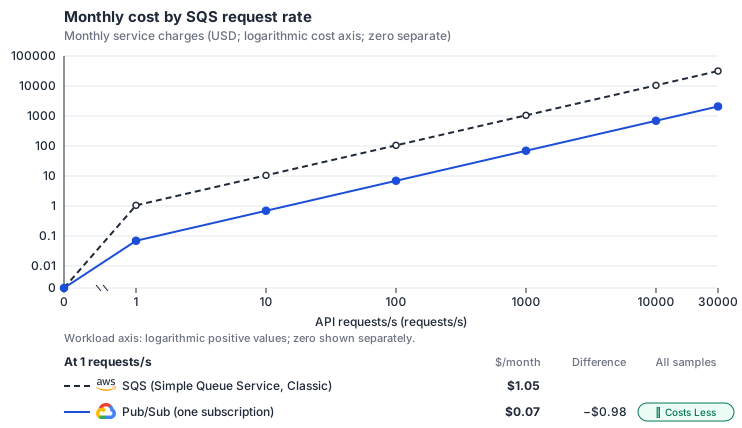
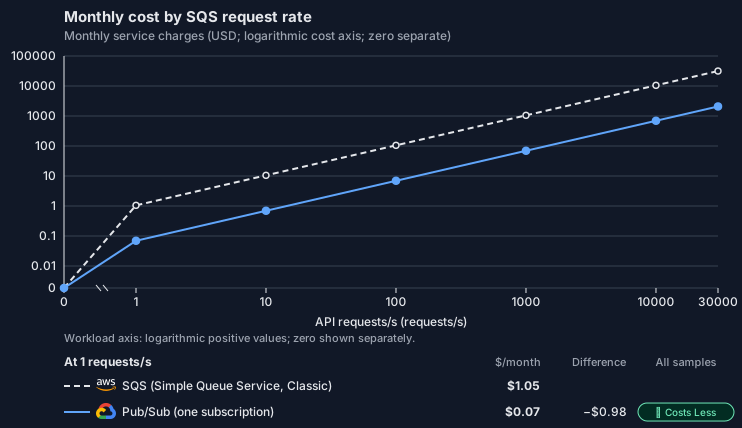
- 1 KiB messages; unbatched send, receive and delete requests in a 1:1:1 mix, with no empty receives or redeliveries. 730 hours/month; one SQS billing unit per API request. Pub/Sub uses one subscription and 64 bytes of assumed overhead. Message-backend charges only; add adapter and shared persistent control PostgreSQL allocations.
- Monthly AWS source usage in us-east-1, priced at the 2026-10-18 reference list rates before free allowances, discounts, credits and tax; not the uploaded invoice total. Rates as of 2026-10-18: us-east-1 → us-central1, USD/month.
- Source prices are reference charges, not an invoice. Target lines cover selected service usage/configuration only; adapter hosting and Tensor9 fees are excluded.
- Samples of explicit prices are not performance measurements or capacity qualification. No interpolation or break-even guarantee is implied.
- Variant assumptions show the first axis sample; any axis-dependent configuration is described by this curve’s workload note.
- One pull subscription, Standard SQS semantics compatible with this mapping, representative message size and batching.
- Pub/Sub publish and delivery each cost USD 40/TiB, with a 1,000-byte minimum per request. Metadata overhead is an explicit assumption.
- Source usage is priced at reference rates; source lines are not actual invoice charges. Free or discounted usage still consumes target resources.
- AWS Standard SQS pricing: https://aws.amazon.com/sqs/pricing/
- Pub/Sub pricing: https://cloud.google.com/pubsub/pricing/
- Free allowances, negotiated discounts, credits, tax and one-time migration charges.
- Charges not listed in the breakdown, including additional network transfer, backups and encryption/KMS.
- Application compute changes, operational labor and portfolio-wide sharing or deduplication of infrastructure.
- Pub/Sub retained-message storage, snapshots, extra subscriptions and transformations; SQS delay/FIFO features and visibility-extension traffic.
sqs-pubsub / 2026-10-18.4. Curve: request-rate.
Sources: AWS Standard SQS pricing, Pub/Sub pricing.
SQS → Google Cloud Pub/Sub: Reference monthly workload. Monthly AWS usage charges at the 2026-10-18 reference list rates in us-east-1, before free allowances, discounts, credits and tax.
Scenario source region: us-east-1. Scenario target region: us-central1. Currency: USD.
- Free allowances, negotiated discounts, credits, tax and one-time migration charges.
- Charges not listed in the breakdown, including additional network transfer, backups and encryption/KMS.
- Application compute changes, operational labor and portfolio-wide sharing or deduplication of infrastructure.
- Pub/Sub retained-message storage, snapshots, extra subscriptions and transformations; SQS delay/FIFO features and visibility-extension traffic.
- Inferred original messages: 100,000,000 messages/month.
- One pull subscription, Standard SQS semantics compatible with this mapping, representative message size and batching.
- Pub/Sub publish and delivery each cost USD 40/TiB, with a 1,000-byte minimum per request. Metadata overhead is an explicit assumption.
sqs-pubsub / 2026-10-18.4. Scenario: sqs-pubsub-reference.
Sources: AWS Standard SQS pricing, Pub/Sub pricing.
Cloud SQL for PostgreSQL
PostgreSQL hosting
Google operates Cloud SQL for PostgreSQL, including database backups and HA. The adapter uses short-lived Cloud SQL IAM tokens as database passwords, without an Auth Proxy or static password. Queue data stays outside the customer’s Kubernetes cluster and survives its rebuild. Tensor9 operates the queue schema and adapter. Queues start empty; existing SQS messages are not migrated. Drain the source or coordinate dual writes before cutover.Persistent queue management and total cost
Cloud Adapter retains a persistent PostgreSQL store for the queue catalog, tenancy and lifecycle/control state, normally shared with the Cloud Adapter deployment. Native broker or Cosmos message storage does not remove this resource. Include its allocated compute, storage, backups and selected HA costs alongside adapter and message-backend charges; an idle or serverless message backend does not imply a zero total installation floor. Backend-only curves omit these shared allocations unless their assumptions explicitly include them. This control store is distinct from the SQS-owned message database. PostgreSQL-authority FIFO composites add recoverable message bodies, receipts, deduplication and outbox state to an explicitly configured SQS message database; they do not store messages in the shared control catalog. A separate logical database and login provide data/permission separation, but still share server CPU, storage, IOPS, WAL and connection limits when hosted on the same instance. Dedicated physical server/instance capacity is a separate allocation and cost decision.Database placement and recovery
Cloud SQL is the durable queue database in your Google Cloud project. The adapter connects over TLS using short-lived IAM database credentials; Google operates the database. Zonal and high-availability configurations have different failure and maintenance behavior. Database backups and recovery policy belong to the selected configuration; they do not make every acknowledged queue operation immune to every database failure. GKE replacement does not replace this external database. Keep its identity and queue schema when rebuilding the application cluster.Capacity and queue workload
The default shared message database holds multiple queues, each with its own table. Dedicated physical server/instance capacity isolates compute and I/O from other server workloads; a separate logical database alone does not. HA changes recovery, commit latency and price rather than FIFO semantics. Neither choice creates an unlimited queue service. Size connection pools, storage, IOPS and WAL for accepted sends, receives, deletes, visibility changes, retries and cleanup together. Long polls wait outside database transactions. Classic queues have no application-visible group ordering. Concurrent receivers claim different visible rows, but a slow consumer may continue processing an earlier copy after its visibility expires. Use idempotent consumer effects and include empty polls and redelivery in database load estimates. Requested live counts scan the message population even for a single requested counter. Frequent depth polling over a large backlog competes for database I/O and pool capacity; receipt classification can change index/heap work. Price those queries separately from sends and completed message cycles. A fall in depth can reflect purge, expiry or dead-letter transfer rather than application completion. The portable Standard-queue benchmark does not establish the capacity of this host, its HA configuration or a FIFO workload. Payload sizes, active-group skew, settlement time, backlog growth and matched native measurements determine whether a proposed size fits. Missing measurements leave capacity unknown.Retries, batches and application changes
The application keeps its SQS SDK and uses the adapter’s configured endpoint and authentication. Backend IAM, database schema permissions and TLS identity belong to the deployment; an AWS ARN or policy is not automatically a target-cloud authorization grant. Scope identities to the customer resources and keep rotated credentials out of message bodies and receipt handles. A batch response reports each entry separately. Retry only failed entries whose outcome is known; a request timeout can follow a committed send or delete. A retried Classic send without deduplication can create another message. Duplicate enqueue suppression does not make consumer side effects exactly once. SDK retries and adapter retries share one bounded deadline, with backoff for provider throttling. An expired observer deadline does not prove a still-running native operation was cancelled. Visibility expiration permits another delivery while an earlier worker can still be executing. Consumers use idempotent writes, choose a visibility duration that covers normal processing and handle stale receipt errors. Retention can expire a message in flight. Queues start empty: drain the source before cutover or coordinate duplicate-safe dual writes. Queue recreation and purge must invalidate old claims independently of public names; data cleanup can continue after logical retirement. Database or broker backup is a resource recovery mechanism, not an automatic replay of application side effects.PostgreSQL queue behavior
Your application keeps its SQS SDK and uses the authenticated Cloud Adapter endpoint configured for the install. The adapter performsSendMessage and ReceiveMessage in the SQS-owned PostgreSQL message database and returns SQS responses, error codes and MD5 checksums. Its message-data login is separate from other services and the shared control catalog.
Each queue is a PostgreSQL table with one row per message. Sending, receiving, deleting, delays, visibility, dead-letter delivery and message counts all work on those rows. Standard queues provide at-least-once delivery with best-effort ordering.
The application keeps its SQS SDK. The adapter stores each queue in a PostgreSQL table.
Architecture
The adapter keeps all queue state in PostgreSQL, including messages and receipt handles, so adapter instances can restart or scale out without losing track of in-flight messages. On Cloud SQL and Azure Flexible Server it signs in with short-lived Cloud SQL IAM or Microsoft Entra tokens used as database passwords, so no static secret is stored. When the stack is deployed, Tensor9 creates one database per Cloud Adapter deployment and one table per declared queue. Each row holds the message body and attributes, its message group, its visibility time, its receipt handle, its receive count and the time it was sent. A Standard queue hands out messages in arrival order, with best-effort ordering under concurrent traffic. A dead-letter queue is another queue table, and a background task deletes messages older than the queue’s retention period. CloudNativePG, Cloud SQL for PostgreSQL, Azure Flexible Server and Scaleway use the same adapter code and tables. They differ in where the data lives: the managed servers run outside your Kubernetes cluster, while CloudNativePG runs inside it. See the rebuild limitation below.Each queue, including each dead-letter queue, is a PostgreSQL table. The same adapter runs on every supported PostgreSQL host.
Receiving messages
One database step selects messages whose visibility timeout has passed, oldest first, up to the requested batch size. In the same step it gives each a new receipt handle, hides it for the visibility timeout, adds one to its receive count and returns it. Messages another receiver is taking at that moment are skipped. Standard queues provide best-effort ordering. When the visibility timeout passes, the message can be delivered again; that does not stop a worker still processing the earlier copy.ApproximateReceiveCount is the actual number of receives, not an estimate. The MD5 checksums of the body and attributes are recomputed, so your SDK’s checks pass. DelaySeconds sets when a message first becomes visible. Long polling waits up to WaitTimeSeconds (at most 20 seconds) and returns as soon as a message is available. SendMessageBatch inserts all entries at once and reports a result for each entry. Message bodies are stored in the queue table.
Two receivers never get the same message at the same time. ApproximateReceiveCount is the actual receive count.
Receipt handles & visibility
Each receive saves a new receipt handle with the message.DeleteMessage and ChangeMessageVisibility find the message by that handle, including after an adapter restart or through another adapter instance.
A delete or visibility change whose handle matches no message returns ReceiptHandleIsInvalid. That includes a message already deleted, or received again under a newer handle. The visibility timeout defaults to 30 seconds. ChangeMessageVisibility can extend it with no lock-duration maximum, and zero makes the message available again immediately. Retention can delete a message while it is in flight.
Receipt handles are saved with messages, so they still work after an adapter restart. Visibility has no lock-duration limit.
Dead-letter & retention
When source and DLQ belong to the same supported SQS-owned message database transaction, receive moves messages atmaxReceiveCount atomically with claiming the rest. Both changes commit or neither does. Cross-database/store transfers are unsupported: sharing a provider, physical server or control log is not a shared message transaction, and no other service’s tables are used. The DLQ retains ordinary queue operations and cleanup. A moved message keeps its MessageId and SentTimestamp, gains DeadLetterQueueSourceArn, and its ApproximateReceiveCount keeps counting receives on both queues. A redrive policy on the DLQ itself counts only receives on the DLQ, and the DLQ’s retention runs from the original send time.
A background task deletes messages sent longer ago than the queue’s retention period, including messages in flight; receiving does not reset that time. The retention period defaults to four days and is kept between 60 seconds and 14 days, so a missing or too-short value cannot delete new messages straight away. One worker per database removes expired messages in batches, pauses during database maintenance, and continues if one queue fails. Limits on rows per pass and time per batch cap the load.
Atomic DLQ moves require the same supported SQS-owned database transaction. Cross-store moves are unsupported. Retention cleanup removes aged messages.
FIFO queues
For strict per-message-group ordering and five-minute duplicate-send suppression, use SQS FIFO. Standard queues provide at-least-once delivery with best-effort ordering.Limitations
Where SQS and the PostgreSQL adapter differ- Throughput behaves differently: one PostgreSQL server serves every queue. All of a Cloud Adapter deployment’s queues share one server, so its capacity bounds peak throughput and a heavy queue can affect the others. In Tensor9’s round-trip test of a moderate-rate Standard queue, the adapter matched SQS throughput (about 300 vs 286 ops/s) with a lower p99 (140 ms vs 172 ms) but a slower median (p50 24 ms vs 15 ms). That is not a measured ceiling, and it does not cover FIFO queues or every host.
- Recovery follows the database placement. The managed database is outside the Cloud Adapter deployment cluster, so replacing that cluster does not replace the queue data. Database availability and recovery still depend on the selected server, HA and backup configuration.
- Messages are limited to 256 KiB by default. The adapter’s default limit is 262144 bytes, while native SQS now accepts up to 1 MiB. Sends are checked against the queue’s declared limit.
- Stale receipt handles behave differently: they return an error.
DeleteMessageandChangeMessageVisibilityreturnReceiptHandleIsInvalidwhen no message matches the handle. - Retention behaves differently: expired messages are removed periodically. An expired message can remain until the next cleanup pass. Retention is kept between 60 seconds and 14 days; a too-short value is raised to 60 seconds so that new messages are not deleted.
- Counts observe queue state, not application completion. Requested message counts read the message database: eligible messages are visible, future-visible messages with a receipt are in flight, and future-visible messages without a receipt are initially delayed. These categories share one query snapshot and can change immediately afterward. Metadata-only reads do not require a message-table count. An unavailable requested count returns an explicit unsupported result rather than zero. Purge, expiry and dead-letter movement can reduce depth without completing the application’s work.
- Queue creation behaves differently: queues are created when the stack is deployed. Tensor9 creates the database and each queue’s table, and its dead-letter table, at deploy time.
CreateQueue,DeleteQueueandSetQueueAttributesact on those tables. Switching a queue between Standard and FIFO is rejected, because it would replace the queue.
Other considerations
- Moving from AWS. The database and queue tables start empty, and existing SQS messages are not migrated. Drain the source queue, or write to both queues during the transition.
- Removing queues. Each queue is created in one step, so a crash never leaves a half-created queue. When a queue is removed from the stack, Tensor9 deletes only queues it created; any other queue is detached and left in place. A queue that still holds messages is not deleted unless deletion is forced.
- Who operates what. On the managed hosts, the provider operates the database’s durability, backups and high availability, and Tensor9 operates the adapter. On CloudNativePG, Tensor9 operates the database inside your cluster.
Google Cloud queue designs
Classic can use native Pub/Sub custody or a transactional database for durable visibility and receipt state. The following designs have different storage owners and bills. Choosing one is an explicit resource/configuration decision; the adapter does not move a running queue between them automatically. | Design | Where bodies and queue state live | Workload consequence | | --- | --- | --- | | Cloud SQL PostgreSQL | Transactional bodies, receipts and dedup | Shared/dedicated capacity; zonal/HA placement | | Firestore | Transactional manifests, binary chunks and claims | Idle-heavy/many-group traffic; hot-group contention and operation/index charges | | Regional Spanner | Serializable queue transactions and binary chunks | Aggregate distributed load; capacity floor and hot-group serialization | | Pub/Sub full-body FIFO + PostgreSQL | Recoverable body in SQL; another body copy traverses Pub/Sub | Two-service cost; first delivery waits for broker observation; per-key payload limit | | PostgreSQL FIFO + Pub/Sub wakeups | Bodies/user state in SQL; broker carries ready hints | Scans repair lost hints; compare with LISTEN/NOTIFY | Firestore: a message manifest and its immutable binary chunks commit together. A 1-MiB body uses four 256-KiB chunks, avoiding Firestore’s per-document limit without introducing a Cloud Storage bucket. Attributes, transaction overhead and indexes must also fit the complete request. Candidate queries are hints; the transaction checks queue generation and claims the group. Chunk cleanup waits until no valid delivery/replay needs the body. Spanner: distributed group keys spread independent work. A read-write transaction checks lifecycle state, deduplication and group ownership before accepting or claiming a message. A read-only scan never owns a delivery. Unknown commit results are resolved from operation identity and durable state. Regional placement is explicit; this design makes no automatic multi-region recovery or measured throughput claim. Full-body Pub/Sub FIFO: Send commits body, group sequence, dedup result and publication intent in PostgreSQL. A publisher sends the body with stable logical identity and digest. A subscriber verifies the existing authority row and records broker observation before acknowledging the physical copy. Only observed eligible group heads reach SQS consumers. Broker acknowledgement is not SQS DeleteMessage: PostgreSQL retains the body and user claim. An outage before observation blocks first delivery and can consume retention time. Pub/Sub’s 1 MB/s ordering-key publish limit applies to bodies, attributes and transport-envelope bytes; more consumers do not remove it. Wakeups: Send commits the same database state but publishes only queue/group readiness. Receive can claim from PostgreSQL without a notification, using bounded repair scans. Duplicate or reordered notifications cannot allocate another message or advance a group. A broker outage can increase discovery latency, while database availability still determines message service. The notification byte limit is not a payload throughput estimate. The transactional designs retain queue incarnation and purge generation with every message, receipt and pending publication. A late publisher cannot recreate a deleted body or enter a replacement queue. Firestore, Spanner and SQL-assisted FIFO transport designs use the separate ordered-batch protocol, rather than direct PostgreSQL’s one-head-per-group mechanism. They return a contiguous group prefix up to the overall ten-message budget, but conservatively wait for all remaining members to settle or expire before redelivery. This is a restriction when individual members have different visibility deadlines. Valid five-minute ReceiveRequestAttemptId replays return the same unchanged set and refresh visibility without another receive-count increment; modified claims return an explicit unsupported result requiring a new attempt. These designs do not establish full AWS batch/replay equivalence. Atomic dead-letter moves require source and target in the same supported transaction. Cross-store moves/redrive are unsupported. Moving a blocked FIFO head to a dead-letter queue permits later messages to proceed and changes the original business sequence; decide whether that is appropriate for the application.Example monthly charges
This Tensor9 Cloud Adapter scenario estimates service charges for the named origin and target services. Adapter hosting and commercial Tensor9 fees need separate allocations. How Tensor9 estimates costs explains the method and what the estimates include.Monthly cost by SQS request rate
Reference monthly service charges by Average API requests/s. Adapter hosting and Tensor9 fees are excluded. Source: us-east-1; target: us-central1; currency: USD.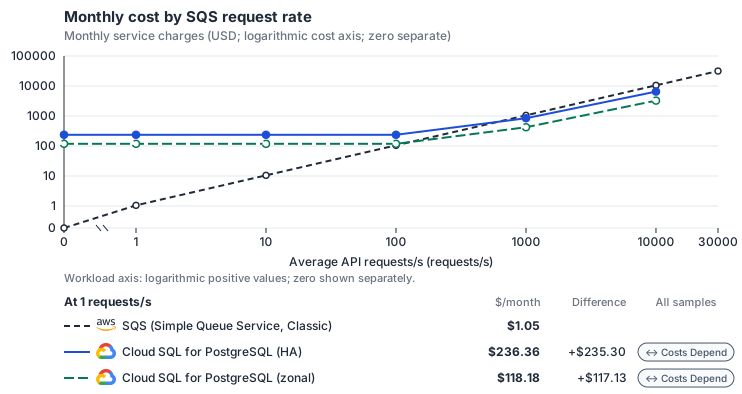
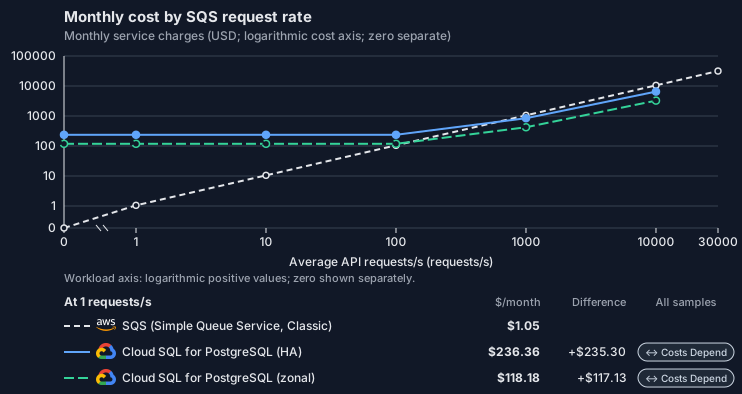
- 1 KiB messages; unbatched send, receive and delete requests in a 1:1:1 mix, with no empty receives or redeliveries. 730 hours/month; one billing unit per API request. Requested minima are 2 vCPU, 8 GiB memory and 100 GiB SSD, fully allocated. A versioned planning policy grows CPU, RAM and disk using 2x peak load, 70% utilization and explicit resident-data assumptions; it is not benchmark calibrated. Above the modeled configuration range, target price and savings are unavailable.
- Monthly AWS source usage in us-east-1, priced at the 2026-10-18 reference list rates before free allowances, discounts, credits and tax; not the uploaded invoice total. Rates as of 2026-10-18: us-east-1 → us-central1, USD/month.
- Source prices are reference charges, not an invoice. Target lines cover selected service usage/configuration only; adapter hosting and Tensor9 fees are excluded.
- Samples of explicit prices are not performance measurements or capacity qualification. No interpolation or break-even guarantee is implied.
- Variant assumptions show the first axis sample; any axis-dependent configuration is described by this curve’s workload note.
- 730 running hours per modeled month. Dedicated database compute and disk cost money even with zero origin traffic.
- Shared database allocation is a caller assumption. Do not sum a full database charge for every adapter sharing that database.
- Estimated allocation from planning assumptions; not benchmark calibrated. CPU, RAM and provisioned disk grow with the inferred workload and explicit peak/backlog assumptions.
- Average API requests, 64-KiB billing units, original messages and complete lifecycle work are distinct. One unbatched send/receive/delete cycle is one lifecycle, not three TPS.
- CPU tiers stop at 96 primary vCPUs; unsupported demand retains source cost but has no target cost, adapted total or savings. No sharding is inferred.
- Actual throughput, latency, connection limits, disk IOPS, claim contention, WAL and vacuum remain unqualified until comparable sustained benchmark samples exist.
- 150 full lifecycle equivalents per primary vCPU-second for a 1 KiB reference message (send, receive/claim and delete). Default 150 is a measured-by-tensor9 lower bound, not benchmark calibrated capacity: k6 offered 300 lifecycles/s to the SQS adapter on Cloud SQL db-custom-2-7680 (2 vCPU, PostgreSQL 16, us-west1) with short timestamp bodies and 299.93/s completed (src/main/kotlin/t9/prime/equiv/generated/eval/CloudsqlK6RoundtripR300T8K6V1_0_0.kt); database CPU was not recorded. These are modeled work units, not measured SQL transactions/s.
- Mean work uses original message arrivals × (2 + deliveries/message + 0.1 × empty receives/message) / 3, then scales by max(1, message bytes / 1024). Source batch fill was already used to infer original messages and is not applied again.
- Peak work is mean work × 2. Required primary CPU divides peak work by 150 lifecycle equivalents/vCPU-second × 0.7 target utilization.
- Resident data uses peak original arrivals × 60 residence seconds × 1024 message bytes × 3 physical storage multiplier. One binary GiB is 1073741824 bytes.
- Provisioned disk rounds (resident GiB + 20 GiB reserve) / 0.7 target disk utilization upward to whole GiB, retaining the caller minimum. Memory is the maximum of caller minimum, CPU × 4 GiB/vCPU and 0.1 of resident data, with a 0.9 GiB/vCPU floor and quarter-GiB upward rounding.
- CPU choices are 2, 4, 8, 16, 32, 64 and 96 primary vCPUs. CPU and memory promote jointly, with at most 6.5 GiB/vCPU, 624 GiB RAM and 65536 GiB disk.
- HA changes standby pricing and does not double primary throughput. Shared allocation changes the assigned cost and does not reduce required capacity.
- No benchmark sample calibrates this policy. Latency, IOPS, polling contention, WAL, vacuum and actual throughput require qualification. Demand beyond the listed configuration bounds is unpriced; this policy does not clamp, automatically shard or extrapolate capacity.
- Source usage is priced at reference rates; source lines are not actual invoice charges. Free or discounted usage still consumes target resources.
- AWS Standard SQS pricing: https://aws.amazon.com/sqs/pricing/
- Cloud SQL Enterprise PostgreSQL pricing: https://cloud.google.com/sql/pricing/
- Cloud SQL for PostgreSQL instance resource settings: https://docs.cloud.google.com/sql/docs/postgres/instance-settings
- Free allowances, negotiated discounts, credits, tax and one-time migration charges.
- Charges not listed in the breakdown, including additional network transfer, backups and encryption/KMS.
- Application compute changes, operational labor and portfolio-wide sharing or deduplication of infrastructure.
- SQS FIFO and fair queues; actual throughput/latency and resident-data behavior beyond the explicit planning assumptions.
sqs-cloudsql / 2026-10-18.4. Curve: request-rate.
Sources: AWS Standard SQS pricing, Cloud SQL Enterprise PostgreSQL pricing, Cloud SQL for PostgreSQL instance resource settings.
SQS → Cloud SQL planned scale-point benchmark
This is a benchmark plan, with historical reference observations retained separately. Planned cases are not completed measurements. The observations below do not calibrate the estimated allocation policy. Plan:sqs-cloudsql-scale-v1. Model: sqs-cloudsql. Workload: 1 KiB unbatched SQS send/receive/delete message cycles (sqs-1kib-unbatched-cycle).
dbEngineVersion, adapterVcpus, adapterMemoryGiB, adapterReplicas, loadGeneratorVcpus, loadGeneratorMemoryGiB, connectionPoolSize.
- cloudsql-zonal-2vcpu unresolved:
adapterVcpus,adapterMemoryGiB,adapterReplicas,loadGeneratorVcpus,loadGeneratorMemoryGiB,connectionPoolSize. - cloudsql-zonal-4vcpu unresolved:
adapterVcpus,adapterMemoryGiB,adapterReplicas,loadGeneratorVcpus,loadGeneratorMemoryGiB,connectionPoolSize. - cloudsql-zonal-8vcpu unresolved:
adapterVcpus,adapterMemoryGiB,adapterReplicas,loadGeneratorVcpus,loadGeneratorMemoryGiB,connectionPoolSize. - cloudsql-zonal-16vcpu unresolved:
adapterVcpus,adapterMemoryGiB,adapterReplicas,loadGeneratorVcpus,loadGeneratorMemoryGiB,connectionPoolSize.
-
historical-k6-roundtrip-r300-t8-1-0-0: source
src/main/kotlin/t9/prime/equiv/generated/eval/CloudsqlK6RoundtripR300T8K6V1_0_0.kt; case unmatched historical observation. Payload unknown bytes; batch fill send/receive/delete unknown/unknown/unknown; queues unknown; concurrency unknown. Operation mix: unknown. Latency scope: historical e2e metric; full send-through-delete timing is not established. Completed cycles unknown; error rate unknown; backlog start/end unknown/unknown; CPU/memory utilization unknown/unknown; p50/p99 24/140 ms; coordinated-omission correction true. The original generated EvalMeasurement is authoritative; metrics are projected from it without independently restating measured values. Tool-reported throughput does not identify offered, produced and sustained completed-message-cycle rates separately. Payload size, batch mix, queue count, concurrency, duration, completed count, errors, backlog, CPU/memory observations and HA are not established by this record. k6/Locust scripts used timestamp-string bodies rather than an exact 1 KiB payload; the OMB payload is also not established here. The source records storage as GB PD_SSD; tier memory is derived from db-custom MiB. Raw tuning is retained alongside the normalized allocation. -
historical-locust-roundtrip-t8-1-0-0: source
src/main/kotlin/t9/prime/equiv/generated/eval/CloudsqlLocustRoundtripT8LocustV1_0_0.kt; case unmatched historical observation. Payload unknown bytes; batch fill send/receive/delete unknown/unknown/unknown; queues unknown; concurrency unknown. Operation mix: unknown. Latency scope: historical e2e metric; full send-through-delete timing is not established. Completed cycles unknown; error rate unknown; backlog start/end unknown/unknown; CPU/memory utilization unknown/unknown; p50/p99 24/35 ms; coordinated-omission correction false. The original generated EvalMeasurement is authoritative; metrics are projected from it without independently restating measured values. Tool-reported throughput does not identify offered, produced and sustained completed-message-cycle rates separately. Payload size, batch mix, queue count, concurrency, duration, completed count, errors, backlog, CPU/memory observations and HA are not established by this record. k6/Locust scripts used timestamp-string bodies rather than an exact 1 KiB payload; the OMB payload is also not established here. The source records storage as GB PD_SSD; tier memory is derived from db-custom MiB. Raw tuning is retained alongside the normalized allocation. -
historical-omb-roundtrip-t2-1-0-0: source
src/main/kotlin/t9/prime/equiv/generated/eval/CloudsqlOmbRoundtripT2OmbV1_0_0.kt; case unmatched historical observation. Payload unknown bytes; batch fill send/receive/delete unknown/unknown/unknown; queues unknown; concurrency unknown. Operation mix: unknown. Latency scope: historical e2e metric; full send-through-delete timing is not established. Completed cycles unknown; error rate unknown; backlog start/end unknown/unknown; CPU/memory utilization unknown/unknown; p50/p99 13/83 ms; coordinated-omission correction true. The original generated EvalMeasurement is authoritative; metrics are projected from it without independently restating measured values. Tool-reported throughput does not identify offered, produced and sustained completed-message-cycle rates separately. Payload size, batch mix, queue count, concurrency, duration, completed count, errors, backlog, CPU/memory observations and HA are not established by this record. k6/Locust scripts used timestamp-string bodies rather than an exact 1 KiB payload; the OMB payload is also not established here. The source records storage as GB PD_SSD; tier memory is derived from db-custom MiB. Raw tuning is retained alongside the normalized allocation. - The 16 cases are planned experiments, each requiring three independent repetitions. No planned case has measured samples yet.
- Pin an adapter version before running a case. Completed-message-cycle throughput, p99 cycle latency, errors and backlog must be measured over 300 seconds after 60 seconds of warmup.
- Acceptance is authored: sustained completed cycles meet the offered rate, p99 ≤ 200 ms, error rate ≤ 0.001 and no backlog growth. This is not measured capacity evidence.
- Tail-latency qualification requires coordinated-omission-corrected measurements under the offered-load workload; correction alone never establishes completion or capacity.
- Historical k6, Locust and OMB observations are different workloads/tools at the same 2-vCPU allocation in us-west1. They are not hardware scaling points and are not averaged.
- Historical observations lack exact payload, HA, duration, completed-cycle counts, error/backlog and resource observations; none qualifies the sizing policy.
- The k6 observation completed its offered 300 cycles/s on 2 vCPU, so the sizing default of 150 lifecycles per vCPU-second is a lower bound. The planned cases must also record database CPU before a measured capacity can replace it.
- Adapter, load-generator and connection-pool allocations must be recorded before a case can qualify. Empty planned environment values are unresolved requirements, not defaults.
- Free allowances, negotiated discounts, credits, tax and one-time migration charges.
- Charges not listed in the breakdown, including additional network transfer, backups and encryption/KMS.
- Application compute changes, operational labor and portfolio-wide sharing or deduplication of infrastructure.
- SQS FIFO and fair queues; actual throughput/latency and resident-data behavior beyond the explicit planning assumptions.
- Inferred original messages: 100,000,000 messages/month.
- Estimated mean lifecycle-equivalent work: 38.05 1-KiB lifecycles/second.
- Estimated peak lifecycle-equivalent work: 76.1 1-KiB lifecycles/second.
- Estimated resident physical queue data: 0.0131 GiB.
- 730 running hours per modeled month. Dedicated database compute and disk cost money even with zero origin traffic.
- Shared database allocation is a caller assumption. Do not sum a full database charge for every adapter sharing that database.
- Estimated allocation from planning assumptions; not benchmark calibrated. CPU, RAM and provisioned disk grow with the inferred workload and explicit peak/backlog assumptions.
- Average API requests, 64-KiB billing units, original messages and complete lifecycle work are distinct. One unbatched send/receive/delete cycle is one lifecycle, not three TPS.
- CPU tiers stop at 96 primary vCPUs; unsupported demand retains source cost but has no target cost, adapted total or savings. No sharding is inferred.
- Actual throughput, latency, connection limits, disk IOPS, claim contention, WAL and vacuum remain unqualified until comparable sustained benchmark samples exist.
- 150 full lifecycle equivalents per primary vCPU-second for a 1 KiB reference message (send, receive/claim and delete). Default 150 is a measured-by-tensor9 lower bound, not benchmark calibrated capacity: k6 offered 300 lifecycles/s to the SQS adapter on Cloud SQL db-custom-2-7680 (2 vCPU, PostgreSQL 16, us-west1) with short timestamp bodies and 299.93/s completed (src/main/kotlin/t9/prime/equiv/generated/eval/CloudsqlK6RoundtripR300T8K6V1_0_0.kt); database CPU was not recorded. These are modeled work units, not measured SQL transactions/s.
- Mean work uses original message arrivals × (2 + deliveries/message + 0.1 × empty receives/message) / 3, then scales by max(1, message bytes / 1024). Source batch fill was already used to infer original messages and is not applied again.
- Peak work is mean work × 2. Required primary CPU divides peak work by 150 lifecycle equivalents/vCPU-second × 0.7 target utilization.
- Resident data uses peak original arrivals × 60 residence seconds × 1024 message bytes × 3 physical storage multiplier. One binary GiB is 1073741824 bytes.
- Provisioned disk rounds (resident GiB + 20 GiB reserve) / 0.7 target disk utilization upward to whole GiB, retaining the caller minimum. Memory is the maximum of caller minimum, CPU × 4 GiB/vCPU and 0.1 of resident data, with a 0.9 GiB/vCPU floor and quarter-GiB upward rounding.
- CPU choices are 2, 4, 8, 16, 32, 64 and 96 primary vCPUs. CPU and memory promote jointly, with at most 6.5 GiB/vCPU, 624 GiB RAM and 65536 GiB disk.
- HA changes standby pricing and does not double primary throughput. Shared allocation changes the assigned cost and does not reduce required capacity.
- No benchmark sample calibrates this policy. Latency, IOPS, polling contention, WAL, vacuum and actual throughput require qualification. Demand beyond the listed configuration bounds is unpriced; this policy does not clamp, automatically shard or extrapolate capacity.
sqs-cloudsql / 2026-10-18.4. Scenario: sqs-cloudsql-reference.
Sources: AWS Standard SQS pricing, Cloud SQL Enterprise PostgreSQL pricing, Cloud SQL for PostgreSQL instance resource settings.
On OCI
OCI Queue
How it works
Tensor9 adds an adapter process to your application pod in OCI and setsAWS_ENDPOINT_URL_SQS to its local address. Your application keeps its SendMessage and ReceiveMessage calls. The adapter performs them on OCI Queue and returns SQS responses, error codes and MD5 checksums.
Each declared standard SQS queue becomes an OCI queue in the customer’s compartment. SendMessage puts a message, ReceiveMessage gets one with a receipt, and DeleteMessage deletes it using that receipt. OCI Queue keeps the messages, receipts, delivery counts and visibility deadlines, so the adapter keeps nothing that must survive a restart. FIFO queues need a different backend, because OCI Queue has no group ordering or deduplication.


Your application keeps its SQS SDK; the adapter turns each call into OCI Queue operations.
Architecture
Because receipts live in OCI Queue, receipt handles stay usable across calls, adapter processes and restarts, and you can run several adapter instances without them sharing state. The adapter signs in with the customer’s OCI workload identity, with no stored credential. Oracle operates queue durability, backups, replication and availability; Tensor9 operates the adapter. At deployment, Tensor9 creates one OCI queue per declared SQS queue in the customer’s compartment, named after it. The queue’s visibility timeout is the declared SQS default; both services default to 30 seconds. Retention is kept up to OCI Queue’s 7-day maximum, andmaxReceiveCount sets the dead-letter delivery-count threshold. OCI Queue applies these settings and tracks queued and in-flight messages.


Each SQS queue is one OCI queue in the customer’s compartment; OCI Queue keeps receipts, receive counts and visibility deadlines.
Receiving messages
ReceiveMessage long-polls. WaitTimeSeconds, at most 20 as in SQS, becomes OCI Queue’s long-poll timeout, which allows up to 30 seconds, so every SQS wait value works unchanged. Each receive gets up to 10 messages, the SQS limit, although OCI Queue itself allows 20. A per-receive VisibilityTimeout is passed to OCI Queue, which applies it when it hands the message out.
The OCI receipt becomes the SQS receipt handle. ApproximateReceiveCount is OCI Queue’s delivery count, starting at 1 and increasing on each redelivery. The adapter rebuilds the body and attributes and recomputes MD5 checksums so your SDK can verify them. Delivery is at least once with best-effort ordering. Single sends use one put; batch sends use a multi-message put with a result for each entry. Deletion uses the receipt. Use OCI monitoring to measure latency and throughput.


A receive returns OCI Queue’s own receipt and delivery count; there is no lock to renew. ApproximateReceiveCount counts from 1.
Receipt handles & visibility
The receipt handle contains OCI Queue’s receipt token. Deletes and visibility updates use it across calls, connections and adapter restarts. A receipt replaced by a later receive, or belonging to a message already deleted, succeeds without doing anything. Malformed handles and handles for another queue returnReceiptHandleIsInvalid.
The visibility timeout is OCI Queue’s per-message visibility. The queue’s default is set on the OCI queue, and OCI Queue’s 30-second default equals SQS’s, so a queue with no setting behaves the same. A per-receive VisibilityTimeout travels with the receive, and ChangeMessageVisibility becomes an OCI update of the message’s visibility. A zero-second change makes the message available to receive again immediately. SQS’s 12-hour maximum equals OCI Queue’s, so every SQS value works. If a consumer’s message was delivered again to someone else, its old receipt is outdated and its update does nothing, rather than affecting the other consumer’s delivery.


Receipt handles keep working across adapter restarts. The 30-second visibility default and 12-hour maximum match SQS.
Dead-letter & retention
maxReceiveCount sets the queue’s delivery-count threshold. When a message’s count exceeds it, OCI Queue moves the message to the queue’s built-in dead-letter queue; the adapter does not copy or delete anything. The threshold is kept, but the destination is always that built-in queue: the dead-letter target named in your redrive policy is dropped. If the build cannot read maxReceiveCount as a literal, no threshold is set and the build reports it.
When Tensor9 provisions the queue, it sets the four-day retention default (345600 seconds) explicitly if none is declared. A declared value above OCI’s seven-day maximum (604800 seconds) is capped at seven days, with a warning, so a queue declared with SQS’s 14-day retention expires messages a week earlier. This applies when the queue is provisioned, not to a later SetQueueAttributes request.


OCI Queue moves a message to its built-in dead-letter queue after maxReceiveCount deliveries. Retention above 7 days is capped, with a warning.
Limitations
Where SQS and OCI Queue differ- FIFO queues are not supported. OCI Queue has no ordering, sessions or deduplication, so a
.fifoqueue is placed on a backend that supports ordering when the deployment is built. Any.fiforequest that still reaches this backend (a pre-declared queue or a URL from elsewhere) is rejected on send, receive, create and purge. - Messages larger than 128 KB are not supported. OCI Queue caps a message at
131072bytes, against SQS’s 1 MiB. An oversize send is rejected withInvalidParameterValuenaming the size and the limit, never truncated. Shrink large payloads, or store the body in OCI Object Storage and send a reference to it. - Retention longer than 7 days is not supported. Retention is kept exactly up to OCI Queue’s 7-day maximum (
604800); a longer value is capped, so a 14-day SQS queue’s messages expire up to a week earlier. The 4-day default (345600) is set explicitly. - Dead-lettering behaves differently.
maxReceiveCountis kept exactly, but OCI Queue always moves the message to the queue’s own built-in dead-letter queue, not to the queue or ARN your redrive policy names. - Queue-level delay is not supported. A positive
delay_secondsis dropped with a warning when the queue is created, because OCI Queue has no such setting. Review delayed-delivery needs before choosing this backend. - Queue policies and customer-managed encryption keys are not kept. An SQS queue policy is removed, with a warning; access is controlled by IAM policies at compartment scope. A
kms_master_key_idis not applied, also with a warning. - You must give each queue a literal name. The OCI queue is named from the SQS queue name, so a computed name or a
name_prefixstops the build with an error. - Queue changes behave differently.
ListQueuesreturns the declared set, and requests that would reconfigure a queue away from its declared settings return an error.SendMessageBatchandDeleteMessageBatchuse OCI multi-message operations with a result per entry, andApproximateNumberOfMessagesandApproximateNumberOfMessagesNotVisiblecome from OCI Queue’s visible and in-flight counts.
Other considerations
- Moving from AWS. The OCI queue starts empty, so messages still in SQS stay on AWS. Switch over once the SQS queue is drained, or send to both until it is.
- Before going live. Queue names, visibility and dead-letter thresholds are kept. Review queues that use SQS’s 14-day retention or messages above 128 KB, which OCI Queue cannot hold.
- Who operates what. Oracle operates OCI Queue durability, backup, replication and availability; Tensor9 operates the adapter, which reaches OCI Queue with the customer’s workload identity.
- Cost. Estimate from your send, receive and delete rates and message volume.
Example monthly charges
This Tensor9 Cloud Adapter scenario estimates service charges for the named origin and target services. Adapter hosting and commercial Tensor9 fees need separate allocations. How Tensor9 estimates costs explains the method and what the estimates include.SQS Standard · SQS request billing units
Feature: SQS Standard. Estimated monthly service charges by SQS request billing units. Adapter hosting and Tensor9 fees are excluded. Source: us-east-1; target: us-ashburn-1 (OCI global price list); currency: USD.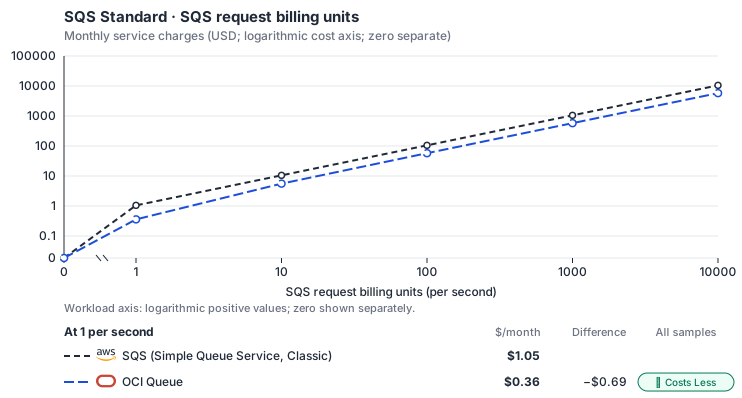
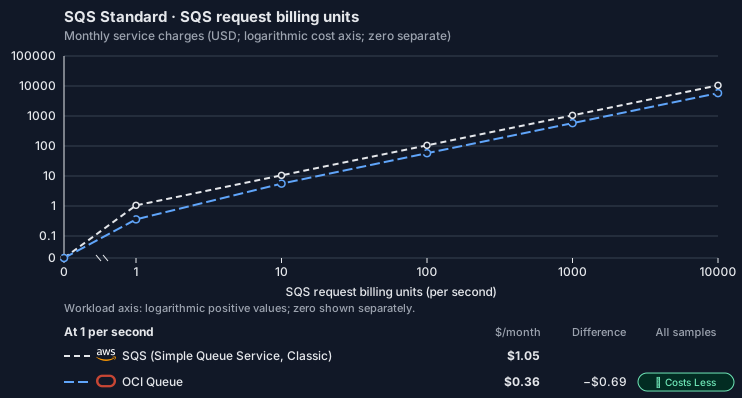
- 1-KiB messages, unbatched send/receive/delete; actual batch and delivery assumptions stay visible. Other native meters and workload assumptions retain their explicitly displayed default quantities. Workload translation and capacity assumptions are not benchmark measurements.
- Native monthly usage priced at the cited provider list prices; listed target allowances apply where present, excluding invoice credits, taxes and negotiated discounts. Rates as of 2026-10-22: us-east-1 → us-ashburn-1 (OCI global price list), USD/month.
- Source prices are reference charges, not an invoice. Target lines cover selected service usage/configuration only; adapter hosting and Tensor9 fees are excluded.
- Samples of explicit prices are not performance measurements or capacity qualification. No interpolation or break-even guarantee is implied.
- Variant assumptions show the first axis sample; any axis-dependent configuration is described by this curve’s workload note.
- Rates are cited provider list prices, editable for discounts, commitments or another region. Workload translation and capacity coefficients remain editable planning assumptions, not benchmark measurements or a commercial quote.
- Default-zero rates are explicit assumptions, not evidence that the deployed service or resource is free.
- Provisioned-unit minimums use an editable approximate allocation floor. Modeled target service cost is max(usage/allocation, minimum), with billable network, durable staging and dependent sinks added separately; actual RU/TU sizing, scaling increments and throughput remain unqualified.
- Durable staging is priced once: provisioned targets include adapter state in their selected allocation; native targets add a separate staging allocation when required. Adapter hosting is a separate allocation and must exclude resources already priced as staging, workers or target capacity.
- A declared adapter mapping and cost model do not establish implementation availability or service equivalence.
- This is a declared directed mapping; a planning estimate does not establish deployment or request-serving support.
- Authored planning assumptions, not measured adapter capacity. Origin rates are cited first-tier list prices, before free allowances and discounts.
- A cost scenario does not establish backend availability, protocol fidelity or production readiness. Registry serving status remains independent.
- Storage follows resident original messages, not every monthly message. Broker delivery bytes include redeliveries.
- FIFO estimates do not qualify dedup support, group throughput or single-group latency; backend limitations remain applicable.
- OCI Queue bills requests after the first million each month; the price list counts each request as 64 KB, so larger messages or batches count as several requests, which the family’s call counts do not multiply. Queue has no storage or retention charge.
- AWS Price List API, AWSQueueService offer: https://pricing.us-east-1.amazonaws.com/offers/v1.0/aws/AWSQueueService/current/us-east-1/index.json
- OCI price list API: https://apexapps.oracle.com/pls/apex/cetools/api/v1/products/
- Additional network transfer, backups, KMS, one-time migration and operational labor unless an explicit meter includes them.
- Destination application execution and separately billed downstream services; supply those allocations separately.
- Taxes, discounts, credits and free-tier allowances not explicitly listed by this model.
- Unmodeled dependent services, task execution and operations outside the selected workload family.
plan-15dc11b20607d1fce76620d26b1597e97614129d / 2026-10-22.planning.2. Curve: workload-1.
Sources: AWS Price List API, AWSQueueService offer, OCI price list API.
SQS Standard → OCI Queue: Authored native-usage planning example. Native monthly usage priced at the cited provider list prices; listed target allowances apply where present, excluding invoice credits, taxes and negotiated discounts.
Scenario source region: us-east-1. Scenario target region: us-ashburn-1 (OCI global price list). Currency: USD.
- Additional network transfer, backups, KMS, one-time migration and operational labor unless an explicit meter includes them.
- Destination application execution and separately billed downstream services; supply those allocations separately.
- Taxes, discounts, credits and free-tier allowances not explicitly listed by this model.
- Unmodeled dependent services, task execution and operations outside the selected workload family.
- Translated reads: 0 operations.
- Translated writes: 0 operations.
- Translated resident physical data: 0 GiB-month.
- Native provider operations: 0 operations.
- Published payload: 0 GiB.
- Delivered payload: 0 GiB.
- Allocated execution CPU: 0 vCPU-hour.
- Allocated execution RAM: 0 GiB-hour.
- Independent resource allocation: 0 resource-hour.
- Independent inventory: 0 resource-month.
- Input tokens: 0 tokens.
- Output tokens: 0 tokens.
- Billable network: 0 GiB.
- Dependent object sink retained data: 0 GiB-month.
- Dependent object sink writes: 0 writes.
- Rates are cited provider list prices, editable for discounts, commitments or another region. Workload translation and capacity coefficients remain editable planning assumptions, not benchmark measurements or a commercial quote.
- Default-zero rates are explicit assumptions, not evidence that the deployed service or resource is free.
- Provisioned-unit minimums use an editable approximate allocation floor. Modeled target service cost is max(usage/allocation, minimum), with billable network, durable staging and dependent sinks added separately; actual RU/TU sizing, scaling increments and throughput remain unqualified.
- Durable staging is priced once: provisioned targets include adapter state in their selected allocation; native targets add a separate staging allocation when required. Adapter hosting is a separate allocation and must exclude resources already priced as staging, workers or target capacity.
- A declared adapter mapping and cost model do not establish implementation availability or service equivalence.
- This is a declared directed mapping; a planning estimate does not establish deployment or request-serving support.
- Authored planning assumptions, not measured adapter capacity. Origin rates are cited first-tier list prices, before free allowances and discounts.
- A cost scenario does not establish backend availability, protocol fidelity or production readiness. Registry serving status remains independent.
- Storage follows resident original messages, not every monthly message. Broker delivery bytes include redeliveries.
- FIFO estimates do not qualify dedup support, group throughput or single-group latency; backend limitations remain applicable.
- OCI Queue bills requests after the first million each month; the price list counts each request as 64 KB, so larger messages or batches count as several requests, which the family’s call counts do not multiply. Queue has no storage or retention charge.
plan-15dc11b20607d1fce76620d26b1597e97614129d / 2026-10-22.planning.2. Scenario: planning-example.
Sources: AWS Price List API, AWSQueueService offer, OCI price list API.
On Scaleway
Scaleway Queues (SQS-compatible)
How it works
Your application keeps its SQS client for the supported standard-queue operations. Scaleway Queues offers an SQS-compatible API: the Tensor9 adapter checks the supported request parameters, signs each request with Scaleway credentials and forwards it to the Scaleway queue. Scaleway operates queue storage and delivery. The adapter’s checks and signing are still in the request path, and sharing the protocol does not mean latency, quotas or features are identical. Check that the queue’s retention and message-size limits meet your needs.Limitations
- Delayed messages are not supported. A provider check on 2026-08-17 found that Scaleway accepted
DelaySecondsbut made the message receivable at once, so the adapter rejects delayed sends. A producer that uses delay for retries or scheduled work needs a different queue or scheduling design. - Per-receive visibility timeouts are not supported. The queue-level visibility timeout works, but a receive-time override does not. -ChangeMessageVisibilitybehaves differently: it accepts only zero or the queue’s current timeout. Zero releases the message; extending one message’s timeout is not possible. Review workers whose processing time varies or that extend visibility while running. - FIFO queues, message system attributes, queue access policies, server-side encryption attributes and tags are not supported. This mapping covers standard queues only. -RedriveAllowPolicyis not supported. Dead-letter queues themselves work. - Attribute reads behave differently: unsupported fields return an error. A read that asks for an unsupported attribute fails instead of returning the full AWS attribute set.
Other considerations
Before switching producers. Create the new queue and test your workers’ requests. The existing SQS backlog does not move; drain it or coordinate dual writes so no work is stranded. Networking. Make sure your workloads can reach the Scaleway endpoint; this mapping does not set up a private Scaleway VPC endpoint. Workers. Long polling and handling duplicates on standard queues remain part of your worker design.Example monthly charges
This Tensor9 Cloud Adapter scenario estimates service charges for the named origin and target services. Adapter hosting and commercial Tensor9 fees need separate allocations. How Tensor9 estimates costs explains the method and what the estimates include.SQS Standard · SQS request billing units
Feature: SQS Standard. Estimated monthly service charges by SQS request billing units. Adapter hosting and Tensor9 fees are excluded. Source: us-east-1; target: fr-par; currency: USD.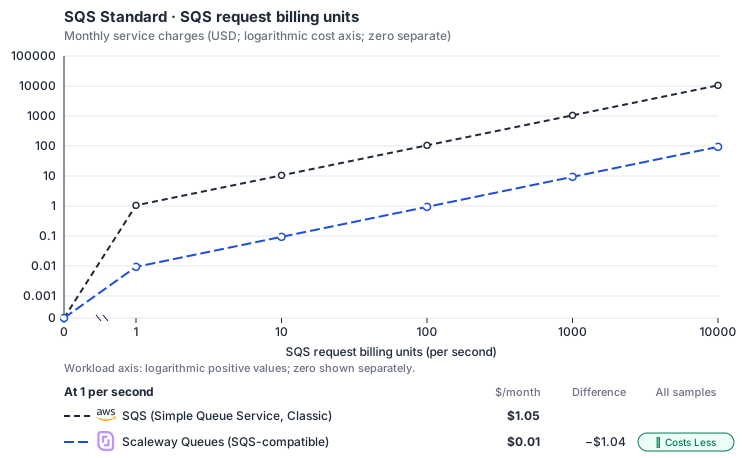
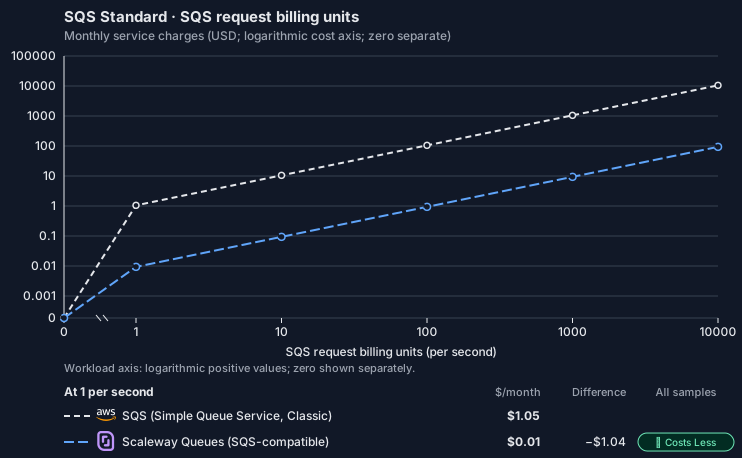
- 1-KiB messages, unbatched send/receive/delete; actual batch and delivery assumptions stay visible. Other native meters and workload assumptions retain their explicitly displayed default quantities. Workload translation and capacity assumptions are not benchmark measurements.
- Native monthly usage priced at the cited provider list prices; listed target allowances apply where present, excluding invoice credits, taxes and negotiated discounts. Rates as of 2026-10-22: us-east-1 → fr-par, USD/month.
- Source prices are reference charges, not an invoice. Target lines cover selected service usage/configuration only; adapter hosting and Tensor9 fees are excluded.
- Samples of explicit prices are not performance measurements or capacity qualification. No interpolation or break-even guarantee is implied.
- Variant assumptions show the first axis sample; any axis-dependent configuration is described by this curve’s workload note.
- Rates are cited provider list prices, editable for discounts, commitments or another region. Workload translation and capacity coefficients remain editable planning assumptions, not benchmark measurements or a commercial quote.
- Default-zero rates are explicit assumptions, not evidence that the deployed service or resource is free.
- Provisioned-unit minimums use an editable approximate allocation floor. Modeled target service cost is max(usage/allocation, minimum), with billable network, durable staging and dependent sinks added separately; actual RU/TU sizing, scaling increments and throughput remain unqualified.
- Durable staging is priced once: provisioned targets include adapter state in their selected allocation; native targets add a separate staging allocation when required. Adapter hosting is a separate allocation and must exclude resources already priced as staging, workers or target capacity.
- A declared adapter mapping and cost model do not establish implementation availability or service equivalence.
- This is a declared directed mapping; a planning estimate does not establish deployment or request-serving support.
- Authored planning assumptions, not measured adapter capacity. Origin rates are cited first-tier list prices, before free allowances and discounts.
- A cost scenario does not establish backend availability, protocol fidelity or production readiness. Registry serving status remains independent.
- Storage follows resident original messages, not every monthly message. Broker delivery bytes include redeliveries.
- FIFO estimates do not qualify dedup support, group throughput or single-group latency; backend limitations remain applicable.
- Scaleway Queues bills the volume of messages travelling through queues, not requests or storage (https://www.scaleway.com/en/docs/queues/faq/). Scaleway bills published bytes; it does not say whether a received message counts again, so delivered bytes are not charged.
- AWS Price List API, AWSQueueService offer: https://pricing.us-east-1.amazonaws.com/offers/v1.0/aws/AWSQueueService/current/us-east-1/index.json
- Scaleway public product catalog: https://api.scaleway.com/product-catalog/v2alpha1/public-catalog/products
- Additional network transfer, backups, KMS, one-time migration and operational labor unless an explicit meter includes them.
- Destination application execution and separately billed downstream services; supply those allocations separately.
- Taxes, discounts, credits and free-tier allowances not explicitly listed by this model.
- Unmodeled dependent services, task execution and operations outside the selected workload family.
plan-63b489f0a3bfc0d52f4664f3bf3e716a4311cb75 / 2026-10-22.planning.2. Curve: workload-1.
Sources: AWS Price List API, AWSQueueService offer, Scaleway public product catalog.
SQS Standard → Scaleway Queues (SQS-compatible): Authored native-usage planning example. Native monthly usage priced at the cited provider list prices; listed target allowances apply where present, excluding invoice credits, taxes and negotiated discounts.
Scenario source region: us-east-1. Scenario target region: fr-par. Currency: USD.
- Additional network transfer, backups, KMS, one-time migration and operational labor unless an explicit meter includes them.
- Destination application execution and separately billed downstream services; supply those allocations separately.
- Taxes, discounts, credits and free-tier allowances not explicitly listed by this model.
- Unmodeled dependent services, task execution and operations outside the selected workload family.
- Translated reads: 0 operations.
- Translated writes: 0 operations.
- Translated resident physical data: 0 GiB-month.
- Native provider operations: 0 operations.
- Published payload: 0 GiB.
- Delivered payload: 0 GiB.
- Allocated execution CPU: 0 vCPU-hour.
- Allocated execution RAM: 0 GiB-hour.
- Independent resource allocation: 0 resource-hour.
- Independent inventory: 0 resource-month.
- Input tokens: 0 tokens.
- Output tokens: 0 tokens.
- Billable network: 0 GiB.
- Dependent object sink retained data: 0 GiB-month.
- Dependent object sink writes: 0 writes.
- Rates are cited provider list prices, editable for discounts, commitments or another region. Workload translation and capacity coefficients remain editable planning assumptions, not benchmark measurements or a commercial quote.
- Default-zero rates are explicit assumptions, not evidence that the deployed service or resource is free.
- Provisioned-unit minimums use an editable approximate allocation floor. Modeled target service cost is max(usage/allocation, minimum), with billable network, durable staging and dependent sinks added separately; actual RU/TU sizing, scaling increments and throughput remain unqualified.
- Durable staging is priced once: provisioned targets include adapter state in their selected allocation; native targets add a separate staging allocation when required. Adapter hosting is a separate allocation and must exclude resources already priced as staging, workers or target capacity.
- A declared adapter mapping and cost model do not establish implementation availability or service equivalence.
- This is a declared directed mapping; a planning estimate does not establish deployment or request-serving support.
- Authored planning assumptions, not measured adapter capacity. Origin rates are cited first-tier list prices, before free allowances and discounts.
- A cost scenario does not establish backend availability, protocol fidelity or production readiness. Registry serving status remains independent.
- Storage follows resident original messages, not every monthly message. Broker delivery bytes include redeliveries.
- FIFO estimates do not qualify dedup support, group throughput or single-group latency; backend limitations remain applicable.
- Scaleway Queues bills the volume of messages travelling through queues, not requests or storage (https://www.scaleway.com/en/docs/queues/faq/). Scaleway bills published bytes; it does not say whether a received message counts again, so delivered bytes are not charged.
plan-63b489f0a3bfc0d52f4664f3bf3e716a4311cb75 / 2026-10-22.planning.2. Scenario: planning-example.
Sources: AWS Price List API, AWSQueueService offer, Scaleway public product catalog.
Scaleway Managed Database for PostgreSQL
PostgreSQL hosting
Scaleway operates the managed PostgreSQL instance outside the customer’s Kubernetes cluster. Tensor9 operates the adapter and queue schema. Queue data survives a Kubernetes cluster rebuild; configure the managed database credentials for the adapter. Tensor9 operates the queue schema and adapter. Queues start empty; existing SQS messages are not migrated. Drain the source or coordinate dual writes before cutover.Persistent queue management and total cost
Cloud Adapter retains a persistent PostgreSQL store for the queue catalog, tenancy and lifecycle/control state, normally shared with the Cloud Adapter deployment. Native broker or Cosmos message storage does not remove this resource. Include its allocated compute, storage, backups and selected HA costs alongside adapter and message-backend charges; an idle or serverless message backend does not imply a zero total installation floor. Backend-only curves omit these shared allocations unless their assumptions explicitly include them. This control store is distinct from the SQS-owned message database. PostgreSQL-authority FIFO composites add recoverable message bodies, receipts, deduplication and outbox state to an explicitly configured SQS message database; they do not store messages in the shared control catalog. A separate logical database and login provide data/permission separation, but still share server CPU, storage, IOPS, WAL and connection limits when hosted on the same instance. Dedicated physical server/instance capacity is a separate allocation and cost decision.Database placement and recovery
Scaleway’s managed PostgreSQL database keeps the queues outside the application cluster. Scaleway operates the server; configure the adapter’s database credentials and network access. Database capacity, availability and backups follow the selected managed instance configuration, rather than the application cluster’s lifecycle.Capacity and queue workload
The default shared message database holds multiple queues, each with its own table. Dedicated physical server/instance capacity isolates compute and I/O from other server workloads; a separate logical database alone does not. HA changes recovery, commit latency and price rather than FIFO semantics. Neither choice creates an unlimited queue service. Size connection pools, storage, IOPS and WAL for accepted sends, receives, deletes, visibility changes, retries and cleanup together. Long polls wait outside database transactions. Classic queues have no application-visible group ordering. Concurrent receivers claim different visible rows, but a slow consumer may continue processing an earlier copy after its visibility expires. Use idempotent consumer effects and include empty polls and redelivery in database load estimates. Requested live counts scan the message population even for a single requested counter. Frequent depth polling over a large backlog competes for database I/O and pool capacity; receipt classification can change index/heap work. Price those queries separately from sends and completed message cycles. A fall in depth can reflect purge, expiry or dead-letter transfer rather than application completion. The portable Standard-queue benchmark does not establish the capacity of this host, its HA configuration or a FIFO workload. Payload sizes, active-group skew, settlement time, backlog growth and matched native measurements determine whether a proposed size fits. Missing measurements leave capacity unknown.Retries, batches and application changes
The application keeps its SQS SDK and uses the adapter’s configured endpoint and authentication. Backend IAM, database schema permissions and TLS identity belong to the deployment; an AWS ARN or policy is not automatically a target-cloud authorization grant. Scope identities to the customer resources and keep rotated credentials out of message bodies and receipt handles. A batch response reports each entry separately. Retry only failed entries whose outcome is known; a request timeout can follow a committed send or delete. A retried Classic send without deduplication can create another message. Duplicate enqueue suppression does not make consumer side effects exactly once. SDK retries and adapter retries share one bounded deadline, with backoff for provider throttling. An expired observer deadline does not prove a still-running native operation was cancelled. Visibility expiration permits another delivery while an earlier worker can still be executing. Consumers use idempotent writes, choose a visibility duration that covers normal processing and handle stale receipt errors. Retention can expire a message in flight. Queues start empty: drain the source before cutover or coordinate duplicate-safe dual writes. Queue recreation and purge must invalidate old claims independently of public names; data cleanup can continue after logical retirement. Database or broker backup is a resource recovery mechanism, not an automatic replay of application side effects.PostgreSQL queue behavior
Your application keeps its SQS SDK and uses the authenticated Cloud Adapter endpoint configured for the install. The adapter performsSendMessage and ReceiveMessage in the SQS-owned PostgreSQL message database and returns SQS responses, error codes and MD5 checksums. Its message-data login is separate from other services and the shared control catalog.
Each queue is a PostgreSQL table with one row per message. Sending, receiving, deleting, delays, visibility, dead-letter delivery and message counts all work on those rows. Standard queues provide at-least-once delivery with best-effort ordering.
The application keeps its SQS SDK. The adapter stores each queue in a PostgreSQL table.
Architecture
The adapter keeps all queue state in PostgreSQL, including messages and receipt handles, so adapter instances can restart or scale out without losing track of in-flight messages. On Cloud SQL and Azure Flexible Server it signs in with short-lived Cloud SQL IAM or Microsoft Entra tokens used as database passwords, so no static secret is stored. When the stack is deployed, Tensor9 creates one database per Cloud Adapter deployment and one table per declared queue. Each row holds the message body and attributes, its message group, its visibility time, its receipt handle, its receive count and the time it was sent. A Standard queue hands out messages in arrival order, with best-effort ordering under concurrent traffic. A dead-letter queue is another queue table, and a background task deletes messages older than the queue’s retention period. CloudNativePG, Cloud SQL for PostgreSQL, Azure Flexible Server and Scaleway use the same adapter code and tables. They differ in where the data lives: the managed servers run outside your Kubernetes cluster, while CloudNativePG runs inside it. See the rebuild limitation below.Each queue, including each dead-letter queue, is a PostgreSQL table. The same adapter runs on every supported PostgreSQL host.
Receiving messages
One database step selects messages whose visibility timeout has passed, oldest first, up to the requested batch size. In the same step it gives each a new receipt handle, hides it for the visibility timeout, adds one to its receive count and returns it. Messages another receiver is taking at that moment are skipped. Standard queues provide best-effort ordering. When the visibility timeout passes, the message can be delivered again; that does not stop a worker still processing the earlier copy.ApproximateReceiveCount is the actual number of receives, not an estimate. The MD5 checksums of the body and attributes are recomputed, so your SDK’s checks pass. DelaySeconds sets when a message first becomes visible. Long polling waits up to WaitTimeSeconds (at most 20 seconds) and returns as soon as a message is available. SendMessageBatch inserts all entries at once and reports a result for each entry. Message bodies are stored in the queue table.
Two receivers never get the same message at the same time. ApproximateReceiveCount is the actual receive count.
Receipt handles & visibility
Each receive saves a new receipt handle with the message.DeleteMessage and ChangeMessageVisibility find the message by that handle, including after an adapter restart or through another adapter instance.
A delete or visibility change whose handle matches no message returns ReceiptHandleIsInvalid. That includes a message already deleted, or received again under a newer handle. The visibility timeout defaults to 30 seconds. ChangeMessageVisibility can extend it with no lock-duration maximum, and zero makes the message available again immediately. Retention can delete a message while it is in flight.
Receipt handles are saved with messages, so they still work after an adapter restart. Visibility has no lock-duration limit.
Dead-letter & retention
When source and DLQ belong to the same supported SQS-owned message database transaction, receive moves messages atmaxReceiveCount atomically with claiming the rest. Both changes commit or neither does. Cross-database/store transfers are unsupported: sharing a provider, physical server or control log is not a shared message transaction, and no other service’s tables are used. The DLQ retains ordinary queue operations and cleanup. A moved message keeps its MessageId and SentTimestamp, gains DeadLetterQueueSourceArn, and its ApproximateReceiveCount keeps counting receives on both queues. A redrive policy on the DLQ itself counts only receives on the DLQ, and the DLQ’s retention runs from the original send time.
A background task deletes messages sent longer ago than the queue’s retention period, including messages in flight; receiving does not reset that time. The retention period defaults to four days and is kept between 60 seconds and 14 days, so a missing or too-short value cannot delete new messages straight away. One worker per database removes expired messages in batches, pauses during database maintenance, and continues if one queue fails. Limits on rows per pass and time per batch cap the load.
Atomic DLQ moves require the same supported SQS-owned database transaction. Cross-store moves are unsupported. Retention cleanup removes aged messages.
FIFO queues
For strict per-message-group ordering and five-minute duplicate-send suppression, use SQS FIFO. Standard queues provide at-least-once delivery with best-effort ordering.Limitations
Where SQS and the PostgreSQL adapter differ- Throughput behaves differently: one PostgreSQL server serves every queue. All of a Cloud Adapter deployment’s queues share one server, so its capacity bounds peak throughput and a heavy queue can affect the others. In Tensor9’s round-trip test of a moderate-rate Standard queue, the adapter matched SQS throughput (about 300 vs 286 ops/s) with a lower p99 (140 ms vs 172 ms) but a slower median (p50 24 ms vs 15 ms). That is not a measured ceiling, and it does not cover FIFO queues or every host.
- Recovery follows the database placement. The managed database is outside the Cloud Adapter deployment cluster, so replacing that cluster does not replace the queue data. Database availability and recovery still depend on the selected server, HA and backup configuration.
- Messages are limited to 256 KiB by default. The adapter’s default limit is 262144 bytes, while native SQS now accepts up to 1 MiB. Sends are checked against the queue’s declared limit.
- Stale receipt handles behave differently: they return an error.
DeleteMessageandChangeMessageVisibilityreturnReceiptHandleIsInvalidwhen no message matches the handle. - Retention behaves differently: expired messages are removed periodically. An expired message can remain until the next cleanup pass. Retention is kept between 60 seconds and 14 days; a too-short value is raised to 60 seconds so that new messages are not deleted.
- Counts observe queue state, not application completion. Requested message counts read the message database: eligible messages are visible, future-visible messages with a receipt are in flight, and future-visible messages without a receipt are initially delayed. These categories share one query snapshot and can change immediately afterward. Metadata-only reads do not require a message-table count. An unavailable requested count returns an explicit unsupported result rather than zero. Purge, expiry and dead-letter movement can reduce depth without completing the application’s work.
- Queue creation behaves differently: queues are created when the stack is deployed. Tensor9 creates the database and each queue’s table, and its dead-letter table, at deploy time.
CreateQueue,DeleteQueueandSetQueueAttributesact on those tables. Switching a queue between Standard and FIFO is rejected, because it would replace the queue.
Other considerations
- Moving from AWS. The database and queue tables start empty, and existing SQS messages are not migrated. Drain the source queue, or write to both queues during the transition.
- Removing queues. Each queue is created in one step, so a crash never leaves a half-created queue. When a queue is removed from the stack, Tensor9 deletes only queues it created; any other queue is detached and left in place. A queue that still holds messages is not deleted unless deletion is forced.
- Who operates what. On the managed hosts, the provider operates the database’s durability, backups and high availability, and Tensor9 operates the adapter. On CloudNativePG, Tensor9 operates the database inside your cluster.
Example monthly charges
This Tensor9 Cloud Adapter scenario estimates service charges for the named origin and target services. Adapter hosting and commercial Tensor9 fees need separate allocations. How Tensor9 estimates costs explains the method and what the estimates include.SQS Standard · SQS request billing units
Feature: SQS Standard. Estimated monthly service charges by SQS request billing units. Adapter hosting and Tensor9 fees are excluded. Source: us-east-1; target: fr-par; currency: USD.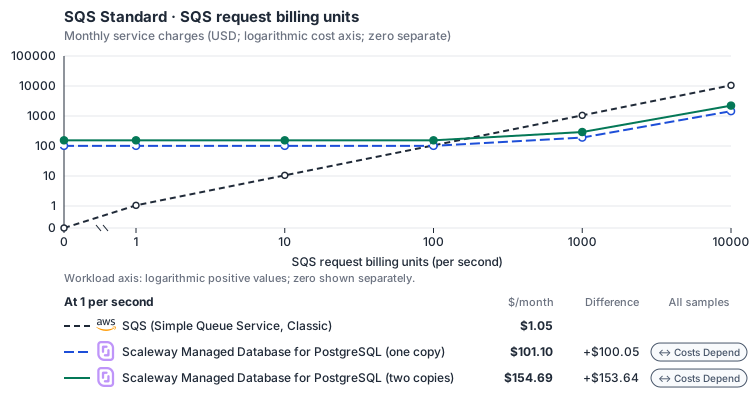
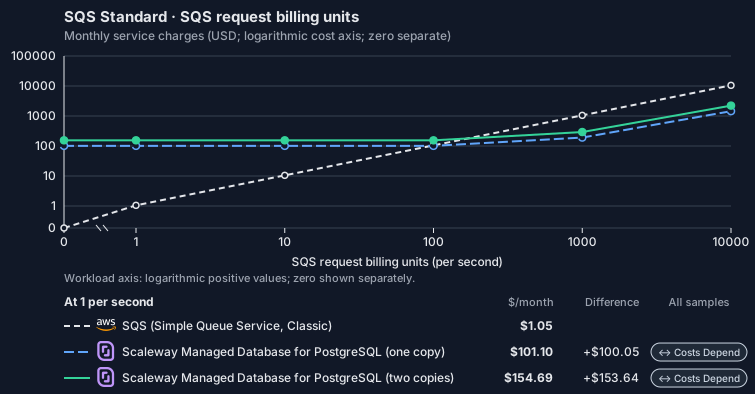
- 1-KiB messages, unbatched send/receive/delete; actual batch and delivery assumptions stay visible. Other native meters and workload assumptions retain their explicitly displayed default quantities. Workload translation and capacity assumptions are not benchmark measurements.
- Native monthly usage priced at the cited provider list prices; listed target allowances apply where present, excluding invoice credits, taxes and negotiated discounts. Rates as of 2026-10-22: us-east-1 → fr-par, USD/month.
- Source prices are reference charges, not an invoice. Target lines cover selected service usage/configuration only; adapter hosting and Tensor9 fees are excluded.
- Samples of explicit prices are not performance measurements or capacity qualification. No interpolation or break-even guarantee is implied.
- Variant assumptions show the first axis sample; any axis-dependent configuration is described by this curve’s workload note.
- Rates are cited provider list prices, editable for discounts, commitments or another region. Workload translation and capacity coefficients remain editable planning assumptions, not benchmark measurements or a commercial quote.
- Default-zero rates are explicit assumptions, not evidence that the deployed service or resource is free.
- Provisioned-unit minimums use an editable approximate allocation floor. Modeled target service cost is max(usage/allocation, minimum), with billable network, durable staging and dependent sinks added separately; actual RU/TU sizing, scaling increments and throughput remain unqualified.
- Durable staging is priced once: provisioned targets include adapter state in their selected allocation; native targets add a separate staging allocation when required. Adapter hosting is a separate allocation and must exclude resources already priced as staging, workers or target capacity.
- A declared adapter mapping and cost model do not establish implementation availability or service equivalence.
- This is a declared directed mapping; a planning estimate does not establish deployment or request-serving support.
- Authored planning assumptions, not measured adapter capacity. Origin rates are cited first-tier list prices, before free allowances and discounts.
- A cost scenario does not establish backend availability, protocol fidelity or production readiness. Registry serving status remains independent.
- Storage follows resident original messages, not every monthly message. Broker delivery bytes include redeliveries.
- FIFO estimates do not qualify dedup support, group throughput or single-group latency; backend limitations remain applicable.
- Scaleway Managed Database for PostgreSQL at Production Optimized (PRO2) prices in EUR converted at the ECB reference rate. A high-availability or replica node bills Scaleway’s ‘Additional nodes’ price, EUR 0.0583 per hour for PRO2-XXS, 53% of the main node. Scaleway lists no egress charge for Managed Databases, so selected network is not charged. Cost Optimized ranges (DB-DEV-S from EUR 0.0156 per hour), Block Storage 15K and backups (EUR 0.03 per GB-month) are not selected.
- Row-store throughput (capacityOpsPerVcpuSecond, default 1500) is measured-by-tensor9 as a lower bound: the DynamoDB adapter on Cloud SQL db-custom-2-7680 (2 vCPU, PostgreSQL 16, us-west1) served 2,974 ops/s of YCSB-A at 16 threads without recorded saturation (src/main/kotlin/t9/prime/equiv/generated/eval/CloudsqlPostgresqlYcsbAT16GoYcsbV1_0_0.kt). Published CPU-bound pgbench reaches 3,101 read-write transactions and 20,289 point reads per vCPU-second (AWS z1d.2xlarge, PostgreSQL 14.5), so actual capacity is likely higher. Reads and writes share one coefficient: at the same adapter version, read-only YCSB-C was not faster than 50%-update YCSB-A.
- Log-broker throughput (capacityStreamMiBPerVcpuSecond 20 at 0.5 utilization, 4 GiB RAM per vCPU) is provider-documented by Google Managed Service for Apache Kafka sizing (https://docs.cloud.google.com/managed-service-for-apache-kafka/docs/plan-cluster-size): write-equivalent bytes are replicated writes plus a quarter of reads. Producer batches below 10 KB lower per-CPU throughput; that penalty is not modeled.
- Disk utilization 0.8 is provider-documented headroom below Cloud SQL automatic storage increase, which triggers near 91-95% full (https://docs.cloud.google.com/sql/docs/postgres/instance-settings). The 20 GiB reserve exceeds PostgreSQL’s 1 GB default max_wal_size; the remainder of that reserve is unmeasured.
- CPU tiers double from 2 vCPUs to the target’s largest node at 4 GiB per vCPU; each target’s documented largest node bounds CPU, RAM, RAM per vCPU and disk, and the durable staging database uses Cloud SQL Enterprise (96 vCPU, 6.5 GiB per vCPU, 624 GiB, 64 TiB). Targets billed per capacity unit or throughput unit are sized by their backend instead.
- No public evidence: peak/mean work (2) and the RAM working-set fraction (0.1). Proposed measurements: the p99 one-minute rate over the monthly mean from customer CloudWatch metrics; the buffer hit ratio while stepping RAM under a fixed YCSB-B load.
- Node bounds: DB-PRO2-L has 32 vCPUs and 128 GB (https://www.scaleway.com/en/pricing/managed-databases/); a volume grows up to 15 TB (https://www.scaleway.com/en/docs/managed-databases-for-postgresql-and-mysql/concepts/).
- Stored GiB already includes the origin family’s physical footprint assumptions; no second storage amplification is applied.
- The operations/vCPU coefficient supplies the compute requirement alongside explicit resource-hour minima.
- Copies and allocation fractions change cost only; they do not increase modeled primary capacity.
- AWS Price List API, AWSQueueService offer: https://pricing.us-east-1.amazonaws.com/offers/v1.0/aws/AWSQueueService/current/us-east-1/index.json
- Scaleway Managed Databases pricing: https://www.scaleway.com/en/pricing/managed-databases/
- Additional network transfer, backups, KMS, one-time migration and operational labor unless an explicit meter includes them.
- Destination application execution and separately billed downstream services; supply those allocations separately.
- Taxes, discounts, credits and free-tier allowances not explicitly listed by this model.
- Unmodeled dependent services, task execution and operations outside the selected workload family.
plan-815ddc40e99f05f91bcd38c679512124353bbc6b / 2026-10-22.planning.2. Curve: workload-1.
Sources: AWS Price List API, AWSQueueService offer, Scaleway Managed Databases pricing.
SQS Standard → Scaleway Managed Database for PostgreSQL: Authored native-usage planning example. Native monthly usage priced at the cited provider list prices; listed target allowances apply where present, excluding invoice credits, taxes and negotiated discounts.
Scenario source region: us-east-1. Scenario target region: fr-par. Currency: USD.
- Additional network transfer, backups, KMS, one-time migration and operational labor unless an explicit meter includes them.
- Destination application execution and separately billed downstream services; supply those allocations separately.
- Taxes, discounts, credits and free-tier allowances not explicitly listed by this model.
- Unmodeled dependent services, task execution and operations outside the selected workload family.
- Translated reads: 0 operations.
- Translated writes: 0 operations.
- Translated resident physical data: 0 GiB-month.
- Native provider operations: 0 operations.
- Published payload: 0 GiB.
- Delivered payload: 0 GiB.
- Allocated execution CPU: 0 vCPU-hour.
- Allocated execution RAM: 0 GiB-hour.
- Independent resource allocation: 0 resource-hour.
- Independent inventory: 0 resource-month.
- Input tokens: 0 tokens.
- Output tokens: 0 tokens.
- Billable network: 0 GiB.
- Dependent object sink retained data: 0 GiB-month.
- Dependent object sink writes: 0 writes.
- Rates are cited provider list prices, editable for discounts, commitments or another region. Workload translation and capacity coefficients remain editable planning assumptions, not benchmark measurements or a commercial quote.
- Default-zero rates are explicit assumptions, not evidence that the deployed service or resource is free.
- Provisioned-unit minimums use an editable approximate allocation floor. Modeled target service cost is max(usage/allocation, minimum), with billable network, durable staging and dependent sinks added separately; actual RU/TU sizing, scaling increments and throughput remain unqualified.
- Durable staging is priced once: provisioned targets include adapter state in their selected allocation; native targets add a separate staging allocation when required. Adapter hosting is a separate allocation and must exclude resources already priced as staging, workers or target capacity.
- A declared adapter mapping and cost model do not establish implementation availability or service equivalence.
- This is a declared directed mapping; a planning estimate does not establish deployment or request-serving support.
- Authored planning assumptions, not measured adapter capacity. Origin rates are cited first-tier list prices, before free allowances and discounts.
- A cost scenario does not establish backend availability, protocol fidelity or production readiness. Registry serving status remains independent.
- Storage follows resident original messages, not every monthly message. Broker delivery bytes include redeliveries.
- FIFO estimates do not qualify dedup support, group throughput or single-group latency; backend limitations remain applicable.
- Scaleway Managed Database for PostgreSQL at Production Optimized (PRO2) prices in EUR converted at the ECB reference rate. A high-availability or replica node bills Scaleway’s ‘Additional nodes’ price, EUR 0.0583 per hour for PRO2-XXS, 53% of the main node. Scaleway lists no egress charge for Managed Databases, so selected network is not charged. Cost Optimized ranges (DB-DEV-S from EUR 0.0156 per hour), Block Storage 15K and backups (EUR 0.03 per GB-month) are not selected.
- Row-store throughput (capacityOpsPerVcpuSecond, default 1500) is measured-by-tensor9 as a lower bound: the DynamoDB adapter on Cloud SQL db-custom-2-7680 (2 vCPU, PostgreSQL 16, us-west1) served 2,974 ops/s of YCSB-A at 16 threads without recorded saturation (src/main/kotlin/t9/prime/equiv/generated/eval/CloudsqlPostgresqlYcsbAT16GoYcsbV1_0_0.kt). Published CPU-bound pgbench reaches 3,101 read-write transactions and 20,289 point reads per vCPU-second (AWS z1d.2xlarge, PostgreSQL 14.5), so actual capacity is likely higher. Reads and writes share one coefficient: at the same adapter version, read-only YCSB-C was not faster than 50%-update YCSB-A.
- Log-broker throughput (capacityStreamMiBPerVcpuSecond 20 at 0.5 utilization, 4 GiB RAM per vCPU) is provider-documented by Google Managed Service for Apache Kafka sizing (https://docs.cloud.google.com/managed-service-for-apache-kafka/docs/plan-cluster-size): write-equivalent bytes are replicated writes plus a quarter of reads. Producer batches below 10 KB lower per-CPU throughput; that penalty is not modeled.
- Disk utilization 0.8 is provider-documented headroom below Cloud SQL automatic storage increase, which triggers near 91-95% full (https://docs.cloud.google.com/sql/docs/postgres/instance-settings). The 20 GiB reserve exceeds PostgreSQL’s 1 GB default max_wal_size; the remainder of that reserve is unmeasured.
- CPU tiers double from 2 vCPUs to the target’s largest node at 4 GiB per vCPU; each target’s documented largest node bounds CPU, RAM, RAM per vCPU and disk, and the durable staging database uses Cloud SQL Enterprise (96 vCPU, 6.5 GiB per vCPU, 624 GiB, 64 TiB). Targets billed per capacity unit or throughput unit are sized by their backend instead.
- No public evidence: peak/mean work (2) and the RAM working-set fraction (0.1). Proposed measurements: the p99 one-minute rate over the monthly mean from customer CloudWatch metrics; the buffer hit ratio while stepping RAM under a fixed YCSB-B load.
- Node bounds: DB-PRO2-L has 32 vCPUs and 128 GB (https://www.scaleway.com/en/pricing/managed-databases/); a volume grows up to 15 TB (https://www.scaleway.com/en/docs/managed-databases-for-postgresql-and-mysql/concepts/).
- Stored GiB already includes the origin family’s physical footprint assumptions; no second storage amplification is applied.
- The operations/vCPU coefficient supplies the compute requirement alongside explicit resource-hour minima.
- Copies and allocation fractions change cost only; they do not increase modeled primary capacity.
plan-815ddc40e99f05f91bcd38c679512124353bbc6b / 2026-10-22.planning.2. Scenario: planning-example.
Sources: AWS Price List API, AWSQueueService offer, Scaleway Managed Databases pricing.
Costs
Estimated monthly service charges for each backend with a published cost model, at one sampled workload from that model’s cost curve. Adapter hosting and Tensor9 fees are excluded. How Tensor9 estimates costs explains the method, what the estimates include and how to read their qualifications.Service level agreements
Listed terms cover requests sent through this service adapter. They do not cover direct connections to the target service or replace the cloud provider’s own SLA. Each origin-to-target pair has its own terms or an explicit pending status. See the SLA tables, measurement rules, and scaling conditions.SQS to Cosmos DB
Why these latency targets differ
The shared Standard/FIFO point-operation target is 20 ms, with 200 ms for a batch of up to ten sends. Cosmos FIFO uses a per-group sequence counter, a durable deduplication marker and an in-flight ownership slot. Their conditional reads/writes are adapter coordination; the clock cannot exclude them merely because they use Cosmos DB. The shared target preserves room for that work instead of advertising the cost of a simple native queue forwarder. Ready-message pickup and delay after the requested wait remain at 500 ms. Discovery, candidate inspection, conditional claims and polling can dominate this path even for a tiny message. The target is not an end-to-end promise for clearing a backlog, and Standard and FIFO observations must remain separate.Adapter and scope
Receive timing
Two phases ofReceiveMessage have separate measurements:
- Ready-message pickup: time from a message becoming available to a waiting receiver until the adapter sends the response. Only separately measured time spent waiting for the backend service is excluded.
- Delay after the requested wait: extra adapter time after the requested wait for a message has ended.
Message guarantees
A send can return success only after the message state has been durably saved. A deduplication marker alone must not produce success for a message that was never committed. The adapter must use the same record of accepted messages when returning success, checking for duplicates, and recovering from a crash. Standard queues can redeliver messages. FIFO preserves the profile’s per-group ordering and supported deduplication behavior; it does not promise global order across groups or exactly-once effects in your application. A consumer can perform a business action and fail before deleting the message, so application-side idempotency still matters. The adapter follows its documented rules for visibility, expiration, message deletion, and movement to a dead-letter queue. Successfully completed changes must survive the process failures covered by the agreement. An expired receipt handle produces the result documented for that adapter; different backends need not return the same error. Approximate queue counts help with troubleshooting but are not guaranteed to show the exact current queue depth.Useful throughput
Count completed API calls separately from message work. A valid emptyReceiveMessage completes an API call but delivers no message. One successful send, nonempty receive and delete form a message lifecycle involving at least three API calls. Redelivery and internal retries must not inflate the count of distinct messages processed.
Measure Standard and FIFO separately. FIFO group distribution, time between receive and delete, visibility timeout, delayed messages and dead-letter traffic change the scaling limit. A large number of consumers cannot make a single serialized group behave like many independent groups.
These standard service levels do not reserve a fixed message rate or specify a maximum throughput. Tensor9 and the customer must agree on limits for the actual workload and production deployment, including how quickly traffic can grow and how large a burst can be. Autoscaling is intended to maintain the stated latency and endpoint reachability within those limits. It cannot remove ordering requirements or backend-service limits.
Operation terms
The named operations retain their documented behavior with supported request options. The 1 KiB limits apply to the latency targets.DeleteMessageBatch, ChangeMessageVisibilityBatch, queue management, tagging and approximate-count reads have no numerical SLA under these standard terms. A capability in the service profile does not automatically receive another operation’s SLA.
The pickup service level differs from the Cloud SQL service level. These targets apply to their respective receive paths; they are not comparative benchmark results or a recommendation to choose one backend.
Scaling on Cosmos DB
Partition distribution, conditional message claims, deduplication and FIFO group serialization affect useful throughput. Native request-unit consumption and throttling need to be considered alongside adapter scheduling, repeated scans and retry amplification. Additional replicas can process independent work. They do not remove contention around the same message claim or FIFO group, and they do not grant additional native serverless capacity. Track completed message lifecycles, native calls per lifecycle and repeated failed claims separately. Once a message expires, the queue must treat it as expired even if the cloud provider has not yet removed its stored data. Do not count expired messages as available work merely because they still appear in a storage view. Time the adapter takes to find an available message, including waits between queue checks, also counts toward adapter latency. It is not automatically excluded as cloud-provider time.Example: two receivers see the same candidate
Two receivers discover a message. The adapter must use a conditional update to assign the message to a receiver under the documented queue rules. It must not give both receivers conflicting ownership just to meet a latency target. Record the claim outcomes and native conditional responses, along with local retries and scheduling. A later redelivery after visibility expires can be legitimate. It is different from simultaneous ownership caused by a broken claim. Inspect receipt timing and the selected queue semantics before calling either event data loss or a duplicate-delivery defect.Example: restart during a dead-letter transition
A message is copied to the dead-letter queue, then the process restarts before removing the source copy. Recovery must preserve the supported message semantics without adapter-induced loss. A valid redelivery is not the same as a missing accepted message. Preserve source and destination observations and identifiers before changing either queue. Do not delete both copies to make the counts agree, and do not replay a send solely to generate an Explain report. If Cosmos DB also reports throttling, investigate serverless/partition pressure and the adapter’s call/retry pattern. Backend throttling does not excuse an incorrect recovery algorithm or excessive local retries.Evidence for support
Record Standard versus FIFO, group distribution, message and attribute sizes, conditional-claim outcomes, wait/visibility settings, dead-letter configuration and the affected time window. Include native request IDs, request-unit/throttling observations and available adapter timing. Keep sensitive bodies and receipt handles out of shared reports. You can contact support before you know what caused the problem.SQS (Simple Queue Service, Classic) to PostgreSQL Flexible Server
What this adapter does
Forazure::1.0.0::postgresql::flexible, The SQL queue uses row locking and SKIP LOCKED; FIFO adds head-of-group selection and deduplication state. The current long-poll loop can sleep between polls. Queue configuration is cached and durable queue state remains in PostgreSQL. A ReceiveMessage response budget is not a delivery-time promise: messages may not yet exist, may be delayed, or may be blocked by a FIFO group head. The short-poll row deliberately removes that ambiguity. Requested long-poll waits need their own measurement treatment in the agreement.
How the latency targets were chosen
Small message send and settlement: +3 ms monthly p99 (adapter-added).ChangeMessageVisibility, DeleteMessage, SendMessage. Native forwarding needs bounded translation; SQL adds queue state; Cosmos FIFO requires multiple durable coordination steps and cannot honestly inherit a 1 ms forwarding budget.
Bounded short-poll receive: +10 ms monthly p99 (adapter-added). ReceiveMessage. Receive scans/selects candidates, claims visibility and creates receipt handles. FIFO head selection and Cosmos slot CAS cost more than a simple send.
Bounded message batches: +30 ms monthly p99 (adapter-added). DeleteMessageBatch, SendMessageBatch. A conservative upper budget for up to ten point paths plus aggregation. It does not assume the implementation parallelizes all target or metadata work.
Queue configuration and discovery: +20 ms monthly p99 (adapter-added). GetQueueAttributes, GetQueueUrl. Queue identity, attributes, tags and counts can use the adapter’s durable catalog; this is not excluded as target message work.
Your signed agreement sets the terms for your deployment. A target does not add an operation or option that the compatibility tables mark unavailable.
What counts toward latency
For a request-response row, measure from the agreed ingress boundary to dispatch of the complete response. A row that explicitly names a first response chunk ends at that chunk; its number does not cover the rest of the stream. A long-poll row names the intentional wait and when adapter delay starts. Include parsing, authorization, admission, translation, serialization, adapter-owned storage and coordination, retries and response handling. Subtract only separately measured target-workload waits and external network segments allowed by the measurement rules. The adapter’s own response handling and dispatch remain covered. A database used for adapter metadata is still adapter work, even if a cloud provider hosts it. For concurrent calls, exclude the union of permitted wait intervals, not the sum of overlapping spans. Calculate each request’s adapter duration first, then the monthly p99. Do not subtract one service’s p99 from another’s. Known adapter timeouts are over-budget samples; failed or incomplete requests cannot disappear to improve the percentile. Missing measurements do not become zero latency. An SDK call span alone does not prove how much of its duration can be excluded.Endpoint reachability and request failures
The endpoint-reachability target measures adapter health checks. Correctly forwarding a target quota or permission error is different from producing that error because the adapter sent the wrong request. Adapter-caused failures remain Tensor9’s responsibility even when the target is healthy. Correctness and data-integrity requirements apply to every supported request. Endpoint reachability does not measure request correctness or grant an allowance for incorrect results.Scaling and target-service capacity
Scale send, receive and settle capacity together, and track in-flight messages, pollers, candidate scans and FIFO group skew. Adding replicas helps independent groups but cannot parallelize the ordered head of one group. The agreement caps active pollers, groups inspected per receive, message bytes, retry amplification and batch entries. Tensor9 scales the fabric within those limits; the customer supplies sufficient broker capacity, Cosmos RU/s or PostgreSQL connections and I/O. Tell Tensor9 the expected steady rate, bursts, concurrency, payload sizes and operation mix. Tensor9 sizes and scales the adapter for the agreed load; you choose and monitor the target service’s capacity with Tensor9’s help. A latency budget is not a requests-per-second rating. Larger requests and higher rates need explicit terms, not silent inheritance of a small-request SLA.Data and behavior guarantees
Acceptance must not be returned before the documented message persistence point. Settlement must apply to the intended message/receipt; FIFO order and deduplication apply only where this directed profile supports them. Duplicate delivery can be legitimate under at-least-once delivery. Dead-letter transitions must not silently discard an accepted message. Durability of the target broker/database remains its own commitment, while broken adapter receipt, marker or coordination logic remains Tensor9’s responsibility.Example and diagnosis
Fororder-events, send a 2 KiB message, receive up to ten messages with WaitTimeSeconds=0, then settle each receipt. For a FIFO queue, distribute independent customers across groups instead of expecting one group to scale with replicas. If native message writes are fast but Cosmos FIFO sends slow down, inspect counter/dedup contention: those coordination waits still count against Tensor9’s fabric budget.
Use tensor9 explain and the documented explain headers to understand the selected adapter and its behavior. Correlate available request diagnostics with the target provider’s latency, throttling and capacity metrics. An explain report helps diagnose a request; it is not by itself a qualified SLA timing measurement. Share the operation, request shape, timestamps and request identifiers with support, with credentials and customer payloads removed.
SQS (Simple Queue Service, Classic) to Azure Queue Storage
What this adapter does
Forazure::1.0.0::queue-storage, The adapter maps message bodies, attributes, receipts and settlement onto the native queue API. Supported delay, long-polling, retention and redrive behavior is target-specific; API translation does not turn a standard queue into FIFO. A ReceiveMessage response budget is not a delivery-time promise: messages may not yet exist, may be delayed, or may be blocked by a FIFO group head. The short-poll row deliberately removes that ambiguity. Requested long-poll waits need their own measurement treatment in the agreement.
How the latency targets were chosen
Small message send and settlement: +1 ms monthly p99 (adapter-added).ChangeMessageVisibility, DeleteMessage, SendMessage. Native forwarding needs bounded translation; SQL adds queue state; Cosmos FIFO requires multiple durable coordination steps and cannot honestly inherit a 1 ms forwarding budget.
Bounded short-poll receive: +3 ms monthly p99 (adapter-added). ReceiveMessage. Receive scans/selects candidates, claims visibility and creates receipt handles. FIFO head selection and Cosmos slot CAS cost more than a simple send.
Bounded message batches: +10 ms monthly p99 (adapter-added). ChangeMessageVisibilityBatch, DeleteMessageBatch, SendMessageBatch. A conservative upper budget for up to ten point paths plus aggregation. It does not assume the implementation parallelizes all target or metadata work.
Queue configuration and discovery: +20 ms monthly p99 (adapter-added). CreateQueue, DeleteQueue, ListQueueTags, ListQueues, PurgeQueue, SetQueueAttributes, TagQueue, UntagQueue. Queue identity, attributes, tags and counts can use the adapter’s durable catalog; this is not excluded as target message work.
Your signed agreement sets the terms for your deployment. A target does not add an operation or option that the compatibility tables mark unavailable.
What counts toward latency
For a request-response row, measure from the agreed ingress boundary to dispatch of the complete response. A row that explicitly names a first response chunk ends at that chunk; its number does not cover the rest of the stream. A long-poll row names the intentional wait and when adapter delay starts. Include parsing, authorization, admission, translation, serialization, adapter-owned storage and coordination, retries and response handling. Subtract only separately measured target-workload waits and external network segments allowed by the measurement rules. The adapter’s own response handling and dispatch remain covered. A database used for adapter metadata is still adapter work, even if a cloud provider hosts it. For concurrent calls, exclude the union of permitted wait intervals, not the sum of overlapping spans. Calculate each request’s adapter duration first, then the monthly p99. Do not subtract one service’s p99 from another’s. Known adapter timeouts are over-budget samples; failed or incomplete requests cannot disappear to improve the percentile. Missing measurements do not become zero latency. An SDK call span alone does not prove how much of its duration can be excluded.Endpoint reachability and request failures
The endpoint-reachability target measures adapter health checks. Correctly forwarding a target quota or permission error is different from producing that error because the adapter sent the wrong request. Adapter-caused failures remain Tensor9’s responsibility even when the target is healthy. Correctness and data-integrity requirements apply to every supported request. Endpoint reachability does not measure request correctness or grant an allowance for incorrect results.Scaling and target-service capacity
Scale send, receive and settle capacity together, and track in-flight messages, pollers, candidate scans and FIFO group skew. Adding replicas helps independent groups but cannot parallelize the ordered head of one group. The agreement caps active pollers, groups inspected per receive, message bytes, retry amplification and batch entries. Tensor9 scales the fabric within those limits; the customer supplies sufficient broker capacity, Cosmos RU/s or PostgreSQL connections and I/O. Tell Tensor9 the expected steady rate, bursts, concurrency, payload sizes and operation mix. Tensor9 sizes and scales the adapter for the agreed load; you choose and monitor the target service’s capacity with Tensor9’s help. A latency budget is not a requests-per-second rating. Larger requests and higher rates need explicit terms, not silent inheritance of a small-request SLA.Data and behavior guarantees
Acceptance must not be returned before the documented message persistence point. Settlement must apply to the intended message/receipt; FIFO order and deduplication apply only where this directed profile supports them. Duplicate delivery can be legitimate under at-least-once delivery. Dead-letter transitions must not silently discard an accepted message. Durability of the target broker/database remains its own commitment, while broken adapter receipt, marker or coordination logic remains Tensor9’s responsibility.Example and diagnosis
Fororder-events, send a 2 KiB message, receive up to ten messages with WaitTimeSeconds=0, then settle each receipt. For a FIFO queue, distribute independent customers across groups instead of expecting one group to scale with replicas. If native message writes are fast but Cosmos FIFO sends slow down, inspect counter/dedup contention: those coordination waits still count against Tensor9’s fabric budget.
Use tensor9 explain and the documented explain headers to understand the selected adapter and its behavior. Correlate available request diagnostics with the target provider’s latency, throttling and capacity metrics. An explain report helps diagnose a request; it is not by itself a qualified SLA timing measurement. Share the operation, request shape, timestamps and request identifiers with support, with credentials and customer payloads removed.
SQS (Simple Queue Service, Classic) to Azure Service Bus
What this adapter does
Forazure::1.0.0::servicebus, Service Bus messages and locks implement queue delivery; FIFO uses sessions. Lock renewal, receipt mapping and settlement remain adapter responsibilities, while native broker delivery uses the target service. A ReceiveMessage response budget is not a delivery-time promise: messages may not yet exist, may be delayed, or may be blocked by a FIFO group head. The short-poll row deliberately removes that ambiguity. Requested long-poll waits need their own measurement treatment in the agreement.
How the latency targets were chosen
Small message send and settlement: +1 ms monthly p99 (adapter-added).ChangeMessageVisibility, DeleteMessage, SendMessage. Native forwarding needs bounded translation; SQL adds queue state; Cosmos FIFO requires multiple durable coordination steps and cannot honestly inherit a 1 ms forwarding budget.
Bounded short-poll receive: +3 ms monthly p99 (adapter-added). ReceiveMessage. Receive scans/selects candidates, claims visibility and creates receipt handles. FIFO head selection and Cosmos slot CAS cost more than a simple send.
Bounded message batches: +10 ms monthly p99 (adapter-added). SendMessageBatch. A conservative upper budget for up to ten point paths plus aggregation. It does not assume the implementation parallelizes all target or metadata work.
Queue configuration and discovery: +20 ms monthly p99 (adapter-added). DeleteQueue, ListQueueTags, ListQueues, SetQueueAttributes, TagQueue, UntagQueue. Queue identity, attributes, tags and counts can use the adapter’s durable catalog; this is not excluded as target message work.
Your signed agreement sets the terms for your deployment. A target does not add an operation or option that the compatibility tables mark unavailable.
What counts toward latency
For a request-response row, measure from the agreed ingress boundary to dispatch of the complete response. A row that explicitly names a first response chunk ends at that chunk; its number does not cover the rest of the stream. A long-poll row names the intentional wait and when adapter delay starts. Include parsing, authorization, admission, translation, serialization, adapter-owned storage and coordination, retries and response handling. Subtract only separately measured target-workload waits and external network segments allowed by the measurement rules. The adapter’s own response handling and dispatch remain covered. A database used for adapter metadata is still adapter work, even if a cloud provider hosts it. For concurrent calls, exclude the union of permitted wait intervals, not the sum of overlapping spans. Calculate each request’s adapter duration first, then the monthly p99. Do not subtract one service’s p99 from another’s. Known adapter timeouts are over-budget samples; failed or incomplete requests cannot disappear to improve the percentile. Missing measurements do not become zero latency. An SDK call span alone does not prove how much of its duration can be excluded.Endpoint reachability and request failures
The endpoint-reachability target measures adapter health checks. Correctly forwarding a target quota or permission error is different from producing that error because the adapter sent the wrong request. Adapter-caused failures remain Tensor9’s responsibility even when the target is healthy. Correctness and data-integrity requirements apply to every supported request. Endpoint reachability does not measure request correctness or grant an allowance for incorrect results.Scaling and target-service capacity
Scale send, receive and settle capacity together, and track in-flight messages, pollers, candidate scans and FIFO group skew. Adding replicas helps independent groups but cannot parallelize the ordered head of one group. The agreement caps active pollers, groups inspected per receive, message bytes, retry amplification and batch entries. Tensor9 scales the fabric within those limits; the customer supplies sufficient broker capacity, Cosmos RU/s or PostgreSQL connections and I/O. Tell Tensor9 the expected steady rate, bursts, concurrency, payload sizes and operation mix. Tensor9 sizes and scales the adapter for the agreed load; you choose and monitor the target service’s capacity with Tensor9’s help. A latency budget is not a requests-per-second rating. Larger requests and higher rates need explicit terms, not silent inheritance of a small-request SLA.Data and behavior guarantees
Acceptance must not be returned before the documented message persistence point. Settlement must apply to the intended message/receipt; FIFO order and deduplication apply only where this directed profile supports them. Duplicate delivery can be legitimate under at-least-once delivery. Dead-letter transitions must not silently discard an accepted message. Durability of the target broker/database remains its own commitment, while broken adapter receipt, marker or coordination logic remains Tensor9’s responsibility.Example and diagnosis
Fororder-events, send a 2 KiB message, receive up to ten messages with WaitTimeSeconds=0, then settle each receipt. For a FIFO queue, distribute independent customers across groups instead of expecting one group to scale with replicas. If native message writes are fast but Cosmos FIFO sends slow down, inspect counter/dedup contention: those coordination waits still count against Tensor9’s fabric budget.
Use tensor9 explain and the documented explain headers to understand the selected adapter and its behavior. Correlate available request diagnostics with the target provider’s latency, throttling and capacity metrics. An explain report helps diagnose a request; it is not by itself a qualified SLA timing measurement. Share the operation, request shape, timestamps and request identifiers with support, with credentials and customer payloads removed.
SQS to Cloud SQL for PostgreSQL
Why these latency targets differ
The shared Standard/FIFO point-operation target stays at 10 ms. A FIFO request can perform durable deduplication and group coordination, so reducing the target to 1 ms would ignore real adapter work. A batch of up to ten entries has a 100 ms budget; this allows sequential per-entry coordination rather than assuming every batch path runs in parallel. Latency targets do not imply a throughput guarantee or favor this backend over another. Ready-message pickup and delay after the requested wait retain their 250 ms targets. The PostgreSQL backend currently polls with sleeps of up to 100 ms between checks. Sleep after a message becomes eligible counts as adapter delay; it is not Cloud SQL execution time. A future notification-driven implementation could support a lower pickup target, but request parsing alone cannot justify one today.Adapter and scope
Receive timing
Two phases ofReceiveMessage have separate measurements:
- Ready-message pickup: time from a message becoming available to a waiting receiver until the adapter sends the response. Only separately measured time spent waiting for the backend service is excluded.
- Delay after the requested wait: extra adapter time after the requested wait for a message has ended.
Message guarantees
A send can return success only after the message state has been durably saved. A deduplication marker alone must not produce success for a message that was never committed. The adapter must use the same record of accepted messages when returning success, checking for duplicates, and recovering from a crash. Standard queues can redeliver messages. FIFO preserves the profile’s per-group ordering and supported deduplication behavior; it does not promise global order across groups or exactly-once effects in your application. A consumer can perform a business action and fail before deleting the message, so application-side idempotency still matters. The adapter follows its documented rules for visibility, expiration, message deletion, and movement to a dead-letter queue. Successfully completed changes must survive the process failures covered by the agreement. An expired receipt handle produces the result documented for that adapter; different backends need not return the same error. Approximate queue counts help with troubleshooting but are not guaranteed to show the exact current queue depth.Useful throughput
Count completed API calls separately from message work. A valid emptyReceiveMessage completes an API call but delivers no message. One successful send, nonempty receive and delete form a message lifecycle involving at least three API calls. Redelivery and internal retries must not inflate the count of distinct messages processed.
Measure Standard and FIFO separately. FIFO group distribution, time between receive and delete, visibility timeout, delayed messages and dead-letter traffic change the scaling limit. A large number of consumers cannot make a single serialized group behave like many independent groups.
These standard service levels do not reserve a fixed message rate or specify a maximum throughput. Tensor9 and the customer must agree on limits for the actual workload and production deployment, including how quickly traffic can grow and how large a burst can be. Autoscaling is intended to maintain the stated latency and endpoint reachability within those limits. It cannot remove ordering requirements or backend-service limits.
Operation terms
The listed operations retain their documented behavior with the request options supported by the adapter. The 1 KiB limits apply to the latency target. Supported larger messages have no numerical request-latency target under these standard terms. Queue management, tagging, approximate-count reads andChangeMessageVisibilityBatch have no numerical SLA under these standard terms. That does not declare them unsupported. Check the adapter’s support details separately. A similar operation name does not make an operation covered by the SLA.
For batch calls, retain per-entry successes and failures. The response to a partial batch is not evidence that every submitted message completed successfully.
Scaling on Cloud SQL
Connection budgets, transaction/lock contention and message claims can limit the adapter before the database reaches its advertised compute capacity. A pool limit configured independently on every replica can exceed the database’s total allowance during scale-out or rollout. Limit total database connections across all adapter instances, including instances that are starting or shutting down. Review query work and lock contention alongside Cloud SQL CPU, storage and connection metrics. Native database execution is separately timed, but acquiring a local connection and scheduling local polling remain adapter work. Independent messages and FIFO groups offer parallel work. A hot group still requires ordered progress. Adding adapter instances must not make competing claims or repeated retries appear to be more successfully processed messages.Example: an empty long poll receives a job
Thejobs queue has an outstanding 20-second ReceiveMessage. Ten seconds later, a message becomes eligible for that receiver. The first ten seconds are legitimate waiting. Measure the subsequent local polling, claim scheduling and response handling against pickup conditions, with native execution recorded separately.
If no message becomes eligible, measure the adapter delay after the requested 20-second deadline instead. Do not compare the entire long poll with the receive processing budget, and do not use approximate queue depth to infer the exact eligibility timestamp.
Example: a committed send loses its response
PostgreSQL commits a message, then the adapter restarts before returning success. The response-path failure remains an adapter failure even though the message exists. The caller’s outcome is uncertain. Inspect the observed state and supported deduplication behavior before retrying. Standard-queue redelivery remains possible. If recovery leaks connections or fails to restore message state, that is not excluded merely because a managed database holds the data. A Cloud SQL outage not caused by the adapter is outside the standard adapter SLA. Tensor9 still helps investigate recovery and backlog behavior. Excessive retries or broken connection recovery remain adapter issues.Evidence for support
Keep the queue type, operation, message-size range, batch outcomes, active FIFO group distribution, wait/visibility settings, time between receiving and deleting a message and relevant request IDs. Include Cloud SQL connections, contention and backend timing for the same interval. Redact message bodies and receipt handles before sharing. An available Explain report supplements these observations; its absence does not prevent support.SQS (Simple Queue Service, Classic) to Pub/Sub
What this adapter does
Forgoogle::1.0.0::pubsub, The adapter maps message bodies, attributes, receipts and settlement onto the native queue API. Supported delay, long-polling, retention and redrive behavior is target-specific; API translation does not turn a standard queue into FIFO. A ReceiveMessage response budget is not a delivery-time promise: messages may not yet exist, may be delayed, or may be blocked by a FIFO group head. The short-poll row deliberately removes that ambiguity. Requested long-poll waits need their own measurement treatment in the agreement.
How the latency targets were chosen
Small message send and settlement: +1 ms monthly p99 (adapter-added).ChangeMessageVisibility, DeleteMessage, SendMessage. Native forwarding needs bounded translation; SQL adds queue state; Cosmos FIFO requires multiple durable coordination steps and cannot honestly inherit a 1 ms forwarding budget.
Bounded short-poll receive: +3 ms monthly p99 (adapter-added). ReceiveMessage. Receive scans/selects candidates, claims visibility and creates receipt handles. FIFO head selection and Cosmos slot CAS cost more than a simple send.
Queue configuration and discovery: +20 ms monthly p99 (adapter-added). SetQueueAttributes. Queue identity, attributes, tags and counts can use the adapter’s durable catalog; this is not excluded as target message work.
Your signed agreement sets the terms for your deployment. A target does not add an operation or option that the compatibility tables mark unavailable.
What counts toward latency
For a request-response row, measure from the agreed ingress boundary to dispatch of the complete response. A row that explicitly names a first response chunk ends at that chunk; its number does not cover the rest of the stream. A long-poll row names the intentional wait and when adapter delay starts. Include parsing, authorization, admission, translation, serialization, adapter-owned storage and coordination, retries and response handling. Subtract only separately measured target-workload waits and external network segments allowed by the measurement rules. The adapter’s own response handling and dispatch remain covered. A database used for adapter metadata is still adapter work, even if a cloud provider hosts it. For concurrent calls, exclude the union of permitted wait intervals, not the sum of overlapping spans. Calculate each request’s adapter duration first, then the monthly p99. Do not subtract one service’s p99 from another’s. Known adapter timeouts are over-budget samples; failed or incomplete requests cannot disappear to improve the percentile. Missing measurements do not become zero latency. An SDK call span alone does not prove how much of its duration can be excluded.Endpoint reachability and request failures
The endpoint-reachability target measures adapter health checks. Correctly forwarding a target quota or permission error is different from producing that error because the adapter sent the wrong request. Adapter-caused failures remain Tensor9’s responsibility even when the target is healthy. Correctness and data-integrity requirements apply to every supported request. Endpoint reachability does not measure request correctness or grant an allowance for incorrect results.Scaling and target-service capacity
Scale send, receive and settle capacity together, and track in-flight messages, pollers, candidate scans and FIFO group skew. Adding replicas helps independent groups but cannot parallelize the ordered head of one group. The agreement caps active pollers, groups inspected per receive, message bytes, retry amplification and batch entries. Tensor9 scales the fabric within those limits; the customer supplies sufficient broker capacity, Cosmos RU/s or PostgreSQL connections and I/O. Tell Tensor9 the expected steady rate, bursts, concurrency, payload sizes and operation mix. Tensor9 sizes and scales the adapter for the agreed load; you choose and monitor the target service’s capacity with Tensor9’s help. A latency budget is not a requests-per-second rating. Larger requests and higher rates need explicit terms, not silent inheritance of a small-request SLA.Data and behavior guarantees
Acceptance must not be returned before the documented message persistence point. Settlement must apply to the intended message/receipt; FIFO order and deduplication apply only where this directed profile supports them. Duplicate delivery can be legitimate under at-least-once delivery. Dead-letter transitions must not silently discard an accepted message. Durability of the target broker/database remains its own commitment, while broken adapter receipt, marker or coordination logic remains Tensor9’s responsibility.Example and diagnosis
Fororder-events, send a 2 KiB message, receive up to ten messages with WaitTimeSeconds=0, then settle each receipt. For a FIFO queue, distribute independent customers across groups instead of expecting one group to scale with replicas. If native message writes are fast but Cosmos FIFO sends slow down, inspect counter/dedup contention: those coordination waits still count against Tensor9’s fabric budget.
Use tensor9 explain and the documented explain headers to understand the selected adapter and its behavior. Correlate available request diagnostics with the target provider’s latency, throttling and capacity metrics. An explain report helps diagnose a request; it is not by itself a qualified SLA timing measurement. Share the operation, request shape, timestamps and request identifiers with support, with credentials and customer payloads removed.
SQS (Simple Queue Service, Classic) to OCI Queue
What this adapter does
Foroci::1.0.0::queue, The adapter maps message bodies, attributes, receipts and settlement onto the native queue API. Supported delay, long-polling, retention and redrive behavior is target-specific; API translation does not turn a standard queue into FIFO. A ReceiveMessage response budget is not a delivery-time promise: messages may not yet exist, may be delayed, or may be blocked by a FIFO group head. The short-poll row deliberately removes that ambiguity. Requested long-poll waits need their own measurement treatment in the agreement.
How the latency targets were chosen
Small message send and settlement: +1 ms monthly p99 (adapter-added).ChangeMessageVisibility, DeleteMessage, SendMessage. Native forwarding needs bounded translation; SQL adds queue state; Cosmos FIFO requires multiple durable coordination steps and cannot honestly inherit a 1 ms forwarding budget.
Bounded short-poll receive: +3 ms monthly p99 (adapter-added). ReceiveMessage. Receive scans/selects candidates, claims visibility and creates receipt handles. FIFO head selection and Cosmos slot CAS cost more than a simple send.
Queue configuration and discovery: +20 ms monthly p99 (adapter-added). SetQueueAttributes. Queue identity, attributes, tags and counts can use the adapter’s durable catalog; this is not excluded as target message work.
Your signed agreement sets the terms for your deployment. A target does not add an operation or option that the compatibility tables mark unavailable.
What counts toward latency
For a request-response row, measure from the agreed ingress boundary to dispatch of the complete response. A row that explicitly names a first response chunk ends at that chunk; its number does not cover the rest of the stream. A long-poll row names the intentional wait and when adapter delay starts. Include parsing, authorization, admission, translation, serialization, adapter-owned storage and coordination, retries and response handling. Subtract only separately measured target-workload waits and external network segments allowed by the measurement rules. The adapter’s own response handling and dispatch remain covered. A database used for adapter metadata is still adapter work, even if a cloud provider hosts it. For concurrent calls, exclude the union of permitted wait intervals, not the sum of overlapping spans. Calculate each request’s adapter duration first, then the monthly p99. Do not subtract one service’s p99 from another’s. Known adapter timeouts are over-budget samples; failed or incomplete requests cannot disappear to improve the percentile. Missing measurements do not become zero latency. An SDK call span alone does not prove how much of its duration can be excluded.Endpoint reachability and request failures
The endpoint-reachability target measures adapter health checks. Correctly forwarding a target quota or permission error is different from producing that error because the adapter sent the wrong request. Adapter-caused failures remain Tensor9’s responsibility even when the target is healthy. Correctness and data-integrity requirements apply to every supported request. Endpoint reachability does not measure request correctness or grant an allowance for incorrect results.Scaling and target-service capacity
Scale send, receive and settle capacity together, and track in-flight messages, pollers, candidate scans and FIFO group skew. Adding replicas helps independent groups but cannot parallelize the ordered head of one group. The agreement caps active pollers, groups inspected per receive, message bytes, retry amplification and batch entries. Tensor9 scales the fabric within those limits; the customer supplies sufficient broker capacity, Cosmos RU/s or PostgreSQL connections and I/O. Tell Tensor9 the expected steady rate, bursts, concurrency, payload sizes and operation mix. Tensor9 sizes and scales the adapter for the agreed load; you choose and monitor the target service’s capacity with Tensor9’s help. A latency budget is not a requests-per-second rating. Larger requests and higher rates need explicit terms, not silent inheritance of a small-request SLA.Data and behavior guarantees
Acceptance must not be returned before the documented message persistence point. Settlement must apply to the intended message/receipt; FIFO order and deduplication apply only where this directed profile supports them. Duplicate delivery can be legitimate under at-least-once delivery. Dead-letter transitions must not silently discard an accepted message. Durability of the target broker/database remains its own commitment, while broken adapter receipt, marker or coordination logic remains Tensor9’s responsibility.Example and diagnosis
Fororder-events, send a 2 KiB message, receive up to ten messages with WaitTimeSeconds=0, then settle each receipt. For a FIFO queue, distribute independent customers across groups instead of expecting one group to scale with replicas. If native message writes are fast but Cosmos FIFO sends slow down, inspect counter/dedup contention: those coordination waits still count against Tensor9’s fabric budget.
Use tensor9 explain and the documented explain headers to understand the selected adapter and its behavior. Correlate available request diagnostics with the target provider’s latency, throttling and capacity metrics. An explain report helps diagnose a request; it is not by itself a qualified SLA timing measurement. Share the operation, request shape, timestamps and request identifiers with support, with credentials and customer payloads removed.
SQS (Simple Queue Service, Classic) to PostgreSQL
What this adapter does
Forpostgres::1.0.0::database, The SQL queue uses row locking and SKIP LOCKED; FIFO adds head-of-group selection and deduplication state. The current long-poll loop can sleep between polls. Queue configuration is cached and durable queue state remains in PostgreSQL. A ReceiveMessage response budget is not a delivery-time promise: messages may not yet exist, may be delayed, or may be blocked by a FIFO group head. The short-poll row deliberately removes that ambiguity. Requested long-poll waits need their own measurement treatment in the agreement.
How the latency targets were chosen
Small message send and settlement: +3 ms monthly p99 (adapter-added).ChangeMessageVisibility, DeleteMessage, SendMessage. Native forwarding needs bounded translation; SQL adds queue state; Cosmos FIFO requires multiple durable coordination steps and cannot honestly inherit a 1 ms forwarding budget.
Bounded short-poll receive: +10 ms monthly p99 (adapter-added). ReceiveMessage. Receive scans/selects candidates, claims visibility and creates receipt handles. FIFO head selection and Cosmos slot CAS cost more than a simple send.
Bounded message batches: +30 ms monthly p99 (adapter-added). DeleteMessageBatch, SendMessageBatch. A conservative upper budget for up to ten point paths plus aggregation. It does not assume the implementation parallelizes all target or metadata work.
Queue configuration and discovery: +20 ms monthly p99 (adapter-added). GetQueueAttributes, GetQueueUrl. Queue identity, attributes, tags and counts can use the adapter’s durable catalog; this is not excluded as target message work.
Your signed agreement sets the terms for your deployment. A target does not add an operation or option that the compatibility tables mark unavailable.
What counts toward latency
For a request-response row, measure from the agreed ingress boundary to dispatch of the complete response. A row that explicitly names a first response chunk ends at that chunk; its number does not cover the rest of the stream. A long-poll row names the intentional wait and when adapter delay starts. Include parsing, authorization, admission, translation, serialization, adapter-owned storage and coordination, retries and response handling. Subtract only separately measured target-workload waits and external network segments allowed by the measurement rules. The adapter’s own response handling and dispatch remain covered. A database used for adapter metadata is still adapter work, even if a cloud provider hosts it. For concurrent calls, exclude the union of permitted wait intervals, not the sum of overlapping spans. Calculate each request’s adapter duration first, then the monthly p99. Do not subtract one service’s p99 from another’s. Known adapter timeouts are over-budget samples; failed or incomplete requests cannot disappear to improve the percentile. Missing measurements do not become zero latency. An SDK call span alone does not prove how much of its duration can be excluded.Endpoint reachability and request failures
The endpoint-reachability target measures adapter health checks. Correctly forwarding a target quota or permission error is different from producing that error because the adapter sent the wrong request. Adapter-caused failures remain Tensor9’s responsibility even when the target is healthy. Correctness and data-integrity requirements apply to every supported request. Endpoint reachability does not measure request correctness or grant an allowance for incorrect results.Scaling and target-service capacity
Scale send, receive and settle capacity together, and track in-flight messages, pollers, candidate scans and FIFO group skew. Adding replicas helps independent groups but cannot parallelize the ordered head of one group. The agreement caps active pollers, groups inspected per receive, message bytes, retry amplification and batch entries. Tensor9 scales the fabric within those limits; the customer supplies sufficient broker capacity, Cosmos RU/s or PostgreSQL connections and I/O. Tell Tensor9 the expected steady rate, bursts, concurrency, payload sizes and operation mix. Tensor9 sizes and scales the adapter for the agreed load; you choose and monitor the target service’s capacity with Tensor9’s help. A latency budget is not a requests-per-second rating. Larger requests and higher rates need explicit terms, not silent inheritance of a small-request SLA.Data and behavior guarantees
Acceptance must not be returned before the documented message persistence point. Settlement must apply to the intended message/receipt; FIFO order and deduplication apply only where this directed profile supports them. Duplicate delivery can be legitimate under at-least-once delivery. Dead-letter transitions must not silently discard an accepted message. Durability of the target broker/database remains its own commitment, while broken adapter receipt, marker or coordination logic remains Tensor9’s responsibility.Example and diagnosis
Fororder-events, send a 2 KiB message, receive up to ten messages with WaitTimeSeconds=0, then settle each receipt. For a FIFO queue, distribute independent customers across groups instead of expecting one group to scale with replicas. If native message writes are fast but Cosmos FIFO sends slow down, inspect counter/dedup contention: those coordination waits still count against Tensor9’s fabric budget.
Use tensor9 explain and the documented explain headers to understand the selected adapter and its behavior. Correlate available request diagnostics with the target provider’s latency, throttling and capacity metrics. An explain report helps diagnose a request; it is not by itself a qualified SLA timing measurement. Share the operation, request shape, timestamps and request identifiers with support, with credentials and customer payloads removed.
SQS (Simple Queue Service, Classic) to Scaleway Queues (SQS-compatible)
What this adapter does
Forscaleway::1.0.0::queues, The adapter maps message bodies, attributes, receipts and settlement onto the native queue API. Supported delay, long-polling, retention and redrive behavior is target-specific; API translation does not turn a standard queue into FIFO. A ReceiveMessage response budget is not a delivery-time promise: messages may not yet exist, may be delayed, or may be blocked by a FIFO group head. The short-poll row deliberately removes that ambiguity. Requested long-poll waits need their own measurement treatment in the agreement.
How the latency targets were chosen
Small message send and settlement: +1 ms monthly p99 (adapter-added).ChangeMessageVisibility, DeleteMessage, SendMessage. Native forwarding needs bounded translation; SQL adds queue state; Cosmos FIFO requires multiple durable coordination steps and cannot honestly inherit a 1 ms forwarding budget.
Bounded short-poll receive: +3 ms monthly p99 (adapter-added). ReceiveMessage. Receive scans/selects candidates, claims visibility and creates receipt handles. FIFO head selection and Cosmos slot CAS cost more than a simple send.
Queue configuration and discovery: +20 ms monthly p99 (adapter-added). GetQueueAttributes, SetQueueAttributes. Queue identity, attributes, tags and counts can use the adapter’s durable catalog; this is not excluded as target message work.
Your signed agreement sets the terms for your deployment. A target does not add an operation or option that the compatibility tables mark unavailable.
What counts toward latency
For a request-response row, measure from the agreed ingress boundary to dispatch of the complete response. A row that explicitly names a first response chunk ends at that chunk; its number does not cover the rest of the stream. A long-poll row names the intentional wait and when adapter delay starts. Include parsing, authorization, admission, translation, serialization, adapter-owned storage and coordination, retries and response handling. Subtract only separately measured target-workload waits and external network segments allowed by the measurement rules. The adapter’s own response handling and dispatch remain covered. A database used for adapter metadata is still adapter work, even if a cloud provider hosts it. For concurrent calls, exclude the union of permitted wait intervals, not the sum of overlapping spans. Calculate each request’s adapter duration first, then the monthly p99. Do not subtract one service’s p99 from another’s. Known adapter timeouts are over-budget samples; failed or incomplete requests cannot disappear to improve the percentile. Missing measurements do not become zero latency. An SDK call span alone does not prove how much of its duration can be excluded.Endpoint reachability and request failures
The endpoint-reachability target measures adapter health checks. Correctly forwarding a target quota or permission error is different from producing that error because the adapter sent the wrong request. Adapter-caused failures remain Tensor9’s responsibility even when the target is healthy. Correctness and data-integrity requirements apply to every supported request. Endpoint reachability does not measure request correctness or grant an allowance for incorrect results.Scaling and target-service capacity
Scale send, receive and settle capacity together, and track in-flight messages, pollers, candidate scans and FIFO group skew. Adding replicas helps independent groups but cannot parallelize the ordered head of one group. The agreement caps active pollers, groups inspected per receive, message bytes, retry amplification and batch entries. Tensor9 scales the fabric within those limits; the customer supplies sufficient broker capacity, Cosmos RU/s or PostgreSQL connections and I/O. Tell Tensor9 the expected steady rate, bursts, concurrency, payload sizes and operation mix. Tensor9 sizes and scales the adapter for the agreed load; you choose and monitor the target service’s capacity with Tensor9’s help. A latency budget is not a requests-per-second rating. Larger requests and higher rates need explicit terms, not silent inheritance of a small-request SLA.Data and behavior guarantees
Acceptance must not be returned before the documented message persistence point. Settlement must apply to the intended message/receipt; FIFO order and deduplication apply only where this directed profile supports them. Duplicate delivery can be legitimate under at-least-once delivery. Dead-letter transitions must not silently discard an accepted message. Durability of the target broker/database remains its own commitment, while broken adapter receipt, marker or coordination logic remains Tensor9’s responsibility.Example and diagnosis
Fororder-events, send a 2 KiB message, receive up to ten messages with WaitTimeSeconds=0, then settle each receipt. For a FIFO queue, distribute independent customers across groups instead of expecting one group to scale with replicas. If native message writes are fast but Cosmos FIFO sends slow down, inspect counter/dedup contention: those coordination waits still count against Tensor9’s fabric budget.
Use tensor9 explain and the documented explain headers to understand the selected adapter and its behavior. Correlate available request diagnostics with the target provider’s latency, throttling and capacity metrics. An explain report helps diagnose a request; it is not by itself a qualified SLA timing measurement. Share the operation, request shape, timestamps and request identifiers with support, with credentials and customer payloads removed.
SQS (Simple Queue Service, Classic) to Scaleway Managed Database for PostgreSQL
What this adapter does
Forscaleway::1.0.0::rdb::postgresql, The SQL queue uses row locking and SKIP LOCKED; FIFO adds head-of-group selection and deduplication state. The current long-poll loop can sleep between polls. Queue configuration is cached and durable queue state remains in PostgreSQL. A ReceiveMessage response budget is not a delivery-time promise: messages may not yet exist, may be delayed, or may be blocked by a FIFO group head. The short-poll row deliberately removes that ambiguity. Requested long-poll waits need their own measurement treatment in the agreement.
How the latency targets were chosen
Small message send and settlement: +3 ms monthly p99 (adapter-added).ChangeMessageVisibility, DeleteMessage, SendMessage. Native forwarding needs bounded translation; SQL adds queue state; Cosmos FIFO requires multiple durable coordination steps and cannot honestly inherit a 1 ms forwarding budget.
Bounded short-poll receive: +10 ms monthly p99 (adapter-added). ReceiveMessage. Receive scans/selects candidates, claims visibility and creates receipt handles. FIFO head selection and Cosmos slot CAS cost more than a simple send.
Bounded message batches: +30 ms monthly p99 (adapter-added). DeleteMessageBatch, SendMessageBatch. A conservative upper budget for up to ten point paths plus aggregation. It does not assume the implementation parallelizes all target or metadata work.
Queue configuration and discovery: +20 ms monthly p99 (adapter-added). GetQueueAttributes, GetQueueUrl. Queue identity, attributes, tags and counts can use the adapter’s durable catalog; this is not excluded as target message work.
Your signed agreement sets the terms for your deployment. A target does not add an operation or option that the compatibility tables mark unavailable.
What counts toward latency
For a request-response row, measure from the agreed ingress boundary to dispatch of the complete response. A row that explicitly names a first response chunk ends at that chunk; its number does not cover the rest of the stream. A long-poll row names the intentional wait and when adapter delay starts. Include parsing, authorization, admission, translation, serialization, adapter-owned storage and coordination, retries and response handling. Subtract only separately measured target-workload waits and external network segments allowed by the measurement rules. The adapter’s own response handling and dispatch remain covered. A database used for adapter metadata is still adapter work, even if a cloud provider hosts it. For concurrent calls, exclude the union of permitted wait intervals, not the sum of overlapping spans. Calculate each request’s adapter duration first, then the monthly p99. Do not subtract one service’s p99 from another’s. Known adapter timeouts are over-budget samples; failed or incomplete requests cannot disappear to improve the percentile. Missing measurements do not become zero latency. An SDK call span alone does not prove how much of its duration can be excluded.Endpoint reachability and request failures
The endpoint-reachability target measures adapter health checks. Correctly forwarding a target quota or permission error is different from producing that error because the adapter sent the wrong request. Adapter-caused failures remain Tensor9’s responsibility even when the target is healthy. Correctness and data-integrity requirements apply to every supported request. Endpoint reachability does not measure request correctness or grant an allowance for incorrect results.Scaling and target-service capacity
Scale send, receive and settle capacity together, and track in-flight messages, pollers, candidate scans and FIFO group skew. Adding replicas helps independent groups but cannot parallelize the ordered head of one group. The agreement caps active pollers, groups inspected per receive, message bytes, retry amplification and batch entries. Tensor9 scales the fabric within those limits; the customer supplies sufficient broker capacity, Cosmos RU/s or PostgreSQL connections and I/O. Tell Tensor9 the expected steady rate, bursts, concurrency, payload sizes and operation mix. Tensor9 sizes and scales the adapter for the agreed load; you choose and monitor the target service’s capacity with Tensor9’s help. A latency budget is not a requests-per-second rating. Larger requests and higher rates need explicit terms, not silent inheritance of a small-request SLA.Data and behavior guarantees
Acceptance must not be returned before the documented message persistence point. Settlement must apply to the intended message/receipt; FIFO order and deduplication apply only where this directed profile supports them. Duplicate delivery can be legitimate under at-least-once delivery. Dead-letter transitions must not silently discard an accepted message. Durability of the target broker/database remains its own commitment, while broken adapter receipt, marker or coordination logic remains Tensor9’s responsibility.Example and diagnosis
Fororder-events, send a 2 KiB message, receive up to ten messages with WaitTimeSeconds=0, then settle each receipt. For a FIFO queue, distribute independent customers across groups instead of expecting one group to scale with replicas. If native message writes are fast but Cosmos FIFO sends slow down, inspect counter/dedup contention: those coordination waits still count against Tensor9’s fabric budget.
Use tensor9 explain and the documented explain headers to understand the selected adapter and its behavior. Correlate available request diagnostics with the target provider’s latency, throttling and capacity metrics. An explain report helps diagnose a request; it is not by itself a qualified SLA timing measurement. Share the operation, request shape, timestamps and request identifiers with support, with credentials and customer payloads removed.
Install and run
The documentation and SLAs are public. Downloading and running the Cloud Adapter binary requires an entitled customer account. SetT9_API_KEY as described in Install and Authenticate, then list the adapters your account may use with this origin: