

What problems does Tensor9 Cloud Adapter solve?
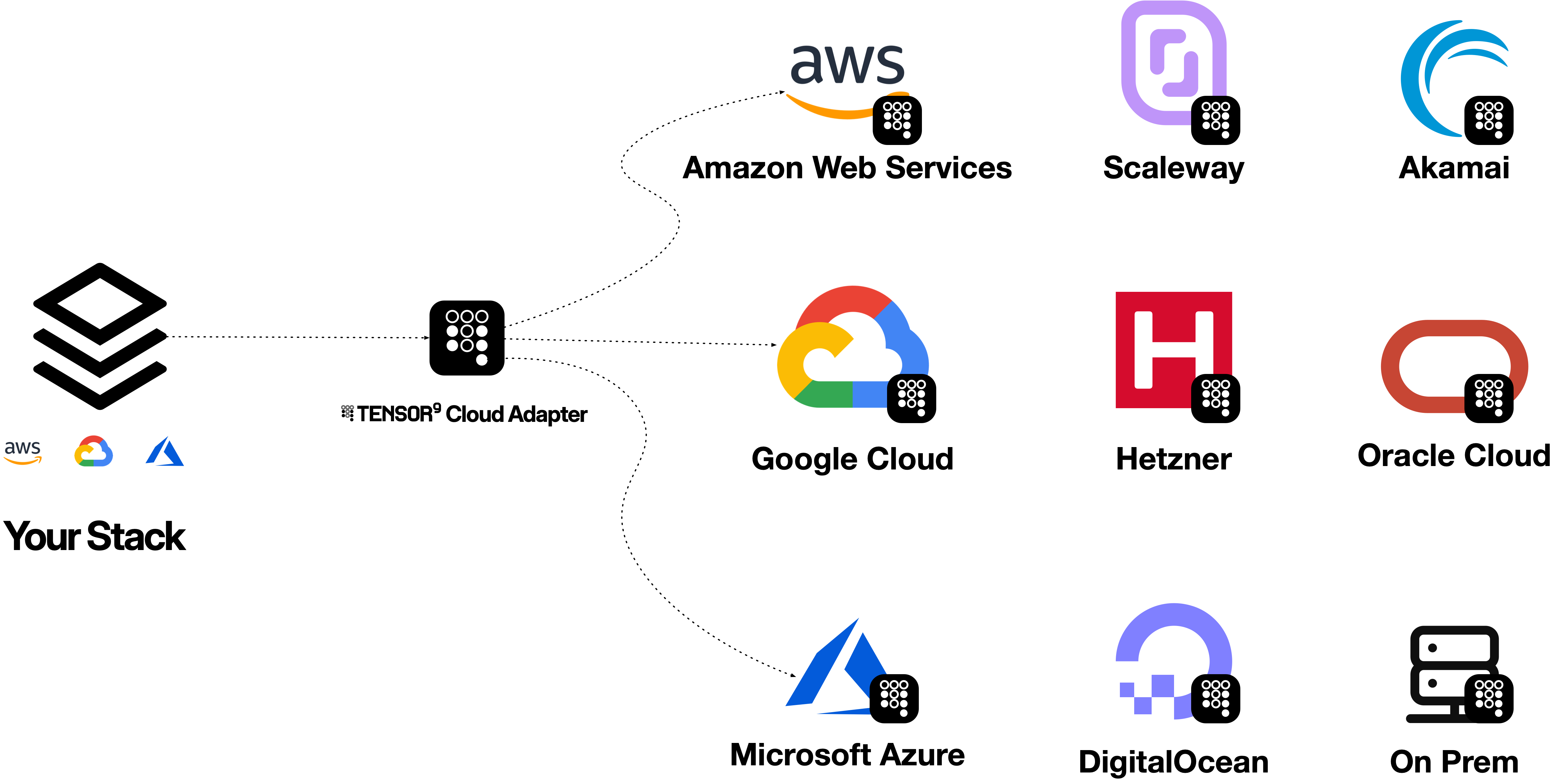
- Cloud service portability: Keep an origin-cloud API while selecting a backend in another cloud or environment.
- Application continuity: Preserve application code, SDK models and request patterns for the operations covered by the selected service adapter.
- Target-native operation: Store data and perform work in the target service rather than maintaining a separate application integration for it.
- Consistent operations: Configure, deploy, update, tune and debug service adapters through one Cloud Adapter workflow.
- High-fidelity testing: Exercise cloud API behavior locally before validating cloud-specific identity, networking, quota and lifecycle behavior against the target service.
What makes the approach different?
- Adaptation, not abstraction: Your application continues to use its existing cloud interface instead of being rewritten around a new portability API.
- Service-specific contracts: Each mapping documents its backends, supported behavior, configuration and differences. Direction matters: an origin-to-target mapping is not automatically reversible.
- Target-native choices: Tuning lets a supported origin request carry target-specific decisions without changing the application’s primary API model.
- Explainable behavior: Diagnostic response headers, service references and
tensor9 explainhelp show how a request is handled and where to investigate a failure.
How is it different from Tensor9 BYOC?
Cloud Adapter focuses on cloud service APIs and their backends. You choose the adapters, configuration and deployment shape needed by your application. Tensor9 BYOC delivers and operates an entire software product inside a customer’s infrastructure. It adapts the full application stack and includes the customer installation and operational model around it.What scenarios is Cloud Adapter useful for?
- Move a workload across clouds: Keep the application’s origin SDK while selected services run in the destination cloud.
- Meet regional or sovereignty requirements: Place service data and operations in an environment selected for the workload.
- Use a different managed-service backend: Retain the origin API while choosing a backend that fits the target environment’s operational model.
- Develop and test locally: Run bounded, repeatable tests with High Fidelity Cloud Emulators, then verify target-cloud behavior with isolated resources.
- Support cloud-aware tools: Point CLIs, SDKs and infrastructure tools at a Cloud Adapter endpoint when their required services and operations are supported.