

google::1.0.0::compute::network, with backend choices shown together. Read how Tensor9 estimates service-adapter costs for price scope and capacity qualification, or return to additional services.
Virtual network and NAT allocation (VPC network) → VPC
Origin API:google::1.0.0::compute::network. Target backend: aws::1.0.0::vpc.
Designed mapping. This cost model describes an intended adapter. Its estimated price does not establish a delivered or selectable backend.
Virtual network and NAT allocation (VPC network) · Selected network GiB per month
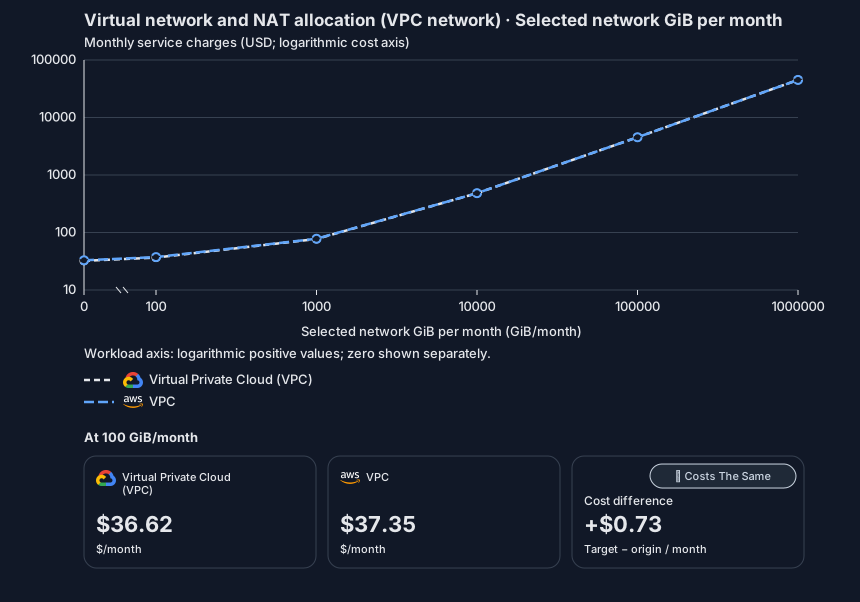
Estimated monthly service charges by Selected network GiB per month. Adapter hosting and Tensor9 fees are excluded. Source: us-central1; target: us-east-1; currency: USD.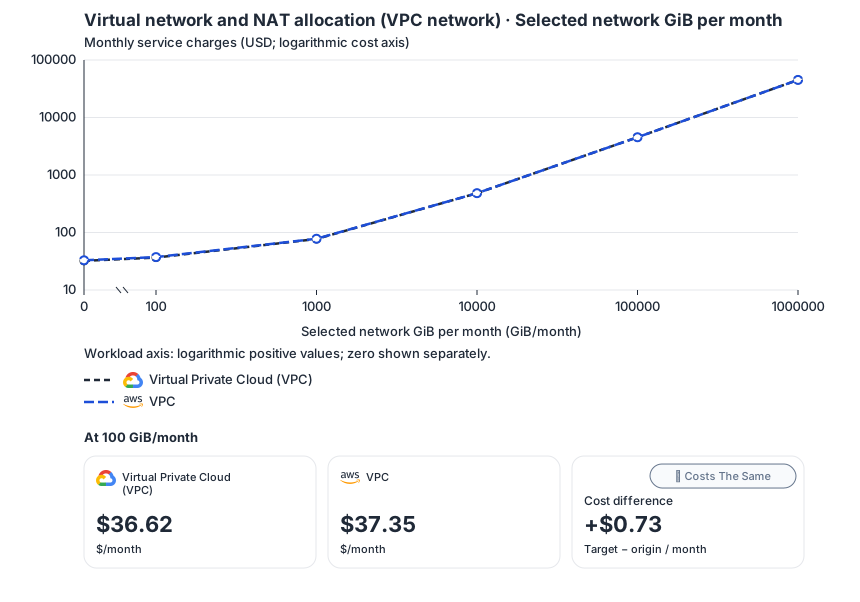
Curve assumptions
- Only this native meter varies; all other source usage and translation assumptions retain the displayed defaults. Editable authored planning guesses, not verified provider tariffs, benchmark measurements or a commercial quote. Other native meters retain their explicitly displayed default quantities.
- Planning estimate · editable authored rates and sizing assumptions dated 2026-10-22; not verified provider prices. us-central1 → us-east-1, USD/month.
- Source prices are reference charges, not an invoice. Target lines cover selected service usage/configuration only; adapter hosting and Tensor9 fees are excluded.
- Explicit tariff samples are not performance measurements or capacity qualification. No interpolation or break-even guarantee is implied.
- Variant assumptions show the first axis sample; any axis-dependent configuration is described by this curve’s workload note.
- Rates are cited provider list prices, editable for discounts, commitments or another region. Workload translation and capacity coefficients remain editable planning assumptions, not benchmark measurements or a commercial quote.
- Default-zero rates are explicit assumptions, not evidence that the deployed service or resource is free.
- Provisioned-unit minimums use an editable approximate allocation floor. Modeled target service cost is max(usage/allocation, minimum), with billable network, durable staging and dependent sinks added separately; actual RU/TU sizing, scaling increments and throughput remain unqualified.
- Durable staging is priced once: provisioned targets include adapter state in their selected allocation; native targets add a separate staging allocation when required. Adapter hosting is a separate allocation and must exclude resources already priced as staging, workers or target capacity.
- A declared adapter mapping and cost model do not establish implementation availability or service equivalence.
- This exact directed mapping has a design profile. Cost modeling does not establish an implemented or deployable adapter.
- Origin unit prices are cited provider list prices; capacity coefficients and translation assumptions are editable authored planning guesses, not measured capacity or a provider quote.
- Management requests do not reveal resource allocation or workload traffic. Provisioned resources and traffic are independent inputs.
- Resource-hours represent selected gateway allocation, not a claim that the network object has an hourly fee.
- Use matching source and target traffic scope: NAT processing, inter-zone transfer and internet egress are different meters.
- Resource-hours are the selected NAT/gateway allocation, not a fee for the network object; network GiB is the gateway’s processed or transferred traffic. Free management API calls do not reveal network traffic. Internet egress (0.09/GB) is additional for traffic leaving AWS.
- VPC pricing: https://cloud.google.com/vpc/pricing
- Cloud NAT pricing: https://cloud.google.com/nat/pricing
- Amazon EC2 price list (AWS Price List API): https://pricing.us-east-1.amazonaws.com/offers/v1.0/aws/AmazonEC2/current/us-east-1/index.csv
- Public IPv4, VPN/interconnect, firewalls, private endpoints, DNS, peering and traffic outside the selected transfer scope.
- Taxes, discounts, credits and free-tier allowances unless explicitly reflected in edited rates.
- Unmodeled dependent services, task execution and operations outside the selected workload family.
plan-bbd4b072184ddf6e48fb129999920b063ad16ecb / 2026-10-22.planning.2. Curve: workload-1.
Sources: VPC pricing, Cloud NAT pricing, Amazon EC2 price list (AWS Price List API).
Virtual network and NAT allocation (VPC network) → Virtual Network
Origin API:google::1.0.0::compute::network. Target backend: azure::1.0.0::vnet.
Designed mapping. This cost model describes an intended adapter. Its estimated price does not establish a delivered or selectable backend.
Virtual network and NAT allocation (VPC network) · Selected network GiB per month
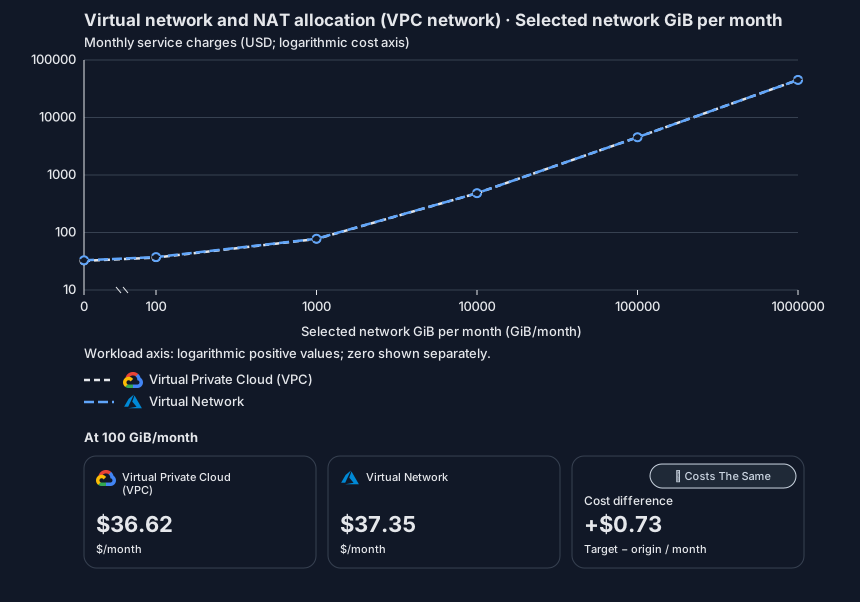
Estimated monthly service charges by Selected network GiB per month. Adapter hosting and Tensor9 fees are excluded. Source: us-central1; target: Global; currency: USD.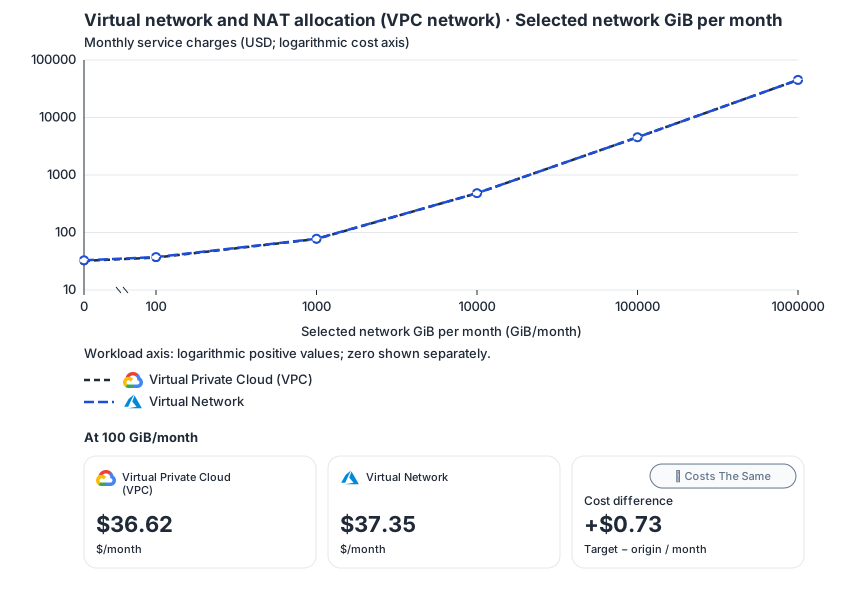
Curve assumptions
- Only this native meter varies; all other source usage and translation assumptions retain the displayed defaults. Editable authored planning guesses, not verified provider tariffs, benchmark measurements or a commercial quote. Other native meters retain their explicitly displayed default quantities.
- Planning estimate · editable authored rates and sizing assumptions dated 2026-10-22; not verified provider prices. us-central1 → Global, USD/month.
- Source prices are reference charges, not an invoice. Target lines cover selected service usage/configuration only; adapter hosting and Tensor9 fees are excluded.
- Explicit tariff samples are not performance measurements or capacity qualification. No interpolation or break-even guarantee is implied.
- Variant assumptions show the first axis sample; any axis-dependent configuration is described by this curve’s workload note.
- Rates are cited provider list prices, editable for discounts, commitments or another region. Workload translation and capacity coefficients remain editable planning assumptions, not benchmark measurements or a commercial quote.
- Default-zero rates are explicit assumptions, not evidence that the deployed service or resource is free.
- Provisioned-unit minimums use an editable approximate allocation floor. Modeled target service cost is max(usage/allocation, minimum), with billable network, durable staging and dependent sinks added separately; actual RU/TU sizing, scaling increments and throughput remain unqualified.
- Durable staging is priced once: provisioned targets include adapter state in their selected allocation; native targets add a separate staging allocation when required. Adapter hosting is a separate allocation and must exclude resources already priced as staging, workers or target capacity.
- A declared adapter mapping and cost model do not establish implementation availability or service equivalence.
- This exact directed mapping has a design profile. Cost modeling does not establish an implemented or deployable adapter.
- Origin unit prices are cited provider list prices; capacity coefficients and translation assumptions are editable authored planning guesses, not measured capacity or a provider quote.
- Management requests do not reveal resource allocation or workload traffic. Provisioned resources and traffic are independent inputs.
- Resource-hours represent selected gateway allocation, not a claim that the network object has an hourly fee.
- Use matching source and target traffic scope: NAT processing, inter-zone transfer and internet egress are different meters.
- Resource-hours are the selected NAT/gateway allocation, not a fee for the network object; network GiB is the gateway’s processed or transferred traffic. Free management API calls do not reveal network traffic.
- VPC pricing: https://cloud.google.com/vpc/pricing
- Cloud NAT pricing: https://cloud.google.com/nat/pricing
- Azure Retail Prices API: https://prices.azure.com/api/retail/prices
- Public IPv4, VPN/interconnect, firewalls, private endpoints, DNS, peering and traffic outside the selected transfer scope.
- Taxes, discounts, credits and free-tier allowances unless explicitly reflected in edited rates.
- Unmodeled dependent services, task execution and operations outside the selected workload family.
plan-196cb4dbbfb0b48a51712e12d4b9a5b2e913b0f7 / 2026-10-22.planning.2. Curve: workload-1.
Sources: VPC pricing, Cloud NAT pricing, Azure Retail Prices API.
See the service catalog for operation coverage, supported directions and backend limitations.