

SQS FIFO → Azure Cosmos DB (queue)
Origin API:aws::1.0.0::sqs::fifo. Target backend: azure::1.0.0::cosmosdb::queue.
SQS FIFO · SQS request billing units
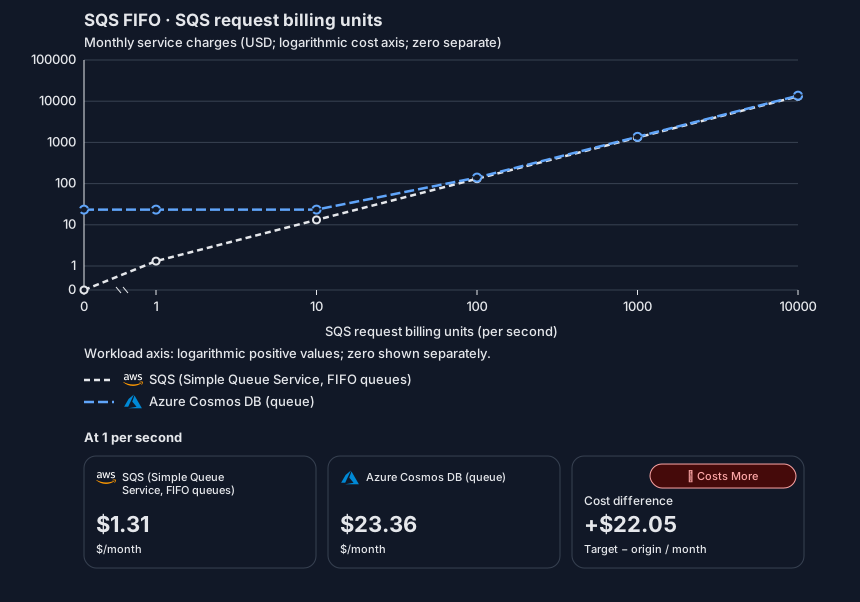
Estimated monthly service charges by SQS request billing units. Adapter hosting and Tensor9 fees are excluded. Source: us-east-1; target: East US; currency: USD.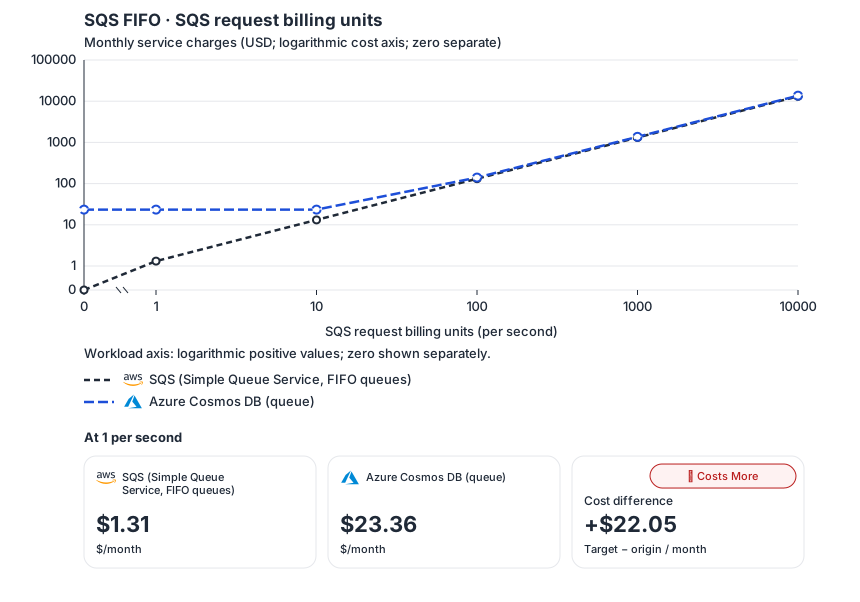
Curve assumptions
- 1-KiB messages, unbatched send/receive/delete; actual batch and delivery assumptions stay visible. Editable authored planning guesses, not verified provider tariffs, benchmark measurements or a commercial quote. Other native meters retain their explicitly displayed default quantities.
- Planning estimate · editable authored rates and sizing assumptions dated 2026-10-22; not verified provider prices. us-east-1 → East US, USD/month.
- Source prices are reference charges, not an invoice. Target lines cover selected service usage/configuration only; adapter hosting and Tensor9 fees are excluded.
- Explicit tariff samples are not performance measurements or capacity qualification. No interpolation or break-even guarantee is implied.
- Variant assumptions show the first axis sample; any axis-dependent configuration is described by this curve’s workload note.
- Rates are cited provider list prices, editable for discounts, commitments or another region. Workload translation and capacity coefficients remain editable planning assumptions, not benchmark measurements or a commercial quote.
- Default-zero rates are explicit assumptions, not evidence that the deployed service or resource is free.
- Provisioned-unit minimums use an editable approximate allocation floor. Modeled target service cost is max(usage/allocation, minimum), with billable network, durable staging and dependent sinks added separately; actual RU/TU sizing, scaling increments and throughput remain unqualified.
- Durable staging is priced once: provisioned targets include adapter state in their selected allocation; native targets add a separate staging allocation when required. Adapter hosting is a separate allocation and must exclude resources already priced as staging, workers or target capacity.
- A declared adapter mapping and cost model do not establish implementation availability or service equivalence.
- This is a declared directed mapping; a planning estimate does not establish deployment or request-serving support.
- Authored planning assumptions, not measured adapter capacity. Origin rates are cited first-tier list prices, before free allowances and discounts.
- A cost scenario does not establish backend availability, protocol fidelity or production readiness. Registry serving status remains independent.
- Storage follows resident original messages, not every monthly message. Broker delivery bytes include redeliveries.
- FIFO estimates do not qualify dedup support, group throughput or single-group latency; backend limitations remain applicable.
- Azure Cosmos DB provisioned throughput bills 100-RU/s blocks per hour and stored GB-months; operations within the provisioned RU/s have no separate charge. Blocks are sized from the family’s reads at 1 RU and writes at 5.5 RU (1 KB items, no extra indexing) at full utilization after the planning peak factor, with the 400 RU/s smallest manual allocation as the floor (USD 23.36/month). Larger messages, indexing and query-based receives raise the RU charge; autoscale (USD 0.012 per 100 RU/s-hour) and serverless (USD 0.25 per million RUs) are not selected.
- AWS Price List API, AWSQueueService offer: https://pricing.us-east-1.amazonaws.com/offers/v1.0/aws/AWSQueueService/current/us-east-1/index.json
- Azure Retail Prices API: https://prices.azure.com/api/retail/prices
- Additional network transfer, backups, KMS, one-time migration and operational labor unless an explicit meter includes them.
- Destination application execution and separately billed downstream services; supply those allocations separately.
- Taxes, discounts, credits and free-tier allowances unless explicitly reflected in edited rates.
- Unmodeled dependent services, task execution and operations outside the selected workload family.
plan-4f4f008a52eb766d518aa4f34d3302fdb02b1a67 / 2026-10-22.planning.2. Curve: workload-1.
Sources: AWS Price List API, AWSQueueService offer, Azure Retail Prices API.
SQS FIFO → Azure Service Bus
Origin API:aws::1.0.0::sqs::fifo. Target backend: azure::1.0.0::servicebus.
SQS FIFO · SQS request billing units
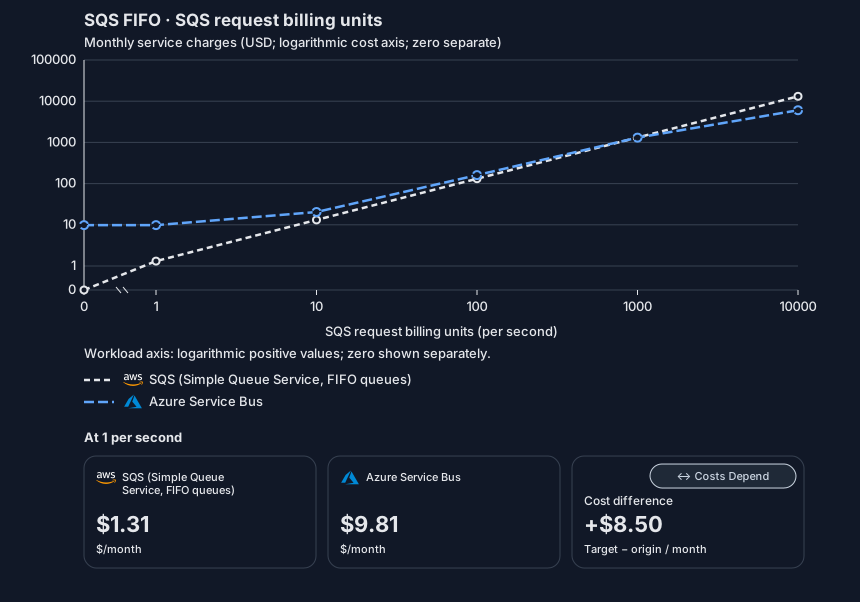
Estimated monthly service charges by SQS request billing units. Adapter hosting and Tensor9 fees are excluded. Source: us-east-1; target: East US; currency: USD.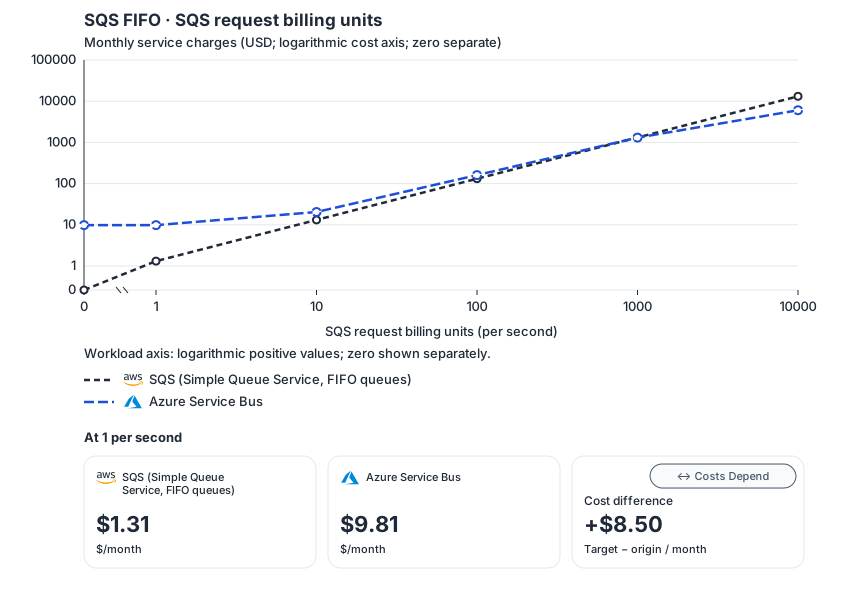
Curve assumptions
- 1-KiB messages, unbatched send/receive/delete; actual batch and delivery assumptions stay visible. Editable authored planning guesses, not verified provider tariffs, benchmark measurements or a commercial quote. Other native meters retain their explicitly displayed default quantities.
- Planning estimate · editable authored rates and sizing assumptions dated 2026-10-22; not verified provider prices. us-east-1 → East US, USD/month.
- Source prices are reference charges, not an invoice. Target lines cover selected service usage/configuration only; adapter hosting and Tensor9 fees are excluded.
- Explicit tariff samples are not performance measurements or capacity qualification. No interpolation or break-even guarantee is implied.
- Variant assumptions show the first axis sample; any axis-dependent configuration is described by this curve’s workload note.
- Rates are cited provider list prices, editable for discounts, commitments or another region. Workload translation and capacity coefficients remain editable planning assumptions, not benchmark measurements or a commercial quote.
- Default-zero rates are explicit assumptions, not evidence that the deployed service or resource is free.
- Provisioned-unit minimums use an editable approximate allocation floor. Modeled target service cost is max(usage/allocation, minimum), with billable network, durable staging and dependent sinks added separately; actual RU/TU sizing, scaling increments and throughput remain unqualified.
- Durable staging is priced once: provisioned targets include adapter state in their selected allocation; native targets add a separate staging allocation when required. Adapter hosting is a separate allocation and must exclude resources already priced as staging, workers or target capacity.
- A declared adapter mapping and cost model do not establish implementation availability or service equivalence.
- This is a declared directed mapping; a planning estimate does not establish deployment or request-serving support.
- Authored planning assumptions, not measured adapter capacity. Origin rates are cited first-tier list prices, before free allowances and discounts.
- A cost scenario does not establish backend availability, protocol fidelity or production readiness. Registry serving status remains independent.
- Storage follows resident original messages, not every monthly message. Broker delivery bytes include redeliveries.
- FIFO estimates do not qualify dedup support, group throughput or single-group latency; backend limitations remain applicable.
- Azure Service Bus Standard bills a namespace base charge that includes 13 million operations a month, then graduated per-operation prices: USD 0.80 per million to 100 million, 0.50 to 2,500 million and 0.20 beyond. An operation is any API call (send, receive, complete) per 64 KB of message; the family’s managed operations count calls, not 64 KB units. Standard has no storage charge (queue size quota up to 5 GB is included). More than 1,000 brokered connections bill USD 0.03 per connection-month, which this profile does not model.
- AWS Price List API, AWSQueueService offer: https://pricing.us-east-1.amazonaws.com/offers/v1.0/aws/AWSQueueService/current/us-east-1/index.json
- Azure Retail Prices API: https://prices.azure.com/api/retail/prices
- Additional network transfer, backups, KMS, one-time migration and operational labor unless an explicit meter includes them.
- Destination application execution and separately billed downstream services; supply those allocations separately.
- Taxes, discounts, credits and free-tier allowances unless explicitly reflected in edited rates.
- Unmodeled dependent services, task execution and operations outside the selected workload family.
plan-41a96e9bd678520a179bd0f5bb232496011160b0 / 2026-10-22.planning.2. Curve: workload-1.
Sources: AWS Price List API, AWSQueueService offer, Azure Retail Prices API.
SQS FIFO → Cloud SQL for PostgreSQL
Origin API:aws::1.0.0::sqs::fifo. Target backend: google::1.0.0::cloudsql::postgresql.
SQS FIFO · SQS request billing units
Estimated monthly service charges by SQS request billing units. Adapter hosting and Tensor9 fees are excluded. Source: us-east-1; target: us-central1; currency: USD.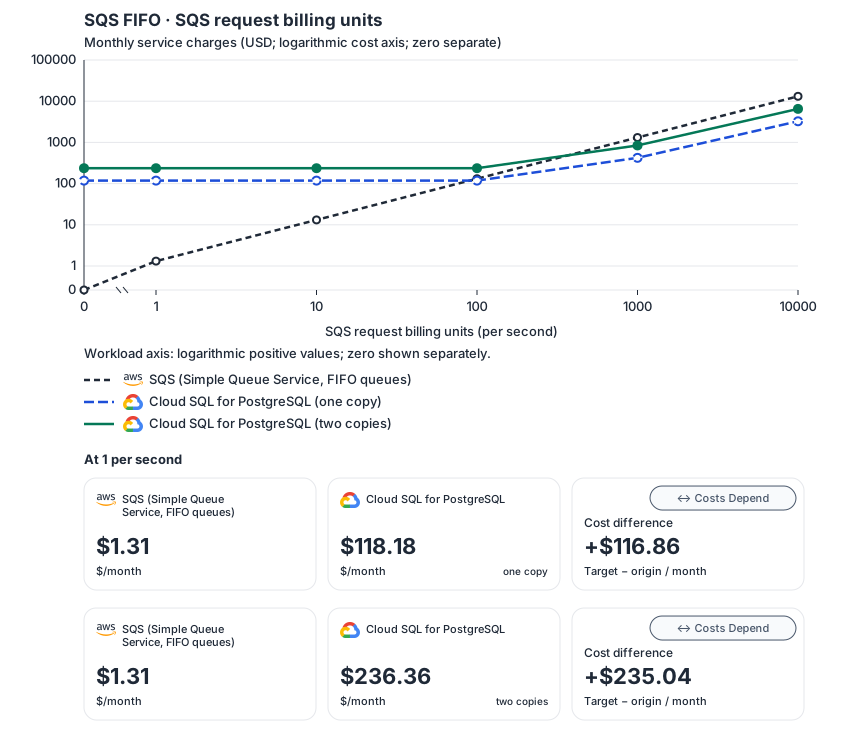
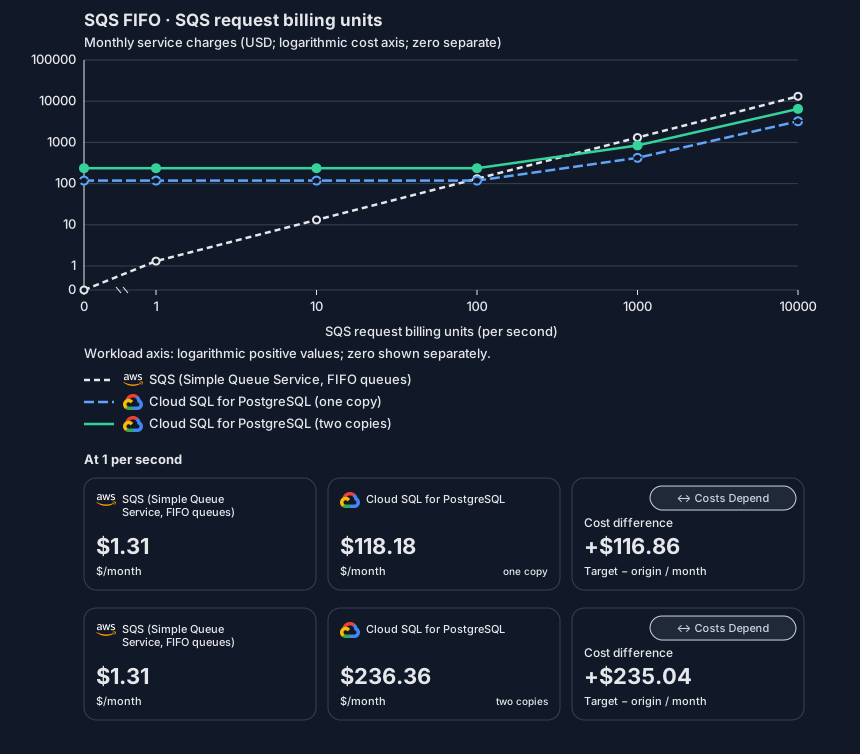
Estimated allocation from planning assumptions; not benchmark calibrated.
The sizing policy grows compute with translated work and peak headroom, memory with compute and working set, and disk with resident working state and reserve. Monthly usage is distinct from resident data; each workload’s assumptions define the translation. HA changes pricing, not this policy’s throughput estimate. Unpriced workloads exceed the policy’s configuration range; no silent vertical cap or automatic sharding is assumed.
- Row-store throughput (capacityOpsPerVcpuSecond, default 1500) is measured-by-tensor9 as a lower bound: the DynamoDB adapter on Cloud SQL db-custom-2-7680 (2 vCPU, PostgreSQL 16, us-west1) served 2,974 ops/s of YCSB-A at 16 threads without recorded saturation (src/main/kotlin/t9/prime/equiv/generated/eval/CloudsqlPostgresqlYcsbAT16GoYcsbV1_0_0.kt). Published CPU-bound pgbench reaches 3,101 read-write transactions and 20,289 point reads per vCPU-second (AWS z1d.2xlarge, PostgreSQL 14.5), so actual capacity is likely higher. Reads and writes share one coefficient: at the same adapter version, read-only YCSB-C was not faster than 50%-update YCSB-A.
- Log-broker throughput (capacityStreamMiBPerVcpuSecond 20 at 0.5 utilization, 4 GiB RAM per vCPU) is provider-documented by Google Managed Service for Apache Kafka sizing (https://docs.cloud.google.com/managed-service-for-apache-kafka/docs/plan-cluster-size): write-equivalent bytes are replicated writes plus a quarter of reads. Producer batches below 10 KB lower per-CPU throughput; that penalty is not modeled.
- Disk utilization 0.8 is provider-documented headroom below Cloud SQL automatic storage increase, which triggers near 91-95% full (https://docs.cloud.google.com/sql/docs/postgres/instance-settings). The 20 GiB reserve exceeds PostgreSQL’s 1 GB default max_wal_size; the remainder of that reserve is unmeasured.
- CPU tiers, 4 GiB per vCPU, at most 6.5 GiB per vCPU, 96 vCPU and 65,536 GiB disk follow Cloud SQL Enterprise custom machine limits (provider-documented, same page); 624 GiB is 96 × 6.5. Targets billed per node, unit or throughput unit are sized by their backend instead.
- No public evidence: peak/mean work (2) and the RAM working-set fraction (0.1). Proposed measurements: the p99 one-minute rate over the monthly mean from customer CloudWatch metrics; the buffer hit ratio while stepping RAM under a fixed YCSB-B load.
- Stored GiB already includes the origin family’s physical footprint assumptions; no second storage amplification is applied.
- The operations/vCPU coefficient supplies the compute requirement alongside explicit resource-hour minima.
- Copies and allocation fractions change cost only; they do not increase modeled primary capacity.
- 1-KiB messages, unbatched send/receive/delete; actual batch and delivery assumptions stay visible. Editable authored planning guesses, not verified provider tariffs, benchmark measurements or a commercial quote. Other native meters retain their explicitly displayed default quantities.
- Planning estimate · editable authored rates and sizing assumptions dated 2026-10-22; not verified provider prices. us-east-1 → us-central1, USD/month.
- Source prices are reference charges, not an invoice. Target lines cover selected service usage/configuration only; adapter hosting and Tensor9 fees are excluded.
- Explicit tariff samples are not performance measurements or capacity qualification. No interpolation or break-even guarantee is implied.
- Variant assumptions show the first axis sample; any axis-dependent configuration is described by this curve’s workload note.
- Rates are cited provider list prices, editable for discounts, commitments or another region. Workload translation and capacity coefficients remain editable planning assumptions, not benchmark measurements or a commercial quote.
- Default-zero rates are explicit assumptions, not evidence that the deployed service or resource is free.
- Provisioned-unit minimums use an editable approximate allocation floor. Modeled target service cost is max(usage/allocation, minimum), with billable network, durable staging and dependent sinks added separately; actual RU/TU sizing, scaling increments and throughput remain unqualified.
- Durable staging is priced once: provisioned targets include adapter state in their selected allocation; native targets add a separate staging allocation when required. Adapter hosting is a separate allocation and must exclude resources already priced as staging, workers or target capacity.
- A declared adapter mapping and cost model do not establish implementation availability or service equivalence.
- This is a declared directed mapping; a planning estimate does not establish deployment or request-serving support.
- Authored planning assumptions, not measured adapter capacity. Origin rates are cited first-tier list prices, before free allowances and discounts.
- A cost scenario does not establish backend availability, protocol fidelity or production readiness. Registry serving status remains independent.
- Storage follows resident original messages, not every monthly message. Broker delivery bytes include redeliveries.
- FIFO estimates do not qualify dedup support, group throughput or single-group latency; backend limitations remain applicable.
- Cloud SQL Enterprise edition (PostgreSQL) publishes separate vCPU, memory and SSD prices for zonal instances; a high-availability (regional) instance bills exactly twice each, which the standby copy reproduces. Enterprise Plus, committed-use discounts, backups (USD 0.08 per GiB-month) and idle IPv4 addresses (0.01 per hour) are not selected.
- Row-store throughput (capacityOpsPerVcpuSecond, default 1500) is measured-by-tensor9 as a lower bound: the DynamoDB adapter on Cloud SQL db-custom-2-7680 (2 vCPU, PostgreSQL 16, us-west1) served 2,974 ops/s of YCSB-A at 16 threads without recorded saturation (src/main/kotlin/t9/prime/equiv/generated/eval/CloudsqlPostgresqlYcsbAT16GoYcsbV1_0_0.kt). Published CPU-bound pgbench reaches 3,101 read-write transactions and 20,289 point reads per vCPU-second (AWS z1d.2xlarge, PostgreSQL 14.5), so actual capacity is likely higher. Reads and writes share one coefficient: at the same adapter version, read-only YCSB-C was not faster than 50%-update YCSB-A.
- Log-broker throughput (capacityStreamMiBPerVcpuSecond 20 at 0.5 utilization, 4 GiB RAM per vCPU) is provider-documented by Google Managed Service for Apache Kafka sizing (https://docs.cloud.google.com/managed-service-for-apache-kafka/docs/plan-cluster-size): write-equivalent bytes are replicated writes plus a quarter of reads. Producer batches below 10 KB lower per-CPU throughput; that penalty is not modeled.
- Disk utilization 0.8 is provider-documented headroom below Cloud SQL automatic storage increase, which triggers near 91-95% full (https://docs.cloud.google.com/sql/docs/postgres/instance-settings). The 20 GiB reserve exceeds PostgreSQL’s 1 GB default max_wal_size; the remainder of that reserve is unmeasured.
- CPU tiers, 4 GiB per vCPU, at most 6.5 GiB per vCPU, 96 vCPU and 65,536 GiB disk follow Cloud SQL Enterprise custom machine limits (provider-documented, same page); 624 GiB is 96 × 6.5. Targets billed per node, unit or throughput unit are sized by their backend instead.
- No public evidence: peak/mean work (2) and the RAM working-set fraction (0.1). Proposed measurements: the p99 one-minute rate over the monthly mean from customer CloudWatch metrics; the buffer hit ratio while stepping RAM under a fixed YCSB-B load.
- Stored GiB already includes the origin family’s physical footprint assumptions; no second storage amplification is applied.
- The operations/vCPU coefficient supplies the compute requirement alongside explicit resource-hour minima.
- Copies and allocation fractions change cost only; they do not increase modeled primary capacity.
- AWS Price List API, AWSQueueService offer: https://pricing.us-east-1.amazonaws.com/offers/v1.0/aws/AWSQueueService/current/us-east-1/index.json
- Cloud SQL pricing: https://cloud.google.com/sql/pricing
- Additional network transfer, backups, KMS, one-time migration and operational labor unless an explicit meter includes them.
- Destination application execution and separately billed downstream services; supply those allocations separately.
- Taxes, discounts, credits and free-tier allowances unless explicitly reflected in edited rates.
- Unmodeled dependent services, task execution and operations outside the selected workload family.
plan-c35b94f39c83dfc6e65b2063cdc3c7857cb28524 / 2026-10-22.planning.2. Curve: workload-1.
Sources: AWS Price List API, AWSQueueService offer, Cloud SQL pricing.
SQS FIFO → PostgreSQL
Origin API:aws::1.0.0::sqs::fifo. Target backend: postgres::1.0.0::database.
SQS FIFO · SQS request billing units
Estimated monthly service charges by SQS request billing units. Adapter hosting and Tensor9 fees are excluded. Source: us-east-1; target: us-central1; currency: USD.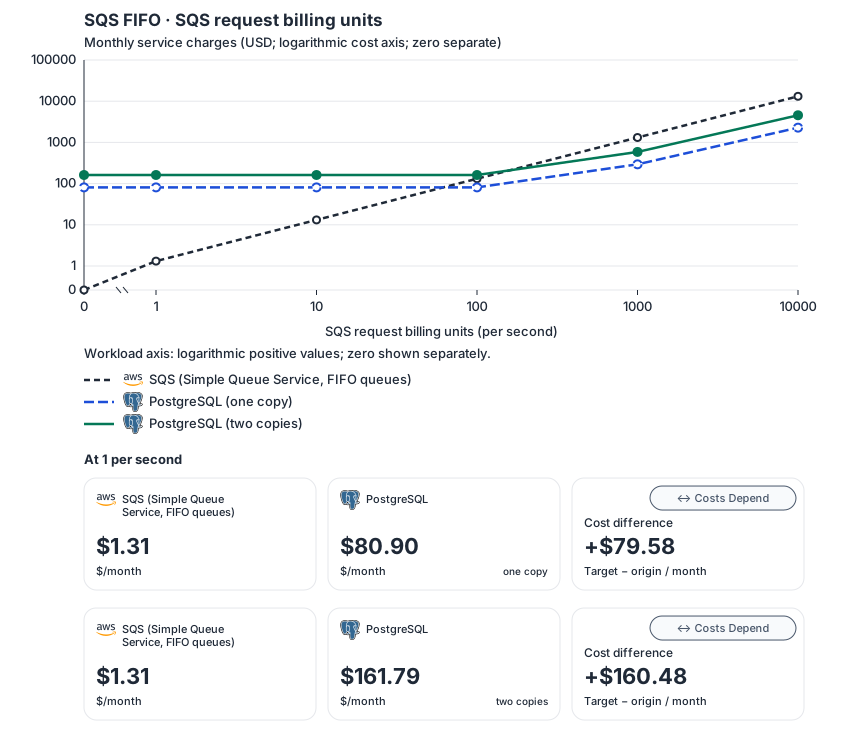
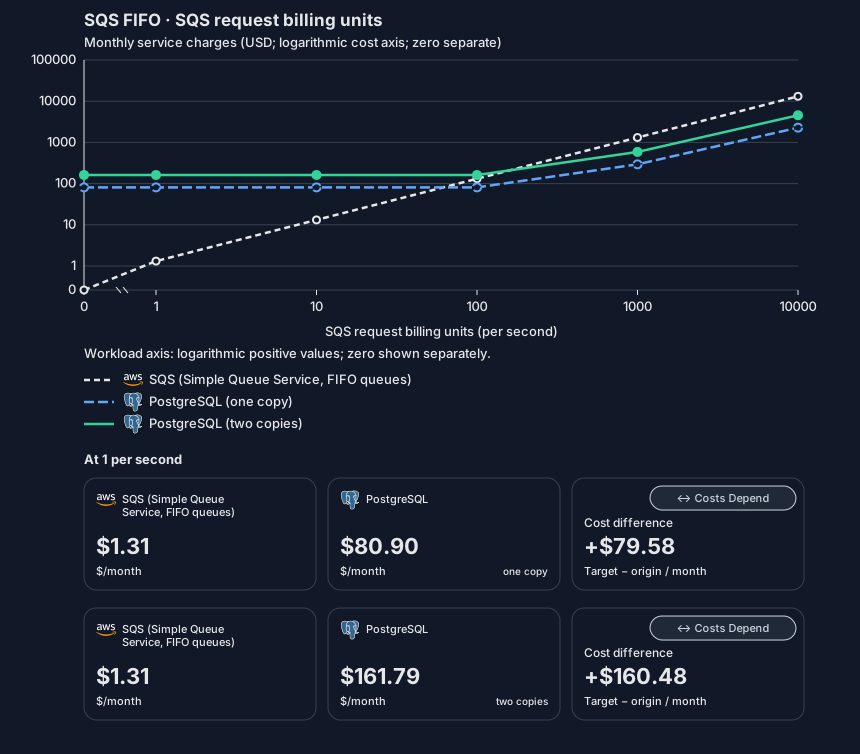
Estimated allocation from planning assumptions; not benchmark calibrated.
The sizing policy grows compute with translated work and peak headroom, memory with compute and working set, and disk with resident working state and reserve. Monthly usage is distinct from resident data; each workload’s assumptions define the translation. HA changes pricing, not this policy’s throughput estimate. Unpriced workloads exceed the policy’s configuration range; no silent vertical cap or automatic sharding is assumed.
- Row-store throughput (capacityOpsPerVcpuSecond, default 1500) is measured-by-tensor9 as a lower bound: the DynamoDB adapter on Cloud SQL db-custom-2-7680 (2 vCPU, PostgreSQL 16, us-west1) served 2,974 ops/s of YCSB-A at 16 threads without recorded saturation (src/main/kotlin/t9/prime/equiv/generated/eval/CloudsqlPostgresqlYcsbAT16GoYcsbV1_0_0.kt). Published CPU-bound pgbench reaches 3,101 read-write transactions and 20,289 point reads per vCPU-second (AWS z1d.2xlarge, PostgreSQL 14.5), so actual capacity is likely higher. Reads and writes share one coefficient: at the same adapter version, read-only YCSB-C was not faster than 50%-update YCSB-A.
- Log-broker throughput (capacityStreamMiBPerVcpuSecond 20 at 0.5 utilization, 4 GiB RAM per vCPU) is provider-documented by Google Managed Service for Apache Kafka sizing (https://docs.cloud.google.com/managed-service-for-apache-kafka/docs/plan-cluster-size): write-equivalent bytes are replicated writes plus a quarter of reads. Producer batches below 10 KB lower per-CPU throughput; that penalty is not modeled.
- Disk utilization 0.8 is provider-documented headroom below Cloud SQL automatic storage increase, which triggers near 91-95% full (https://docs.cloud.google.com/sql/docs/postgres/instance-settings). The 20 GiB reserve exceeds PostgreSQL’s 1 GB default max_wal_size; the remainder of that reserve is unmeasured.
- CPU tiers, 4 GiB per vCPU, at most 6.5 GiB per vCPU, 96 vCPU and 65,536 GiB disk follow Cloud SQL Enterprise custom machine limits (provider-documented, same page); 624 GiB is 96 × 6.5. Targets billed per node, unit or throughput unit are sized by their backend instead.
- No public evidence: peak/mean work (2) and the RAM working-set fraction (0.1). Proposed measurements: the p99 one-minute rate over the monthly mean from customer CloudWatch metrics; the buffer hit ratio while stepping RAM under a fixed YCSB-B load.
- Stored GiB already includes the origin family’s physical footprint assumptions; no second storage amplification is applied.
- The operations/vCPU coefficient supplies the compute requirement alongside explicit resource-hour minima.
- Copies and allocation fractions change cost only; they do not increase modeled primary capacity.
- 1-KiB messages, unbatched send/receive/delete; actual batch and delivery assumptions stay visible. Editable authored planning guesses, not verified provider tariffs, benchmark measurements or a commercial quote. Other native meters retain their explicitly displayed default quantities.
- Planning estimate · editable authored rates and sizing assumptions dated 2026-10-22; not verified provider prices. us-east-1 → us-central1, USD/month.
- Source prices are reference charges, not an invoice. Target lines cover selected service usage/configuration only; adapter hosting and Tensor9 fees are excluded.
- Explicit tariff samples are not performance measurements or capacity qualification. No interpolation or break-even guarantee is implied.
- Variant assumptions show the first axis sample; any axis-dependent configuration is described by this curve’s workload note.
- Rates are cited provider list prices, editable for discounts, commitments or another region. Workload translation and capacity coefficients remain editable planning assumptions, not benchmark measurements or a commercial quote.
- Default-zero rates are explicit assumptions, not evidence that the deployed service or resource is free.
- Provisioned-unit minimums use an editable approximate allocation floor. Modeled target service cost is max(usage/allocation, minimum), with billable network, durable staging and dependent sinks added separately; actual RU/TU sizing, scaling increments and throughput remain unqualified.
- Durable staging is priced once: provisioned targets include adapter state in their selected allocation; native targets add a separate staging allocation when required. Adapter hosting is a separate allocation and must exclude resources already priced as staging, workers or target capacity.
- A declared adapter mapping and cost model do not establish implementation availability or service equivalence.
- This is a declared directed mapping; a planning estimate does not establish deployment or request-serving support.
- Authored planning assumptions, not measured adapter capacity. Origin rates are cited first-tier list prices, before free allowances and discounts.
- A cost scenario does not establish backend availability, protocol fidelity or production readiness. Registry serving status remains independent.
- Storage follows resident original messages, not every monthly message. Broker delivery bytes include redeliveries.
- FIFO estimates do not qualify dedup support, group throughput or single-group latency; backend limitations remain applicable.
- Self-hosted target: PostgreSQL (PostgreSQL License, https://www.postgresql.org/about/licence/). Selected CPU, RAM and physical disk allocation grow with workload; no per-operation price is assumed. No vendor tariff: the target runs on the customer’s Kubernetes nodes, so CPU, RAM and disk bill at the Kubernetes node reference rates, Compute Engine N2 in us-central1 (USD 0.031611/vCPU-hour, 0.004237/GiB-hour) with pd-balanced disk (0.10/GiB-month) and Premium Tier egress. The cost-optimized E2 series lists 0.02181159/vCPU-hour and 0.00292353/GiB-hour; AWS m6i/r6i and Azure D2s v5/E2s v5 both decompose to 0.033/vCPU-hour and 0.00375/GiB-hour. Requested CPU and RAM are billed; node bin-packing waste, system reservations and the cluster control-plane fee are not.
- Row-store throughput (capacityOpsPerVcpuSecond, default 1500) is measured-by-tensor9 as a lower bound: the DynamoDB adapter on Cloud SQL db-custom-2-7680 (2 vCPU, PostgreSQL 16, us-west1) served 2,974 ops/s of YCSB-A at 16 threads without recorded saturation (src/main/kotlin/t9/prime/equiv/generated/eval/CloudsqlPostgresqlYcsbAT16GoYcsbV1_0_0.kt). Published CPU-bound pgbench reaches 3,101 read-write transactions and 20,289 point reads per vCPU-second (AWS z1d.2xlarge, PostgreSQL 14.5), so actual capacity is likely higher. Reads and writes share one coefficient: at the same adapter version, read-only YCSB-C was not faster than 50%-update YCSB-A.
- Log-broker throughput (capacityStreamMiBPerVcpuSecond 20 at 0.5 utilization, 4 GiB RAM per vCPU) is provider-documented by Google Managed Service for Apache Kafka sizing (https://docs.cloud.google.com/managed-service-for-apache-kafka/docs/plan-cluster-size): write-equivalent bytes are replicated writes plus a quarter of reads. Producer batches below 10 KB lower per-CPU throughput; that penalty is not modeled.
- Disk utilization 0.8 is provider-documented headroom below Cloud SQL automatic storage increase, which triggers near 91-95% full (https://docs.cloud.google.com/sql/docs/postgres/instance-settings). The 20 GiB reserve exceeds PostgreSQL’s 1 GB default max_wal_size; the remainder of that reserve is unmeasured.
- CPU tiers, 4 GiB per vCPU, at most 6.5 GiB per vCPU, 96 vCPU and 65,536 GiB disk follow Cloud SQL Enterprise custom machine limits (provider-documented, same page); 624 GiB is 96 × 6.5. Targets billed per node, unit or throughput unit are sized by their backend instead.
- No public evidence: peak/mean work (2) and the RAM working-set fraction (0.1). Proposed measurements: the p99 one-minute rate over the monthly mean from customer CloudWatch metrics; the buffer hit ratio while stepping RAM under a fixed YCSB-B load.
- Stored GiB already includes the origin family’s physical footprint assumptions; no second storage amplification is applied.
- The operations/vCPU coefficient supplies the compute requirement alongside explicit resource-hour minima.
- Copies and allocation fractions change cost only; they do not increase modeled primary capacity.
- AWS Price List API, AWSQueueService offer: https://pricing.us-east-1.amazonaws.com/offers/v1.0/aws/AWSQueueService/current/us-east-1/index.json
- Compute Engine general-purpose machine pricing: https://cloud.google.com/products/compute/pricing/general-purpose
- Disk and image pricing: https://cloud.google.com/compute/disks-image-pricing
- Network pricing: https://cloud.google.com/vpc/network-pricing
- Additional network transfer, backups, KMS, one-time migration and operational labor unless an explicit meter includes them.
- Destination application execution and separately billed downstream services; supply those allocations separately.
- Taxes, discounts, credits and free-tier allowances unless explicitly reflected in edited rates.
- Unmodeled dependent services, task execution and operations outside the selected workload family.
plan-2205b0bb4fecd035329ea8f524e1a885b9bdcdab / 2026-10-22.planning.2. Curve: workload-1.
Sources: AWS Price List API, AWSQueueService offer, Compute Engine general-purpose machine pricing, Disk and image pricing, Network pricing.
SQS FIFO → PostgreSQL Flexible Server
Origin API:aws::1.0.0::sqs::fifo. Target backend: azure::1.0.0::postgresql::flexible.
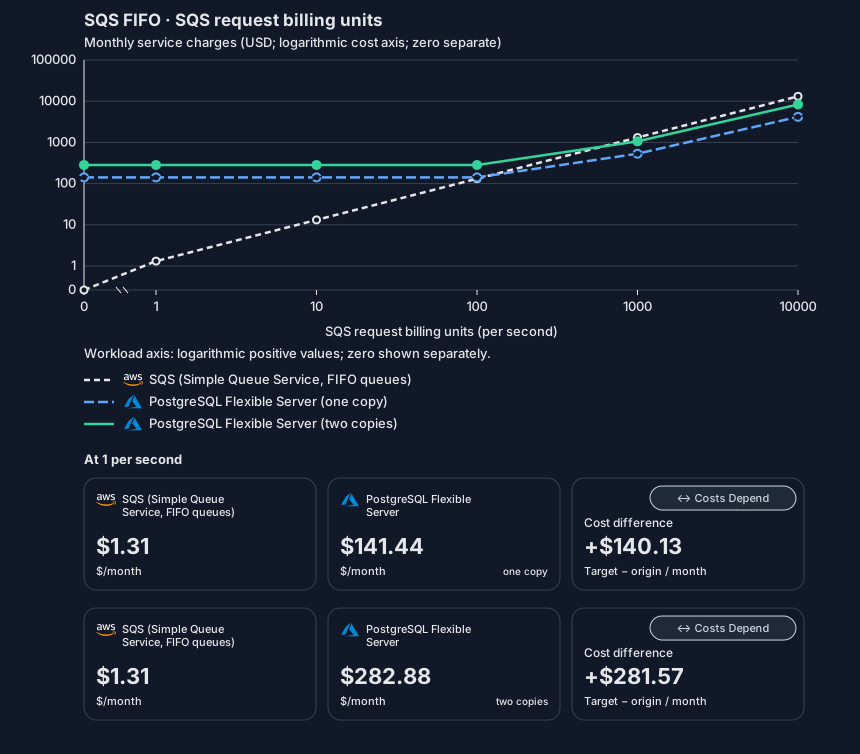
SQS FIFO · SQS request billing units
Estimated monthly service charges by SQS request billing units. Adapter hosting and Tensor9 fees are excluded. Source: us-east-1; target: eastus; currency: USD.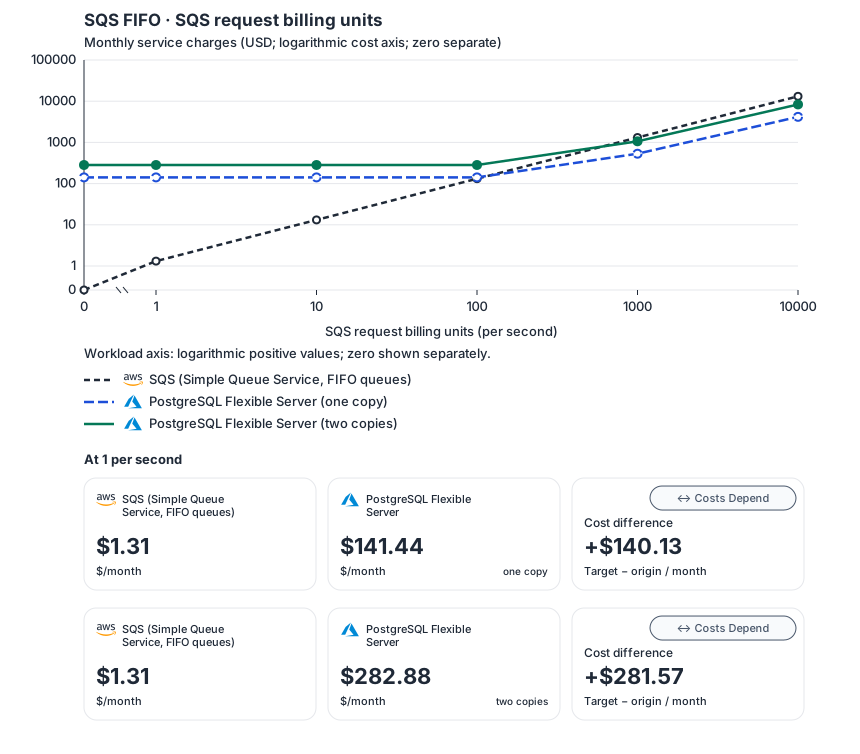
Estimated allocation from planning assumptions; not benchmark calibrated.
The sizing policy grows compute with translated work and peak headroom, memory with compute and working set, and disk with resident working state and reserve. Monthly usage is distinct from resident data; each workload’s assumptions define the translation. HA changes pricing, not this policy’s throughput estimate. Unpriced workloads exceed the policy’s configuration range; no silent vertical cap or automatic sharding is assumed.
- Row-store throughput (capacityOpsPerVcpuSecond, default 1500) is measured-by-tensor9 as a lower bound: the DynamoDB adapter on Cloud SQL db-custom-2-7680 (2 vCPU, PostgreSQL 16, us-west1) served 2,974 ops/s of YCSB-A at 16 threads without recorded saturation (src/main/kotlin/t9/prime/equiv/generated/eval/CloudsqlPostgresqlYcsbAT16GoYcsbV1_0_0.kt). Published CPU-bound pgbench reaches 3,101 read-write transactions and 20,289 point reads per vCPU-second (AWS z1d.2xlarge, PostgreSQL 14.5), so actual capacity is likely higher. Reads and writes share one coefficient: at the same adapter version, read-only YCSB-C was not faster than 50%-update YCSB-A.
- Log-broker throughput (capacityStreamMiBPerVcpuSecond 20 at 0.5 utilization, 4 GiB RAM per vCPU) is provider-documented by Google Managed Service for Apache Kafka sizing (https://docs.cloud.google.com/managed-service-for-apache-kafka/docs/plan-cluster-size): write-equivalent bytes are replicated writes plus a quarter of reads. Producer batches below 10 KB lower per-CPU throughput; that penalty is not modeled.
- Disk utilization 0.8 is provider-documented headroom below Cloud SQL automatic storage increase, which triggers near 91-95% full (https://docs.cloud.google.com/sql/docs/postgres/instance-settings). The 20 GiB reserve exceeds PostgreSQL’s 1 GB default max_wal_size; the remainder of that reserve is unmeasured.
- CPU tiers, 4 GiB per vCPU, at most 6.5 GiB per vCPU, 96 vCPU and 65,536 GiB disk follow Cloud SQL Enterprise custom machine limits (provider-documented, same page); 624 GiB is 96 × 6.5. Targets billed per node, unit or throughput unit are sized by their backend instead.
- No public evidence: peak/mean work (2) and the RAM working-set fraction (0.1). Proposed measurements: the p99 one-minute rate over the monthly mean from customer CloudWatch metrics; the buffer hit ratio while stepping RAM under a fixed YCSB-B load.
- Stored GiB already includes the origin family’s physical footprint assumptions; no second storage amplification is applied.
- The operations/vCPU coefficient supplies the compute requirement alongside explicit resource-hour minima.
- Copies and allocation fractions change cost only; they do not increase modeled primary capacity.
- 1-KiB messages, unbatched send/receive/delete; actual batch and delivery assumptions stay visible. Editable authored planning guesses, not verified provider tariffs, benchmark measurements or a commercial quote. Other native meters retain their explicitly displayed default quantities.
- Planning estimate · editable authored rates and sizing assumptions dated 2026-10-22; not verified provider prices. us-east-1 → eastus, USD/month.
- Source prices are reference charges, not an invoice. Target lines cover selected service usage/configuration only; adapter hosting and Tensor9 fees are excluded.
- Explicit tariff samples are not performance measurements or capacity qualification. No interpolation or break-even guarantee is implied.
- Variant assumptions show the first axis sample; any axis-dependent configuration is described by this curve’s workload note.
- Rates are cited provider list prices, editable for discounts, commitments or another region. Workload translation and capacity coefficients remain editable planning assumptions, not benchmark measurements or a commercial quote.
- Default-zero rates are explicit assumptions, not evidence that the deployed service or resource is free.
- Provisioned-unit minimums use an editable approximate allocation floor. Modeled target service cost is max(usage/allocation, minimum), with billable network, durable staging and dependent sinks added separately; actual RU/TU sizing, scaling increments and throughput remain unqualified.
- Durable staging is priced once: provisioned targets include adapter state in their selected allocation; native targets add a separate staging allocation when required. Adapter hosting is a separate allocation and must exclude resources already priced as staging, workers or target capacity.
- A declared adapter mapping and cost model do not establish implementation availability or service equivalence.
- This is a declared directed mapping; a planning estimate does not establish deployment or request-serving support.
- Authored planning assumptions, not measured adapter capacity. Origin rates are cited first-tier list prices, before free allowances and discounts.
- A cost scenario does not establish backend availability, protocol fidelity or production readiness. Registry serving status remains independent.
- Storage follows resident original messages, not every monthly message. Broker delivery bytes include redeliveries.
- FIFO estimates do not qualify dedup support, group throughput or single-group latency; backend limitations remain applicable.
- Azure Database for PostgreSQL Flexible Server bills vCores with a fixed memory ratio per series; the vCPU and memory rates decompose the General Purpose and Memory Optimized v5 prices. High availability bills the standby’s compute and storage as a second copy. The minimum is the smallest Burstable server, which does not support high availability; the smallest General Purpose server (2 vCores) costs USD 133.62 per month. Additional IOPS, backup storage and reserved capacity are not selected.
- Row-store throughput (capacityOpsPerVcpuSecond, default 1500) is measured-by-tensor9 as a lower bound: the DynamoDB adapter on Cloud SQL db-custom-2-7680 (2 vCPU, PostgreSQL 16, us-west1) served 2,974 ops/s of YCSB-A at 16 threads without recorded saturation (src/main/kotlin/t9/prime/equiv/generated/eval/CloudsqlPostgresqlYcsbAT16GoYcsbV1_0_0.kt). Published CPU-bound pgbench reaches 3,101 read-write transactions and 20,289 point reads per vCPU-second (AWS z1d.2xlarge, PostgreSQL 14.5), so actual capacity is likely higher. Reads and writes share one coefficient: at the same adapter version, read-only YCSB-C was not faster than 50%-update YCSB-A.
- Log-broker throughput (capacityStreamMiBPerVcpuSecond 20 at 0.5 utilization, 4 GiB RAM per vCPU) is provider-documented by Google Managed Service for Apache Kafka sizing (https://docs.cloud.google.com/managed-service-for-apache-kafka/docs/plan-cluster-size): write-equivalent bytes are replicated writes plus a quarter of reads. Producer batches below 10 KB lower per-CPU throughput; that penalty is not modeled.
- Disk utilization 0.8 is provider-documented headroom below Cloud SQL automatic storage increase, which triggers near 91-95% full (https://docs.cloud.google.com/sql/docs/postgres/instance-settings). The 20 GiB reserve exceeds PostgreSQL’s 1 GB default max_wal_size; the remainder of that reserve is unmeasured.
- CPU tiers, 4 GiB per vCPU, at most 6.5 GiB per vCPU, 96 vCPU and 65,536 GiB disk follow Cloud SQL Enterprise custom machine limits (provider-documented, same page); 624 GiB is 96 × 6.5. Targets billed per node, unit or throughput unit are sized by their backend instead.
- No public evidence: peak/mean work (2) and the RAM working-set fraction (0.1). Proposed measurements: the p99 one-minute rate over the monthly mean from customer CloudWatch metrics; the buffer hit ratio while stepping RAM under a fixed YCSB-B load.
- Stored GiB already includes the origin family’s physical footprint assumptions; no second storage amplification is applied.
- The operations/vCPU coefficient supplies the compute requirement alongside explicit resource-hour minima.
- Copies and allocation fractions change cost only; they do not increase modeled primary capacity.
- AWS Price List API, AWSQueueService offer: https://pricing.us-east-1.amazonaws.com/offers/v1.0/aws/AWSQueueService/current/us-east-1/index.json
- Azure Retail Prices API: https://prices.azure.com/api/retail/prices
- Additional network transfer, backups, KMS, one-time migration and operational labor unless an explicit meter includes them.
- Destination application execution and separately billed downstream services; supply those allocations separately.
- Taxes, discounts, credits and free-tier allowances unless explicitly reflected in edited rates.
- Unmodeled dependent services, task execution and operations outside the selected workload family.
plan-d6e6756733e57b05fe1084c81427de33e78217f0 / 2026-10-22.planning.2. Curve: workload-1.
Sources: AWS Price List API, AWSQueueService offer, Azure Retail Prices API.
SQS FIFO → Scaleway Managed Database for PostgreSQL
Origin API:aws::1.0.0::sqs::fifo. Target backend: scaleway::1.0.0::rdb::postgresql.
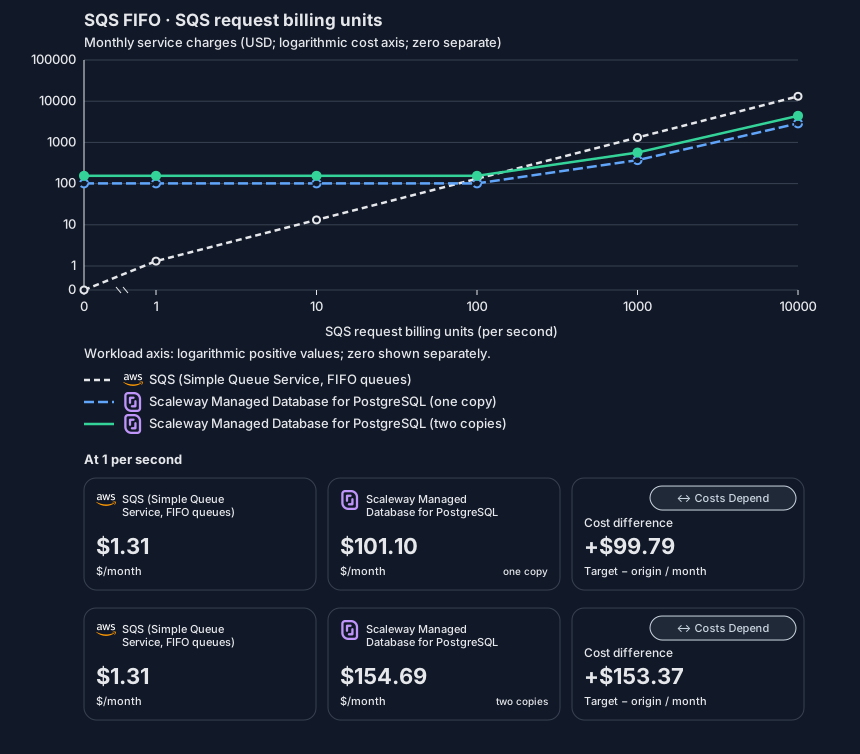
SQS FIFO · SQS request billing units
Estimated monthly service charges by SQS request billing units. Adapter hosting and Tensor9 fees are excluded. Source: us-east-1; target: fr-par; currency: USD.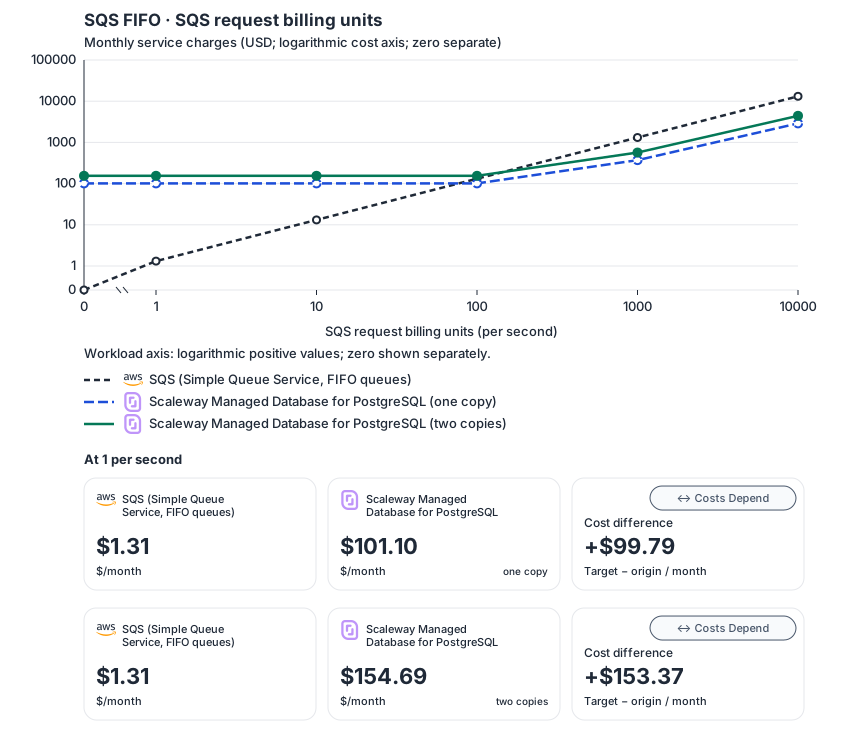
Estimated allocation from planning assumptions; not benchmark calibrated.
The sizing policy grows compute with translated work and peak headroom, memory with compute and working set, and disk with resident working state and reserve. Monthly usage is distinct from resident data; each workload’s assumptions define the translation. HA changes pricing, not this policy’s throughput estimate. Unpriced workloads exceed the policy’s configuration range; no silent vertical cap or automatic sharding is assumed.
- Row-store throughput (capacityOpsPerVcpuSecond, default 1500) is measured-by-tensor9 as a lower bound: the DynamoDB adapter on Cloud SQL db-custom-2-7680 (2 vCPU, PostgreSQL 16, us-west1) served 2,974 ops/s of YCSB-A at 16 threads without recorded saturation (src/main/kotlin/t9/prime/equiv/generated/eval/CloudsqlPostgresqlYcsbAT16GoYcsbV1_0_0.kt). Published CPU-bound pgbench reaches 3,101 read-write transactions and 20,289 point reads per vCPU-second (AWS z1d.2xlarge, PostgreSQL 14.5), so actual capacity is likely higher. Reads and writes share one coefficient: at the same adapter version, read-only YCSB-C was not faster than 50%-update YCSB-A.
- Log-broker throughput (capacityStreamMiBPerVcpuSecond 20 at 0.5 utilization, 4 GiB RAM per vCPU) is provider-documented by Google Managed Service for Apache Kafka sizing (https://docs.cloud.google.com/managed-service-for-apache-kafka/docs/plan-cluster-size): write-equivalent bytes are replicated writes plus a quarter of reads. Producer batches below 10 KB lower per-CPU throughput; that penalty is not modeled.
- Disk utilization 0.8 is provider-documented headroom below Cloud SQL automatic storage increase, which triggers near 91-95% full (https://docs.cloud.google.com/sql/docs/postgres/instance-settings). The 20 GiB reserve exceeds PostgreSQL’s 1 GB default max_wal_size; the remainder of that reserve is unmeasured.
- CPU tiers, 4 GiB per vCPU, at most 6.5 GiB per vCPU, 96 vCPU and 65,536 GiB disk follow Cloud SQL Enterprise custom machine limits (provider-documented, same page); 624 GiB is 96 × 6.5. Targets billed per node, unit or throughput unit are sized by their backend instead.
- No public evidence: peak/mean work (2) and the RAM working-set fraction (0.1). Proposed measurements: the p99 one-minute rate over the monthly mean from customer CloudWatch metrics; the buffer hit ratio while stepping RAM under a fixed YCSB-B load.
- Stored GiB already includes the origin family’s physical footprint assumptions; no second storage amplification is applied.
- The operations/vCPU coefficient supplies the compute requirement alongside explicit resource-hour minima.
- Copies and allocation fractions change cost only; they do not increase modeled primary capacity.
- 1-KiB messages, unbatched send/receive/delete; actual batch and delivery assumptions stay visible. Editable authored planning guesses, not verified provider tariffs, benchmark measurements or a commercial quote. Other native meters retain their explicitly displayed default quantities.
- Planning estimate · editable authored rates and sizing assumptions dated 2026-10-22; not verified provider prices. us-east-1 → fr-par, USD/month.
- Source prices are reference charges, not an invoice. Target lines cover selected service usage/configuration only; adapter hosting and Tensor9 fees are excluded.
- Explicit tariff samples are not performance measurements or capacity qualification. No interpolation or break-even guarantee is implied.
- Variant assumptions show the first axis sample; any axis-dependent configuration is described by this curve’s workload note.
- Rates are cited provider list prices, editable for discounts, commitments or another region. Workload translation and capacity coefficients remain editable planning assumptions, not benchmark measurements or a commercial quote.
- Default-zero rates are explicit assumptions, not evidence that the deployed service or resource is free.
- Provisioned-unit minimums use an editable approximate allocation floor. Modeled target service cost is max(usage/allocation, minimum), with billable network, durable staging and dependent sinks added separately; actual RU/TU sizing, scaling increments and throughput remain unqualified.
- Durable staging is priced once: provisioned targets include adapter state in their selected allocation; native targets add a separate staging allocation when required. Adapter hosting is a separate allocation and must exclude resources already priced as staging, workers or target capacity.
- A declared adapter mapping and cost model do not establish implementation availability or service equivalence.
- This is a declared directed mapping; a planning estimate does not establish deployment or request-serving support.
- Authored planning assumptions, not measured adapter capacity. Origin rates are cited first-tier list prices, before free allowances and discounts.
- A cost scenario does not establish backend availability, protocol fidelity or production readiness. Registry serving status remains independent.
- Storage follows resident original messages, not every monthly message. Broker delivery bytes include redeliveries.
- FIFO estimates do not qualify dedup support, group throughput or single-group latency; backend limitations remain applicable.
- Scaleway Managed Database for PostgreSQL at Production Optimized (PRO2) prices in EUR converted at the ECB reference rate. A high-availability or replica node bills Scaleway’s ‘Additional nodes’ price, EUR 0.0583 per hour for PRO2-XXS, 53% of the main node. Scaleway lists no egress charge for Managed Databases, so selected network is not charged. Cost Optimized ranges (DB-DEV-S from EUR 0.0156 per hour), Block Storage 15K and backups (EUR 0.03 per GB-month) are not selected.
- Row-store throughput (capacityOpsPerVcpuSecond, default 1500) is measured-by-tensor9 as a lower bound: the DynamoDB adapter on Cloud SQL db-custom-2-7680 (2 vCPU, PostgreSQL 16, us-west1) served 2,974 ops/s of YCSB-A at 16 threads without recorded saturation (src/main/kotlin/t9/prime/equiv/generated/eval/CloudsqlPostgresqlYcsbAT16GoYcsbV1_0_0.kt). Published CPU-bound pgbench reaches 3,101 read-write transactions and 20,289 point reads per vCPU-second (AWS z1d.2xlarge, PostgreSQL 14.5), so actual capacity is likely higher. Reads and writes share one coefficient: at the same adapter version, read-only YCSB-C was not faster than 50%-update YCSB-A.
- Log-broker throughput (capacityStreamMiBPerVcpuSecond 20 at 0.5 utilization, 4 GiB RAM per vCPU) is provider-documented by Google Managed Service for Apache Kafka sizing (https://docs.cloud.google.com/managed-service-for-apache-kafka/docs/plan-cluster-size): write-equivalent bytes are replicated writes plus a quarter of reads. Producer batches below 10 KB lower per-CPU throughput; that penalty is not modeled.
- Disk utilization 0.8 is provider-documented headroom below Cloud SQL automatic storage increase, which triggers near 91-95% full (https://docs.cloud.google.com/sql/docs/postgres/instance-settings). The 20 GiB reserve exceeds PostgreSQL’s 1 GB default max_wal_size; the remainder of that reserve is unmeasured.
- CPU tiers, 4 GiB per vCPU, at most 6.5 GiB per vCPU, 96 vCPU and 65,536 GiB disk follow Cloud SQL Enterprise custom machine limits (provider-documented, same page); 624 GiB is 96 × 6.5. Targets billed per node, unit or throughput unit are sized by their backend instead.
- No public evidence: peak/mean work (2) and the RAM working-set fraction (0.1). Proposed measurements: the p99 one-minute rate over the monthly mean from customer CloudWatch metrics; the buffer hit ratio while stepping RAM under a fixed YCSB-B load.
- Stored GiB already includes the origin family’s physical footprint assumptions; no second storage amplification is applied.
- The operations/vCPU coefficient supplies the compute requirement alongside explicit resource-hour minima.
- Copies and allocation fractions change cost only; they do not increase modeled primary capacity.
- AWS Price List API, AWSQueueService offer: https://pricing.us-east-1.amazonaws.com/offers/v1.0/aws/AWSQueueService/current/us-east-1/index.json
- Scaleway Managed Databases pricing: https://www.scaleway.com/en/pricing/managed-databases/
- Additional network transfer, backups, KMS, one-time migration and operational labor unless an explicit meter includes them.
- Destination application execution and separately billed downstream services; supply those allocations separately.
- Taxes, discounts, credits and free-tier allowances unless explicitly reflected in edited rates.
- Unmodeled dependent services, task execution and operations outside the selected workload family.
plan-587f83be80f7d547d383d9abce0fac6d8798d699 / 2026-10-22.planning.2. Curve: workload-1.
Sources: AWS Price List API, AWSQueueService offer, Scaleway Managed Databases pricing.
SQS Standard → Azure Cosmos DB (queue)
Origin API:aws::1.0.0::sqs::classic. Target backend: azure::1.0.0::cosmosdb::queue.
SQS Standard · SQS request billing units
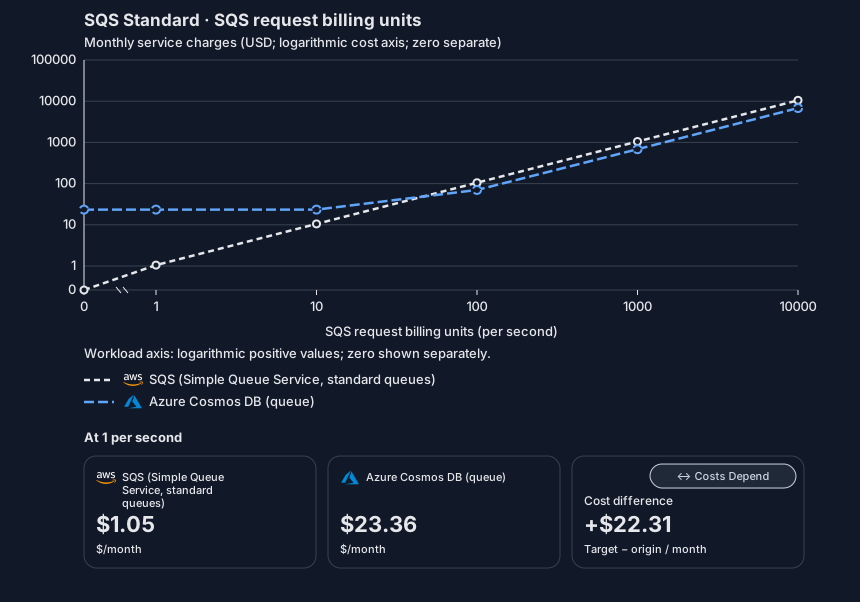
Estimated monthly service charges by SQS request billing units. Adapter hosting and Tensor9 fees are excluded. Source: us-east-1; target: East US; currency: USD.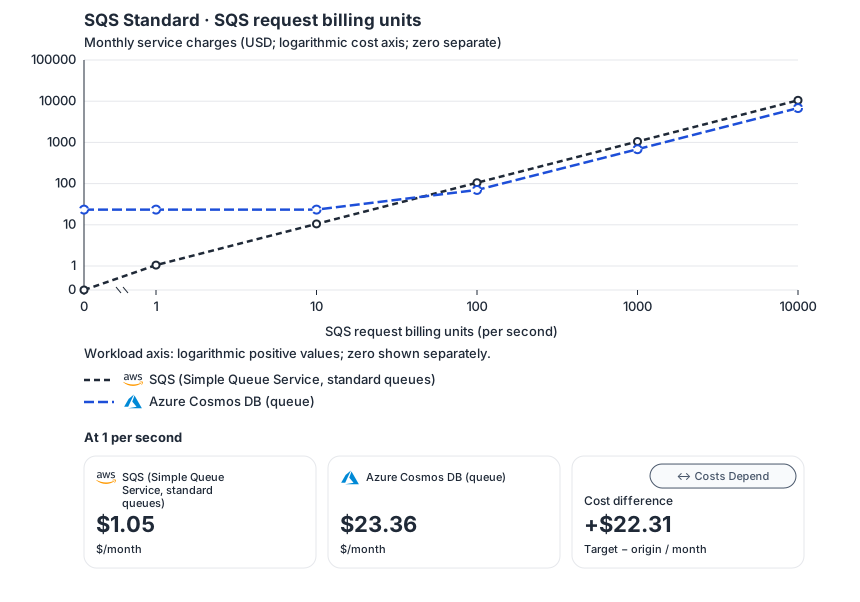
Curve assumptions
- 1-KiB messages, unbatched send/receive/delete; actual batch and delivery assumptions stay visible. Editable authored planning guesses, not verified provider tariffs, benchmark measurements or a commercial quote. Other native meters retain their explicitly displayed default quantities.
- Planning estimate · editable authored rates and sizing assumptions dated 2026-10-22; not verified provider prices. us-east-1 → East US, USD/month.
- Source prices are reference charges, not an invoice. Target lines cover selected service usage/configuration only; adapter hosting and Tensor9 fees are excluded.
- Explicit tariff samples are not performance measurements or capacity qualification. No interpolation or break-even guarantee is implied.
- Variant assumptions show the first axis sample; any axis-dependent configuration is described by this curve’s workload note.
- Rates are cited provider list prices, editable for discounts, commitments or another region. Workload translation and capacity coefficients remain editable planning assumptions, not benchmark measurements or a commercial quote.
- Default-zero rates are explicit assumptions, not evidence that the deployed service or resource is free.
- Provisioned-unit minimums use an editable approximate allocation floor. Modeled target service cost is max(usage/allocation, minimum), with billable network, durable staging and dependent sinks added separately; actual RU/TU sizing, scaling increments and throughput remain unqualified.
- Durable staging is priced once: provisioned targets include adapter state in their selected allocation; native targets add a separate staging allocation when required. Adapter hosting is a separate allocation and must exclude resources already priced as staging, workers or target capacity.
- A declared adapter mapping and cost model do not establish implementation availability or service equivalence.
- This is a declared directed mapping; a planning estimate does not establish deployment or request-serving support.
- Authored planning assumptions, not measured adapter capacity. Origin rates are cited first-tier list prices, before free allowances and discounts.
- A cost scenario does not establish backend availability, protocol fidelity or production readiness. Registry serving status remains independent.
- Storage follows resident original messages, not every monthly message. Broker delivery bytes include redeliveries.
- FIFO estimates do not qualify dedup support, group throughput or single-group latency; backend limitations remain applicable.
- Azure Cosmos DB provisioned throughput bills 100-RU/s blocks per hour and stored GB-months; operations within the provisioned RU/s have no separate charge. Blocks are sized from the family’s reads at 1 RU and writes at 5.5 RU (1 KB items, no extra indexing) at full utilization after the planning peak factor, with the 400 RU/s smallest manual allocation as the floor (USD 23.36/month). Larger messages, indexing and query-based receives raise the RU charge; autoscale (USD 0.012 per 100 RU/s-hour) and serverless (USD 0.25 per million RUs) are not selected.
- AWS Price List API, AWSQueueService offer: https://pricing.us-east-1.amazonaws.com/offers/v1.0/aws/AWSQueueService/current/us-east-1/index.json
- Azure Retail Prices API: https://prices.azure.com/api/retail/prices
- Additional network transfer, backups, KMS, one-time migration and operational labor unless an explicit meter includes them.
- Destination application execution and separately billed downstream services; supply those allocations separately.
- Taxes, discounts, credits and free-tier allowances unless explicitly reflected in edited rates.
- Unmodeled dependent services, task execution and operations outside the selected workload family.
plan-dad0c8f973de92af6643c3cb9f65340d91c718a5 / 2026-10-22.planning.2. Curve: workload-1.
Sources: AWS Price List API, AWSQueueService offer, Azure Retail Prices API.
SQS Standard → Azure Queue Storage
Origin API:aws::1.0.0::sqs::classic. Target backend: azure::1.0.0::queue-storage.
SQS Standard · SQS request billing units
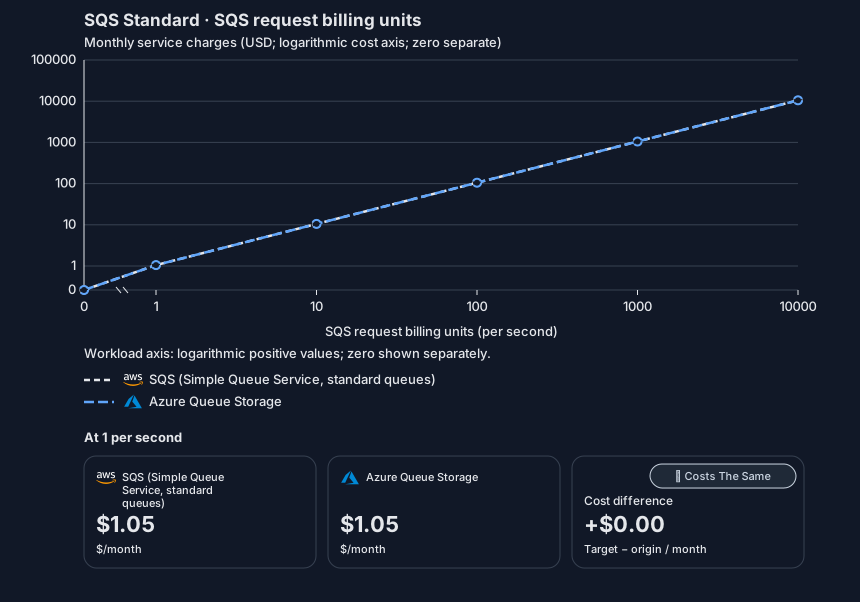
Estimated monthly service charges by SQS request billing units. Adapter hosting and Tensor9 fees are excluded. Source: us-east-1; target: East US; currency: USD.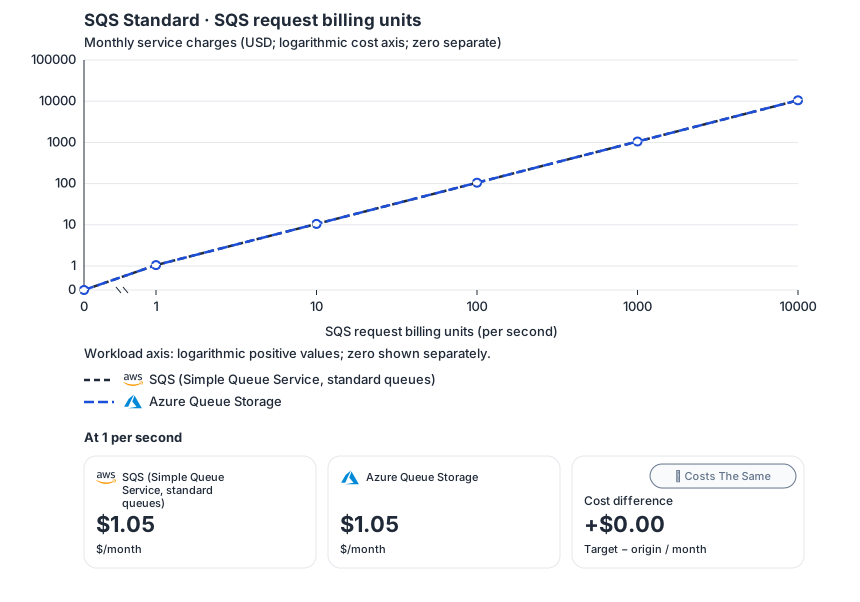
Curve assumptions
- 1-KiB messages, unbatched send/receive/delete; actual batch and delivery assumptions stay visible. Editable authored planning guesses, not verified provider tariffs, benchmark measurements or a commercial quote. Other native meters retain their explicitly displayed default quantities.
- Planning estimate · editable authored rates and sizing assumptions dated 2026-10-22; not verified provider prices. us-east-1 → East US, USD/month.
- Source prices are reference charges, not an invoice. Target lines cover selected service usage/configuration only; adapter hosting and Tensor9 fees are excluded.
- Explicit tariff samples are not performance measurements or capacity qualification. No interpolation or break-even guarantee is implied.
- Variant assumptions show the first axis sample; any axis-dependent configuration is described by this curve’s workload note.
- Rates are cited provider list prices, editable for discounts, commitments or another region. Workload translation and capacity coefficients remain editable planning assumptions, not benchmark measurements or a commercial quote.
- Default-zero rates are explicit assumptions, not evidence that the deployed service or resource is free.
- Provisioned-unit minimums use an editable approximate allocation floor. Modeled target service cost is max(usage/allocation, minimum), with billable network, durable staging and dependent sinks added separately; actual RU/TU sizing, scaling increments and throughput remain unqualified.
- Durable staging is priced once: provisioned targets include adapter state in their selected allocation; native targets add a separate staging allocation when required. Adapter hosting is a separate allocation and must exclude resources already priced as staging, workers or target capacity.
- A declared adapter mapping and cost model do not establish implementation availability or service equivalence.
- This is a declared directed mapping; a planning estimate does not establish deployment or request-serving support.
- Authored planning assumptions, not measured adapter capacity. Origin rates are cited first-tier list prices, before free allowances and discounts.
- A cost scenario does not establish backend availability, protocol fidelity or production readiness. Registry serving status remains independent.
- Storage follows resident original messages, not every monthly message. Broker delivery bytes include redeliveries.
- FIFO estimates do not qualify dedup support, group throughput or single-group latency; backend limitations remain applicable.
- Azure Queue Storage (general-purpose v2, Standard LRS) bills every REST operation and stored GB-months. Each managed operation is one queue call; a queue message is at most 64 KiB, so no size multiplier applies. GRS, ZRS and the legacy general-purpose v1 account price differently. Internet egress is billed by Azure networking, not the queue, and the mapped families select none.
- AWS Price List API, AWSQueueService offer: https://pricing.us-east-1.amazonaws.com/offers/v1.0/aws/AWSQueueService/current/us-east-1/index.json
- Azure Retail Prices API: https://prices.azure.com/api/retail/prices
- Additional network transfer, backups, KMS, one-time migration and operational labor unless an explicit meter includes them.
- Destination application execution and separately billed downstream services; supply those allocations separately.
- Taxes, discounts, credits and free-tier allowances unless explicitly reflected in edited rates.
- Unmodeled dependent services, task execution and operations outside the selected workload family.
plan-d5bf5eea867ef509a6394c8ab16664bacb37eb07 / 2026-10-22.planning.2. Curve: workload-1.
Sources: AWS Price List API, AWSQueueService offer, Azure Retail Prices API.
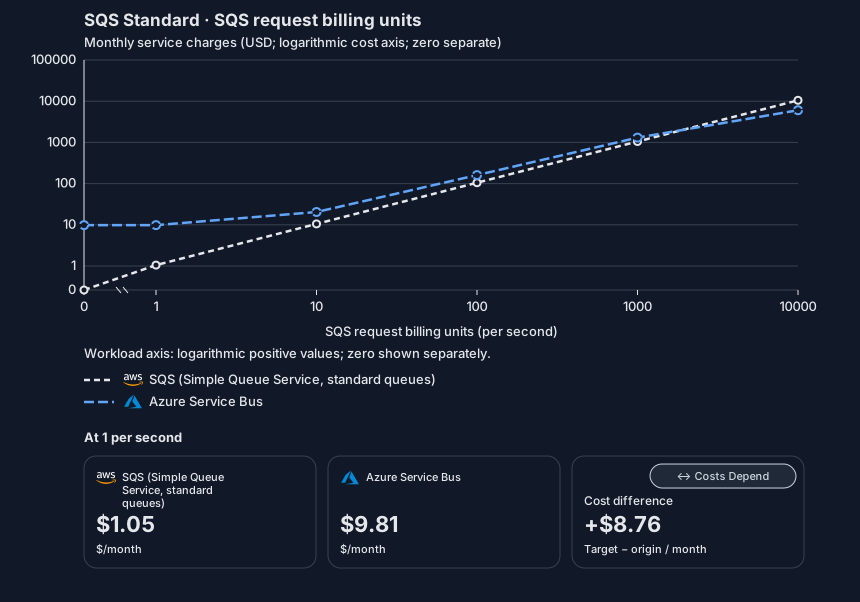
SQS Standard → Azure Service Bus
Origin API:aws::1.0.0::sqs::classic. Target backend: azure::1.0.0::servicebus.
SQS Standard · SQS request billing units
Estimated monthly service charges by SQS request billing units. Adapter hosting and Tensor9 fees are excluded. Source: us-east-1; target: East US; currency: USD.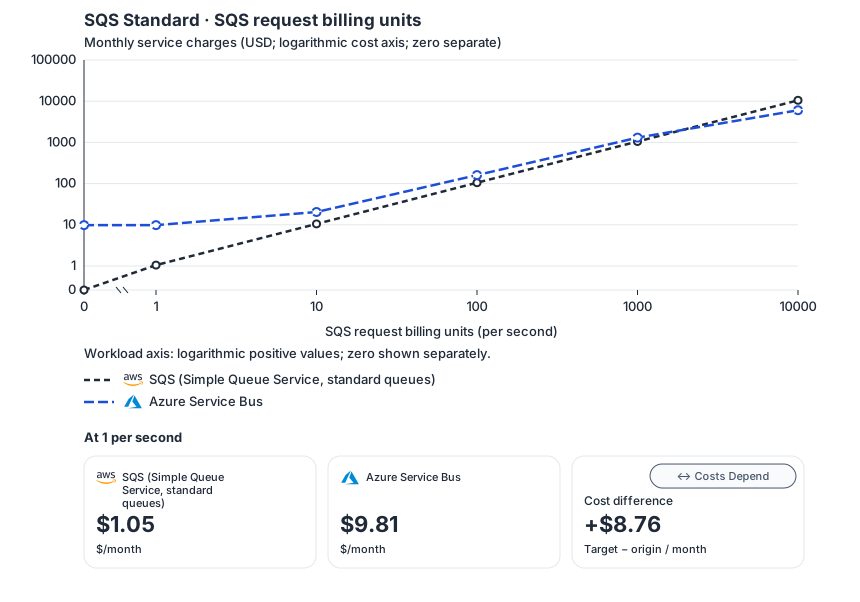
Curve assumptions
- 1-KiB messages, unbatched send/receive/delete; actual batch and delivery assumptions stay visible. Editable authored planning guesses, not verified provider tariffs, benchmark measurements or a commercial quote. Other native meters retain their explicitly displayed default quantities.
- Planning estimate · editable authored rates and sizing assumptions dated 2026-10-22; not verified provider prices. us-east-1 → East US, USD/month.
- Source prices are reference charges, not an invoice. Target lines cover selected service usage/configuration only; adapter hosting and Tensor9 fees are excluded.
- Explicit tariff samples are not performance measurements or capacity qualification. No interpolation or break-even guarantee is implied.
- Variant assumptions show the first axis sample; any axis-dependent configuration is described by this curve’s workload note.
- Rates are cited provider list prices, editable for discounts, commitments or another region. Workload translation and capacity coefficients remain editable planning assumptions, not benchmark measurements or a commercial quote.
- Default-zero rates are explicit assumptions, not evidence that the deployed service or resource is free.
- Provisioned-unit minimums use an editable approximate allocation floor. Modeled target service cost is max(usage/allocation, minimum), with billable network, durable staging and dependent sinks added separately; actual RU/TU sizing, scaling increments and throughput remain unqualified.
- Durable staging is priced once: provisioned targets include adapter state in their selected allocation; native targets add a separate staging allocation when required. Adapter hosting is a separate allocation and must exclude resources already priced as staging, workers or target capacity.
- A declared adapter mapping and cost model do not establish implementation availability or service equivalence.
- This is a declared directed mapping; a planning estimate does not establish deployment or request-serving support.
- Authored planning assumptions, not measured adapter capacity. Origin rates are cited first-tier list prices, before free allowances and discounts.
- A cost scenario does not establish backend availability, protocol fidelity or production readiness. Registry serving status remains independent.
- Storage follows resident original messages, not every monthly message. Broker delivery bytes include redeliveries.
- FIFO estimates do not qualify dedup support, group throughput or single-group latency; backend limitations remain applicable.
- Azure Service Bus Standard bills a namespace base charge that includes 13 million operations a month, then graduated per-operation prices: USD 0.80 per million to 100 million, 0.50 to 2,500 million and 0.20 beyond. An operation is any API call (send, receive, complete) per 64 KB of message; the family’s managed operations count calls, not 64 KB units. Standard has no storage charge (queue size quota up to 5 GB is included). More than 1,000 brokered connections bill USD 0.03 per connection-month, which this profile does not model.
- AWS Price List API, AWSQueueService offer: https://pricing.us-east-1.amazonaws.com/offers/v1.0/aws/AWSQueueService/current/us-east-1/index.json
- Azure Retail Prices API: https://prices.azure.com/api/retail/prices
- Additional network transfer, backups, KMS, one-time migration and operational labor unless an explicit meter includes them.
- Destination application execution and separately billed downstream services; supply those allocations separately.
- Taxes, discounts, credits and free-tier allowances unless explicitly reflected in edited rates.
- Unmodeled dependent services, task execution and operations outside the selected workload family.
plan-ca45f8cb19ce07ffe770050ff2faf4e2ac2dad0b / 2026-10-22.planning.2. Curve: workload-1.
Sources: AWS Price List API, AWSQueueService offer, Azure Retail Prices API.
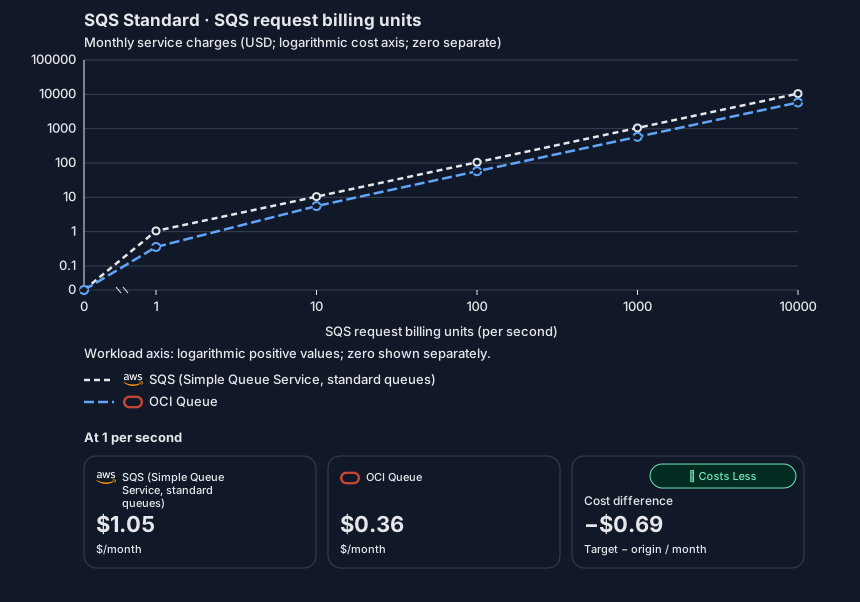
SQS Standard → OCI Queue
Origin API:aws::1.0.0::sqs::classic. Target backend: oci::1.0.0::queue.
SQS Standard · SQS request billing units
Estimated monthly service charges by SQS request billing units. Adapter hosting and Tensor9 fees are excluded. Source: us-east-1; target: us-ashburn-1 (OCI global price list); currency: USD.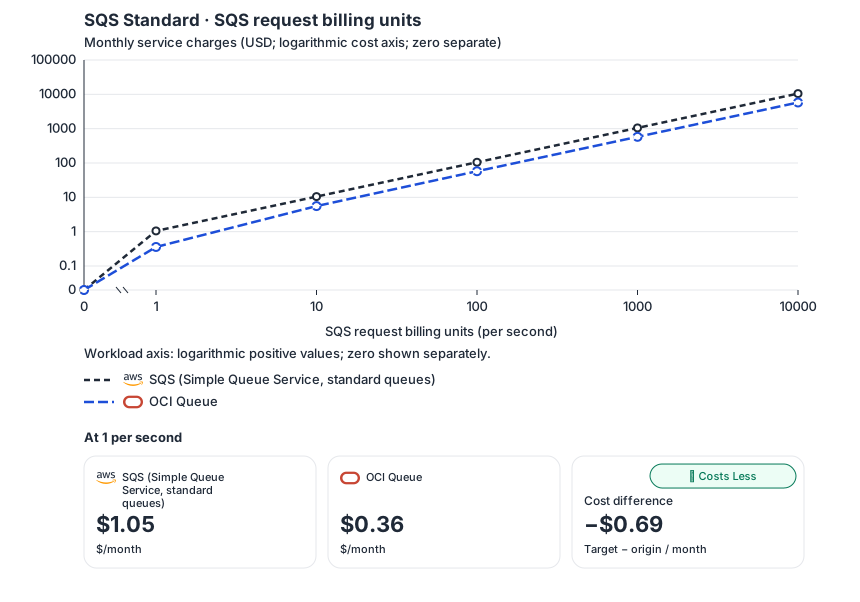
Curve assumptions
- 1-KiB messages, unbatched send/receive/delete; actual batch and delivery assumptions stay visible. Editable authored planning guesses, not verified provider tariffs, benchmark measurements or a commercial quote. Other native meters retain their explicitly displayed default quantities.
- Planning estimate · editable authored rates and sizing assumptions dated 2026-10-22; not verified provider prices. us-east-1 → us-ashburn-1 (OCI global price list), USD/month.
- Source prices are reference charges, not an invoice. Target lines cover selected service usage/configuration only; adapter hosting and Tensor9 fees are excluded.
- Explicit tariff samples are not performance measurements or capacity qualification. No interpolation or break-even guarantee is implied.
- Variant assumptions show the first axis sample; any axis-dependent configuration is described by this curve’s workload note.
- Rates are cited provider list prices, editable for discounts, commitments or another region. Workload translation and capacity coefficients remain editable planning assumptions, not benchmark measurements or a commercial quote.
- Default-zero rates are explicit assumptions, not evidence that the deployed service or resource is free.
- Provisioned-unit minimums use an editable approximate allocation floor. Modeled target service cost is max(usage/allocation, minimum), with billable network, durable staging and dependent sinks added separately; actual RU/TU sizing, scaling increments and throughput remain unqualified.
- Durable staging is priced once: provisioned targets include adapter state in their selected allocation; native targets add a separate staging allocation when required. Adapter hosting is a separate allocation and must exclude resources already priced as staging, workers or target capacity.
- A declared adapter mapping and cost model do not establish implementation availability or service equivalence.
- This is a declared directed mapping; a planning estimate does not establish deployment or request-serving support.
- Authored planning assumptions, not measured adapter capacity. Origin rates are cited first-tier list prices, before free allowances and discounts.
- A cost scenario does not establish backend availability, protocol fidelity or production readiness. Registry serving status remains independent.
- Storage follows resident original messages, not every monthly message. Broker delivery bytes include redeliveries.
- FIFO estimates do not qualify dedup support, group throughput or single-group latency; backend limitations remain applicable.
- OCI Queue bills requests after the first million each month; the price list counts each request as 64 KB, so larger messages or batches count as several requests, which the family’s call counts do not multiply. Queue has no storage or retention charge.
- AWS Price List API, AWSQueueService offer: https://pricing.us-east-1.amazonaws.com/offers/v1.0/aws/AWSQueueService/current/us-east-1/index.json
- OCI price list API: https://apexapps.oracle.com/pls/apex/cetools/api/v1/products/
- Additional network transfer, backups, KMS, one-time migration and operational labor unless an explicit meter includes them.
- Destination application execution and separately billed downstream services; supply those allocations separately.
- Taxes, discounts, credits and free-tier allowances unless explicitly reflected in edited rates.
- Unmodeled dependent services, task execution and operations outside the selected workload family.
plan-15dc11b20607d1fce76620d26b1597e97614129d / 2026-10-22.planning.2. Curve: workload-1.
Sources: AWS Price List API, AWSQueueService offer, OCI price list API.
SQS Standard → PostgreSQL
Origin API:aws::1.0.0::sqs::classic. Target backend: postgres::1.0.0::database.
SQS Standard · SQS request billing units
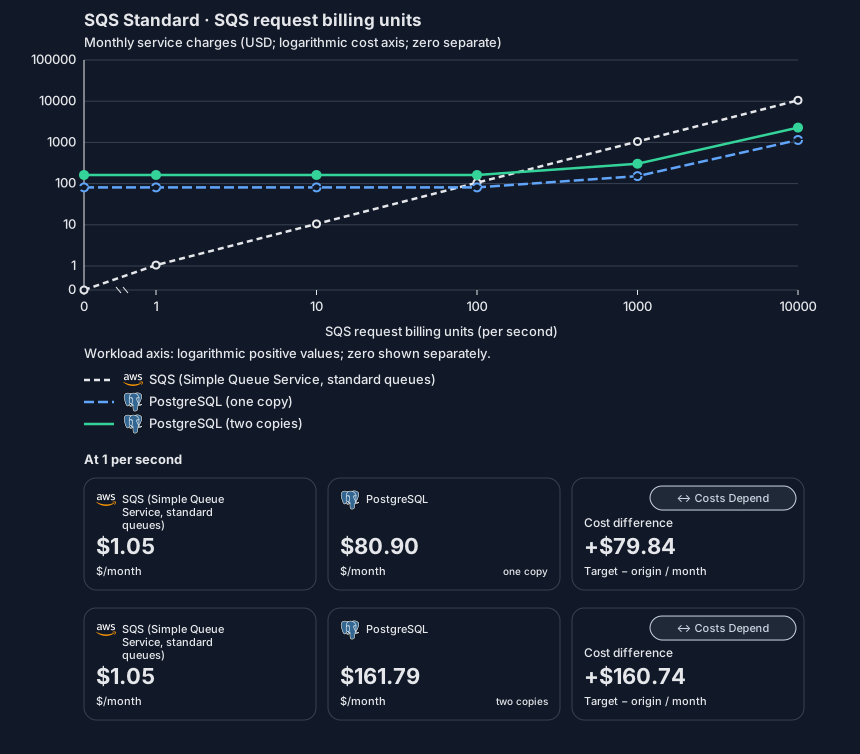
Estimated monthly service charges by SQS request billing units. Adapter hosting and Tensor9 fees are excluded. Source: us-east-1; target: us-central1; currency: USD.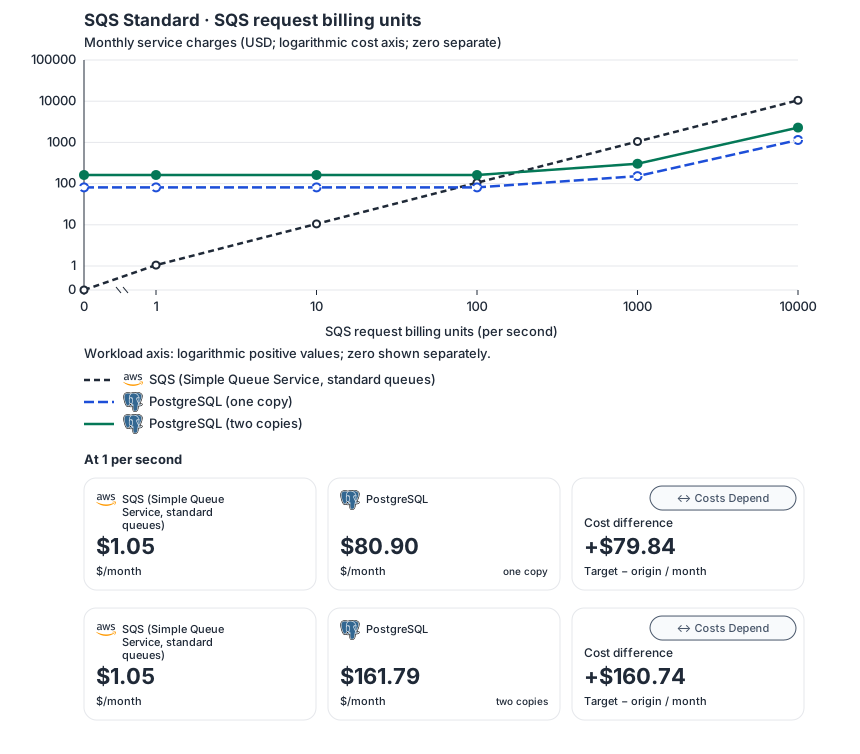
Estimated allocation from planning assumptions; not benchmark calibrated.
The sizing policy grows compute with translated work and peak headroom, memory with compute and working set, and disk with resident working state and reserve. Monthly usage is distinct from resident data; each workload’s assumptions define the translation. HA changes pricing, not this policy’s throughput estimate. Unpriced workloads exceed the policy’s configuration range; no silent vertical cap or automatic sharding is assumed.
- Row-store throughput (capacityOpsPerVcpuSecond, default 1500) is measured-by-tensor9 as a lower bound: the DynamoDB adapter on Cloud SQL db-custom-2-7680 (2 vCPU, PostgreSQL 16, us-west1) served 2,974 ops/s of YCSB-A at 16 threads without recorded saturation (src/main/kotlin/t9/prime/equiv/generated/eval/CloudsqlPostgresqlYcsbAT16GoYcsbV1_0_0.kt). Published CPU-bound pgbench reaches 3,101 read-write transactions and 20,289 point reads per vCPU-second (AWS z1d.2xlarge, PostgreSQL 14.5), so actual capacity is likely higher. Reads and writes share one coefficient: at the same adapter version, read-only YCSB-C was not faster than 50%-update YCSB-A.
- Log-broker throughput (capacityStreamMiBPerVcpuSecond 20 at 0.5 utilization, 4 GiB RAM per vCPU) is provider-documented by Google Managed Service for Apache Kafka sizing (https://docs.cloud.google.com/managed-service-for-apache-kafka/docs/plan-cluster-size): write-equivalent bytes are replicated writes plus a quarter of reads. Producer batches below 10 KB lower per-CPU throughput; that penalty is not modeled.
- Disk utilization 0.8 is provider-documented headroom below Cloud SQL automatic storage increase, which triggers near 91-95% full (https://docs.cloud.google.com/sql/docs/postgres/instance-settings). The 20 GiB reserve exceeds PostgreSQL’s 1 GB default max_wal_size; the remainder of that reserve is unmeasured.
- CPU tiers, 4 GiB per vCPU, at most 6.5 GiB per vCPU, 96 vCPU and 65,536 GiB disk follow Cloud SQL Enterprise custom machine limits (provider-documented, same page); 624 GiB is 96 × 6.5. Targets billed per node, unit or throughput unit are sized by their backend instead.
- No public evidence: peak/mean work (2) and the RAM working-set fraction (0.1). Proposed measurements: the p99 one-minute rate over the monthly mean from customer CloudWatch metrics; the buffer hit ratio while stepping RAM under a fixed YCSB-B load.
- Stored GiB already includes the origin family’s physical footprint assumptions; no second storage amplification is applied.
- The operations/vCPU coefficient supplies the compute requirement alongside explicit resource-hour minima.
- Copies and allocation fractions change cost only; they do not increase modeled primary capacity.
- 1-KiB messages, unbatched send/receive/delete; actual batch and delivery assumptions stay visible. Editable authored planning guesses, not verified provider tariffs, benchmark measurements or a commercial quote. Other native meters retain their explicitly displayed default quantities.
- Planning estimate · editable authored rates and sizing assumptions dated 2026-10-22; not verified provider prices. us-east-1 → us-central1, USD/month.
- Source prices are reference charges, not an invoice. Target lines cover selected service usage/configuration only; adapter hosting and Tensor9 fees are excluded.
- Explicit tariff samples are not performance measurements or capacity qualification. No interpolation or break-even guarantee is implied.
- Variant assumptions show the first axis sample; any axis-dependent configuration is described by this curve’s workload note.
- Rates are cited provider list prices, editable for discounts, commitments or another region. Workload translation and capacity coefficients remain editable planning assumptions, not benchmark measurements or a commercial quote.
- Default-zero rates are explicit assumptions, not evidence that the deployed service or resource is free.
- Provisioned-unit minimums use an editable approximate allocation floor. Modeled target service cost is max(usage/allocation, minimum), with billable network, durable staging and dependent sinks added separately; actual RU/TU sizing, scaling increments and throughput remain unqualified.
- Durable staging is priced once: provisioned targets include adapter state in their selected allocation; native targets add a separate staging allocation when required. Adapter hosting is a separate allocation and must exclude resources already priced as staging, workers or target capacity.
- A declared adapter mapping and cost model do not establish implementation availability or service equivalence.
- This is a declared directed mapping; a planning estimate does not establish deployment or request-serving support.
- Authored planning assumptions, not measured adapter capacity. Origin rates are cited first-tier list prices, before free allowances and discounts.
- A cost scenario does not establish backend availability, protocol fidelity or production readiness. Registry serving status remains independent.
- Storage follows resident original messages, not every monthly message. Broker delivery bytes include redeliveries.
- FIFO estimates do not qualify dedup support, group throughput or single-group latency; backend limitations remain applicable.
- Self-hosted target: PostgreSQL (PostgreSQL License, https://www.postgresql.org/about/licence/). Selected CPU, RAM and physical disk allocation grow with workload; no per-operation price is assumed. No vendor tariff: the target runs on the customer’s Kubernetes nodes, so CPU, RAM and disk bill at the Kubernetes node reference rates, Compute Engine N2 in us-central1 (USD 0.031611/vCPU-hour, 0.004237/GiB-hour) with pd-balanced disk (0.10/GiB-month) and Premium Tier egress. The cost-optimized E2 series lists 0.02181159/vCPU-hour and 0.00292353/GiB-hour; AWS m6i/r6i and Azure D2s v5/E2s v5 both decompose to 0.033/vCPU-hour and 0.00375/GiB-hour. Requested CPU and RAM are billed; node bin-packing waste, system reservations and the cluster control-plane fee are not.
- Row-store throughput (capacityOpsPerVcpuSecond, default 1500) is measured-by-tensor9 as a lower bound: the DynamoDB adapter on Cloud SQL db-custom-2-7680 (2 vCPU, PostgreSQL 16, us-west1) served 2,974 ops/s of YCSB-A at 16 threads without recorded saturation (src/main/kotlin/t9/prime/equiv/generated/eval/CloudsqlPostgresqlYcsbAT16GoYcsbV1_0_0.kt). Published CPU-bound pgbench reaches 3,101 read-write transactions and 20,289 point reads per vCPU-second (AWS z1d.2xlarge, PostgreSQL 14.5), so actual capacity is likely higher. Reads and writes share one coefficient: at the same adapter version, read-only YCSB-C was not faster than 50%-update YCSB-A.
- Log-broker throughput (capacityStreamMiBPerVcpuSecond 20 at 0.5 utilization, 4 GiB RAM per vCPU) is provider-documented by Google Managed Service for Apache Kafka sizing (https://docs.cloud.google.com/managed-service-for-apache-kafka/docs/plan-cluster-size): write-equivalent bytes are replicated writes plus a quarter of reads. Producer batches below 10 KB lower per-CPU throughput; that penalty is not modeled.
- Disk utilization 0.8 is provider-documented headroom below Cloud SQL automatic storage increase, which triggers near 91-95% full (https://docs.cloud.google.com/sql/docs/postgres/instance-settings). The 20 GiB reserve exceeds PostgreSQL’s 1 GB default max_wal_size; the remainder of that reserve is unmeasured.
- CPU tiers, 4 GiB per vCPU, at most 6.5 GiB per vCPU, 96 vCPU and 65,536 GiB disk follow Cloud SQL Enterprise custom machine limits (provider-documented, same page); 624 GiB is 96 × 6.5. Targets billed per node, unit or throughput unit are sized by their backend instead.
- No public evidence: peak/mean work (2) and the RAM working-set fraction (0.1). Proposed measurements: the p99 one-minute rate over the monthly mean from customer CloudWatch metrics; the buffer hit ratio while stepping RAM under a fixed YCSB-B load.
- Stored GiB already includes the origin family’s physical footprint assumptions; no second storage amplification is applied.
- The operations/vCPU coefficient supplies the compute requirement alongside explicit resource-hour minima.
- Copies and allocation fractions change cost only; they do not increase modeled primary capacity.
- AWS Price List API, AWSQueueService offer: https://pricing.us-east-1.amazonaws.com/offers/v1.0/aws/AWSQueueService/current/us-east-1/index.json
- Compute Engine general-purpose machine pricing: https://cloud.google.com/products/compute/pricing/general-purpose
- Disk and image pricing: https://cloud.google.com/compute/disks-image-pricing
- Network pricing: https://cloud.google.com/vpc/network-pricing
- Additional network transfer, backups, KMS, one-time migration and operational labor unless an explicit meter includes them.
- Destination application execution and separately billed downstream services; supply those allocations separately.
- Taxes, discounts, credits and free-tier allowances unless explicitly reflected in edited rates.
- Unmodeled dependent services, task execution and operations outside the selected workload family.
plan-a5003d6d1b075ed4d7688651bd5e72c32088cf9c / 2026-10-22.planning.2. Curve: workload-1.
Sources: AWS Price List API, AWSQueueService offer, Compute Engine general-purpose machine pricing, Disk and image pricing, Network pricing.
SQS Standard → PostgreSQL Flexible Server
Origin API:aws::1.0.0::sqs::classic. Target backend: azure::1.0.0::postgresql::flexible.
SQS Standard · SQS request billing units
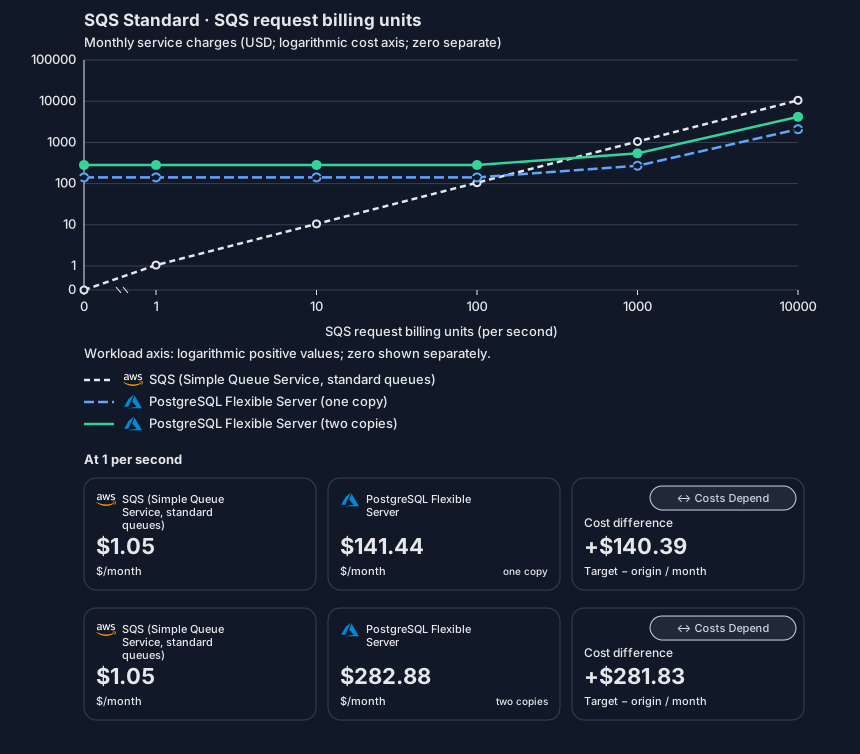
Estimated monthly service charges by SQS request billing units. Adapter hosting and Tensor9 fees are excluded. Source: us-east-1; target: eastus; currency: USD.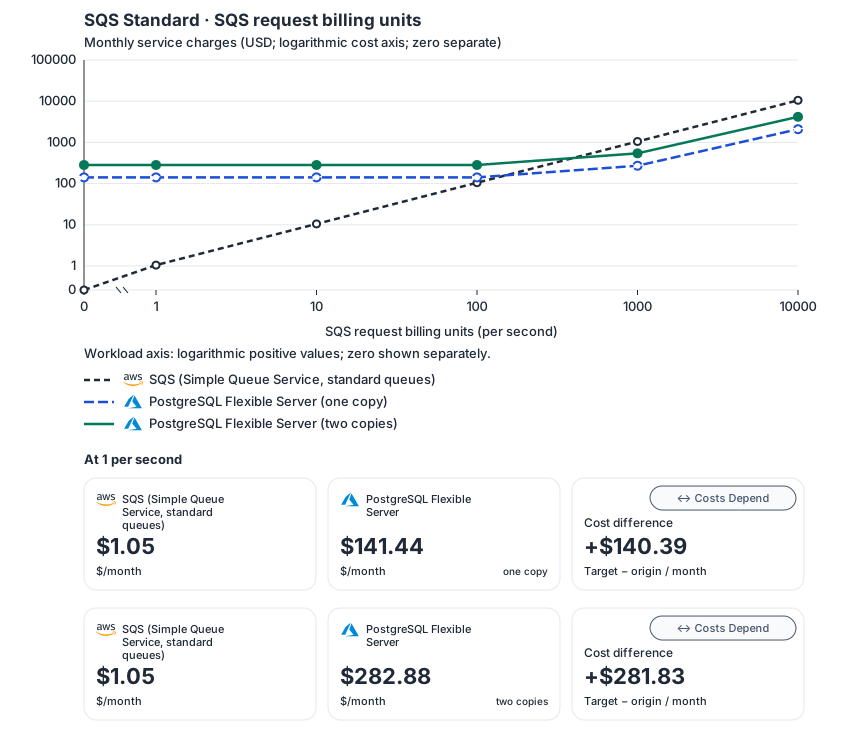
Estimated allocation from planning assumptions; not benchmark calibrated.
The sizing policy grows compute with translated work and peak headroom, memory with compute and working set, and disk with resident working state and reserve. Monthly usage is distinct from resident data; each workload’s assumptions define the translation. HA changes pricing, not this policy’s throughput estimate. Unpriced workloads exceed the policy’s configuration range; no silent vertical cap or automatic sharding is assumed.
- Row-store throughput (capacityOpsPerVcpuSecond, default 1500) is measured-by-tensor9 as a lower bound: the DynamoDB adapter on Cloud SQL db-custom-2-7680 (2 vCPU, PostgreSQL 16, us-west1) served 2,974 ops/s of YCSB-A at 16 threads without recorded saturation (src/main/kotlin/t9/prime/equiv/generated/eval/CloudsqlPostgresqlYcsbAT16GoYcsbV1_0_0.kt). Published CPU-bound pgbench reaches 3,101 read-write transactions and 20,289 point reads per vCPU-second (AWS z1d.2xlarge, PostgreSQL 14.5), so actual capacity is likely higher. Reads and writes share one coefficient: at the same adapter version, read-only YCSB-C was not faster than 50%-update YCSB-A.
- Log-broker throughput (capacityStreamMiBPerVcpuSecond 20 at 0.5 utilization, 4 GiB RAM per vCPU) is provider-documented by Google Managed Service for Apache Kafka sizing (https://docs.cloud.google.com/managed-service-for-apache-kafka/docs/plan-cluster-size): write-equivalent bytes are replicated writes plus a quarter of reads. Producer batches below 10 KB lower per-CPU throughput; that penalty is not modeled.
- Disk utilization 0.8 is provider-documented headroom below Cloud SQL automatic storage increase, which triggers near 91-95% full (https://docs.cloud.google.com/sql/docs/postgres/instance-settings). The 20 GiB reserve exceeds PostgreSQL’s 1 GB default max_wal_size; the remainder of that reserve is unmeasured.
- CPU tiers, 4 GiB per vCPU, at most 6.5 GiB per vCPU, 96 vCPU and 65,536 GiB disk follow Cloud SQL Enterprise custom machine limits (provider-documented, same page); 624 GiB is 96 × 6.5. Targets billed per node, unit or throughput unit are sized by their backend instead.
- No public evidence: peak/mean work (2) and the RAM working-set fraction (0.1). Proposed measurements: the p99 one-minute rate over the monthly mean from customer CloudWatch metrics; the buffer hit ratio while stepping RAM under a fixed YCSB-B load.
- Stored GiB already includes the origin family’s physical footprint assumptions; no second storage amplification is applied.
- The operations/vCPU coefficient supplies the compute requirement alongside explicit resource-hour minima.
- Copies and allocation fractions change cost only; they do not increase modeled primary capacity.
- 1-KiB messages, unbatched send/receive/delete; actual batch and delivery assumptions stay visible. Editable authored planning guesses, not verified provider tariffs, benchmark measurements or a commercial quote. Other native meters retain their explicitly displayed default quantities.
- Planning estimate · editable authored rates and sizing assumptions dated 2026-10-22; not verified provider prices. us-east-1 → eastus, USD/month.
- Source prices are reference charges, not an invoice. Target lines cover selected service usage/configuration only; adapter hosting and Tensor9 fees are excluded.
- Explicit tariff samples are not performance measurements or capacity qualification. No interpolation or break-even guarantee is implied.
- Variant assumptions show the first axis sample; any axis-dependent configuration is described by this curve’s workload note.
- Rates are cited provider list prices, editable for discounts, commitments or another region. Workload translation and capacity coefficients remain editable planning assumptions, not benchmark measurements or a commercial quote.
- Default-zero rates are explicit assumptions, not evidence that the deployed service or resource is free.
- Provisioned-unit minimums use an editable approximate allocation floor. Modeled target service cost is max(usage/allocation, minimum), with billable network, durable staging and dependent sinks added separately; actual RU/TU sizing, scaling increments and throughput remain unqualified.
- Durable staging is priced once: provisioned targets include adapter state in their selected allocation; native targets add a separate staging allocation when required. Adapter hosting is a separate allocation and must exclude resources already priced as staging, workers or target capacity.
- A declared adapter mapping and cost model do not establish implementation availability or service equivalence.
- This is a declared directed mapping; a planning estimate does not establish deployment or request-serving support.
- Authored planning assumptions, not measured adapter capacity. Origin rates are cited first-tier list prices, before free allowances and discounts.
- A cost scenario does not establish backend availability, protocol fidelity or production readiness. Registry serving status remains independent.
- Storage follows resident original messages, not every monthly message. Broker delivery bytes include redeliveries.
- FIFO estimates do not qualify dedup support, group throughput or single-group latency; backend limitations remain applicable.
- Azure Database for PostgreSQL Flexible Server bills vCores with a fixed memory ratio per series; the vCPU and memory rates decompose the General Purpose and Memory Optimized v5 prices. High availability bills the standby’s compute and storage as a second copy. The minimum is the smallest Burstable server, which does not support high availability; the smallest General Purpose server (2 vCores) costs USD 133.62 per month. Additional IOPS, backup storage and reserved capacity are not selected.
- Row-store throughput (capacityOpsPerVcpuSecond, default 1500) is measured-by-tensor9 as a lower bound: the DynamoDB adapter on Cloud SQL db-custom-2-7680 (2 vCPU, PostgreSQL 16, us-west1) served 2,974 ops/s of YCSB-A at 16 threads without recorded saturation (src/main/kotlin/t9/prime/equiv/generated/eval/CloudsqlPostgresqlYcsbAT16GoYcsbV1_0_0.kt). Published CPU-bound pgbench reaches 3,101 read-write transactions and 20,289 point reads per vCPU-second (AWS z1d.2xlarge, PostgreSQL 14.5), so actual capacity is likely higher. Reads and writes share one coefficient: at the same adapter version, read-only YCSB-C was not faster than 50%-update YCSB-A.
- Log-broker throughput (capacityStreamMiBPerVcpuSecond 20 at 0.5 utilization, 4 GiB RAM per vCPU) is provider-documented by Google Managed Service for Apache Kafka sizing (https://docs.cloud.google.com/managed-service-for-apache-kafka/docs/plan-cluster-size): write-equivalent bytes are replicated writes plus a quarter of reads. Producer batches below 10 KB lower per-CPU throughput; that penalty is not modeled.
- Disk utilization 0.8 is provider-documented headroom below Cloud SQL automatic storage increase, which triggers near 91-95% full (https://docs.cloud.google.com/sql/docs/postgres/instance-settings). The 20 GiB reserve exceeds PostgreSQL’s 1 GB default max_wal_size; the remainder of that reserve is unmeasured.
- CPU tiers, 4 GiB per vCPU, at most 6.5 GiB per vCPU, 96 vCPU and 65,536 GiB disk follow Cloud SQL Enterprise custom machine limits (provider-documented, same page); 624 GiB is 96 × 6.5. Targets billed per node, unit or throughput unit are sized by their backend instead.
- No public evidence: peak/mean work (2) and the RAM working-set fraction (0.1). Proposed measurements: the p99 one-minute rate over the monthly mean from customer CloudWatch metrics; the buffer hit ratio while stepping RAM under a fixed YCSB-B load.
- Stored GiB already includes the origin family’s physical footprint assumptions; no second storage amplification is applied.
- The operations/vCPU coefficient supplies the compute requirement alongside explicit resource-hour minima.
- Copies and allocation fractions change cost only; they do not increase modeled primary capacity.
- AWS Price List API, AWSQueueService offer: https://pricing.us-east-1.amazonaws.com/offers/v1.0/aws/AWSQueueService/current/us-east-1/index.json
- Azure Retail Prices API: https://prices.azure.com/api/retail/prices
- Additional network transfer, backups, KMS, one-time migration and operational labor unless an explicit meter includes them.
- Destination application execution and separately billed downstream services; supply those allocations separately.
- Taxes, discounts, credits and free-tier allowances unless explicitly reflected in edited rates.
- Unmodeled dependent services, task execution and operations outside the selected workload family.
plan-89783f4d5bd47a02bac1ee1d677521ebf845f89c / 2026-10-22.planning.2. Curve: workload-1.
Sources: AWS Price List API, AWSQueueService offer, Azure Retail Prices API.
SQS Standard → Scaleway Managed Database for PostgreSQL
Origin API:aws::1.0.0::sqs::classic. Target backend: scaleway::1.0.0::rdb::postgresql.
SQS Standard · SQS request billing units
Estimated monthly service charges by SQS request billing units. Adapter hosting and Tensor9 fees are excluded. Source: us-east-1; target: fr-par; currency: USD.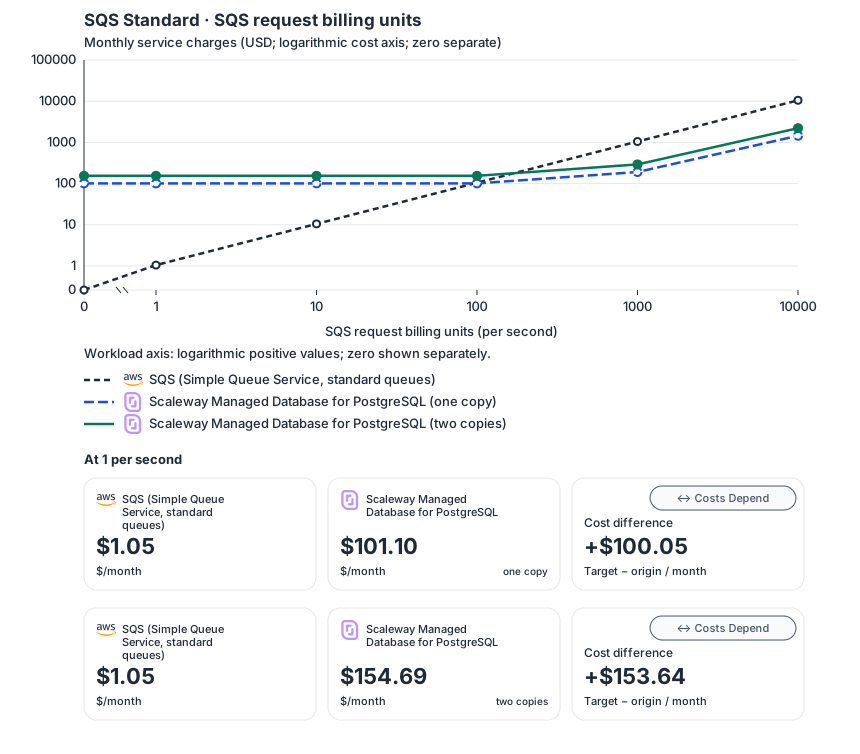
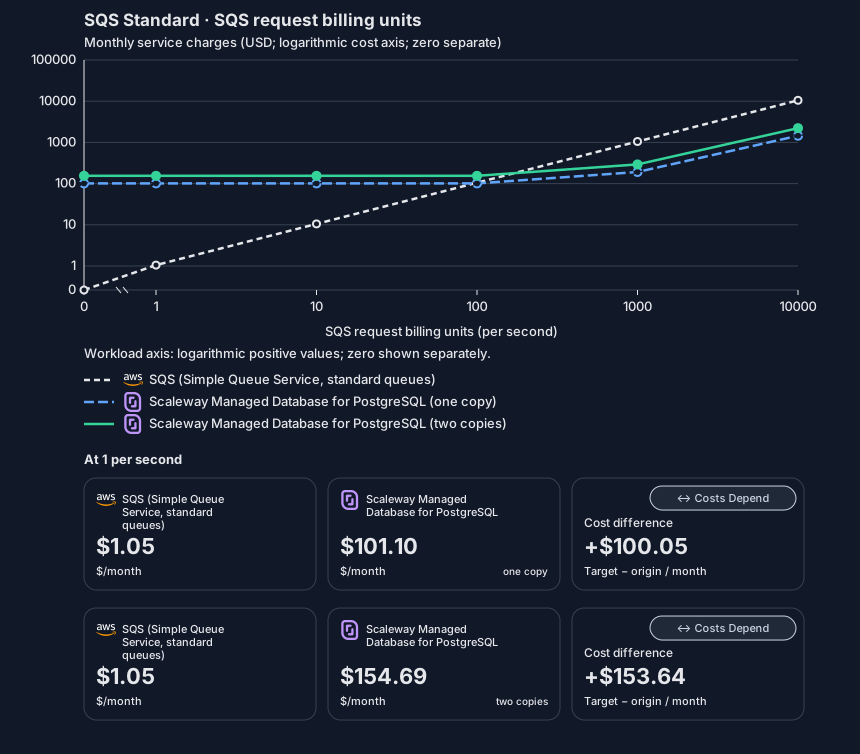
Estimated allocation from planning assumptions; not benchmark calibrated.
The sizing policy grows compute with translated work and peak headroom, memory with compute and working set, and disk with resident working state and reserve. Monthly usage is distinct from resident data; each workload’s assumptions define the translation. HA changes pricing, not this policy’s throughput estimate. Unpriced workloads exceed the policy’s configuration range; no silent vertical cap or automatic sharding is assumed.
- Row-store throughput (capacityOpsPerVcpuSecond, default 1500) is measured-by-tensor9 as a lower bound: the DynamoDB adapter on Cloud SQL db-custom-2-7680 (2 vCPU, PostgreSQL 16, us-west1) served 2,974 ops/s of YCSB-A at 16 threads without recorded saturation (src/main/kotlin/t9/prime/equiv/generated/eval/CloudsqlPostgresqlYcsbAT16GoYcsbV1_0_0.kt). Published CPU-bound pgbench reaches 3,101 read-write transactions and 20,289 point reads per vCPU-second (AWS z1d.2xlarge, PostgreSQL 14.5), so actual capacity is likely higher. Reads and writes share one coefficient: at the same adapter version, read-only YCSB-C was not faster than 50%-update YCSB-A.
- Log-broker throughput (capacityStreamMiBPerVcpuSecond 20 at 0.5 utilization, 4 GiB RAM per vCPU) is provider-documented by Google Managed Service for Apache Kafka sizing (https://docs.cloud.google.com/managed-service-for-apache-kafka/docs/plan-cluster-size): write-equivalent bytes are replicated writes plus a quarter of reads. Producer batches below 10 KB lower per-CPU throughput; that penalty is not modeled.
- Disk utilization 0.8 is provider-documented headroom below Cloud SQL automatic storage increase, which triggers near 91-95% full (https://docs.cloud.google.com/sql/docs/postgres/instance-settings). The 20 GiB reserve exceeds PostgreSQL’s 1 GB default max_wal_size; the remainder of that reserve is unmeasured.
- CPU tiers, 4 GiB per vCPU, at most 6.5 GiB per vCPU, 96 vCPU and 65,536 GiB disk follow Cloud SQL Enterprise custom machine limits (provider-documented, same page); 624 GiB is 96 × 6.5. Targets billed per node, unit or throughput unit are sized by their backend instead.
- No public evidence: peak/mean work (2) and the RAM working-set fraction (0.1). Proposed measurements: the p99 one-minute rate over the monthly mean from customer CloudWatch metrics; the buffer hit ratio while stepping RAM under a fixed YCSB-B load.
- Stored GiB already includes the origin family’s physical footprint assumptions; no second storage amplification is applied.
- The operations/vCPU coefficient supplies the compute requirement alongside explicit resource-hour minima.
- Copies and allocation fractions change cost only; they do not increase modeled primary capacity.
- 1-KiB messages, unbatched send/receive/delete; actual batch and delivery assumptions stay visible. Editable authored planning guesses, not verified provider tariffs, benchmark measurements or a commercial quote. Other native meters retain their explicitly displayed default quantities.
- Planning estimate · editable authored rates and sizing assumptions dated 2026-10-22; not verified provider prices. us-east-1 → fr-par, USD/month.
- Source prices are reference charges, not an invoice. Target lines cover selected service usage/configuration only; adapter hosting and Tensor9 fees are excluded.
- Explicit tariff samples are not performance measurements or capacity qualification. No interpolation or break-even guarantee is implied.
- Variant assumptions show the first axis sample; any axis-dependent configuration is described by this curve’s workload note.
- Rates are cited provider list prices, editable for discounts, commitments or another region. Workload translation and capacity coefficients remain editable planning assumptions, not benchmark measurements or a commercial quote.
- Default-zero rates are explicit assumptions, not evidence that the deployed service or resource is free.
- Provisioned-unit minimums use an editable approximate allocation floor. Modeled target service cost is max(usage/allocation, minimum), with billable network, durable staging and dependent sinks added separately; actual RU/TU sizing, scaling increments and throughput remain unqualified.
- Durable staging is priced once: provisioned targets include adapter state in their selected allocation; native targets add a separate staging allocation when required. Adapter hosting is a separate allocation and must exclude resources already priced as staging, workers or target capacity.
- A declared adapter mapping and cost model do not establish implementation availability or service equivalence.
- This is a declared directed mapping; a planning estimate does not establish deployment or request-serving support.
- Authored planning assumptions, not measured adapter capacity. Origin rates are cited first-tier list prices, before free allowances and discounts.
- A cost scenario does not establish backend availability, protocol fidelity or production readiness. Registry serving status remains independent.
- Storage follows resident original messages, not every monthly message. Broker delivery bytes include redeliveries.
- FIFO estimates do not qualify dedup support, group throughput or single-group latency; backend limitations remain applicable.
- Scaleway Managed Database for PostgreSQL at Production Optimized (PRO2) prices in EUR converted at the ECB reference rate. A high-availability or replica node bills Scaleway’s ‘Additional nodes’ price, EUR 0.0583 per hour for PRO2-XXS, 53% of the main node. Scaleway lists no egress charge for Managed Databases, so selected network is not charged. Cost Optimized ranges (DB-DEV-S from EUR 0.0156 per hour), Block Storage 15K and backups (EUR 0.03 per GB-month) are not selected.
- Row-store throughput (capacityOpsPerVcpuSecond, default 1500) is measured-by-tensor9 as a lower bound: the DynamoDB adapter on Cloud SQL db-custom-2-7680 (2 vCPU, PostgreSQL 16, us-west1) served 2,974 ops/s of YCSB-A at 16 threads without recorded saturation (src/main/kotlin/t9/prime/equiv/generated/eval/CloudsqlPostgresqlYcsbAT16GoYcsbV1_0_0.kt). Published CPU-bound pgbench reaches 3,101 read-write transactions and 20,289 point reads per vCPU-second (AWS z1d.2xlarge, PostgreSQL 14.5), so actual capacity is likely higher. Reads and writes share one coefficient: at the same adapter version, read-only YCSB-C was not faster than 50%-update YCSB-A.
- Log-broker throughput (capacityStreamMiBPerVcpuSecond 20 at 0.5 utilization, 4 GiB RAM per vCPU) is provider-documented by Google Managed Service for Apache Kafka sizing (https://docs.cloud.google.com/managed-service-for-apache-kafka/docs/plan-cluster-size): write-equivalent bytes are replicated writes plus a quarter of reads. Producer batches below 10 KB lower per-CPU throughput; that penalty is not modeled.
- Disk utilization 0.8 is provider-documented headroom below Cloud SQL automatic storage increase, which triggers near 91-95% full (https://docs.cloud.google.com/sql/docs/postgres/instance-settings). The 20 GiB reserve exceeds PostgreSQL’s 1 GB default max_wal_size; the remainder of that reserve is unmeasured.
- CPU tiers, 4 GiB per vCPU, at most 6.5 GiB per vCPU, 96 vCPU and 65,536 GiB disk follow Cloud SQL Enterprise custom machine limits (provider-documented, same page); 624 GiB is 96 × 6.5. Targets billed per node, unit or throughput unit are sized by their backend instead.
- No public evidence: peak/mean work (2) and the RAM working-set fraction (0.1). Proposed measurements: the p99 one-minute rate over the monthly mean from customer CloudWatch metrics; the buffer hit ratio while stepping RAM under a fixed YCSB-B load.
- Stored GiB already includes the origin family’s physical footprint assumptions; no second storage amplification is applied.
- The operations/vCPU coefficient supplies the compute requirement alongside explicit resource-hour minima.
- Copies and allocation fractions change cost only; they do not increase modeled primary capacity.
- AWS Price List API, AWSQueueService offer: https://pricing.us-east-1.amazonaws.com/offers/v1.0/aws/AWSQueueService/current/us-east-1/index.json
- Scaleway Managed Databases pricing: https://www.scaleway.com/en/pricing/managed-databases/
- Additional network transfer, backups, KMS, one-time migration and operational labor unless an explicit meter includes them.
- Destination application execution and separately billed downstream services; supply those allocations separately.
- Taxes, discounts, credits and free-tier allowances unless explicitly reflected in edited rates.
- Unmodeled dependent services, task execution and operations outside the selected workload family.
plan-815ddc40e99f05f91bcd38c679512124353bbc6b / 2026-10-22.planning.2. Curve: workload-1.
Sources: AWS Price List API, AWSQueueService offer, Scaleway Managed Databases pricing.
SQS Standard → Scaleway Queues (SQS-compatible)
Origin API:aws::1.0.0::sqs::classic. Target backend: scaleway::1.0.0::queues.
SQS Standard · SQS request billing units
Estimated monthly service charges by SQS request billing units. Adapter hosting and Tensor9 fees are excluded. Source: us-east-1; target: fr-par; currency: USD.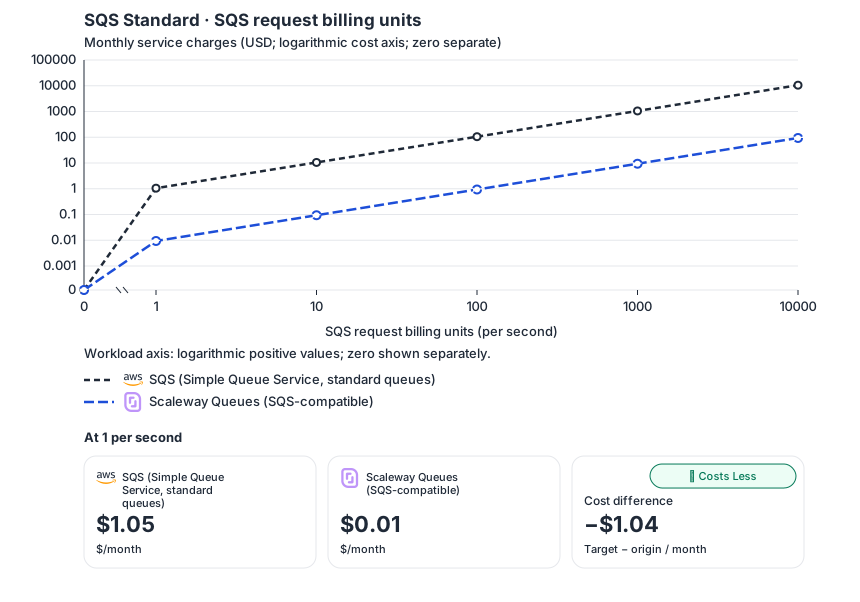
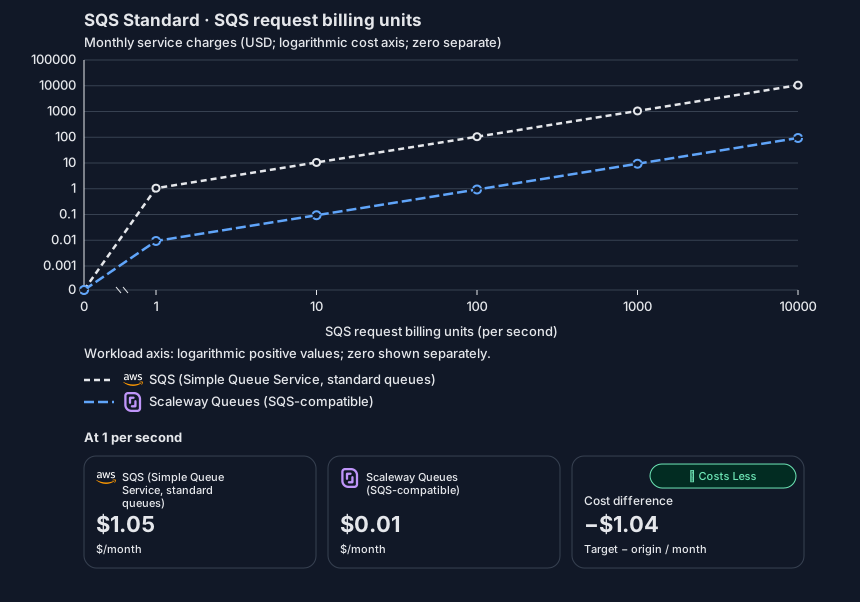
Curve assumptions
- 1-KiB messages, unbatched send/receive/delete; actual batch and delivery assumptions stay visible. Editable authored planning guesses, not verified provider tariffs, benchmark measurements or a commercial quote. Other native meters retain their explicitly displayed default quantities.
- Planning estimate · editable authored rates and sizing assumptions dated 2026-10-22; not verified provider prices. us-east-1 → fr-par, USD/month.
- Source prices are reference charges, not an invoice. Target lines cover selected service usage/configuration only; adapter hosting and Tensor9 fees are excluded.
- Explicit tariff samples are not performance measurements or capacity qualification. No interpolation or break-even guarantee is implied.
- Variant assumptions show the first axis sample; any axis-dependent configuration is described by this curve’s workload note.
- Rates are cited provider list prices, editable for discounts, commitments or another region. Workload translation and capacity coefficients remain editable planning assumptions, not benchmark measurements or a commercial quote.
- Default-zero rates are explicit assumptions, not evidence that the deployed service or resource is free.
- Provisioned-unit minimums use an editable approximate allocation floor. Modeled target service cost is max(usage/allocation, minimum), with billable network, durable staging and dependent sinks added separately; actual RU/TU sizing, scaling increments and throughput remain unqualified.
- Durable staging is priced once: provisioned targets include adapter state in their selected allocation; native targets add a separate staging allocation when required. Adapter hosting is a separate allocation and must exclude resources already priced as staging, workers or target capacity.
- A declared adapter mapping and cost model do not establish implementation availability or service equivalence.
- This is a declared directed mapping; a planning estimate does not establish deployment or request-serving support.
- Authored planning assumptions, not measured adapter capacity. Origin rates are cited first-tier list prices, before free allowances and discounts.
- A cost scenario does not establish backend availability, protocol fidelity or production readiness. Registry serving status remains independent.
- Storage follows resident original messages, not every monthly message. Broker delivery bytes include redeliveries.
- FIFO estimates do not qualify dedup support, group throughput or single-group latency; backend limitations remain applicable.
- Scaleway Queues bills the volume of messages travelling through queues, not requests or storage (https://www.scaleway.com/en/docs/queues/faq/). Scaleway bills published bytes; it does not say whether a received message counts again, so delivered bytes are not charged.
- AWS Price List API, AWSQueueService offer: https://pricing.us-east-1.amazonaws.com/offers/v1.0/aws/AWSQueueService/current/us-east-1/index.json
- Scaleway public product catalog: https://api.scaleway.com/product-catalog/v2alpha1/public-catalog/products
- Additional network transfer, backups, KMS, one-time migration and operational labor unless an explicit meter includes them.
- Destination application execution and separately billed downstream services; supply those allocations separately.
- Taxes, discounts, credits and free-tier allowances unless explicitly reflected in edited rates.
- Unmodeled dependent services, task execution and operations outside the selected workload family.
plan-63b489f0a3bfc0d52f4664f3bf3e716a4311cb75 / 2026-10-22.planning.2. Curve: workload-1.
Sources: AWS Price List API, AWSQueueService offer, Scaleway public product catalog.
SQS → Cloud SQL for PostgreSQL
Origin API:aws::1.0.0::sqs::classic. Target backend: google::1.0.0::cloudsql::postgresql.
Monthly cost by SQS request rate
Reference monthly service charges by Average API requests/s. Adapter hosting and Tensor9 fees are excluded. Source: us-east-1; target: us-central1; currency: USD.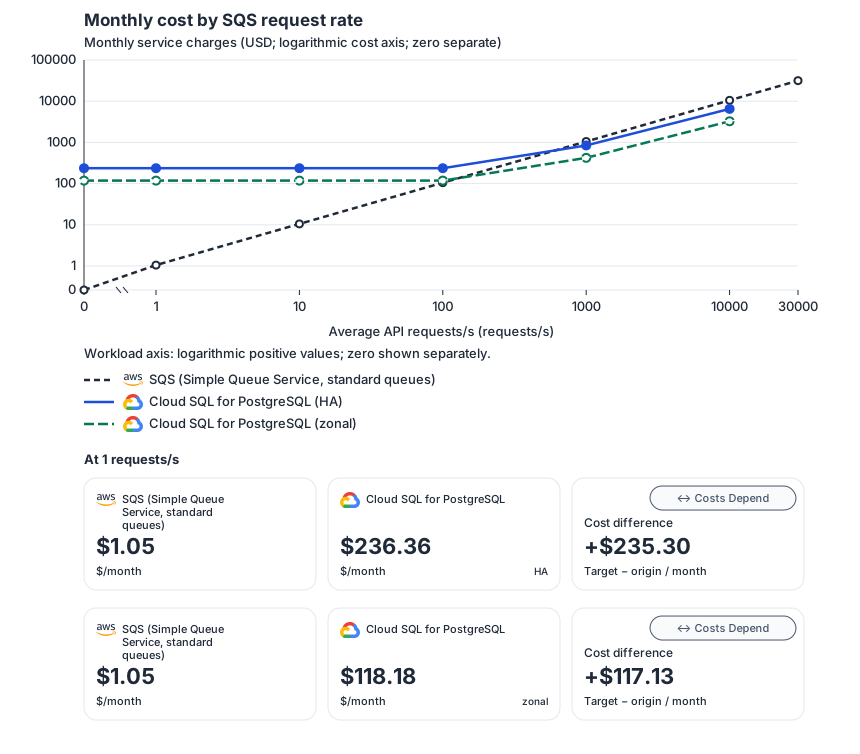
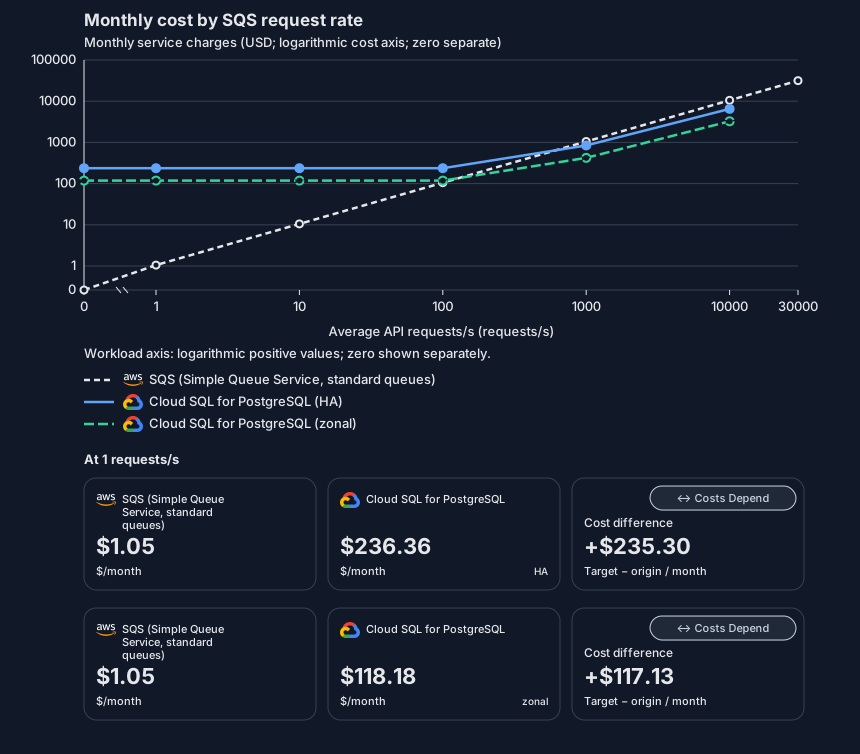
Estimated allocation from planning assumptions; not benchmark calibrated.
The sizing policy grows compute with translated work and peak headroom, memory with compute and working set, and disk with resident working state and reserve. Monthly usage is distinct from resident data; each workload’s assumptions define the translation. HA changes pricing, not this policy’s throughput estimate. Unpriced workloads exceed the policy’s configuration range; no silent vertical cap or automatic sharding is assumed.
- 150 full lifecycle equivalents per primary vCPU-second for a 1 KiB reference message (send, receive/claim and delete). Default 150 is a measured-by-tensor9 lower bound, not benchmark calibrated capacity: k6 offered 300 lifecycles/s to the SQS adapter on Cloud SQL db-custom-2-7680 (2 vCPU, PostgreSQL 16, us-west1) with short timestamp bodies and 299.93/s completed (src/main/kotlin/t9/prime/equiv/generated/eval/CloudsqlK6RoundtripR300T8K6V1_0_0.kt); database CPU was not recorded. These are modeled work units, not measured SQL transactions/s.
- Mean work uses original message arrivals × (2 + deliveries/message + 0.1 × empty receives/message) / 3, then scales by max(1, message bytes / 1024). Source batch fill was already used to infer original messages and is not applied again.
- Peak work is mean work × 2. Required primary CPU divides peak work by 150 lifecycle equivalents/vCPU-second × 0.7 target utilization.
- Resident data uses peak original arrivals × 60 residence seconds × 1024 message bytes × 3 physical storage multiplier. One binary GiB is 1073741824 bytes.
- Provisioned disk rounds (resident GiB + 20 GiB reserve) / 0.7 target disk utilization upward to whole GiB, retaining the caller minimum. Memory is the maximum of caller minimum, CPU × 4 GiB/vCPU and 0.1 of resident data, with a 0.9 GiB/vCPU floor and quarter-GiB upward rounding.
- CPU choices are 2, 4, 8, 16, 32, 64 and 96 primary vCPUs. CPU and memory promote jointly, with at most 6.5 GiB/vCPU, 624 GiB RAM and 65536 GiB disk.
- HA changes standby pricing and does not double primary throughput. Shared allocation changes the assigned cost and does not reduce required capacity.
- No benchmark sample calibrates this policy. Latency, IOPS, polling contention, WAL, vacuum and actual throughput require qualification. Demand beyond the listed configuration bounds is unpriced; this policy does not clamp, automatically shard or extrapolate capacity.
- No listed primary CPU tier through 96 vCPUs satisfies required CPU 190.4761904761904761904761904761905, caller minimum 2 vCPUs and memory at most 6.5 GiB/vCPU or 624 GiB. Required memory at 96 vCPUs is 384 GiB.
- 1 KiB messages; unbatched send, receive and delete requests in a 1:1:1 mix, with no empty receives or redeliveries. 730 hours/month; one billing unit per API request. Requested minima are 2 vCPU, 8 GiB memory and 100 GiB SSD, fully allocated. A versioned planning policy grows CPU, RAM and disk using 2x peak load, 70% utilization and explicit resident-data assumptions; it is not benchmark calibrated. Above the modeled configuration range, target price and savings are unavailable.
- Reference list rates as of 2026-10-18: us-east-1 → us-central1, USD/month.
- Source prices are reference charges, not an invoice. Target lines cover selected service usage/configuration only; adapter hosting and Tensor9 fees are excluded.
- Explicit tariff samples are not performance measurements or capacity qualification. No interpolation or break-even guarantee is implied.
- Variant assumptions show the first axis sample; any axis-dependent configuration is described by this curve’s workload note.
- 730 running hours per modeled month. Dedicated database compute and disk cost money even with zero origin traffic.
- Shared database allocation is a caller assumption. Do not sum a full database charge for every adapter sharing that database.
- Estimated allocation from planning assumptions; not benchmark calibrated. CPU, RAM and provisioned disk grow with the inferred workload and explicit peak/backlog assumptions.
- Average API requests, 64-KiB billing units, original messages and complete lifecycle work are distinct. One unbatched send/receive/delete cycle is one lifecycle, not three TPS.
- CPU tiers stop at 96 primary vCPUs; unsupported demand retains source cost but has no target cost, adapted total or savings. No sharding is inferred.
- Actual throughput, latency, connection limits, disk IOPS, claim contention, WAL and vacuum remain unqualified until comparable sustained benchmark samples exist.
- 150 full lifecycle equivalents per primary vCPU-second for a 1 KiB reference message (send, receive/claim and delete). Default 150 is a measured-by-tensor9 lower bound, not benchmark calibrated capacity: k6 offered 300 lifecycles/s to the SQS adapter on Cloud SQL db-custom-2-7680 (2 vCPU, PostgreSQL 16, us-west1) with short timestamp bodies and 299.93/s completed (src/main/kotlin/t9/prime/equiv/generated/eval/CloudsqlK6RoundtripR300T8K6V1_0_0.kt); database CPU was not recorded. These are modeled work units, not measured SQL transactions/s.
- Mean work uses original message arrivals × (2 + deliveries/message + 0.1 × empty receives/message) / 3, then scales by max(1, message bytes / 1024). Source batch fill was already used to infer original messages and is not applied again.
- Peak work is mean work × 2. Required primary CPU divides peak work by 150 lifecycle equivalents/vCPU-second × 0.7 target utilization.
- Resident data uses peak original arrivals × 60 residence seconds × 1024 message bytes × 3 physical storage multiplier. One binary GiB is 1073741824 bytes.
- Provisioned disk rounds (resident GiB + 20 GiB reserve) / 0.7 target disk utilization upward to whole GiB, retaining the caller minimum. Memory is the maximum of caller minimum, CPU × 4 GiB/vCPU and 0.1 of resident data, with a 0.9 GiB/vCPU floor and quarter-GiB upward rounding.
- CPU choices are 2, 4, 8, 16, 32, 64 and 96 primary vCPUs. CPU and memory promote jointly, with at most 6.5 GiB/vCPU, 624 GiB RAM and 65536 GiB disk.
- HA changes standby pricing and does not double primary throughput. Shared allocation changes the assigned cost and does not reduce required capacity.
- No benchmark sample calibrates this policy. Latency, IOPS, polling contention, WAL, vacuum and actual throughput require qualification. Demand beyond the listed configuration bounds is unpriced; this policy does not clamp, automatically shard or extrapolate capacity.
- Source usage is priced at reference rates; source lines are not actual invoice charges. Free or discounted usage still consumes target resources.
- AWS Standard SQS pricing: https://aws.amazon.com/sqs/pricing/
- Cloud SQL Enterprise PostgreSQL pricing: https://cloud.google.com/sql/pricing/
- Cloud SQL for PostgreSQL instance resource settings: https://docs.cloud.google.com/sql/docs/postgres/instance-settings
- Free allowances, negotiated discounts, credits, tax and one-time migration charges.
- Charges not listed in the breakdown, including additional network transfer, backups and encryption/KMS.
- Application compute changes, operational labor and portfolio-wide sharing or deduplication of infrastructure.
- SQS FIFO and fair queues; actual throughput/latency and resident-data behavior beyond the explicit planning assumptions.
sqs-cloudsql / 2026-10-18.4. Curve: request-rate.
Sources: AWS Standard SQS pricing, Cloud SQL Enterprise PostgreSQL pricing, Cloud SQL for PostgreSQL instance resource settings.
SQS → Cloud SQL planned scale-point benchmark
This is a benchmark plan, with historical reference observations retained separately. Planned cases are not completed measurements. The observations below do not calibrate the estimated allocation policy. Plan:sqs-cloudsql-scale-v1. Model: sqs-cloudsql. Workload: 1 KiB unbatched SQS send/receive/delete message cycles (sqs-1kib-unbatched-cycle).
Operation mix: SendMessage:ReceiveMessage:DeleteMessage = 1:1:1; no empty receives or retries. Latency scope: send start through successful delete completion.
Planned configurations
Required environment keys must be resolved before a planned case can produce matching evidence:
dbEngineVersion, adapterVcpus, adapterMemoryGiB, adapterReplicas, loadGeneratorVcpus, loadGeneratorMemoryGiB, connectionPoolSize.
- cloudsql-zonal-2vcpu unresolved:
adapterVcpus,adapterMemoryGiB,adapterReplicas,loadGeneratorVcpus,loadGeneratorMemoryGiB,connectionPoolSize. - cloudsql-zonal-4vcpu unresolved:
adapterVcpus,adapterMemoryGiB,adapterReplicas,loadGeneratorVcpus,loadGeneratorMemoryGiB,connectionPoolSize. - cloudsql-zonal-8vcpu unresolved:
adapterVcpus,adapterMemoryGiB,adapterReplicas,loadGeneratorVcpus,loadGeneratorMemoryGiB,connectionPoolSize. - cloudsql-zonal-16vcpu unresolved:
adapterVcpus,adapterMemoryGiB,adapterReplicas,loadGeneratorVcpus,loadGeneratorMemoryGiB,connectionPoolSize.
Historical reference observations
These observations remain separate records. Unknown payload, measurement duration, availability, completed-cycle throughput or other missing fields prevent treating a tool’s request rate as qualified message-lifecycle capacity.
-
historical-k6-roundtrip-r300-t8-1-0-0: source
src/main/kotlin/t9/prime/equiv/generated/eval/CloudsqlK6RoundtripR300T8K6V1_0_0.kt; case unmatched historical observation. Payload unknown bytes; batch fill send/receive/delete unknown/unknown/unknown; queues unknown; concurrency unknown. Operation mix: unknown. Latency scope: historical e2e metric; full send-through-delete timing is not established. Completed cycles unknown; error rate unknown; backlog start/end unknown/unknown; CPU/memory utilization unknown/unknown; p50/p99 24/140 ms; coordinated-omission correction true. The original generated EvalMeasurement is authoritative; metrics are projected from it without independently restating measured values. Tool-reported throughput does not identify offered, produced and sustained completed-message-cycle rates separately. Payload size, batch mix, queue count, concurrency, duration, completed count, errors, backlog, CPU/memory observations and HA are not established by this record. k6/Locust scripts used timestamp-string bodies rather than an exact 1 KiB payload; the OMB payload is also not established here. The source records storage as GB PD_SSD; tier memory is derived from db-custom MiB. Raw tuning is retained alongside the normalized allocation. -
historical-locust-roundtrip-t8-1-0-0: source
src/main/kotlin/t9/prime/equiv/generated/eval/CloudsqlLocustRoundtripT8LocustV1_0_0.kt; case unmatched historical observation. Payload unknown bytes; batch fill send/receive/delete unknown/unknown/unknown; queues unknown; concurrency unknown. Operation mix: unknown. Latency scope: historical e2e metric; full send-through-delete timing is not established. Completed cycles unknown; error rate unknown; backlog start/end unknown/unknown; CPU/memory utilization unknown/unknown; p50/p99 24/35 ms; coordinated-omission correction false. The original generated EvalMeasurement is authoritative; metrics are projected from it without independently restating measured values. Tool-reported throughput does not identify offered, produced and sustained completed-message-cycle rates separately. Payload size, batch mix, queue count, concurrency, duration, completed count, errors, backlog, CPU/memory observations and HA are not established by this record. k6/Locust scripts used timestamp-string bodies rather than an exact 1 KiB payload; the OMB payload is also not established here. The source records storage as GB PD_SSD; tier memory is derived from db-custom MiB. Raw tuning is retained alongside the normalized allocation. -
historical-omb-roundtrip-t2-1-0-0: source
src/main/kotlin/t9/prime/equiv/generated/eval/CloudsqlOmbRoundtripT2OmbV1_0_0.kt; case unmatched historical observation. Payload unknown bytes; batch fill send/receive/delete unknown/unknown/unknown; queues unknown; concurrency unknown. Operation mix: unknown. Latency scope: historical e2e metric; full send-through-delete timing is not established. Completed cycles unknown; error rate unknown; backlog start/end unknown/unknown; CPU/memory utilization unknown/unknown; p50/p99 13/83 ms; coordinated-omission correction true. The original generated EvalMeasurement is authoritative; metrics are projected from it without independently restating measured values. Tool-reported throughput does not identify offered, produced and sustained completed-message-cycle rates separately. Payload size, batch mix, queue count, concurrency, duration, completed count, errors, backlog, CPU/memory observations and HA are not established by this record. k6/Locust scripts used timestamp-string bodies rather than an exact 1 KiB payload; the OMB payload is also not established here. The source records storage as GB PD_SSD; tier memory is derived from db-custom MiB. Raw tuning is retained alongside the normalized allocation. - The 16 cases are planned experiments, each requiring three independent repetitions. No planned case has measured samples yet.
- Pin an adapter version before running a case. Completed-message-cycle throughput, p99 cycle latency, errors and backlog must be measured over 300 seconds after 60 seconds of warmup.
- Acceptance is authored: sustained completed cycles meet the offered rate, p99 ≤ 200 ms, error rate ≤ 0.001 and no backlog growth. This is not measured capacity evidence.
- Tail-latency qualification requires coordinated-omission-corrected measurements under the offered-load workload; correction alone never establishes completion or capacity.
- Historical k6, Locust and OMB observations are different workloads/tools at the same 2-vCPU allocation in us-west1. They are not hardware scaling points and are not averaged.
- Historical observations lack exact payload, HA, duration, completed-cycle counts, error/backlog and resource observations; none qualifies the sizing policy.
- The k6 observation completed its offered 300 cycles/s on 2 vCPU, so the sizing default of 150 lifecycles per vCPU-second is a lower bound. The planned cases must also record database CPU before a measured capacity can replace it.
- Adapter, load-generator and connection-pool allocations must be recorded before a case can qualify. Empty planned environment values are unresolved requirements, not defaults.
SQS → Google Cloud Pub/Sub
Origin API:aws::1.0.0::sqs::classic. Target backend: google::1.0.0::pubsub.
Monthly cost by SQS request rate
Reference monthly service charges by API requests/s. Adapter hosting and Tensor9 fees are excluded. Source: us-east-1; target: us-central1; currency: USD.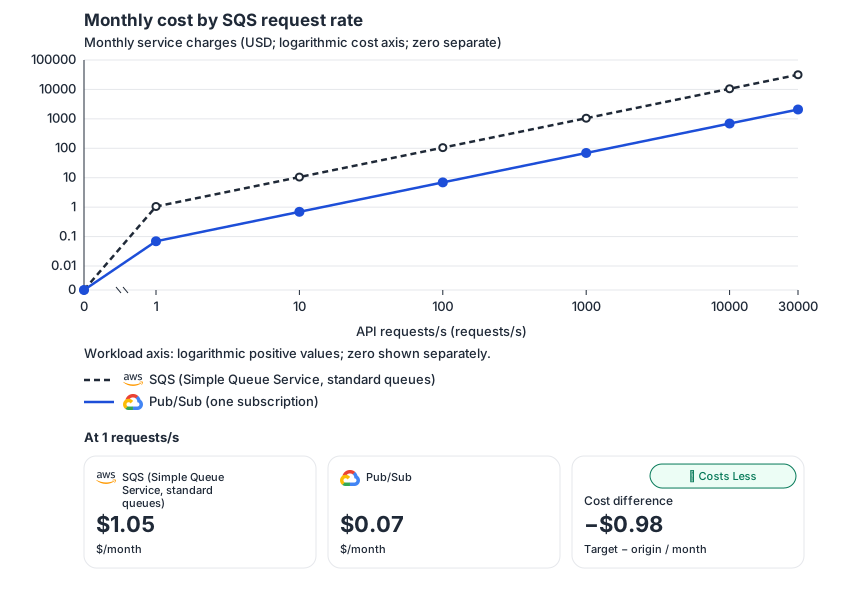
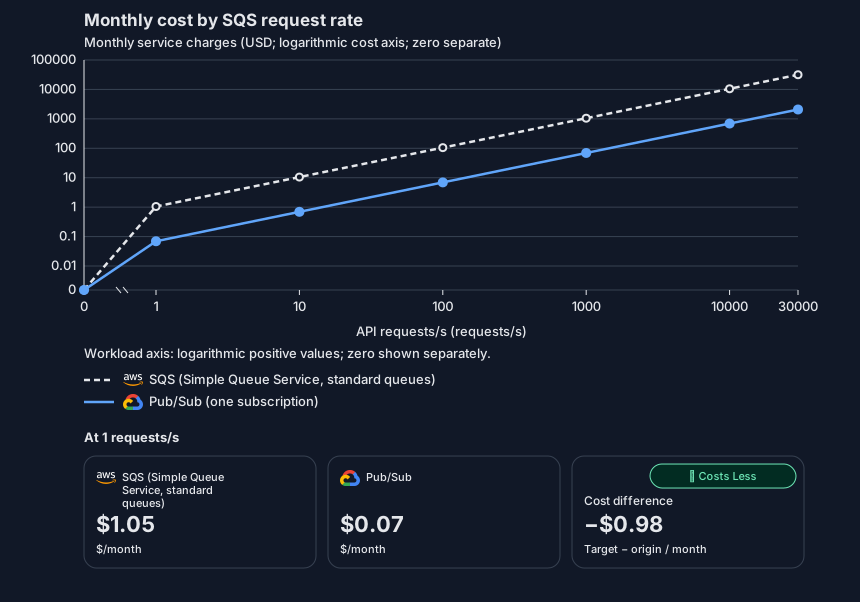
Curve assumptions
- 1 KiB messages; unbatched send, receive and delete requests in a 1:1:1 mix, with no empty receives or redeliveries. 730 hours/month; one SQS billing unit per API request. Pub/Sub uses one subscription and 64 bytes of assumed overhead.
- Reference list rates as of 2026-10-18: us-east-1 → us-central1, USD/month.
- Source prices are reference charges, not an invoice. Target lines cover selected service usage/configuration only; adapter hosting and Tensor9 fees are excluded.
- Explicit tariff samples are not performance measurements or capacity qualification. No interpolation or break-even guarantee is implied.
- Variant assumptions show the first axis sample; any axis-dependent configuration is described by this curve’s workload note.
- One pull subscription, Standard SQS semantics compatible with this mapping, representative message size and batching.
- Pub/Sub publish and delivery each cost USD 40/TiB, with a 1,000-byte minimum per request. Metadata overhead is an explicit assumption.
- Source usage is priced at reference rates; source lines are not actual invoice charges. Free or discounted usage still consumes target resources.
- AWS Standard SQS pricing: https://aws.amazon.com/sqs/pricing/
- Pub/Sub pricing: https://cloud.google.com/pubsub/pricing/
- Free allowances, negotiated discounts, credits, tax and one-time migration charges.
- Charges not listed in the breakdown, including additional network transfer, backups and encryption/KMS.
- Application compute changes, operational labor and portfolio-wide sharing or deduplication of infrastructure.
- Pub/Sub retained-message storage, snapshots, extra subscriptions and transformations; SQS delay/FIFO features and visibility-extension traffic.
sqs-pubsub / 2026-10-18.4. Curve: request-rate.
Sources: AWS Standard SQS pricing, Pub/Sub pricing.
See the service catalog for supported directions, operation coverage and adapter limitations.