

google::1.0.0::dns, with backend choices shown together. Read how Tensor9 estimates service-adapter costs for price scope and capacity qualification, or return to additional services.
Authoritative DNS zones and queries (Cloud DNS) → Azure DNS
Origin API:google::1.0.0::dns. Target backend: azure::1.0.0::dns.
Designed mapping. This cost model describes an intended adapter. Its estimated price does not establish a delivered or selectable backend.
Authoritative DNS zones and queries (Cloud DNS) · Authoritative DNS queries per second
Estimated monthly service charges by Authoritative DNS queries per second. Adapter hosting and Tensor9 fees are excluded. Source: us-central1; target: eastus; currency: USD.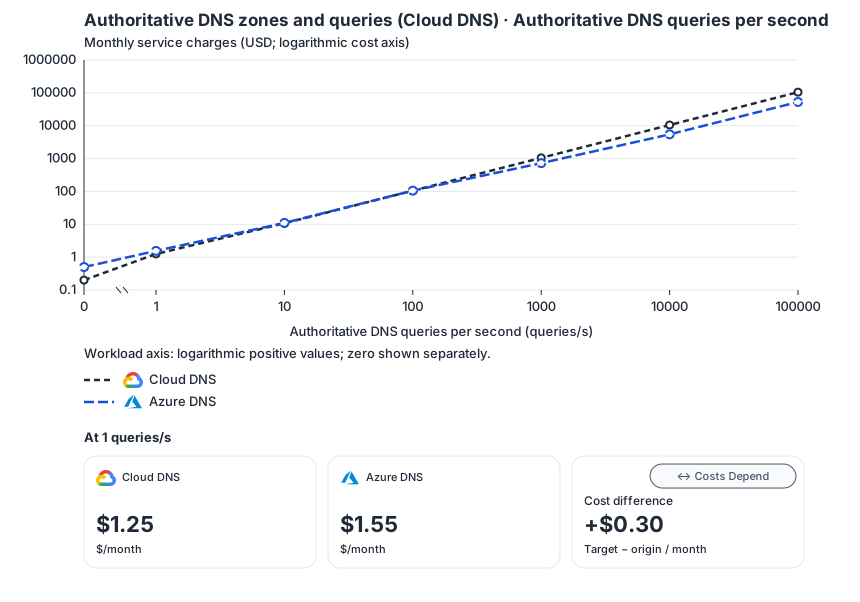
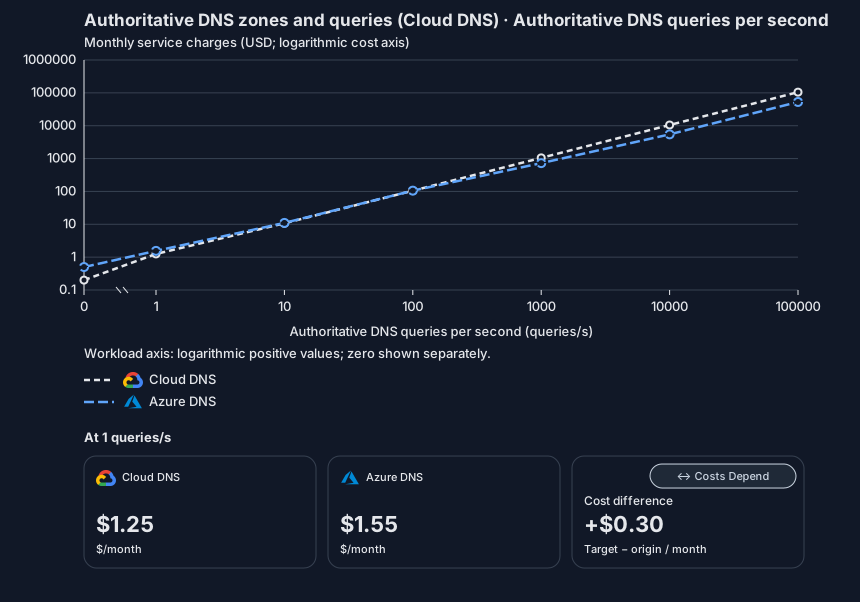
Curve assumptions
- Only this native meter varies; all other source usage and translation assumptions retain the displayed defaults. Editable authored planning guesses, not verified provider tariffs, benchmark measurements or a commercial quote. Other native meters retain their explicitly displayed default quantities.
- Planning estimate · editable authored rates and sizing assumptions dated 2026-10-22; not verified provider prices. us-central1 → eastus, USD/month.
- Source prices are reference charges, not an invoice. Target lines cover selected service usage/configuration only; adapter hosting and Tensor9 fees are excluded.
- Explicit tariff samples are not performance measurements or capacity qualification. No interpolation or break-even guarantee is implied.
- Variant assumptions show the first axis sample; any axis-dependent configuration is described by this curve’s workload note.
- Rates are cited provider list prices, editable for discounts, commitments or another region. Workload translation and capacity coefficients remain editable planning assumptions, not benchmark measurements or a commercial quote.
- Default-zero rates are explicit assumptions, not evidence that the deployed service or resource is free.
- Provisioned-unit minimums use an editable approximate allocation floor. Modeled target service cost is max(usage/allocation, minimum), with billable network, durable staging and dependent sinks added separately; actual RU/TU sizing, scaling increments and throughput remain unqualified.
- Durable staging is priced once: provisioned targets include adapter state in their selected allocation; native targets add a separate staging allocation when required. Adapter hosting is a separate allocation and must exclude resources already priced as staging, workers or target capacity.
- A declared adapter mapping and cost model do not establish implementation availability or service equivalence.
- This exact directed mapping has a design profile. Cost modeling does not establish an implemented or deployable adapter.
- Origin unit prices are cited provider list prices; capacity coefficients and translation assumptions are editable authored planning guesses, not measured capacity or a provider quote.
- Management requests do not reveal resource allocation or workload traffic. Provisioned resources and traffic are independent inputs.
- This compares authoritative zones and query meters; resolver forwarding has a different allocation and tariff.
- A cost scenario does not establish live-qualified runtime DNS propagation or public authority.
- Zone-months and authoritative queries are billed independently; management calls are free. Azure DNS public zones and queries; zone and query prices step down after 25 zones and one billion queries.
- Cloud DNS pricing: https://cloud.google.com/dns/pricing
- Azure Retail Prices API: https://prices.azure.com/api/retail/prices
- Health checks, DNSSEC premiums, resolver endpoints, query logs, domain registration and routing-policy premiums.
- Taxes, discounts, credits and free-tier allowances unless explicitly reflected in edited rates.
- Unmodeled dependent services, task execution and operations outside the selected workload family.
plan-6a1f3e0fcf12a62887b36090fd47289189f686b5 / 2026-10-22.planning.2. Curve: workload-1.
Sources: Cloud DNS pricing, Azure Retail Prices API.
Authoritative DNS zones and queries (Cloud DNS) → Route53
Origin API:google::1.0.0::dns. Target backend: aws::1.0.0::route53.
Designed mapping. This cost model describes an intended adapter. Its estimated price does not establish a delivered or selectable backend.
Authoritative DNS zones and queries (Cloud DNS) · Authoritative DNS queries per second
Estimated monthly service charges by Authoritative DNS queries per second. Adapter hosting and Tensor9 fees are excluded. Source: us-central1; target: us-east-1; currency: USD.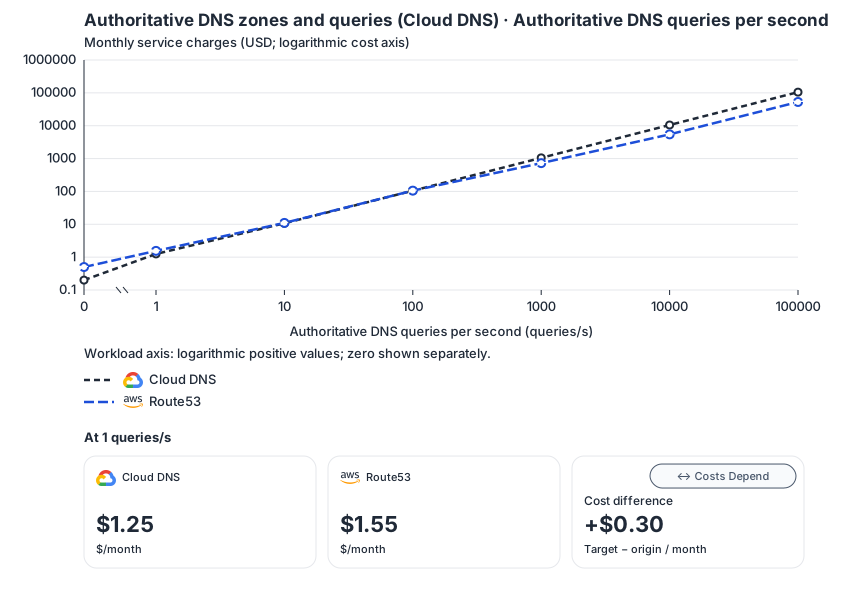
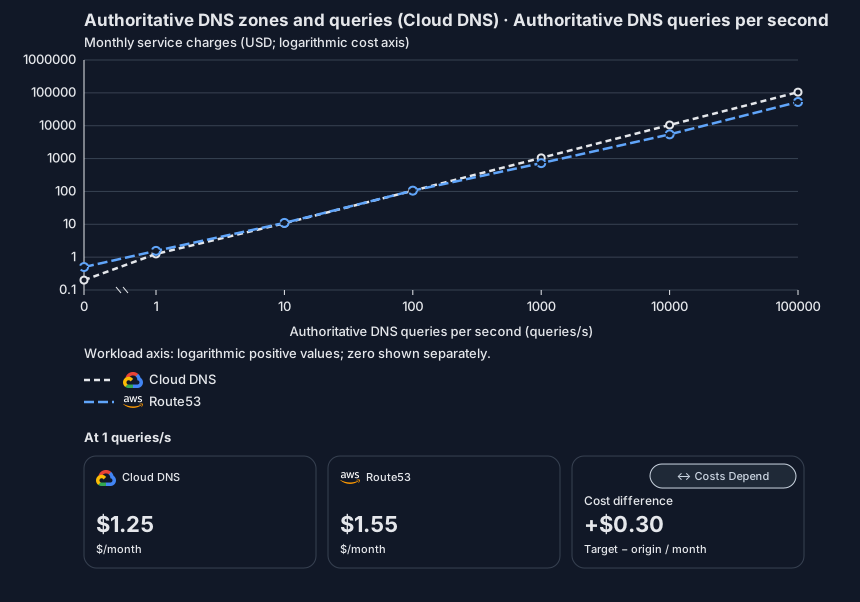
Curve assumptions
- Only this native meter varies; all other source usage and translation assumptions retain the displayed defaults. Editable authored planning guesses, not verified provider tariffs, benchmark measurements or a commercial quote. Other native meters retain their explicitly displayed default quantities.
- Planning estimate · editable authored rates and sizing assumptions dated 2026-10-22; not verified provider prices. us-central1 → us-east-1, USD/month.
- Source prices are reference charges, not an invoice. Target lines cover selected service usage/configuration only; adapter hosting and Tensor9 fees are excluded.
- Explicit tariff samples are not performance measurements or capacity qualification. No interpolation or break-even guarantee is implied.
- Variant assumptions show the first axis sample; any axis-dependent configuration is described by this curve’s workload note.
- Rates are cited provider list prices, editable for discounts, commitments or another region. Workload translation and capacity coefficients remain editable planning assumptions, not benchmark measurements or a commercial quote.
- Default-zero rates are explicit assumptions, not evidence that the deployed service or resource is free.
- Provisioned-unit minimums use an editable approximate allocation floor. Modeled target service cost is max(usage/allocation, minimum), with billable network, durable staging and dependent sinks added separately; actual RU/TU sizing, scaling increments and throughput remain unqualified.
- Durable staging is priced once: provisioned targets include adapter state in their selected allocation; native targets add a separate staging allocation when required. Adapter hosting is a separate allocation and must exclude resources already priced as staging, workers or target capacity.
- A declared adapter mapping and cost model do not establish implementation availability or service equivalence.
- This exact directed mapping has a design profile. Cost modeling does not establish an implemented or deployable adapter.
- Origin unit prices are cited provider list prices; capacity coefficients and translation assumptions are editable authored planning guesses, not measured capacity or a provider quote.
- Management requests do not reveal resource allocation or workload traffic. Provisioned resources and traffic are independent inputs.
- This compares authoritative zones and query meters; resolver forwarding has a different allocation and tariff.
- A cost scenario does not establish live-qualified runtime DNS propagation or public authority.
- Zone-months and authoritative queries are billed independently; management calls are free. Route 53 public hosted zones and standard queries; zone and query prices step down after 25 zones and one billion queries. Alias queries to AWS resources are free, and latency, geo and weighted routing queries cost more.
- Cloud DNS pricing: https://cloud.google.com/dns/pricing
- AWS Price List API: https://pricing.us-east-1.amazonaws.com/offers/v1.0/aws/AmazonRoute53/current/aws-other/index.json
- Health checks, DNSSEC premiums, resolver endpoints, query logs, domain registration and routing-policy premiums.
- Taxes, discounts, credits and free-tier allowances unless explicitly reflected in edited rates.
- Unmodeled dependent services, task execution and operations outside the selected workload family.
plan-ce4ac7e6ecaa7ffb421ec5546d2fc57f6fbefebd / 2026-10-22.planning.2. Curve: workload-1.
Sources: Cloud DNS pricing, AWS Price List API.
See the service catalog for operation coverage, supported directions and backend limitations.