

- Coverage by target cloud
- How the backends compare
- On Google Cloud
- On Google Cloud, Azure, OCI, and Private Kubernetes
- On Azure
- State-machine administration
- Costs
- Service level agreements
- Step Functions to Azure Durable Functions
- Step Functions to Cloud Workflows
- Step Functions to Temporal Cloud (Managed)
- Step Functions to Temporal (Self-Hosted)
- Step Functions State Machine to Azure Durable Functions
- Step Functions State Machine to Cloud Workflows
- Step Functions State Machine to Temporal Cloud (Managed)
- Step Functions State Machine to Temporal (Self-Hosted)
- Debug this service
Coverage by target cloud
How the backends compare
Each row compares a capability of Step Functions with its adaptation on each backend. A dash means this row is not stated for that backend.Max adaptation
On Google Cloud
Via Cloud Workflows
How it works
Your application keeps calling the Step Functions API. On Google Cloud those calls reach a Tensor9 service adapter instead of AWS. The adapter holds each state machine as a record (the Amazon States Language definition as you wrote it, the role, the type, the versions, the aliases and the tags) and answers everystates: operation from that record and from the executions it has admitted.
Cloud Workflows executes its own language, so for each revision of a state machine the adapter prepares an immutable set of bounded workflow modules and a manifest in Cloud Workflows. Four quotas make that split necessary: a single workflow source is capped at 128 KB against the 1 MB an ASL definition may be, parallel steps nest two deep, 20 branches run at once within one execution, and variables, arguments and events share 512 KB. A Parallel or Map that exceeds the depth or width runs its branches as child executions; a large definition spans several modules. Data flow and expression semantics (paths, intrinsics, JSONata, Choice rules) are evaluated by an adapter helper the workflow calls, so ASL behaves as it does on AWS rather than as an approximation in the Workflows language.
StartExecution admits the execution and pins its revision. A Standard execution runs as a Workflows execution of that revision’s prepared workflow; an Express execution runs inline in the adapter and leaves no durable record, as on AWS. The workflow runs under a service account the adapter creates for that revision, so its calls to other services present an identity of their own and are authorized per workflow rather than for the whole project. A Task state’s Resource names an AWS service and is served by that service’s mapping on the same appliance; a .waitForTaskToken integration parks the execution on a Workflows callback until SendTaskSuccess or SendTaskFailure arrives. Each Task effect is authorized against the state machine’s execution role, or the Task.Credentials role where one is set, before it is made. GetExecutionHistory returns Step Functions events built from the adapter’s record and the Workflows execution in causal order.
Infrastructure-only translation
A deployment that translates infrastructure only, with no adapter, treats the state machine as a Terraform resource. The Tensor9 compiler emits a Cloud Workflows workflow with the state machine’s name in the appliance’s region and stops there: the Amazon States Language definition has no mechanical translation to the Workflows language (Task, Wait, Choice, Map and Parallel states against Workflows steps, switch, try/retry/except, for and parallel), so the workflow’s source is left unset and reported as an omission, and the logic must be re-authored by hand in Workflows YAML. The execution role, an EXPRESS type, the logging configuration and tags are reported as lossy for the same reason: the role is a separate IAM object with no service-account email to bind, Workflows has one durable execution model, logging is a Cloud Logging setting, and label keys must be lowercase without dots. That path exists so a deployment with a state machine still produces a valid Google Cloud stack; it does not answer the Step Functions API, and an application that callsstates: needs the adapter above.
Limitations
- Activities are served by the adapter. Cloud Workflows has callback endpoints but no resource a worker outside the platform long-polls by name, so an Activity is a queue the adapter serves: GetActivityTask holds the poll open for up to 60 seconds, the token is minted by the adapter, and a completion resumes the workflow through its callback. Workers need no code change; they must reach the adapter’s endpoint. - Large Map Runs are paced by the appliance. A Map Run becomes child Workflows executions within MaxConcurrency, and a Parallel or inline Map wider than 20 branches also runs as child executions. A large Map Run is admitted with backpressure rather than all at once; its semantics do not change, and an UpdateMapRun that cannot reach children already running fails with a named error instead of reporting a change that did not happen. - A ceiling reached mid-execution is named. Cloud Workflows has budgets of its own, such as its step budget per execution. When one is reached inside a window AWS would still honour, the execution fails with an error naming the ceiling rather than as an ordinary timeout, and a task token outstanding for as long as AWS allows is either honoured or fails the same way. - Definitions span modules. A definition larger than 128 KB, or nested deeper than Workflows allows, is split across prepared modules. The split is the adapter’s and is invisible to the API, but the prepared workflows are visible in the Google Cloud console, named per revision. - Logs and traces do not reach CloudWatch or X-Ray.
includeExecutionDatadecides whether execution payloads are written at all and the configured destination decides whose log they reach; the entries land in Cloud Logging, since CloudWatch Logs is a service the appliance does not adapt. AtracingConfigurationthat enables X-Ray tracing is rejected at CreateStateMachine and UpdateStateMachine rather than stored and ignored. - Service integrations are bounded by the appliance. A Resource naming a service the appliance does not serve is reported by ValidateStateMachineDefinition and refused at CreateStateMachine with an error naming the state. - Without the adapter, the definition does not come across. The infrastructure-only translation emits the Workflows shell and leaves its source unset; the state machine’s logic must be re-authored by hand. - The engine choice is fixed per execution. Which engine runs a state machine is chosen per deployment and recorded with each execution. Changing it affects executions started afterwards; executions already running, their history and their outstanding task tokens stay on the engine they started on until they complete and their retention expires. Nothing migrates a live execution.
Other considerations
- Migration. State machines are created by your own deployment through CreateStateMachine, versions and aliases included; the adapter prepares each revision’s modules at that point. Executions do not migrate, and AWS execution history is not copied. - Who operates what. Google operates Cloud Workflows and stores each execution’s state and history for 90 days after it completes. Tensor9 operates the adapter, the prepared modules and the helper service; an adapter upgrade leaves a revision’s prepared modules in place, so a running execution keeps the code it started with. - Cost shape. AWS bills a Standard execution per state transition. Cloud Workflows bills per step executed and per external call, and the adapter helper’s evaluations count as external calls. - What you see in the Google Cloud console. Workflows named per revision and their executions, under the per-revision service accounts the adapter creates. State machines, execution ARNs and versions exist in the adapter’s record and are what the Step Functions API returns.
Example monthly charges
This Tensor9 BYOC scenario estimates service charges for the named origin and target services. Adapter hosting and commercial Tensor9 fees need separate allocations. How Tensor9 estimates costs explains the method and what the estimates include.Step Functions Standard · State transitions
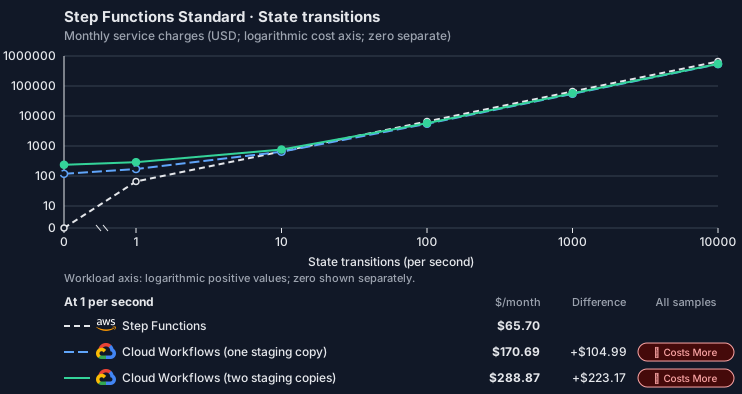
Feature: Step Functions Standard. Estimated monthly service charges by State transitions. Adapter hosting and Tensor9 fees are excluded. Source: us-east-1; target: us-central1; currency: USD.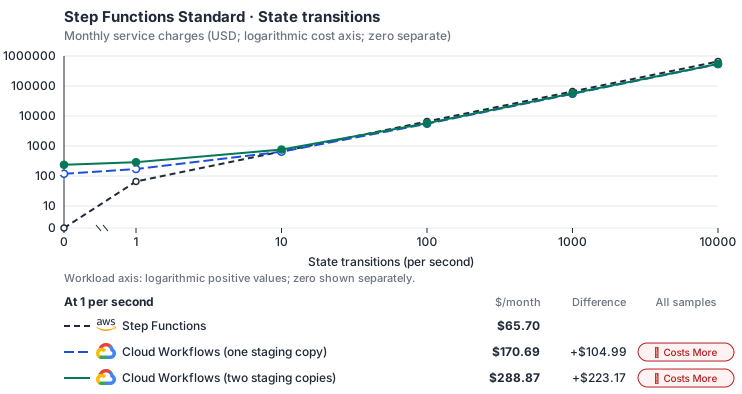
Estimated allocation, not benchmark calibrated: sized from 2 vCPU, 8 GiB memory and 100 GiB SSD at 0 per second to 96 vCPU, 624 GiB memory and 21,655 GiB SSD at 10,000 per second.
Curve assumptions
- Includes source retries; target amplification is applied only once. Other native meters and workload assumptions retain their explicitly displayed default quantities. Workload translation and capacity assumptions are not benchmark measurements.
- Native monthly usage priced at the cited provider list prices; listed target allowances apply where present, excluding invoice credits, taxes and negotiated discounts. Rates as of 2026-10-22: us-east-1 → us-central1, USD/month.
- Source prices are reference charges, not an invoice. Target lines cover selected service usage/configuration only; adapter hosting and Tensor9 fees are excluded.
- Samples of explicit prices are not performance measurements or capacity qualification. No interpolation or break-even guarantee is implied.
- Variant assumptions show the first axis sample; any axis-dependent configuration is described by this curve’s workload note.
- Rates are cited provider list prices, editable for discounts, commitments or another region. Workload translation and capacity coefficients remain editable planning assumptions, not benchmark measurements or a commercial quote.
- Default-zero rates are explicit assumptions, not evidence that the deployed service or resource is free.
- Provisioned-unit minimums use an editable approximate allocation floor. Modeled target service cost is max(usage/allocation, minimum), with billable network, durable staging and dependent sinks added separately; actual RU/TU sizing, scaling increments and throughput remain unqualified.
- Durable staging is priced once: provisioned targets include adapter state in their selected allocation; native targets add a separate staging allocation when required. Adapter hosting is a separate allocation and must exclude resources already priced as staging, workers or target capacity.
- A declared adapter mapping and cost model do not establish implementation availability or service equivalence.
- This is a declared directed mapping; a planning estimate does not establish deployment or request-serving support.
- Authored planning assumptions, not measured adapter capacity. Origin rates are cited first-tier list prices, before free allowances and discounts.
- A cost scenario does not establish backend availability, protocol fidelity or production readiness. Registry serving status remains independent.
- Managed steps, worker CPU and durable history are distinct target cost components. Internal/external step split needs target-specific assumptions.
- Standard-only origin profile; no inference of Express duration, memory or task execution cost.
- Google Workflows bills executed steps, including failed and retried ones, in increments of 1,000. Translated Step Functions steps are priced as internal steps (USD 0.01 per 1,000 after 5,000 free): assignments, conditions, subworkflow calls and calls to *.googleapis.com, Cloud Run and Cloud Run functions, which is where translated state-machine work runs. External steps (HTTP to endpoints outside Google Cloud or custom domains, and callback waits) bill USD 0.025 per 1,000 after 2,000 free; a workflow dominated by those should set the step rate to 0.000025. Worker CPU is not a Workflows charge.
- Row-store throughput (capacityOpsPerVcpuSecond, default 1500) is measured-by-tensor9 as a lower bound: the DynamoDB adapter on Cloud SQL db-custom-2-7680 (2 vCPU, PostgreSQL 16, us-west1) served 2,974 ops/s of YCSB-A at 16 threads without recorded saturation (src/main/kotlin/t9/prime/equiv/generated/eval/CloudsqlPostgresqlYcsbAT16GoYcsbV1_0_0.kt). Published CPU-bound pgbench reaches 3,101 read-write transactions and 20,289 point reads per vCPU-second (AWS z1d.2xlarge, PostgreSQL 14.5), so actual capacity is likely higher. Reads and writes share one coefficient: at the same adapter version, read-only YCSB-C was not faster than 50%-update YCSB-A.
- Log-broker throughput (capacityStreamMiBPerVcpuSecond 20 at 0.5 utilization, 4 GiB RAM per vCPU) is provider-documented by Google Managed Service for Apache Kafka sizing (https://docs.cloud.google.com/managed-service-for-apache-kafka/docs/plan-cluster-size): write-equivalent bytes are replicated writes plus a quarter of reads. Producer batches below 10 KB lower per-CPU throughput; that penalty is not modeled.
- Disk utilization 0.8 is provider-documented headroom below Cloud SQL automatic storage increase, which triggers near 91-95% full (https://docs.cloud.google.com/sql/docs/postgres/instance-settings). The 20 GiB reserve exceeds PostgreSQL’s 1 GB default max_wal_size; the remainder of that reserve is unmeasured.
- CPU tiers double from 2 vCPUs to the target’s largest node at 4 GiB per vCPU; each target’s documented largest node bounds CPU, RAM, RAM per vCPU and disk, and the durable staging database uses Cloud SQL Enterprise (96 vCPU, 6.5 GiB per vCPU, 624 GiB, 64 TiB). Targets billed per capacity unit or throughput unit are sized by their backend instead.
- No public evidence: peak/mean work (2) and the RAM working-set fraction (0.1). Proposed measurements: the p99 one-minute rate over the monthly mean from customer CloudWatch metrics; the buffer hit ratio while stepping RAM under a fixed YCSB-B load.
- Node bounds: Cloud SQL Enterprise allows 1-96 vCPUs at 0.9-6.5 GB per vCPU and up to 64 TB with a dedicated vCPU (https://docs.cloud.google.com/sql/docs/postgres/instance-settings).
- Stored GiB already includes the origin family’s physical footprint assumptions; no second storage amplification is applied.
- The operations/vCPU coefficient supplies the compute requirement alongside explicit resource-hour minima.
- Copies and allocation fractions change cost only; they do not increase modeled primary capacity.
- AWS Price List API, AmazonStates offer: https://pricing.us-east-1.amazonaws.com/offers/v1.0/aws/AmazonStates/current/us-east-1/index.json
- Workflows pricing: https://cloud.google.com/workflows/pricing
- Additional network transfer, backups, KMS, one-time migration and operational labor unless an explicit meter includes them.
- Destination application execution and separately billed downstream services; supply those allocations separately.
- Taxes, discounts, credits and free-tier allowances not explicitly listed by this model.
- Unmodeled dependent services, task execution and operations outside the selected workload family.
plan-ad343f795f60d331cee21f2d116f519470c34325 / 2026-10-22.planning.2. Curve: workload-1.
Sources: AWS Price List API, AmazonStates offer, Workflows pricing.
Step Functions Standard → Cloud Workflows: Authored native-usage planning example. Native monthly usage priced at the cited provider list prices; listed target allowances apply where present, excluding invoice credits, taxes and negotiated discounts.
Scenario source region: us-east-1. Scenario target region: us-central1. Currency: USD.
Estimated allocation, not benchmark calibrated: sized at 2 vCPU, 8 GiB memory and 100 GiB SSD for this scenario.
Unestimated components: Adapter hosting, Tensor9 fees. A modeled adapted total and savings require these costs.
Cost scope: Modeled target native service and explicitly modeled state allocation; hosting and Tensor9 fees only when supplied.
Excluded costs and workload features:
- Additional network transfer, backups, KMS, one-time migration and operational labor unless an explicit meter includes them.
- Destination application execution and separately billed downstream services; supply those allocations separately.
- Taxes, discounts, credits and free-tier allowances not explicitly listed by this model.
- Unmodeled dependent services, task execution and operations outside the selected workload family.
- Translated reads: 0 operations.
- Translated writes: 0 operations.
- Translated resident physical data: 0 GiB-month.
- Native provider operations: 0 operations.
- Published payload: 0 GiB.
- Delivered payload: 0 GiB.
- Allocated execution CPU: 0 vCPU-hour.
- Allocated execution RAM: 0 GiB-hour.
- Independent resource allocation: 0 resource-hour.
- Independent inventory: 0 resource-month.
- Input tokens: 0 tokens.
- Output tokens: 0 tokens.
- Billable network: 0 GiB.
- Dependent object sink retained data: 0 GiB-month.
- Dependent object sink writes: 0 writes.
- Rates are cited provider list prices, editable for discounts, commitments or another region. Workload translation and capacity coefficients remain editable planning assumptions, not benchmark measurements or a commercial quote.
- Default-zero rates are explicit assumptions, not evidence that the deployed service or resource is free.
- Provisioned-unit minimums use an editable approximate allocation floor. Modeled target service cost is max(usage/allocation, minimum), with billable network, durable staging and dependent sinks added separately; actual RU/TU sizing, scaling increments and throughput remain unqualified.
- Durable staging is priced once: provisioned targets include adapter state in their selected allocation; native targets add a separate staging allocation when required. Adapter hosting is a separate allocation and must exclude resources already priced as staging, workers or target capacity.
- A declared adapter mapping and cost model do not establish implementation availability or service equivalence.
- This is a declared directed mapping; a planning estimate does not establish deployment or request-serving support.
- Authored planning assumptions, not measured adapter capacity. Origin rates are cited first-tier list prices, before free allowances and discounts.
- A cost scenario does not establish backend availability, protocol fidelity or production readiness. Registry serving status remains independent.
- Managed steps, worker CPU and durable history are distinct target cost components. Internal/external step split needs target-specific assumptions.
- Standard-only origin profile; no inference of Express duration, memory or task execution cost.
- Google Workflows bills executed steps, including failed and retried ones, in increments of 1,000. Translated Step Functions steps are priced as internal steps (USD 0.01 per 1,000 after 5,000 free): assignments, conditions, subworkflow calls and calls to *.googleapis.com, Cloud Run and Cloud Run functions, which is where translated state-machine work runs. External steps (HTTP to endpoints outside Google Cloud or custom domains, and callback waits) bill USD 0.025 per 1,000 after 2,000 free; a workflow dominated by those should set the step rate to 0.000025. Worker CPU is not a Workflows charge.
- Row-store throughput (capacityOpsPerVcpuSecond, default 1500) is measured-by-tensor9 as a lower bound: the DynamoDB adapter on Cloud SQL db-custom-2-7680 (2 vCPU, PostgreSQL 16, us-west1) served 2,974 ops/s of YCSB-A at 16 threads without recorded saturation (src/main/kotlin/t9/prime/equiv/generated/eval/CloudsqlPostgresqlYcsbAT16GoYcsbV1_0_0.kt). Published CPU-bound pgbench reaches 3,101 read-write transactions and 20,289 point reads per vCPU-second (AWS z1d.2xlarge, PostgreSQL 14.5), so actual capacity is likely higher. Reads and writes share one coefficient: at the same adapter version, read-only YCSB-C was not faster than 50%-update YCSB-A.
- Log-broker throughput (capacityStreamMiBPerVcpuSecond 20 at 0.5 utilization, 4 GiB RAM per vCPU) is provider-documented by Google Managed Service for Apache Kafka sizing (https://docs.cloud.google.com/managed-service-for-apache-kafka/docs/plan-cluster-size): write-equivalent bytes are replicated writes plus a quarter of reads. Producer batches below 10 KB lower per-CPU throughput; that penalty is not modeled.
- Disk utilization 0.8 is provider-documented headroom below Cloud SQL automatic storage increase, which triggers near 91-95% full (https://docs.cloud.google.com/sql/docs/postgres/instance-settings). The 20 GiB reserve exceeds PostgreSQL’s 1 GB default max_wal_size; the remainder of that reserve is unmeasured.
- CPU tiers double from 2 vCPUs to the target’s largest node at 4 GiB per vCPU; each target’s documented largest node bounds CPU, RAM, RAM per vCPU and disk, and the durable staging database uses Cloud SQL Enterprise (96 vCPU, 6.5 GiB per vCPU, 624 GiB, 64 TiB). Targets billed per capacity unit or throughput unit are sized by their backend instead.
- No public evidence: peak/mean work (2) and the RAM working-set fraction (0.1). Proposed measurements: the p99 one-minute rate over the monthly mean from customer CloudWatch metrics; the buffer hit ratio while stepping RAM under a fixed YCSB-B load.
- Node bounds: Cloud SQL Enterprise allows 1-96 vCPUs at 0.9-6.5 GB per vCPU and up to 64 TB with a dedicated vCPU (https://docs.cloud.google.com/sql/docs/postgres/instance-settings).
- Stored GiB already includes the origin family’s physical footprint assumptions; no second storage amplification is applied.
- The operations/vCPU coefficient supplies the compute requirement alongside explicit resource-hour minima.
- Copies and allocation fractions change cost only; they do not increase modeled primary capacity.
plan-ad343f795f60d331cee21f2d116f519470c34325 / 2026-10-22.planning.2. Scenario: planning-example.
Sources: AWS Price List API, AmazonStates offer, Workflows pricing.
On Google Cloud, Azure, OCI, and Private Kubernetes
Via Temporal (Self-Hosted)
How it works
Your application keeps calling the Step Functions API, now in the target environment. A Tensor9 service adapter stores your state-machine definitions, revisions, versions and aliases. When a Standard execution starts, a worker maintained by Tensor9 reads the selected Amazon States Language (ASL) definition and runs it as a Temporal workflow. One worker runs many definitions, so your team has no generated code to maintain. The Temporal service and its database run in the deployment environment. Workers use Temporal’s task queues, timers and execution history, so an execution continues after a worker restarts. The adapter keeps the AWS execution ARN and returns execution status and history in the Step Functions response format. Express executions run separately in the adapter, on a short-lived path.Tasks, callbacks and an approval example
A Task’sResource names an AWS integration, not a Temporal workflow. The adapter looks up the requested operation in the service mappings available in this deployment and checks the execution role before calling it. Temporal activities make the external calls. Your ASL Retry and Catch rules decide each attempt, so a Temporal retry never quietly adds another one. AWS Activities stay a separate queue that your workers poll with GetActivityTask.
Take an order waiting for approval with .waitForTaskToken. While the workflow waits, the adapter ties the task token to the current attempt. An authorized SendTaskSuccess or SendTaskFailure call records that attempt’s result and resumes the workflow. A network acknowledgment alone does not complete the task. A .sync task instead watches the submitted job until it finishes.
Parallel branches and Map items run as child workflows. Item order, concurrency limits, and the difference between retrying one item and retrying the whole Map are kept. When a long execution continues in a fresh Temporal history (continue-as-new), or workers are upgraded, the execution keeps its ARN and its definition revision.
Debugging and worker upgrades
Operators use Temporal Web UI to inspect Standard executions. Its history, pending activities and timers show whether an execution is stuck on an external call or waiting for a callback. It does not show the AWS console’s ASL graph or highlighted state path.GetExecutionHistory returns the Step Functions view of a Standard execution. Seeing decoded payloads needs separate permission.
Tensor9 maintains the interpreter and compatible worker versions. Running executions keep their program and evaluator versions during an upgrade. Your deployment operator keeps the Temporal service available and owns database backups and restores. Keeping the Helm release without backing up the database is not enough to recover.
Limitations
Where Step Functions and self-hosted Temporal differ- Only the service integrations in this deployment are supported. A Task can call only an operation and invocation pattern that has a service mapping here. A Glue or SageMaker ARN does not work just because Temporal can schedule an activity.
- External calls behave differently: replay does not make them safe to repeat. Temporal’s replay does not make a remote, non-idempotent operation safe to submit twice. Work a service has already accepted follows that service’s recovery and cancellation rules.
- Capacity behaves differently: the installed cluster sets it. Worker capacity, database throughput and Temporal history limits cap concurrency. ASL
MaxConcurrencyis an upper bound, not reserved throughput. - X-Ray tracing and CloudWatch Logs are not supported. Enabling X-Ray tracing is rejected, and configured logs do not go to AWS CloudWatch Logs. Use Temporal Web UI and the deployment’s logs instead of the AWS console.
- Express executions behave differently. They have no Standard execution-history API and cannot use Activities, Distributed Map,
.syncor.waitForTaskToken.
Other considerations
- Moving from AWS. Deploy definitions, versions and aliases through the Step Functions API. Existing AWS executions and callbacks finish on AWS; their running state and history are not imported.
- Operations. The deployment operator owns the Temporal cluster, its database, backups, network access and upgrades. Tensor9 maintains the adapter and interpreter workers. Running costs include the workers and database as well as the Temporal services.
- Data and credentials. Protect both the adapter’s records and Temporal’s history. Configure authentication and encryption for the cluster and restrict Web UI access; a namespace name alone does not control access.
- Changing engines. A backend change applies to new executions. Keep the old workers, credentials and callback routes until their executions finish and their retention period ends.
Example monthly charges
This Tensor9 BYOC scenario estimates service charges for the named origin and target services. Adapter hosting and commercial Tensor9 fees need separate allocations. How Tensor9 estimates costs explains the method and what the estimates include.Step Functions Standard · State transitions
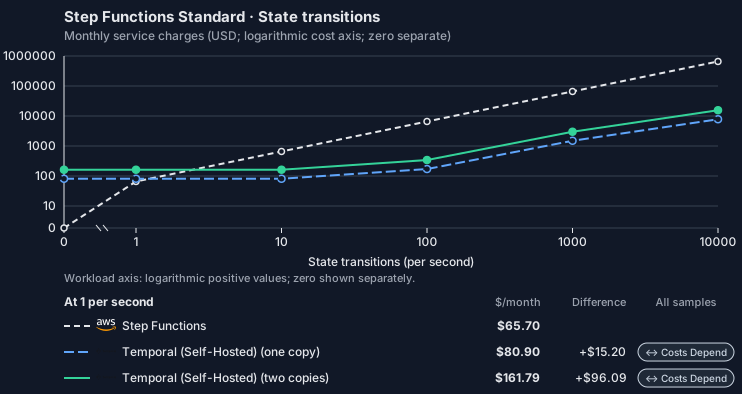
Feature: Step Functions Standard. Estimated monthly service charges by State transitions. Adapter hosting and Tensor9 fees are excluded. Source: us-east-1; target: us-central1; currency: USD.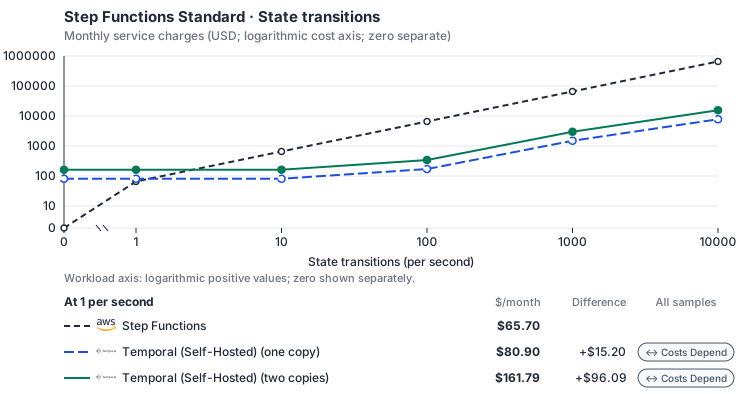
Estimated allocation, not benchmark calibrated: sized from 2 vCPU, 8 GiB memory and 100 GiB SSD at 0 per second to 128 vCPU, 864 GiB memory and 21,655 GiB SSD at 10,000 per second.
Curve assumptions
- Includes source retries; target amplification is applied only once. Other native meters and workload assumptions retain their explicitly displayed default quantities. Workload translation and capacity assumptions are not benchmark measurements.
- Native monthly usage priced at the cited provider list prices; listed target allowances apply where present, excluding invoice credits, taxes and negotiated discounts. Rates as of 2026-10-22: us-east-1 → us-central1, USD/month.
- Source prices are reference charges, not an invoice. Target lines cover selected service usage/configuration only; adapter hosting and Tensor9 fees are excluded.
- Samples of explicit prices are not performance measurements or capacity qualification. No interpolation or break-even guarantee is implied.
- Variant assumptions show the first axis sample; any axis-dependent configuration is described by this curve’s workload note.
- Rates are cited provider list prices, editable for discounts, commitments or another region. Workload translation and capacity coefficients remain editable planning assumptions, not benchmark measurements or a commercial quote.
- Default-zero rates are explicit assumptions, not evidence that the deployed service or resource is free.
- Provisioned-unit minimums use an editable approximate allocation floor. Modeled target service cost is max(usage/allocation, minimum), with billable network, durable staging and dependent sinks added separately; actual RU/TU sizing, scaling increments and throughput remain unqualified.
- Durable staging is priced once: provisioned targets include adapter state in their selected allocation; native targets add a separate staging allocation when required. Adapter hosting is a separate allocation and must exclude resources already priced as staging, workers or target capacity.
- A declared adapter mapping and cost model do not establish implementation availability or service equivalence.
- This is a declared directed mapping; a planning estimate does not establish deployment or request-serving support.
- Authored planning assumptions, not measured adapter capacity. Origin rates are cited first-tier list prices, before free allowances and discounts.
- A cost scenario does not establish backend availability, protocol fidelity or production readiness. Registry serving status remains independent.
- Managed steps, worker CPU and durable history are distinct target cost components. Internal/external step split needs target-specific assumptions.
- Standard-only origin profile; no inference of Express duration, memory or task execution cost.
- Self-hosted target: Temporal server (MIT, https://github.com/temporalio/temporal/blob/main/LICENSE); Temporal Cloud is a separate target. Selected CPU, RAM and physical disk allocation grow with workload; no per-operation price is assumed. No vendor charge: the target runs on the customer’s Kubernetes nodes, so CPU, RAM and disk bill at the Kubernetes node reference rates, Compute Engine N2 in us-central1 (USD 0.031611/vCPU-hour, 0.004237/GiB-hour) with pd-balanced disk (0.10/GiB-month) and Premium Tier egress. The cost-optimized E2 series lists 0.02181159/vCPU-hour and 0.00292353/GiB-hour; AWS m6i/r6i and Azure D2s v5/E2s v5 both decompose to 0.033/vCPU-hour and 0.00375/GiB-hour. Requested CPU and RAM are billed; node bin-packing waste, system reservations and the cluster control-plane fee are not.
- Row-store throughput (capacityOpsPerVcpuSecond, default 1500) is measured-by-tensor9 as a lower bound: the DynamoDB adapter on Cloud SQL db-custom-2-7680 (2 vCPU, PostgreSQL 16, us-west1) served 2,974 ops/s of YCSB-A at 16 threads without recorded saturation (src/main/kotlin/t9/prime/equiv/generated/eval/CloudsqlPostgresqlYcsbAT16GoYcsbV1_0_0.kt). Published CPU-bound pgbench reaches 3,101 read-write transactions and 20,289 point reads per vCPU-second (AWS z1d.2xlarge, PostgreSQL 14.5), so actual capacity is likely higher. Reads and writes share one coefficient: at the same adapter version, read-only YCSB-C was not faster than 50%-update YCSB-A.
- Log-broker throughput (capacityStreamMiBPerVcpuSecond 20 at 0.5 utilization, 4 GiB RAM per vCPU) is provider-documented by Google Managed Service for Apache Kafka sizing (https://docs.cloud.google.com/managed-service-for-apache-kafka/docs/plan-cluster-size): write-equivalent bytes are replicated writes plus a quarter of reads. Producer batches below 10 KB lower per-CPU throughput; that penalty is not modeled.
- Disk utilization 0.8 is provider-documented headroom below Cloud SQL automatic storage increase, which triggers near 91-95% full (https://docs.cloud.google.com/sql/docs/postgres/instance-settings). The 20 GiB reserve exceeds PostgreSQL’s 1 GB default max_wal_size; the remainder of that reserve is unmeasured.
- CPU tiers double from 2 vCPUs to the target’s largest node at 4 GiB per vCPU; each target’s documented largest node bounds CPU, RAM, RAM per vCPU and disk, and the durable staging database uses Cloud SQL Enterprise (96 vCPU, 6.5 GiB per vCPU, 624 GiB, 64 TiB). Targets billed per capacity unit or throughput unit are sized by their backend instead.
- No public evidence: peak/mean work (2) and the RAM working-set fraction (0.1). Proposed measurements: the p99 one-minute rate over the monthly mean from customer CloudWatch metrics; the buffer hit ratio while stepping RAM under a fixed YCSB-B load.
- Node bounds: Compute Engine n2-highmem-128 has 128 vCPUs and 864 GB (https://docs.cloud.google.com/compute/docs/general-purpose-machines); a Persistent Disk volume holds up to 64 TiB (https://docs.cloud.google.com/compute/docs/disks/persistent-disks).
- Stored GiB already includes the origin family’s physical footprint assumptions; no second storage amplification is applied.
- The operations/vCPU coefficient supplies the compute requirement alongside explicit resource-hour minima.
- Copies and allocation fractions change cost only; they do not increase modeled primary capacity.
- AWS Price List API, AmazonStates offer: https://pricing.us-east-1.amazonaws.com/offers/v1.0/aws/AmazonStates/current/us-east-1/index.json
- Compute Engine general-purpose machine pricing: https://cloud.google.com/products/compute/pricing/general-purpose
- Disk and image pricing: https://cloud.google.com/compute/disks-image-pricing
- Network pricing: https://cloud.google.com/vpc/network-pricing
- Additional network transfer, backups, KMS, one-time migration and operational labor unless an explicit meter includes them.
- Destination application execution and separately billed downstream services; supply those allocations separately.
- Taxes, discounts, credits and free-tier allowances not explicitly listed by this model.
- Unmodeled dependent services, task execution and operations outside the selected workload family.
plan-3d0b8bb9b6b5c0aa92054cdfa7cba72cf3c79b5c / 2026-10-22.planning.2. Curve: workload-1.
Sources: AWS Price List API, AmazonStates offer, Compute Engine general-purpose machine pricing, Disk and image pricing, Network pricing.
Step Functions Standard → Temporal (Self-Hosted): Authored native-usage planning example. Native monthly usage priced at the cited provider list prices; listed target allowances apply where present, excluding invoice credits, taxes and negotiated discounts.
Scenario source region: us-east-1. Scenario target region: us-central1. Currency: USD.
Estimated allocation, not benchmark calibrated: sized at 2 vCPU, 8 GiB memory and 100 GiB SSD for this scenario.
Unestimated components: Adapter hosting, Tensor9 fees. A modeled adapted total and savings require these costs.
Cost scope: Modeled target native service and explicitly modeled state allocation; hosting and Tensor9 fees only when supplied.
Excluded costs and workload features:
- Additional network transfer, backups, KMS, one-time migration and operational labor unless an explicit meter includes them.
- Destination application execution and separately billed downstream services; supply those allocations separately.
- Taxes, discounts, credits and free-tier allowances not explicitly listed by this model.
- Unmodeled dependent services, task execution and operations outside the selected workload family.
- Translated reads: 0 operations.
- Translated writes: 0 operations.
- Translated resident physical data: 0 GiB-month.
- Native provider operations: 0 operations.
- Published payload: 0 GiB.
- Delivered payload: 0 GiB.
- Allocated execution CPU: 0 vCPU-hour.
- Allocated execution RAM: 0 GiB-hour.
- Independent resource allocation: 0 resource-hour.
- Independent inventory: 0 resource-month.
- Input tokens: 0 tokens.
- Output tokens: 0 tokens.
- Billable network: 0 GiB.
- Dependent object sink retained data: 0 GiB-month.
- Dependent object sink writes: 0 writes.
- Rates are cited provider list prices, editable for discounts, commitments or another region. Workload translation and capacity coefficients remain editable planning assumptions, not benchmark measurements or a commercial quote.
- Default-zero rates are explicit assumptions, not evidence that the deployed service or resource is free.
- Provisioned-unit minimums use an editable approximate allocation floor. Modeled target service cost is max(usage/allocation, minimum), with billable network, durable staging and dependent sinks added separately; actual RU/TU sizing, scaling increments and throughput remain unqualified.
- Durable staging is priced once: provisioned targets include adapter state in their selected allocation; native targets add a separate staging allocation when required. Adapter hosting is a separate allocation and must exclude resources already priced as staging, workers or target capacity.
- A declared adapter mapping and cost model do not establish implementation availability or service equivalence.
- This is a declared directed mapping; a planning estimate does not establish deployment or request-serving support.
- Authored planning assumptions, not measured adapter capacity. Origin rates are cited first-tier list prices, before free allowances and discounts.
- A cost scenario does not establish backend availability, protocol fidelity or production readiness. Registry serving status remains independent.
- Managed steps, worker CPU and durable history are distinct target cost components. Internal/external step split needs target-specific assumptions.
- Standard-only origin profile; no inference of Express duration, memory or task execution cost.
- Self-hosted target: Temporal server (MIT, https://github.com/temporalio/temporal/blob/main/LICENSE); Temporal Cloud is a separate target. Selected CPU, RAM and physical disk allocation grow with workload; no per-operation price is assumed. No vendor charge: the target runs on the customer’s Kubernetes nodes, so CPU, RAM and disk bill at the Kubernetes node reference rates, Compute Engine N2 in us-central1 (USD 0.031611/vCPU-hour, 0.004237/GiB-hour) with pd-balanced disk (0.10/GiB-month) and Premium Tier egress. The cost-optimized E2 series lists 0.02181159/vCPU-hour and 0.00292353/GiB-hour; AWS m6i/r6i and Azure D2s v5/E2s v5 both decompose to 0.033/vCPU-hour and 0.00375/GiB-hour. Requested CPU and RAM are billed; node bin-packing waste, system reservations and the cluster control-plane fee are not.
- Row-store throughput (capacityOpsPerVcpuSecond, default 1500) is measured-by-tensor9 as a lower bound: the DynamoDB adapter on Cloud SQL db-custom-2-7680 (2 vCPU, PostgreSQL 16, us-west1) served 2,974 ops/s of YCSB-A at 16 threads without recorded saturation (src/main/kotlin/t9/prime/equiv/generated/eval/CloudsqlPostgresqlYcsbAT16GoYcsbV1_0_0.kt). Published CPU-bound pgbench reaches 3,101 read-write transactions and 20,289 point reads per vCPU-second (AWS z1d.2xlarge, PostgreSQL 14.5), so actual capacity is likely higher. Reads and writes share one coefficient: at the same adapter version, read-only YCSB-C was not faster than 50%-update YCSB-A.
- Log-broker throughput (capacityStreamMiBPerVcpuSecond 20 at 0.5 utilization, 4 GiB RAM per vCPU) is provider-documented by Google Managed Service for Apache Kafka sizing (https://docs.cloud.google.com/managed-service-for-apache-kafka/docs/plan-cluster-size): write-equivalent bytes are replicated writes plus a quarter of reads. Producer batches below 10 KB lower per-CPU throughput; that penalty is not modeled.
- Disk utilization 0.8 is provider-documented headroom below Cloud SQL automatic storage increase, which triggers near 91-95% full (https://docs.cloud.google.com/sql/docs/postgres/instance-settings). The 20 GiB reserve exceeds PostgreSQL’s 1 GB default max_wal_size; the remainder of that reserve is unmeasured.
- CPU tiers double from 2 vCPUs to the target’s largest node at 4 GiB per vCPU; each target’s documented largest node bounds CPU, RAM, RAM per vCPU and disk, and the durable staging database uses Cloud SQL Enterprise (96 vCPU, 6.5 GiB per vCPU, 624 GiB, 64 TiB). Targets billed per capacity unit or throughput unit are sized by their backend instead.
- No public evidence: peak/mean work (2) and the RAM working-set fraction (0.1). Proposed measurements: the p99 one-minute rate over the monthly mean from customer CloudWatch metrics; the buffer hit ratio while stepping RAM under a fixed YCSB-B load.
- Node bounds: Compute Engine n2-highmem-128 has 128 vCPUs and 864 GB (https://docs.cloud.google.com/compute/docs/general-purpose-machines); a Persistent Disk volume holds up to 64 TiB (https://docs.cloud.google.com/compute/docs/disks/persistent-disks).
- Stored GiB already includes the origin family’s physical footprint assumptions; no second storage amplification is applied.
- The operations/vCPU coefficient supplies the compute requirement alongside explicit resource-hour minima.
- Copies and allocation fractions change cost only; they do not increase modeled primary capacity.
plan-3d0b8bb9b6b5c0aa92054cdfa7cba72cf3c79b5c / 2026-10-22.planning.2. Scenario: planning-example.
Sources: AWS Price List API, AmazonStates offer, Compute Engine general-purpose machine pricing, Disk and image pricing, Network pricing.
Via Temporal Cloud (Managed)
How it works
Your application keeps calling the Step Functions API in the target environment. A Tensor9 service adapter stores definitions, revisions, versions and aliases, and starts Standard executions in a Temporal Cloud namespace that the customer owns. Interpreter workers maintained by Tensor9 run beside the adapter in the deployment environment and run the original Amazon States Language (ASL) definition. Temporal operates the workflow service and stores execution history in the namespace’s region. The workers run the orchestration and make the service calls; Temporal Cloud does not host them. Express executions run separately in the adapter, on a short-lived path.Connecting the namespace
You connect an existing namespace that the customer owns, using its full namespace ID, its endpoint and an authorized credential. The first connection uses mutual TLS. The customer creates the namespace and handles billing and account administration. Deploying or removing the adapter never creates or deletes the namespace. The workers need network access to Temporal Cloud and to the service adapters that Tasks call. An application on Azure, Google Cloud, Kubernetes or OCI can use the namespace wherever its history is stored. Choose the namespace region and connectivity to meet the deployment’s data-residency requirements. This option needs access to the managed service, so it does not work in a disconnected deployment.An execution waiting for approval
StartExecution returns an AWS execution ARN while the Standard workflow runs. The interpreter uses Temporal timers for Wait states, activities for external calls, and child workflows for Parallel branches and Map items. Your ASL Retry and Catch rules decide each attempt. When a service gives an unclear answer, the integration adapter handles it under its own idempotency rules.
For an approval task using .waitForTaskToken, an authorized callback goes to the Step Functions adapter in the deployment environment. The adapter records the result for the exact attempt that is waiting and passes it to the workflow in Temporal Cloud. The caller gets a success response only after that result is saved; a notification from Temporal alone is not enough.
If a worker restarts during the wait, a compatible worker resumes from Temporal’s history. The execution keeps its ARN, its definition and its worker version. Switching the deployment to another engine affects only later executions; it does not move this waiting approval.
Limitations
Where Step Functions and Temporal Cloud differ- Execution history behaves differently: it is stored outside the deployment environment. Temporal Cloud stores workflow history and any encoded payloads in the namespace’s region. Encrypting payloads does not move that storage into the local cluster. Keep secrets out of searchable metadata.
- AWS service integrations are not provided by the namespace. A Task’s
Resourcemust map to a supported service operation and invocation pattern in this deployment..syncand callback behavior depend on that integration. - Capacity behaves differently: service and worker limits both apply. Namespace limits, history size, worker slots and downstream service limits affect throughput. Choosing Temporal Cloud does not reserve concurrency for every Map item.
- The AWS console view and X-Ray tracing are not supported. Temporal Web UI shows workflow history and pending work, not the AWS console’s ASL graph. Decoding payloads needs permission. Logs go to the deployment’s logging destination, and enabling X-Ray tracing is rejected.
- Express executions behave differently. They have no Standard execution-history API and cannot use Activities, Distributed Map,
.syncor.waitForTaskToken.
Other considerations
- Responsibility and cost. Temporal operates the managed service. The customer owns the account, namespace, credentials and billing. Tensor9 maintains the service adapter and interpreter workers, whose compute runs in the deployment environment.
- Retention and encryption. Set namespace retention to match the adapter’s history and redrive retention requirements. If you use customer-managed encryption, configure the workers’ payload codec and key access. Web UI access and permission to decode payloads are separate controls.
- Moving from AWS. Deploy definitions, versions and aliases through the adapter. Existing AWS executions finish on AWS; running executions, outstanding task tokens and past runs are not imported into Temporal Cloud.
- Credentials and removal. Rotate namespace credentials while keeping access for running executions. Removing the adapter releases its connection and its workers, and leaves the customer’s namespace and unrelated workflows intact.
Example monthly charges
This Tensor9 BYOC scenario estimates service charges for the named origin and target services. Adapter hosting and commercial Tensor9 fees need separate allocations. How Tensor9 estimates costs explains the method and what the estimates include.Step Functions Standard · State transitions
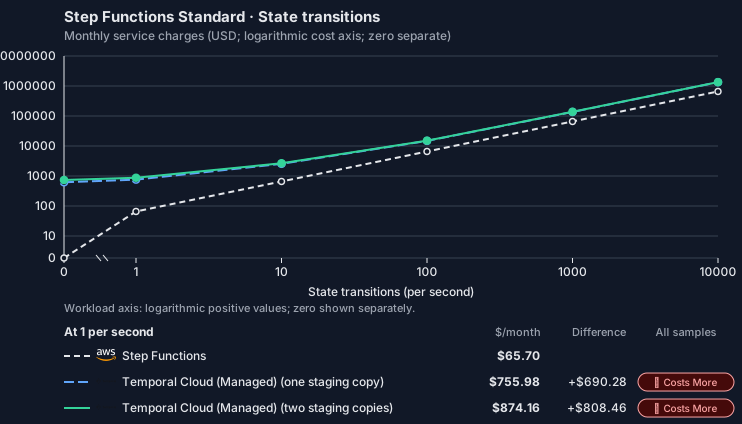
Feature: Step Functions Standard. Estimated monthly service charges by State transitions. Adapter hosting and Tensor9 fees are excluded. Source: us-east-1; target: Temporal Cloud (global list); currency: USD.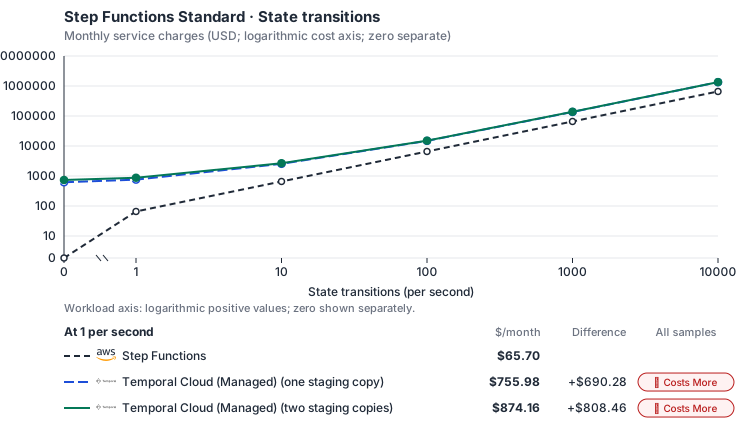
Estimated allocation, not benchmark calibrated: sized from 2 vCPU, 8 GiB memory and 100 GiB SSD at 0 per second to 96 vCPU, 624 GiB memory and 21,655 GiB SSD at 10,000 per second.
Curve assumptions
- Includes source retries; target amplification is applied only once. Other native meters and workload assumptions retain their explicitly displayed default quantities. Workload translation and capacity assumptions are not benchmark measurements.
- Native monthly usage priced at the cited provider list prices; listed target allowances apply where present, excluding invoice credits, taxes and negotiated discounts. Rates as of 2026-10-22: us-east-1 → Temporal Cloud (global list), USD/month.
- Source prices are reference charges, not an invoice. Target lines cover selected service usage/configuration only; adapter hosting and Tensor9 fees are excluded.
- Samples of explicit prices are not performance measurements or capacity qualification. No interpolation or break-even guarantee is implied.
- Variant assumptions show the first axis sample; any axis-dependent configuration is described by this curve’s workload note.
- Rates are cited provider list prices, editable for discounts, commitments or another region. Workload translation and capacity coefficients remain editable planning assumptions, not benchmark measurements or a commercial quote.
- Default-zero rates are explicit assumptions, not evidence that the deployed service or resource is free.
- Provisioned-unit minimums use an editable approximate allocation floor. Modeled target service cost is max(usage/allocation, minimum), with billable network, durable staging and dependent sinks added separately; actual RU/TU sizing, scaling increments and throughput remain unqualified.
- Durable staging is priced once: provisioned targets include adapter state in their selected allocation; native targets add a separate staging allocation when required. Adapter hosting is a separate allocation and must exclude resources already priced as staging, workers or target capacity.
- A declared adapter mapping and cost model do not establish implementation availability or service equivalence.
- This is a declared directed mapping; a planning estimate does not establish deployment or request-serving support.
- Authored planning assumptions, not measured adapter capacity. Origin rates are cited first-tier list prices, before free allowances and discounts.
- A cost scenario does not establish backend availability, protocol fidelity or production readiness. Registry serving status remains independent.
- Managed steps, worker CPU and durable history are distinct target cost components. Internal/external step split needs target-specific assumptions.
- Standard-only origin profile; no inference of Express duration, memory or task execution cost.
- Temporal Cloud bills Actions, active and retained workflow-history storage, and a plan. The profile selects the Business plan: the greater of USD 500/month or 10% of consumption, with 2.5 million Actions, 2.5 GB of active and 100 GB of retained storage included. The 500 base is exact while consumption stays under USD 5,000/month; above that the plan adds 10% of consumption, which is not modeled. Pay-as-you-go Actions graduate from USD 50 to 25 per million by volume beyond the included Actions. History storage bills USD 0.042 per active GBh and 0.00105 per retained GBh. The family’s retained history of closed executions bills at the retained rate beyond the 100 GB included; active history of running executions is small for Step Functions workloads and is not modeled. The Developer plan (no base, 10% of consumption, USD 50 per million Actions at every volume) is not selected. Workers run on the customer’s own compute.
- Row-store throughput (capacityOpsPerVcpuSecond, default 1500) is measured-by-tensor9 as a lower bound: the DynamoDB adapter on Cloud SQL db-custom-2-7680 (2 vCPU, PostgreSQL 16, us-west1) served 2,974 ops/s of YCSB-A at 16 threads without recorded saturation (src/main/kotlin/t9/prime/equiv/generated/eval/CloudsqlPostgresqlYcsbAT16GoYcsbV1_0_0.kt). Published CPU-bound pgbench reaches 3,101 read-write transactions and 20,289 point reads per vCPU-second (AWS z1d.2xlarge, PostgreSQL 14.5), so actual capacity is likely higher. Reads and writes share one coefficient: at the same adapter version, read-only YCSB-C was not faster than 50%-update YCSB-A.
- Log-broker throughput (capacityStreamMiBPerVcpuSecond 20 at 0.5 utilization, 4 GiB RAM per vCPU) is provider-documented by Google Managed Service for Apache Kafka sizing (https://docs.cloud.google.com/managed-service-for-apache-kafka/docs/plan-cluster-size): write-equivalent bytes are replicated writes plus a quarter of reads. Producer batches below 10 KB lower per-CPU throughput; that penalty is not modeled.
- Disk utilization 0.8 is provider-documented headroom below Cloud SQL automatic storage increase, which triggers near 91-95% full (https://docs.cloud.google.com/sql/docs/postgres/instance-settings). The 20 GiB reserve exceeds PostgreSQL’s 1 GB default max_wal_size; the remainder of that reserve is unmeasured.
- CPU tiers double from 2 vCPUs to the target’s largest node at 4 GiB per vCPU; each target’s documented largest node bounds CPU, RAM, RAM per vCPU and disk, and the durable staging database uses Cloud SQL Enterprise (96 vCPU, 6.5 GiB per vCPU, 624 GiB, 64 TiB). Targets billed per capacity unit or throughput unit are sized by their backend instead.
- No public evidence: peak/mean work (2) and the RAM working-set fraction (0.1). Proposed measurements: the p99 one-minute rate over the monthly mean from customer CloudWatch metrics; the buffer hit ratio while stepping RAM under a fixed YCSB-B load.
- Node bounds: Cloud SQL Enterprise allows 1-96 vCPUs at 0.9-6.5 GB per vCPU and up to 64 TB with a dedicated vCPU (https://docs.cloud.google.com/sql/docs/postgres/instance-settings).
- Stored GiB already includes the origin family’s physical footprint assumptions; no second storage amplification is applied.
- The operations/vCPU coefficient supplies the compute requirement alongside explicit resource-hour minima.
- Copies and allocation fractions change cost only; they do not increase modeled primary capacity.
- AWS Price List API, AmazonStates offer: https://pricing.us-east-1.amazonaws.com/offers/v1.0/aws/AmazonStates/current/us-east-1/index.json
- Temporal Cloud pricing: https://docs.temporal.io/cloud/pricing
- Additional network transfer, backups, KMS, one-time migration and operational labor unless an explicit meter includes them.
- Destination application execution and separately billed downstream services; supply those allocations separately.
- Taxes, discounts, credits and free-tier allowances not explicitly listed by this model.
- Unmodeled dependent services, task execution and operations outside the selected workload family.
plan-da083b8e1fb5732303b4a2a29ceac0278a9dbc01 / 2026-10-22.planning.2. Curve: workload-1.
Sources: AWS Price List API, AmazonStates offer, Temporal Cloud pricing.
Step Functions Standard → Temporal Cloud (Managed): Authored native-usage planning example. Native monthly usage priced at the cited provider list prices; listed target allowances apply where present, excluding invoice credits, taxes and negotiated discounts.
Scenario source region: us-east-1. Scenario target region: Temporal Cloud (global list). Currency: USD.
Estimated allocation, not benchmark calibrated: sized at 2 vCPU, 8 GiB memory and 100 GiB SSD for this scenario.
Unestimated components: Adapter hosting, Tensor9 fees. A modeled adapted total and savings require these costs.
Cost scope: Modeled target native service and explicitly modeled state allocation; hosting and Tensor9 fees only when supplied.
Excluded costs and workload features:
- Additional network transfer, backups, KMS, one-time migration and operational labor unless an explicit meter includes them.
- Destination application execution and separately billed downstream services; supply those allocations separately.
- Taxes, discounts, credits and free-tier allowances not explicitly listed by this model.
- Unmodeled dependent services, task execution and operations outside the selected workload family.
- Translated reads: 0 operations.
- Translated writes: 0 operations.
- Translated resident physical data: 0 GiB-month.
- Native provider operations: 0 operations.
- Published payload: 0 GiB.
- Delivered payload: 0 GiB.
- Allocated execution CPU: 0 vCPU-hour.
- Allocated execution RAM: 0 GiB-hour.
- Independent resource allocation: 0 resource-hour.
- Independent inventory: 0 resource-month.
- Input tokens: 0 tokens.
- Output tokens: 0 tokens.
- Billable network: 0 GiB.
- Dependent object sink retained data: 0 GiB-month.
- Dependent object sink writes: 0 writes.
- Rates are cited provider list prices, editable for discounts, commitments or another region. Workload translation and capacity coefficients remain editable planning assumptions, not benchmark measurements or a commercial quote.
- Default-zero rates are explicit assumptions, not evidence that the deployed service or resource is free.
- Provisioned-unit minimums use an editable approximate allocation floor. Modeled target service cost is max(usage/allocation, minimum), with billable network, durable staging and dependent sinks added separately; actual RU/TU sizing, scaling increments and throughput remain unqualified.
- Durable staging is priced once: provisioned targets include adapter state in their selected allocation; native targets add a separate staging allocation when required. Adapter hosting is a separate allocation and must exclude resources already priced as staging, workers or target capacity.
- A declared adapter mapping and cost model do not establish implementation availability or service equivalence.
- This is a declared directed mapping; a planning estimate does not establish deployment or request-serving support.
- Authored planning assumptions, not measured adapter capacity. Origin rates are cited first-tier list prices, before free allowances and discounts.
- A cost scenario does not establish backend availability, protocol fidelity or production readiness. Registry serving status remains independent.
- Managed steps, worker CPU and durable history are distinct target cost components. Internal/external step split needs target-specific assumptions.
- Standard-only origin profile; no inference of Express duration, memory or task execution cost.
- Temporal Cloud bills Actions, active and retained workflow-history storage, and a plan. The profile selects the Business plan: the greater of USD 500/month or 10% of consumption, with 2.5 million Actions, 2.5 GB of active and 100 GB of retained storage included. The 500 base is exact while consumption stays under USD 5,000/month; above that the plan adds 10% of consumption, which is not modeled. Pay-as-you-go Actions graduate from USD 50 to 25 per million by volume beyond the included Actions. History storage bills USD 0.042 per active GBh and 0.00105 per retained GBh. The family’s retained history of closed executions bills at the retained rate beyond the 100 GB included; active history of running executions is small for Step Functions workloads and is not modeled. The Developer plan (no base, 10% of consumption, USD 50 per million Actions at every volume) is not selected. Workers run on the customer’s own compute.
- Row-store throughput (capacityOpsPerVcpuSecond, default 1500) is measured-by-tensor9 as a lower bound: the DynamoDB adapter on Cloud SQL db-custom-2-7680 (2 vCPU, PostgreSQL 16, us-west1) served 2,974 ops/s of YCSB-A at 16 threads without recorded saturation (src/main/kotlin/t9/prime/equiv/generated/eval/CloudsqlPostgresqlYcsbAT16GoYcsbV1_0_0.kt). Published CPU-bound pgbench reaches 3,101 read-write transactions and 20,289 point reads per vCPU-second (AWS z1d.2xlarge, PostgreSQL 14.5), so actual capacity is likely higher. Reads and writes share one coefficient: at the same adapter version, read-only YCSB-C was not faster than 50%-update YCSB-A.
- Log-broker throughput (capacityStreamMiBPerVcpuSecond 20 at 0.5 utilization, 4 GiB RAM per vCPU) is provider-documented by Google Managed Service for Apache Kafka sizing (https://docs.cloud.google.com/managed-service-for-apache-kafka/docs/plan-cluster-size): write-equivalent bytes are replicated writes plus a quarter of reads. Producer batches below 10 KB lower per-CPU throughput; that penalty is not modeled.
- Disk utilization 0.8 is provider-documented headroom below Cloud SQL automatic storage increase, which triggers near 91-95% full (https://docs.cloud.google.com/sql/docs/postgres/instance-settings). The 20 GiB reserve exceeds PostgreSQL’s 1 GB default max_wal_size; the remainder of that reserve is unmeasured.
- CPU tiers double from 2 vCPUs to the target’s largest node at 4 GiB per vCPU; each target’s documented largest node bounds CPU, RAM, RAM per vCPU and disk, and the durable staging database uses Cloud SQL Enterprise (96 vCPU, 6.5 GiB per vCPU, 624 GiB, 64 TiB). Targets billed per capacity unit or throughput unit are sized by their backend instead.
- No public evidence: peak/mean work (2) and the RAM working-set fraction (0.1). Proposed measurements: the p99 one-minute rate over the monthly mean from customer CloudWatch metrics; the buffer hit ratio while stepping RAM under a fixed YCSB-B load.
- Node bounds: Cloud SQL Enterprise allows 1-96 vCPUs at 0.9-6.5 GB per vCPU and up to 64 TB with a dedicated vCPU (https://docs.cloud.google.com/sql/docs/postgres/instance-settings).
- Stored GiB already includes the origin family’s physical footprint assumptions; no second storage amplification is applied.
- The operations/vCPU coefficient supplies the compute requirement alongside explicit resource-hour minima.
- Copies and allocation fractions change cost only; they do not increase modeled primary capacity.
plan-da083b8e1fb5732303b4a2a29ceac0278a9dbc01 / 2026-10-22.planning.2. Scenario: planning-example.
Sources: AWS Price List API, AmazonStates offer, Temporal Cloud pricing.
On Azure
Via Azure Durable Functions
How it works
Your application keeps calling the Step Functions API. In the target environment those calls reach a Tensor9 service adapter instead of AWS. The adapter holds each state machine as a record: the Amazon States Language definition as you wrote it, the execution role, the type, the versions, the aliases and the tags. It answers everystates: operation from that record and from the executions it has admitted.
A Standard execution is a Durable Functions orchestration instance; an Express execution runs inline in the adapter and leaves no durable record, as on AWS. StartExecution admits the execution, pins the revision it will run, and for a Standard execution hands it to an orchestrator function that Tensor9 maintains and deploys into an Azure Functions app in the target environment. That orchestrator is generic: it interprets the definition state by state, so a state machine is never rewritten into orchestrator code and an UpdateStateMachine deploys nothing. Durable timers serve Wait states, activity functions serve Task states, sub-orchestrations serve Parallel branches and Map items, and external events serve callbacks and task tokens; StopExecution terminates the instance. Durable Functions checkpoints the orchestration’s progress in its task hub, so an execution survives a restart of the function app or of the adapter and resumes where it left off. GetExecutionHistory returns Step Functions events built from that record in causal order; the platform’s own replay events are not part of it.
A Task state’s Resource names an AWS service, and it is served by that service’s mapping on the same appliance: a Lambda ARN invokes the function the Lambda mapping runs, an SQS or SNS integration reaches the queue or topic served there, and a .waitForTaskToken integration parks the orchestration on an external event until SendTaskSuccess or SendTaskFailure arrives. Each Task effect is authorized against the state machine’s execution role, or the Task.Credentials role where one is set, before it is made, and the call itself travels on the appliance’s own identity; no AWS credential is involved.
Azure resources behind a deployment
Two Azure resources sit behind a Step Functions deployment: a function app on a Premium plan, which gives the orchestrator always-ready instances and virtual-network access, and a storage account whose task hub holds orchestration history and queued work. Both are owned in the target environment. Tensor9 deploys its orchestrator code into the function app and upgrades it, and removing a backend selection never deletes the function app or the storage account. In the Azure portal you see orchestration instances named by the adapter, activity invocations, and the storage account’s queues and tables. State machines, executions and ARNs are not Azure resources; they exist in the adapter’s record and are what the Step Functions API returns, so DescribeExecution, ListExecutions and GetExecutionHistory are the way to observe an execution, exactly as on AWS.Limitations
- Activities are served by the adapter. Azure has no resource that a worker outside the platform long-polls by name, so an Activity is a queue the adapter itself serves: GetActivityTask holds the poll open for up to 60 seconds, the task token is minted by the adapter, and SendTaskSuccess, SendTaskFailure and SendTaskHeartbeat are checked against it. Workers need no code change; they must reach the adapter’s endpoint. - Large Map Runs are paced by the appliance. A Map Run becomes N child orchestrations within MaxConcurrency, and a large one is admitted with backpressure rather than all at once; its semantics do not change. An UpdateMapRun that cannot reach children already running fails with a named error instead of reporting a change that did not happen. - Logs and traces do not reach CloudWatch or X-Ray.
includeExecutionDatadecides whether execution payloads are written at all and the configured destination decides whose log they reach; the destination is served by the appliance’s logging, since CloudWatch Logs is a service the appliance does not adapt. AtracingConfigurationthat enables X-Ray tracing is rejected at CreateStateMachine and UpdateStateMachine, because X-Ray is not adapted and a setting that is stored but ignored would misreport what runs. - Service integrations are bounded by the appliance. A Task state reaches the services adapted on the same appliance. A Resource naming a service the appliance does not serve is reported by ValidateStateMachineDefinition and refused at CreateStateMachine with an error naming the state; a definition is never admitted only to fail on its first execution. - The engine choice is fixed per execution. Which engine runs a state machine is chosen per deployment and recorded with each execution. Changing it affects executions started afterwards; executions already running, their history and their outstanding task tokens stay on the engine they started on until they complete and their retention expires. Nothing migrates a live execution.
Other considerations
- Migration. State machines are created by your own deployment: applying your Step Functions resources against the adapter creates them through CreateStateMachine, versions and aliases included. Executions do not migrate. One started on AWS completes on AWS, one started after cutover runs on Azure, and AWS execution history is not copied. - Who operates what. The function app and the storage account are owned in the target environment and operated by Microsoft. Tensor9 maintains the orchestrator code deployed into the function app, upgrades it, and operates the adapter; an upgrade keeps in-flight orchestrations on the orchestrator version they started with, so a running execution is not replayed against changed code. - Cost shape. AWS bills a Standard execution per state transition and an Express one per run, duration and memory. On Azure the cost is the Premium plan’s instances, which run whether or not executions are in flight, plus storage transactions on the task hub. - Durability. Orchestration state lives in the storage account; the adapter’s own record of state machines, versions, aliases and Activities lives in the appliance’s durable store. Both are in the target environment.
Example monthly charges
This Tensor9 BYOC scenario estimates service charges for the named origin and target services. Adapter hosting and commercial Tensor9 fees need separate allocations. How Tensor9 estimates costs explains the method and what the estimates include.Step Functions Standard · State transitions
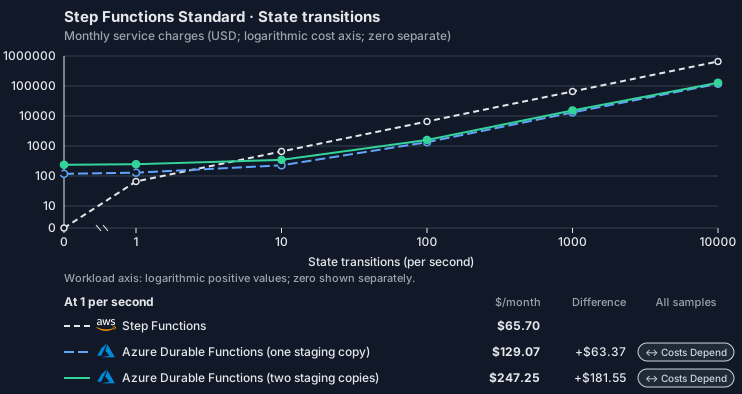
Feature: Step Functions Standard. Estimated monthly service charges by State transitions. Adapter hosting and Tensor9 fees are excluded. Source: us-east-1; target: East US; currency: USD.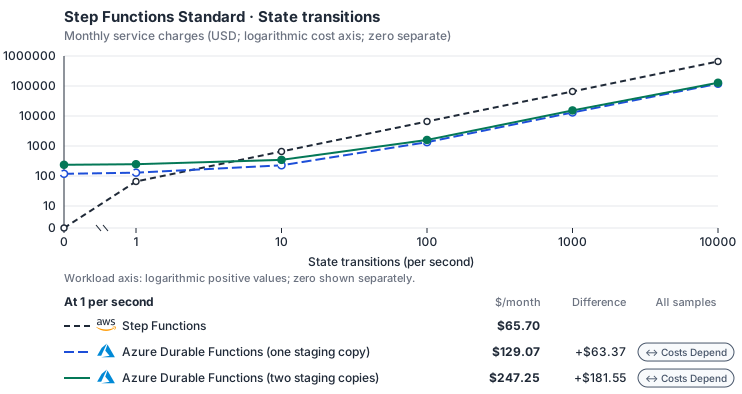
Estimated allocation, not benchmark calibrated: sized from 2 vCPU, 8 GiB memory and 100 GiB SSD at 0 per second to 96 vCPU, 624 GiB memory and 21,655 GiB SSD at 10,000 per second.
Curve assumptions
- Includes source retries; target amplification is applied only once. Other native meters and workload assumptions retain their explicitly displayed default quantities. Workload translation and capacity assumptions are not benchmark measurements.
- Native monthly usage priced at the cited provider list prices; listed target allowances apply where present, excluding invoice credits, taxes and negotiated discounts. Rates as of 2026-10-22: us-east-1 → East US, USD/month.
- Source prices are reference charges, not an invoice. Target lines cover selected service usage/configuration only; adapter hosting and Tensor9 fees are excluded.
- Samples of explicit prices are not performance measurements or capacity qualification. No interpolation or break-even guarantee is implied.
- Variant assumptions show the first axis sample; any axis-dependent configuration is described by this curve’s workload note.
- Rates are cited provider list prices, editable for discounts, commitments or another region. Workload translation and capacity coefficients remain editable planning assumptions, not benchmark measurements or a commercial quote.
- Default-zero rates are explicit assumptions, not evidence that the deployed service or resource is free.
- Provisioned-unit minimums use an editable approximate allocation floor. Modeled target service cost is max(usage/allocation, minimum), with billable network, durable staging and dependent sinks added separately; actual RU/TU sizing, scaling increments and throughput remain unqualified.
- Durable staging is priced once: provisioned targets include adapter state in their selected allocation; native targets add a separate staging allocation when required. Adapter hosting is a separate allocation and must exclude resources already priced as staging, workers or target capacity.
- A declared adapter mapping and cost model do not establish implementation availability or service equivalence.
- This is a declared directed mapping; a planning estimate does not establish deployment or request-serving support.
- Authored planning assumptions, not measured adapter capacity. Origin rates are cited first-tier list prices, before free allowances and discounts.
- A cost scenario does not establish backend availability, protocol fidelity or production readiness. Registry serving status remains independent.
- Managed steps, worker CPU and durable history are distinct target cost components. Internal/external step split needs target-specific assumptions.
- Standard-only origin profile; no inference of Express duration, memory or task execution cost.
- Azure Durable Functions has no orchestration charge of its own: with the default Azure Storage provider it bills the function executions that run orchestrator and activity steps plus the queue and table transactions that persist their messages and history in the customer’s storage account. The step rate is that composite on Flex Consumption. Execution GB-seconds (USD 0.000026 per GB-second on Flex Consumption), idle queue polling (a few hundred thousand transactions a month per app) and table storage (USD 0.045 per GB-month) are not modeled, and the family’s worker CPU is not a Durable Functions charge. The Durable Task Scheduler (Dedicated USD 0.684932 per capacity-unit hour) is an alternative backend and is not selected.
- Row-store throughput (capacityOpsPerVcpuSecond, default 1500) is measured-by-tensor9 as a lower bound: the DynamoDB adapter on Cloud SQL db-custom-2-7680 (2 vCPU, PostgreSQL 16, us-west1) served 2,974 ops/s of YCSB-A at 16 threads without recorded saturation (src/main/kotlin/t9/prime/equiv/generated/eval/CloudsqlPostgresqlYcsbAT16GoYcsbV1_0_0.kt). Published CPU-bound pgbench reaches 3,101 read-write transactions and 20,289 point reads per vCPU-second (AWS z1d.2xlarge, PostgreSQL 14.5), so actual capacity is likely higher. Reads and writes share one coefficient: at the same adapter version, read-only YCSB-C was not faster than 50%-update YCSB-A.
- Log-broker throughput (capacityStreamMiBPerVcpuSecond 20 at 0.5 utilization, 4 GiB RAM per vCPU) is provider-documented by Google Managed Service for Apache Kafka sizing (https://docs.cloud.google.com/managed-service-for-apache-kafka/docs/plan-cluster-size): write-equivalent bytes are replicated writes plus a quarter of reads. Producer batches below 10 KB lower per-CPU throughput; that penalty is not modeled.
- Disk utilization 0.8 is provider-documented headroom below Cloud SQL automatic storage increase, which triggers near 91-95% full (https://docs.cloud.google.com/sql/docs/postgres/instance-settings). The 20 GiB reserve exceeds PostgreSQL’s 1 GB default max_wal_size; the remainder of that reserve is unmeasured.
- CPU tiers double from 2 vCPUs to the target’s largest node at 4 GiB per vCPU; each target’s documented largest node bounds CPU, RAM, RAM per vCPU and disk, and the durable staging database uses Cloud SQL Enterprise (96 vCPU, 6.5 GiB per vCPU, 624 GiB, 64 TiB). Targets billed per capacity unit or throughput unit are sized by their backend instead.
- No public evidence: peak/mean work (2) and the RAM working-set fraction (0.1). Proposed measurements: the p99 one-minute rate over the monthly mean from customer CloudWatch metrics; the buffer hit ratio while stepping RAM under a fixed YCSB-B load.
- Node bounds: Cloud SQL Enterprise allows 1-96 vCPUs at 0.9-6.5 GB per vCPU and up to 64 TB with a dedicated vCPU (https://docs.cloud.google.com/sql/docs/postgres/instance-settings).
- Stored GiB already includes the origin family’s physical footprint assumptions; no second storage amplification is applied.
- The operations/vCPU coefficient supplies the compute requirement alongside explicit resource-hour minima.
- Copies and allocation fractions change cost only; they do not increase modeled primary capacity.
- AWS Price List API, AmazonStates offer: https://pricing.us-east-1.amazonaws.com/offers/v1.0/aws/AmazonStates/current/us-east-1/index.json
- Azure Retail Prices API: https://prices.azure.com/api/retail/prices
- Additional network transfer, backups, KMS, one-time migration and operational labor unless an explicit meter includes them.
- Destination application execution and separately billed downstream services; supply those allocations separately.
- Taxes, discounts, credits and free-tier allowances not explicitly listed by this model.
- Unmodeled dependent services, task execution and operations outside the selected workload family.
plan-8165b354acdf9b1901b0eeb4a8430b57478f42e2 / 2026-10-22.planning.2. Curve: workload-1.
Sources: AWS Price List API, AmazonStates offer, Azure Retail Prices API.
Step Functions Standard → Azure Durable Functions: Authored native-usage planning example. Native monthly usage priced at the cited provider list prices; listed target allowances apply where present, excluding invoice credits, taxes and negotiated discounts.
Scenario source region: us-east-1. Scenario target region: East US. Currency: USD.
Estimated allocation, not benchmark calibrated: sized at 2 vCPU, 8 GiB memory and 100 GiB SSD for this scenario.
Unestimated components: Adapter hosting, Tensor9 fees. A modeled adapted total and savings require these costs.
Cost scope: Modeled target native service and explicitly modeled state allocation; hosting and Tensor9 fees only when supplied.
Excluded costs and workload features:
- Additional network transfer, backups, KMS, one-time migration and operational labor unless an explicit meter includes them.
- Destination application execution and separately billed downstream services; supply those allocations separately.
- Taxes, discounts, credits and free-tier allowances not explicitly listed by this model.
- Unmodeled dependent services, task execution and operations outside the selected workload family.
- Translated reads: 0 operations.
- Translated writes: 0 operations.
- Translated resident physical data: 0 GiB-month.
- Native provider operations: 0 operations.
- Published payload: 0 GiB.
- Delivered payload: 0 GiB.
- Allocated execution CPU: 0 vCPU-hour.
- Allocated execution RAM: 0 GiB-hour.
- Independent resource allocation: 0 resource-hour.
- Independent inventory: 0 resource-month.
- Input tokens: 0 tokens.
- Output tokens: 0 tokens.
- Billable network: 0 GiB.
- Dependent object sink retained data: 0 GiB-month.
- Dependent object sink writes: 0 writes.
- Rates are cited provider list prices, editable for discounts, commitments or another region. Workload translation and capacity coefficients remain editable planning assumptions, not benchmark measurements or a commercial quote.
- Default-zero rates are explicit assumptions, not evidence that the deployed service or resource is free.
- Provisioned-unit minimums use an editable approximate allocation floor. Modeled target service cost is max(usage/allocation, minimum), with billable network, durable staging and dependent sinks added separately; actual RU/TU sizing, scaling increments and throughput remain unqualified.
- Durable staging is priced once: provisioned targets include adapter state in their selected allocation; native targets add a separate staging allocation when required. Adapter hosting is a separate allocation and must exclude resources already priced as staging, workers or target capacity.
- A declared adapter mapping and cost model do not establish implementation availability or service equivalence.
- This is a declared directed mapping; a planning estimate does not establish deployment or request-serving support.
- Authored planning assumptions, not measured adapter capacity. Origin rates are cited first-tier list prices, before free allowances and discounts.
- A cost scenario does not establish backend availability, protocol fidelity or production readiness. Registry serving status remains independent.
- Managed steps, worker CPU and durable history are distinct target cost components. Internal/external step split needs target-specific assumptions.
- Standard-only origin profile; no inference of Express duration, memory or task execution cost.
- Azure Durable Functions has no orchestration charge of its own: with the default Azure Storage provider it bills the function executions that run orchestrator and activity steps plus the queue and table transactions that persist their messages and history in the customer’s storage account. The step rate is that composite on Flex Consumption. Execution GB-seconds (USD 0.000026 per GB-second on Flex Consumption), idle queue polling (a few hundred thousand transactions a month per app) and table storage (USD 0.045 per GB-month) are not modeled, and the family’s worker CPU is not a Durable Functions charge. The Durable Task Scheduler (Dedicated USD 0.684932 per capacity-unit hour) is an alternative backend and is not selected.
- Row-store throughput (capacityOpsPerVcpuSecond, default 1500) is measured-by-tensor9 as a lower bound: the DynamoDB adapter on Cloud SQL db-custom-2-7680 (2 vCPU, PostgreSQL 16, us-west1) served 2,974 ops/s of YCSB-A at 16 threads without recorded saturation (src/main/kotlin/t9/prime/equiv/generated/eval/CloudsqlPostgresqlYcsbAT16GoYcsbV1_0_0.kt). Published CPU-bound pgbench reaches 3,101 read-write transactions and 20,289 point reads per vCPU-second (AWS z1d.2xlarge, PostgreSQL 14.5), so actual capacity is likely higher. Reads and writes share one coefficient: at the same adapter version, read-only YCSB-C was not faster than 50%-update YCSB-A.
- Log-broker throughput (capacityStreamMiBPerVcpuSecond 20 at 0.5 utilization, 4 GiB RAM per vCPU) is provider-documented by Google Managed Service for Apache Kafka sizing (https://docs.cloud.google.com/managed-service-for-apache-kafka/docs/plan-cluster-size): write-equivalent bytes are replicated writes plus a quarter of reads. Producer batches below 10 KB lower per-CPU throughput; that penalty is not modeled.
- Disk utilization 0.8 is provider-documented headroom below Cloud SQL automatic storage increase, which triggers near 91-95% full (https://docs.cloud.google.com/sql/docs/postgres/instance-settings). The 20 GiB reserve exceeds PostgreSQL’s 1 GB default max_wal_size; the remainder of that reserve is unmeasured.
- CPU tiers double from 2 vCPUs to the target’s largest node at 4 GiB per vCPU; each target’s documented largest node bounds CPU, RAM, RAM per vCPU and disk, and the durable staging database uses Cloud SQL Enterprise (96 vCPU, 6.5 GiB per vCPU, 624 GiB, 64 TiB). Targets billed per capacity unit or throughput unit are sized by their backend instead.
- No public evidence: peak/mean work (2) and the RAM working-set fraction (0.1). Proposed measurements: the p99 one-minute rate over the monthly mean from customer CloudWatch metrics; the buffer hit ratio while stepping RAM under a fixed YCSB-B load.
- Node bounds: Cloud SQL Enterprise allows 1-96 vCPUs at 0.9-6.5 GB per vCPU and up to 64 TB with a dedicated vCPU (https://docs.cloud.google.com/sql/docs/postgres/instance-settings).
- Stored GiB already includes the origin family’s physical footprint assumptions; no second storage amplification is applied.
- The operations/vCPU coefficient supplies the compute requirement alongside explicit resource-hour minima.
- Copies and allocation fractions change cost only; they do not increase modeled primary capacity.
plan-8165b354acdf9b1901b0eeb4a8430b57478f42e2 / 2026-10-22.planning.2. Scenario: planning-example.
Sources: AWS Price List API, AmazonStates offer, Azure Retail Prices API.
State-machine administration
The state-machine API manages definitions, versions, aliases and configuration. The backend-specific sections below describe these administration operations alongside the execution behavior documented above.On Google Cloud
Via Cloud Workflows
The state machine as an adapter record, prepared per revision
CreateStateMachine stores the definition, role, type, encryption, logging and tags as one revision and prepares that revision’s Cloud Workflows modules. UpdateStateMachine produces the next revision and prepares its own modules; nothing already prepared is changed, so an execution keeps running the modules it started on. DeleteStateMachine succeeds immediately and the state machine reads DELETING; it is retired once its running executions complete.Limitations
- A state the translation cannot express is refused, not dropped. The engine keeps its own list of runnable state types and refused fields and applies it at CreateStateMachine and ValidateStateMachineDefinition, because a workflow that silently omitted a state would run to a different answer than the one asked for. - Tracing cannot be enabled. X-Ray is not adapted, so a
tracingConfigurationthat enables tracing is rejected at CreateStateMachine and UpdateStateMachine. - Logs stay on the appliance.includeExecutionDataand the configured destination are honoured; the destination is served by the appliance, since CloudWatch Logs is not adapted. - A Task Resource must name a served service. ValidateStateMachineDefinition reports, and CreateStateMachine refuses, a Resource naming a service this appliance does not adapt.
Other considerations
Cloud Workflows creates a new workflow revision only when a workflow’s source or service account changes, and every execution records the revision it is using. The adapter relies on exactly that: a Step Functions version or alias maps onto prepared modules that are never edited in place, so AWS’s immutable-version guarantee holds without Cloud Workflows needing an alias concept of its own.Example monthly charges
This Tensor9 BYOC scenario estimates service charges for the named origin and target services. Adapter hosting and commercial Tensor9 fees need separate allocations. How Tensor9 estimates costs explains the method and what the estimates include.Step Functions Standard · State transitions
Feature: Step Functions Standard. Estimated monthly service charges by State transitions. Adapter hosting and Tensor9 fees are excluded. Source: us-east-1; target: us-central1; currency: USD.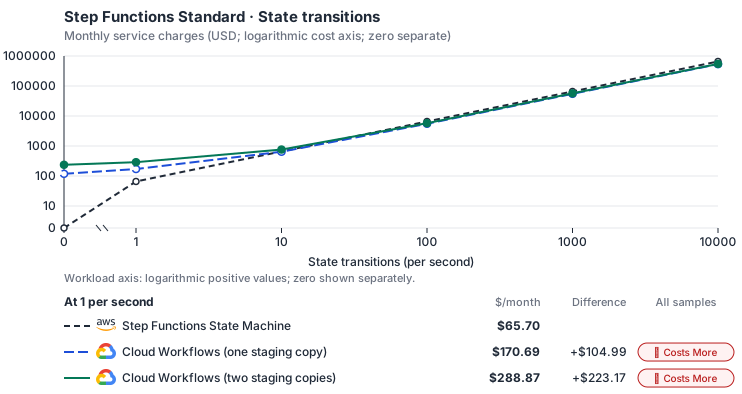
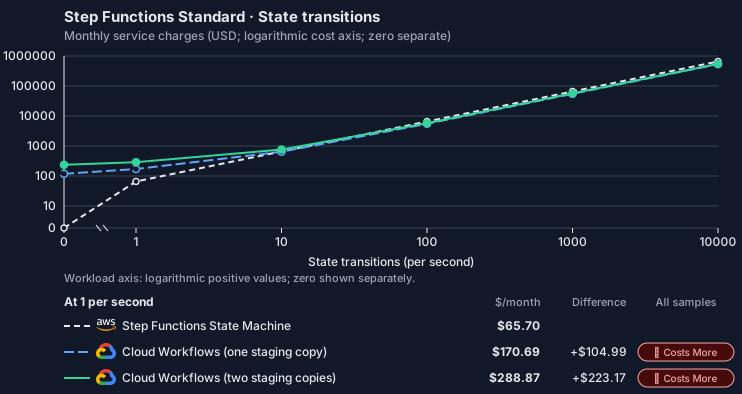
Estimated allocation, not benchmark calibrated: sized from 2 vCPU, 8 GiB memory and 100 GiB SSD at 0 per second to 96 vCPU, 624 GiB memory and 21,655 GiB SSD at 10,000 per second.
Curve assumptions
- Includes source retries; target amplification is applied only once. Other native meters and workload assumptions retain their explicitly displayed default quantities. Workload translation and capacity assumptions are not benchmark measurements.
- Native monthly usage priced at the cited provider list prices; listed target allowances apply where present, excluding invoice credits, taxes and negotiated discounts. Rates as of 2026-10-22: us-east-1 → us-central1, USD/month.
- Source prices are reference charges, not an invoice. Target lines cover selected service usage/configuration only; adapter hosting and Tensor9 fees are excluded.
- Samples of explicit prices are not performance measurements or capacity qualification. No interpolation or break-even guarantee is implied.
- Variant assumptions show the first axis sample; any axis-dependent configuration is described by this curve’s workload note.
- Rates are cited provider list prices, editable for discounts, commitments or another region. Workload translation and capacity coefficients remain editable planning assumptions, not benchmark measurements or a commercial quote.
- Default-zero rates are explicit assumptions, not evidence that the deployed service or resource is free.
- Provisioned-unit minimums use an editable approximate allocation floor. Modeled target service cost is max(usage/allocation, minimum), with billable network, durable staging and dependent sinks added separately; actual RU/TU sizing, scaling increments and throughput remain unqualified.
- Durable staging is priced once: provisioned targets include adapter state in their selected allocation; native targets add a separate staging allocation when required. Adapter hosting is a separate allocation and must exclude resources already priced as staging, workers or target capacity.
- A declared adapter mapping and cost model do not establish implementation availability or service equivalence.
- This is a declared directed mapping; a planning estimate does not establish deployment or request-serving support.
- Authored planning assumptions, not measured adapter capacity. Origin rates are cited first-tier list prices, before free allowances and discounts.
- A cost scenario does not establish backend availability, protocol fidelity or production readiness. Registry serving status remains independent.
- Managed steps, worker CPU and durable history are distinct target cost components. Internal/external step split needs target-specific assumptions.
- Standard-only origin profile; no inference of Express duration, memory or task execution cost.
- Google Workflows bills executed steps, including failed and retried ones, in increments of 1,000. Translated Step Functions steps are priced as internal steps (USD 0.01 per 1,000 after 5,000 free): assignments, conditions, subworkflow calls and calls to *.googleapis.com, Cloud Run and Cloud Run functions, which is where translated state-machine work runs. External steps (HTTP to endpoints outside Google Cloud or custom domains, and callback waits) bill USD 0.025 per 1,000 after 2,000 free; a workflow dominated by those should set the step rate to 0.000025. Worker CPU is not a Workflows charge.
- Row-store throughput (capacityOpsPerVcpuSecond, default 1500) is measured-by-tensor9 as a lower bound: the DynamoDB adapter on Cloud SQL db-custom-2-7680 (2 vCPU, PostgreSQL 16, us-west1) served 2,974 ops/s of YCSB-A at 16 threads without recorded saturation (src/main/kotlin/t9/prime/equiv/generated/eval/CloudsqlPostgresqlYcsbAT16GoYcsbV1_0_0.kt). Published CPU-bound pgbench reaches 3,101 read-write transactions and 20,289 point reads per vCPU-second (AWS z1d.2xlarge, PostgreSQL 14.5), so actual capacity is likely higher. Reads and writes share one coefficient: at the same adapter version, read-only YCSB-C was not faster than 50%-update YCSB-A.
- Log-broker throughput (capacityStreamMiBPerVcpuSecond 20 at 0.5 utilization, 4 GiB RAM per vCPU) is provider-documented by Google Managed Service for Apache Kafka sizing (https://docs.cloud.google.com/managed-service-for-apache-kafka/docs/plan-cluster-size): write-equivalent bytes are replicated writes plus a quarter of reads. Producer batches below 10 KB lower per-CPU throughput; that penalty is not modeled.
- Disk utilization 0.8 is provider-documented headroom below Cloud SQL automatic storage increase, which triggers near 91-95% full (https://docs.cloud.google.com/sql/docs/postgres/instance-settings). The 20 GiB reserve exceeds PostgreSQL’s 1 GB default max_wal_size; the remainder of that reserve is unmeasured.
- CPU tiers double from 2 vCPUs to the target’s largest node at 4 GiB per vCPU; each target’s documented largest node bounds CPU, RAM, RAM per vCPU and disk, and the durable staging database uses Cloud SQL Enterprise (96 vCPU, 6.5 GiB per vCPU, 624 GiB, 64 TiB). Targets billed per capacity unit or throughput unit are sized by their backend instead.
- No public evidence: peak/mean work (2) and the RAM working-set fraction (0.1). Proposed measurements: the p99 one-minute rate over the monthly mean from customer CloudWatch metrics; the buffer hit ratio while stepping RAM under a fixed YCSB-B load.
- Node bounds: Cloud SQL Enterprise allows 1-96 vCPUs at 0.9-6.5 GB per vCPU and up to 64 TB with a dedicated vCPU (https://docs.cloud.google.com/sql/docs/postgres/instance-settings).
- Stored GiB already includes the origin family’s physical footprint assumptions; no second storage amplification is applied.
- The operations/vCPU coefficient supplies the compute requirement alongside explicit resource-hour minima.
- Copies and allocation fractions change cost only; they do not increase modeled primary capacity.
- AWS Price List API, AmazonStates offer: https://pricing.us-east-1.amazonaws.com/offers/v1.0/aws/AmazonStates/current/us-east-1/index.json
- Workflows pricing: https://cloud.google.com/workflows/pricing
- Additional network transfer, backups, KMS, one-time migration and operational labor unless an explicit meter includes them.
- Destination application execution and separately billed downstream services; supply those allocations separately.
- Taxes, discounts, credits and free-tier allowances not explicitly listed by this model.
- Unmodeled dependent services, task execution and operations outside the selected workload family.
plan-dd928168a42606a9934f60caa9c01c39c2e315fe / 2026-10-22.planning.2. Curve: workload-1.
Sources: AWS Price List API, AmazonStates offer, Workflows pricing.
Step Functions Standard → Cloud Workflows: Authored native-usage planning example. Native monthly usage priced at the cited provider list prices; listed target allowances apply where present, excluding invoice credits, taxes and negotiated discounts.
Scenario source region: us-east-1. Scenario target region: us-central1. Currency: USD.
Estimated allocation, not benchmark calibrated: sized at 2 vCPU, 8 GiB memory and 100 GiB SSD for this scenario.
Unestimated components: Adapter hosting, Tensor9 fees. A modeled adapted total and savings require these costs.
Cost scope: Modeled target native service and explicitly modeled state allocation; hosting and Tensor9 fees only when supplied.
Excluded costs and workload features:
- Additional network transfer, backups, KMS, one-time migration and operational labor unless an explicit meter includes them.
- Destination application execution and separately billed downstream services; supply those allocations separately.
- Taxes, discounts, credits and free-tier allowances not explicitly listed by this model.
- Unmodeled dependent services, task execution and operations outside the selected workload family.
- Translated reads: 0 operations.
- Translated writes: 0 operations.
- Translated resident physical data: 0 GiB-month.
- Native provider operations: 0 operations.
- Published payload: 0 GiB.
- Delivered payload: 0 GiB.
- Allocated execution CPU: 0 vCPU-hour.
- Allocated execution RAM: 0 GiB-hour.
- Independent resource allocation: 0 resource-hour.
- Independent inventory: 0 resource-month.
- Input tokens: 0 tokens.
- Output tokens: 0 tokens.
- Billable network: 0 GiB.
- Dependent object sink retained data: 0 GiB-month.
- Dependent object sink writes: 0 writes.
- Rates are cited provider list prices, editable for discounts, commitments or another region. Workload translation and capacity coefficients remain editable planning assumptions, not benchmark measurements or a commercial quote.
- Default-zero rates are explicit assumptions, not evidence that the deployed service or resource is free.
- Provisioned-unit minimums use an editable approximate allocation floor. Modeled target service cost is max(usage/allocation, minimum), with billable network, durable staging and dependent sinks added separately; actual RU/TU sizing, scaling increments and throughput remain unqualified.
- Durable staging is priced once: provisioned targets include adapter state in their selected allocation; native targets add a separate staging allocation when required. Adapter hosting is a separate allocation and must exclude resources already priced as staging, workers or target capacity.
- A declared adapter mapping and cost model do not establish implementation availability or service equivalence.
- This is a declared directed mapping; a planning estimate does not establish deployment or request-serving support.
- Authored planning assumptions, not measured adapter capacity. Origin rates are cited first-tier list prices, before free allowances and discounts.
- A cost scenario does not establish backend availability, protocol fidelity or production readiness. Registry serving status remains independent.
- Managed steps, worker CPU and durable history are distinct target cost components. Internal/external step split needs target-specific assumptions.
- Standard-only origin profile; no inference of Express duration, memory or task execution cost.
- Google Workflows bills executed steps, including failed and retried ones, in increments of 1,000. Translated Step Functions steps are priced as internal steps (USD 0.01 per 1,000 after 5,000 free): assignments, conditions, subworkflow calls and calls to *.googleapis.com, Cloud Run and Cloud Run functions, which is where translated state-machine work runs. External steps (HTTP to endpoints outside Google Cloud or custom domains, and callback waits) bill USD 0.025 per 1,000 after 2,000 free; a workflow dominated by those should set the step rate to 0.000025. Worker CPU is not a Workflows charge.
- Row-store throughput (capacityOpsPerVcpuSecond, default 1500) is measured-by-tensor9 as a lower bound: the DynamoDB adapter on Cloud SQL db-custom-2-7680 (2 vCPU, PostgreSQL 16, us-west1) served 2,974 ops/s of YCSB-A at 16 threads without recorded saturation (src/main/kotlin/t9/prime/equiv/generated/eval/CloudsqlPostgresqlYcsbAT16GoYcsbV1_0_0.kt). Published CPU-bound pgbench reaches 3,101 read-write transactions and 20,289 point reads per vCPU-second (AWS z1d.2xlarge, PostgreSQL 14.5), so actual capacity is likely higher. Reads and writes share one coefficient: at the same adapter version, read-only YCSB-C was not faster than 50%-update YCSB-A.
- Log-broker throughput (capacityStreamMiBPerVcpuSecond 20 at 0.5 utilization, 4 GiB RAM per vCPU) is provider-documented by Google Managed Service for Apache Kafka sizing (https://docs.cloud.google.com/managed-service-for-apache-kafka/docs/plan-cluster-size): write-equivalent bytes are replicated writes plus a quarter of reads. Producer batches below 10 KB lower per-CPU throughput; that penalty is not modeled.
- Disk utilization 0.8 is provider-documented headroom below Cloud SQL automatic storage increase, which triggers near 91-95% full (https://docs.cloud.google.com/sql/docs/postgres/instance-settings). The 20 GiB reserve exceeds PostgreSQL’s 1 GB default max_wal_size; the remainder of that reserve is unmeasured.
- CPU tiers double from 2 vCPUs to the target’s largest node at 4 GiB per vCPU; each target’s documented largest node bounds CPU, RAM, RAM per vCPU and disk, and the durable staging database uses Cloud SQL Enterprise (96 vCPU, 6.5 GiB per vCPU, 624 GiB, 64 TiB). Targets billed per capacity unit or throughput unit are sized by their backend instead.
- No public evidence: peak/mean work (2) and the RAM working-set fraction (0.1). Proposed measurements: the p99 one-minute rate over the monthly mean from customer CloudWatch metrics; the buffer hit ratio while stepping RAM under a fixed YCSB-B load.
- Node bounds: Cloud SQL Enterprise allows 1-96 vCPUs at 0.9-6.5 GB per vCPU and up to 64 TB with a dedicated vCPU (https://docs.cloud.google.com/sql/docs/postgres/instance-settings).
- Stored GiB already includes the origin family’s physical footprint assumptions; no second storage amplification is applied.
- The operations/vCPU coefficient supplies the compute requirement alongside explicit resource-hour minima.
- Copies and allocation fractions change cost only; they do not increase modeled primary capacity.
plan-dd928168a42606a9934f60caa9c01c39c2e315fe / 2026-10-22.planning.2. Scenario: planning-example.
Sources: AWS Price List API, AmazonStates offer, Workflows pricing.
On Google Cloud, Azure, OCI, and Private Kubernetes
Via Temporal (Self-Hosted)
How it works
A Step Functions state machine is a record in the Tensor9 service adapter: its ASL definition, execution role, type and settings. Creating one does not create a Temporal workflow type or a new Temporal cluster. The interpreter workers are shared. A Standard execution reads the definition revision selected when it starts, and that revision never changes.UpdateStateMachine changes later executions only. Published versions keep their definitions, and an alias picks a version by weight for each new execution. DeleteStateMachine reports DELETING and ends running executions at their next state transition. Once they have closed, the state machine, its versions and its aliases are removed. Deleting an Express state machine is eventually consistent.
Limitations
Where the Step Functions state-machine mapping differs- Task resources without a supported integration are rejected.
ValidateStateMachineDefinitionreports them, andCreateStateMachinerejects them. Enabling X-Ray tracing is also rejected. - State machines behave differently: Temporal does not store them. Temporal Web UI shows executions and their history.
DescribeStateMachineand the versions and aliases APIs read the adapter’s records.
Other considerations
- Backups. Protect the adapter’s records as well as the self-hosted Temporal database. Restoring only one of them does not restore the service.
- Deployment. Apply state-machine resources and publish versions through the Step Functions endpoint. Your team receives no workflow-specific worker code.
- Operations. The deployment operator maintains the Temporal cluster and backups; Tensor9 maintains the adapter and interpreter. Execution, callback and capacity behavior are described on the Step Functions card.
Example monthly charges
This Tensor9 BYOC scenario estimates service charges for the named origin and target services. Adapter hosting and commercial Tensor9 fees need separate allocations. How Tensor9 estimates costs explains the method and what the estimates include.Step Functions Standard · State transitions
Feature: Step Functions Standard. Estimated monthly service charges by State transitions. Adapter hosting and Tensor9 fees are excluded. Source: us-east-1; target: us-central1; currency: USD.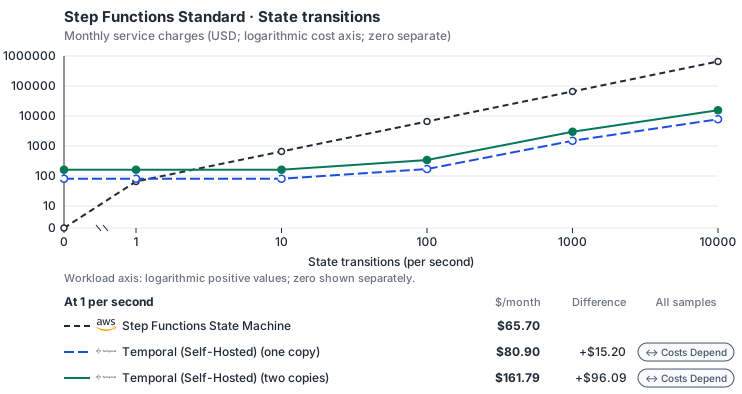
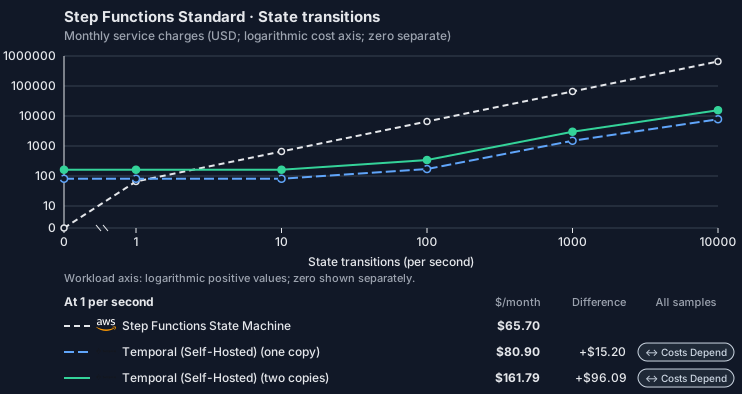
Estimated allocation, not benchmark calibrated: sized from 2 vCPU, 8 GiB memory and 100 GiB SSD at 0 per second to 128 vCPU, 864 GiB memory and 21,655 GiB SSD at 10,000 per second.
Curve assumptions
- Includes source retries; target amplification is applied only once. Other native meters and workload assumptions retain their explicitly displayed default quantities. Workload translation and capacity assumptions are not benchmark measurements.
- Native monthly usage priced at the cited provider list prices; listed target allowances apply where present, excluding invoice credits, taxes and negotiated discounts. Rates as of 2026-10-22: us-east-1 → us-central1, USD/month.
- Source prices are reference charges, not an invoice. Target lines cover selected service usage/configuration only; adapter hosting and Tensor9 fees are excluded.
- Samples of explicit prices are not performance measurements or capacity qualification. No interpolation or break-even guarantee is implied.
- Variant assumptions show the first axis sample; any axis-dependent configuration is described by this curve’s workload note.
- Rates are cited provider list prices, editable for discounts, commitments or another region. Workload translation and capacity coefficients remain editable planning assumptions, not benchmark measurements or a commercial quote.
- Default-zero rates are explicit assumptions, not evidence that the deployed service or resource is free.
- Provisioned-unit minimums use an editable approximate allocation floor. Modeled target service cost is max(usage/allocation, minimum), with billable network, durable staging and dependent sinks added separately; actual RU/TU sizing, scaling increments and throughput remain unqualified.
- Durable staging is priced once: provisioned targets include adapter state in their selected allocation; native targets add a separate staging allocation when required. Adapter hosting is a separate allocation and must exclude resources already priced as staging, workers or target capacity.
- A declared adapter mapping and cost model do not establish implementation availability or service equivalence.
- This is a declared directed mapping; a planning estimate does not establish deployment or request-serving support.
- Authored planning assumptions, not measured adapter capacity. Origin rates are cited first-tier list prices, before free allowances and discounts.
- A cost scenario does not establish backend availability, protocol fidelity or production readiness. Registry serving status remains independent.
- Managed steps, worker CPU and durable history are distinct target cost components. Internal/external step split needs target-specific assumptions.
- Standard-only origin profile; no inference of Express duration, memory or task execution cost.
- Self-hosted target: Temporal server (MIT, https://github.com/temporalio/temporal/blob/main/LICENSE); Temporal Cloud is a separate target. Selected CPU, RAM and physical disk allocation grow with workload; no per-operation price is assumed. No vendor charge: the target runs on the customer’s Kubernetes nodes, so CPU, RAM and disk bill at the Kubernetes node reference rates, Compute Engine N2 in us-central1 (USD 0.031611/vCPU-hour, 0.004237/GiB-hour) with pd-balanced disk (0.10/GiB-month) and Premium Tier egress. The cost-optimized E2 series lists 0.02181159/vCPU-hour and 0.00292353/GiB-hour; AWS m6i/r6i and Azure D2s v5/E2s v5 both decompose to 0.033/vCPU-hour and 0.00375/GiB-hour. Requested CPU and RAM are billed; node bin-packing waste, system reservations and the cluster control-plane fee are not.
- Row-store throughput (capacityOpsPerVcpuSecond, default 1500) is measured-by-tensor9 as a lower bound: the DynamoDB adapter on Cloud SQL db-custom-2-7680 (2 vCPU, PostgreSQL 16, us-west1) served 2,974 ops/s of YCSB-A at 16 threads without recorded saturation (src/main/kotlin/t9/prime/equiv/generated/eval/CloudsqlPostgresqlYcsbAT16GoYcsbV1_0_0.kt). Published CPU-bound pgbench reaches 3,101 read-write transactions and 20,289 point reads per vCPU-second (AWS z1d.2xlarge, PostgreSQL 14.5), so actual capacity is likely higher. Reads and writes share one coefficient: at the same adapter version, read-only YCSB-C was not faster than 50%-update YCSB-A.
- Log-broker throughput (capacityStreamMiBPerVcpuSecond 20 at 0.5 utilization, 4 GiB RAM per vCPU) is provider-documented by Google Managed Service for Apache Kafka sizing (https://docs.cloud.google.com/managed-service-for-apache-kafka/docs/plan-cluster-size): write-equivalent bytes are replicated writes plus a quarter of reads. Producer batches below 10 KB lower per-CPU throughput; that penalty is not modeled.
- Disk utilization 0.8 is provider-documented headroom below Cloud SQL automatic storage increase, which triggers near 91-95% full (https://docs.cloud.google.com/sql/docs/postgres/instance-settings). The 20 GiB reserve exceeds PostgreSQL’s 1 GB default max_wal_size; the remainder of that reserve is unmeasured.
- CPU tiers double from 2 vCPUs to the target’s largest node at 4 GiB per vCPU; each target’s documented largest node bounds CPU, RAM, RAM per vCPU and disk, and the durable staging database uses Cloud SQL Enterprise (96 vCPU, 6.5 GiB per vCPU, 624 GiB, 64 TiB). Targets billed per capacity unit or throughput unit are sized by their backend instead.
- No public evidence: peak/mean work (2) and the RAM working-set fraction (0.1). Proposed measurements: the p99 one-minute rate over the monthly mean from customer CloudWatch metrics; the buffer hit ratio while stepping RAM under a fixed YCSB-B load.
- Node bounds: Compute Engine n2-highmem-128 has 128 vCPUs and 864 GB (https://docs.cloud.google.com/compute/docs/general-purpose-machines); a Persistent Disk volume holds up to 64 TiB (https://docs.cloud.google.com/compute/docs/disks/persistent-disks).
- Stored GiB already includes the origin family’s physical footprint assumptions; no second storage amplification is applied.
- The operations/vCPU coefficient supplies the compute requirement alongside explicit resource-hour minima.
- Copies and allocation fractions change cost only; they do not increase modeled primary capacity.
- AWS Price List API, AmazonStates offer: https://pricing.us-east-1.amazonaws.com/offers/v1.0/aws/AmazonStates/current/us-east-1/index.json
- Compute Engine general-purpose machine pricing: https://cloud.google.com/products/compute/pricing/general-purpose
- Disk and image pricing: https://cloud.google.com/compute/disks-image-pricing
- Network pricing: https://cloud.google.com/vpc/network-pricing
- Additional network transfer, backups, KMS, one-time migration and operational labor unless an explicit meter includes them.
- Destination application execution and separately billed downstream services; supply those allocations separately.
- Taxes, discounts, credits and free-tier allowances not explicitly listed by this model.
- Unmodeled dependent services, task execution and operations outside the selected workload family.
plan-9910f41b4207fb4a6bfcd36d62f40d9657403e70 / 2026-10-22.planning.2. Curve: workload-1.
Sources: AWS Price List API, AmazonStates offer, Compute Engine general-purpose machine pricing, Disk and image pricing, Network pricing.
Step Functions Standard → Temporal (Self-Hosted): Authored native-usage planning example. Native monthly usage priced at the cited provider list prices; listed target allowances apply where present, excluding invoice credits, taxes and negotiated discounts.
Scenario source region: us-east-1. Scenario target region: us-central1. Currency: USD.
Estimated allocation, not benchmark calibrated: sized at 2 vCPU, 8 GiB memory and 100 GiB SSD for this scenario.
Unestimated components: Adapter hosting, Tensor9 fees. A modeled adapted total and savings require these costs.
Cost scope: Modeled target native service and explicitly modeled state allocation; hosting and Tensor9 fees only when supplied.
Excluded costs and workload features:
- Additional network transfer, backups, KMS, one-time migration and operational labor unless an explicit meter includes them.
- Destination application execution and separately billed downstream services; supply those allocations separately.
- Taxes, discounts, credits and free-tier allowances not explicitly listed by this model.
- Unmodeled dependent services, task execution and operations outside the selected workload family.
- Translated reads: 0 operations.
- Translated writes: 0 operations.
- Translated resident physical data: 0 GiB-month.
- Native provider operations: 0 operations.
- Published payload: 0 GiB.
- Delivered payload: 0 GiB.
- Allocated execution CPU: 0 vCPU-hour.
- Allocated execution RAM: 0 GiB-hour.
- Independent resource allocation: 0 resource-hour.
- Independent inventory: 0 resource-month.
- Input tokens: 0 tokens.
- Output tokens: 0 tokens.
- Billable network: 0 GiB.
- Dependent object sink retained data: 0 GiB-month.
- Dependent object sink writes: 0 writes.
- Rates are cited provider list prices, editable for discounts, commitments or another region. Workload translation and capacity coefficients remain editable planning assumptions, not benchmark measurements or a commercial quote.
- Default-zero rates are explicit assumptions, not evidence that the deployed service or resource is free.
- Provisioned-unit minimums use an editable approximate allocation floor. Modeled target service cost is max(usage/allocation, minimum), with billable network, durable staging and dependent sinks added separately; actual RU/TU sizing, scaling increments and throughput remain unqualified.
- Durable staging is priced once: provisioned targets include adapter state in their selected allocation; native targets add a separate staging allocation when required. Adapter hosting is a separate allocation and must exclude resources already priced as staging, workers or target capacity.
- A declared adapter mapping and cost model do not establish implementation availability or service equivalence.
- This is a declared directed mapping; a planning estimate does not establish deployment or request-serving support.
- Authored planning assumptions, not measured adapter capacity. Origin rates are cited first-tier list prices, before free allowances and discounts.
- A cost scenario does not establish backend availability, protocol fidelity or production readiness. Registry serving status remains independent.
- Managed steps, worker CPU and durable history are distinct target cost components. Internal/external step split needs target-specific assumptions.
- Standard-only origin profile; no inference of Express duration, memory or task execution cost.
- Self-hosted target: Temporal server (MIT, https://github.com/temporalio/temporal/blob/main/LICENSE); Temporal Cloud is a separate target. Selected CPU, RAM and physical disk allocation grow with workload; no per-operation price is assumed. No vendor charge: the target runs on the customer’s Kubernetes nodes, so CPU, RAM and disk bill at the Kubernetes node reference rates, Compute Engine N2 in us-central1 (USD 0.031611/vCPU-hour, 0.004237/GiB-hour) with pd-balanced disk (0.10/GiB-month) and Premium Tier egress. The cost-optimized E2 series lists 0.02181159/vCPU-hour and 0.00292353/GiB-hour; AWS m6i/r6i and Azure D2s v5/E2s v5 both decompose to 0.033/vCPU-hour and 0.00375/GiB-hour. Requested CPU and RAM are billed; node bin-packing waste, system reservations and the cluster control-plane fee are not.
- Row-store throughput (capacityOpsPerVcpuSecond, default 1500) is measured-by-tensor9 as a lower bound: the DynamoDB adapter on Cloud SQL db-custom-2-7680 (2 vCPU, PostgreSQL 16, us-west1) served 2,974 ops/s of YCSB-A at 16 threads without recorded saturation (src/main/kotlin/t9/prime/equiv/generated/eval/CloudsqlPostgresqlYcsbAT16GoYcsbV1_0_0.kt). Published CPU-bound pgbench reaches 3,101 read-write transactions and 20,289 point reads per vCPU-second (AWS z1d.2xlarge, PostgreSQL 14.5), so actual capacity is likely higher. Reads and writes share one coefficient: at the same adapter version, read-only YCSB-C was not faster than 50%-update YCSB-A.
- Log-broker throughput (capacityStreamMiBPerVcpuSecond 20 at 0.5 utilization, 4 GiB RAM per vCPU) is provider-documented by Google Managed Service for Apache Kafka sizing (https://docs.cloud.google.com/managed-service-for-apache-kafka/docs/plan-cluster-size): write-equivalent bytes are replicated writes plus a quarter of reads. Producer batches below 10 KB lower per-CPU throughput; that penalty is not modeled.
- Disk utilization 0.8 is provider-documented headroom below Cloud SQL automatic storage increase, which triggers near 91-95% full (https://docs.cloud.google.com/sql/docs/postgres/instance-settings). The 20 GiB reserve exceeds PostgreSQL’s 1 GB default max_wal_size; the remainder of that reserve is unmeasured.
- CPU tiers double from 2 vCPUs to the target’s largest node at 4 GiB per vCPU; each target’s documented largest node bounds CPU, RAM, RAM per vCPU and disk, and the durable staging database uses Cloud SQL Enterprise (96 vCPU, 6.5 GiB per vCPU, 624 GiB, 64 TiB). Targets billed per capacity unit or throughput unit are sized by their backend instead.
- No public evidence: peak/mean work (2) and the RAM working-set fraction (0.1). Proposed measurements: the p99 one-minute rate over the monthly mean from customer CloudWatch metrics; the buffer hit ratio while stepping RAM under a fixed YCSB-B load.
- Node bounds: Compute Engine n2-highmem-128 has 128 vCPUs and 864 GB (https://docs.cloud.google.com/compute/docs/general-purpose-machines); a Persistent Disk volume holds up to 64 TiB (https://docs.cloud.google.com/compute/docs/disks/persistent-disks).
- Stored GiB already includes the origin family’s physical footprint assumptions; no second storage amplification is applied.
- The operations/vCPU coefficient supplies the compute requirement alongside explicit resource-hour minima.
- Copies and allocation fractions change cost only; they do not increase modeled primary capacity.
plan-9910f41b4207fb4a6bfcd36d62f40d9657403e70 / 2026-10-22.planning.2. Scenario: planning-example.
Sources: AWS Price List API, AmazonStates offer, Compute Engine general-purpose machine pricing, Disk and image pricing, Network pricing.
Via Temporal Cloud (Managed)
How it works
The Tensor9 service adapter stores each state machine’s ASL definition, execution role, type and settings. The customer supplies an existing Temporal Cloud namespace. Creating a state machine saves a definition; it does not create a namespace or change who owns the account. Published versions are saved in the adapter and never change. Aliases route new executions across versions, and each execution keeps the revision it started with. Updating a state machine does not change running executions. Deleting it ends running executions at their next state transition, then removes the definition, versions and aliases once they close. Deleting an Express state machine is eventually consistent. The Temporal Cloud namespace stays intact.Limitations
Where the Step Functions state-machine mapping differs- Namespace settings are not managed through Step Functions. The state-machine APIs do not set Temporal Cloud regions, retention, account permissions or billing. You configure these when you connect the deployment.
- Unsupported integrations and X-Ray tracing are rejected. Definitions must use the service integrations available in this deployment. Enabling X-Ray tracing is rejected, and logs go to the deployment’s logging destination.
Other considerations
- Definitions and history. Definitions, versions and aliases are saved in the adapter; Temporal Cloud holds execution history in the namespace’s region. Keep both for as long as your retention requirements say.
- Ownership. The customer controls the namespace and its credentials. Tensor9 maintains the adapter and interpreter workers in the deployment environment; Temporal operates the managed workflow service.
- Moving from AWS. Recreate definitions and versions through the Step Functions API. Running executions, their history and outstanding task tokens stay with the original service.
Example monthly charges
This Tensor9 BYOC scenario estimates service charges for the named origin and target services. Adapter hosting and commercial Tensor9 fees need separate allocations. How Tensor9 estimates costs explains the method and what the estimates include.Step Functions Standard · State transitions
Feature: Step Functions Standard. Estimated monthly service charges by State transitions. Adapter hosting and Tensor9 fees are excluded. Source: us-east-1; target: Temporal Cloud (global list); currency: USD.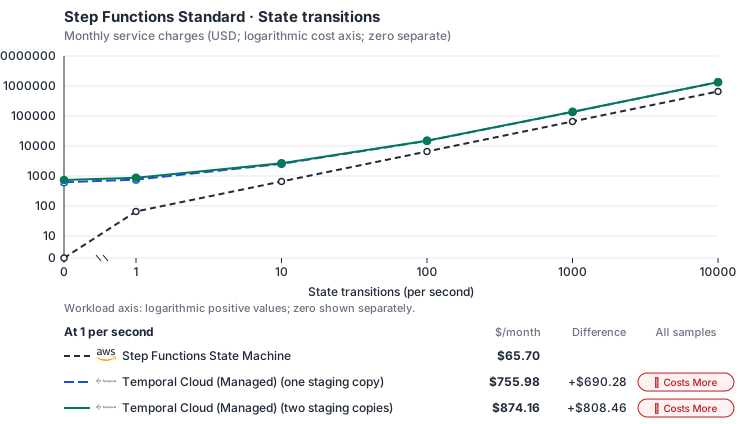
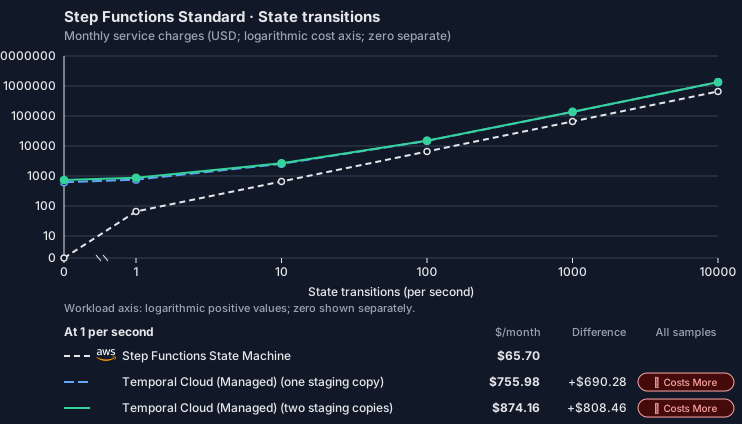
Estimated allocation, not benchmark calibrated: sized from 2 vCPU, 8 GiB memory and 100 GiB SSD at 0 per second to 96 vCPU, 624 GiB memory and 21,655 GiB SSD at 10,000 per second.
Curve assumptions
- Includes source retries; target amplification is applied only once. Other native meters and workload assumptions retain their explicitly displayed default quantities. Workload translation and capacity assumptions are not benchmark measurements.
- Native monthly usage priced at the cited provider list prices; listed target allowances apply where present, excluding invoice credits, taxes and negotiated discounts. Rates as of 2026-10-22: us-east-1 → Temporal Cloud (global list), USD/month.
- Source prices are reference charges, not an invoice. Target lines cover selected service usage/configuration only; adapter hosting and Tensor9 fees are excluded.
- Samples of explicit prices are not performance measurements or capacity qualification. No interpolation or break-even guarantee is implied.
- Variant assumptions show the first axis sample; any axis-dependent configuration is described by this curve’s workload note.
- Rates are cited provider list prices, editable for discounts, commitments or another region. Workload translation and capacity coefficients remain editable planning assumptions, not benchmark measurements or a commercial quote.
- Default-zero rates are explicit assumptions, not evidence that the deployed service or resource is free.
- Provisioned-unit minimums use an editable approximate allocation floor. Modeled target service cost is max(usage/allocation, minimum), with billable network, durable staging and dependent sinks added separately; actual RU/TU sizing, scaling increments and throughput remain unqualified.
- Durable staging is priced once: provisioned targets include adapter state in their selected allocation; native targets add a separate staging allocation when required. Adapter hosting is a separate allocation and must exclude resources already priced as staging, workers or target capacity.
- A declared adapter mapping and cost model do not establish implementation availability or service equivalence.
- This is a declared directed mapping; a planning estimate does not establish deployment or request-serving support.
- Authored planning assumptions, not measured adapter capacity. Origin rates are cited first-tier list prices, before free allowances and discounts.
- A cost scenario does not establish backend availability, protocol fidelity or production readiness. Registry serving status remains independent.
- Managed steps, worker CPU and durable history are distinct target cost components. Internal/external step split needs target-specific assumptions.
- Standard-only origin profile; no inference of Express duration, memory or task execution cost.
- Temporal Cloud bills Actions, active and retained workflow-history storage, and a plan. The profile selects the Business plan: the greater of USD 500/month or 10% of consumption, with 2.5 million Actions, 2.5 GB of active and 100 GB of retained storage included. The 500 base is exact while consumption stays under USD 5,000/month; above that the plan adds 10% of consumption, which is not modeled. Pay-as-you-go Actions graduate from USD 50 to 25 per million by volume beyond the included Actions. History storage bills USD 0.042 per active GBh and 0.00105 per retained GBh. The family’s retained history of closed executions bills at the retained rate beyond the 100 GB included; active history of running executions is small for Step Functions workloads and is not modeled. The Developer plan (no base, 10% of consumption, USD 50 per million Actions at every volume) is not selected. Workers run on the customer’s own compute.
- Row-store throughput (capacityOpsPerVcpuSecond, default 1500) is measured-by-tensor9 as a lower bound: the DynamoDB adapter on Cloud SQL db-custom-2-7680 (2 vCPU, PostgreSQL 16, us-west1) served 2,974 ops/s of YCSB-A at 16 threads without recorded saturation (src/main/kotlin/t9/prime/equiv/generated/eval/CloudsqlPostgresqlYcsbAT16GoYcsbV1_0_0.kt). Published CPU-bound pgbench reaches 3,101 read-write transactions and 20,289 point reads per vCPU-second (AWS z1d.2xlarge, PostgreSQL 14.5), so actual capacity is likely higher. Reads and writes share one coefficient: at the same adapter version, read-only YCSB-C was not faster than 50%-update YCSB-A.
- Log-broker throughput (capacityStreamMiBPerVcpuSecond 20 at 0.5 utilization, 4 GiB RAM per vCPU) is provider-documented by Google Managed Service for Apache Kafka sizing (https://docs.cloud.google.com/managed-service-for-apache-kafka/docs/plan-cluster-size): write-equivalent bytes are replicated writes plus a quarter of reads. Producer batches below 10 KB lower per-CPU throughput; that penalty is not modeled.
- Disk utilization 0.8 is provider-documented headroom below Cloud SQL automatic storage increase, which triggers near 91-95% full (https://docs.cloud.google.com/sql/docs/postgres/instance-settings). The 20 GiB reserve exceeds PostgreSQL’s 1 GB default max_wal_size; the remainder of that reserve is unmeasured.
- CPU tiers double from 2 vCPUs to the target’s largest node at 4 GiB per vCPU; each target’s documented largest node bounds CPU, RAM, RAM per vCPU and disk, and the durable staging database uses Cloud SQL Enterprise (96 vCPU, 6.5 GiB per vCPU, 624 GiB, 64 TiB). Targets billed per capacity unit or throughput unit are sized by their backend instead.
- No public evidence: peak/mean work (2) and the RAM working-set fraction (0.1). Proposed measurements: the p99 one-minute rate over the monthly mean from customer CloudWatch metrics; the buffer hit ratio while stepping RAM under a fixed YCSB-B load.
- Node bounds: Cloud SQL Enterprise allows 1-96 vCPUs at 0.9-6.5 GB per vCPU and up to 64 TB with a dedicated vCPU (https://docs.cloud.google.com/sql/docs/postgres/instance-settings).
- Stored GiB already includes the origin family’s physical footprint assumptions; no second storage amplification is applied.
- The operations/vCPU coefficient supplies the compute requirement alongside explicit resource-hour minima.
- Copies and allocation fractions change cost only; they do not increase modeled primary capacity.
- AWS Price List API, AmazonStates offer: https://pricing.us-east-1.amazonaws.com/offers/v1.0/aws/AmazonStates/current/us-east-1/index.json
- Temporal Cloud pricing: https://docs.temporal.io/cloud/pricing
- Additional network transfer, backups, KMS, one-time migration and operational labor unless an explicit meter includes them.
- Destination application execution and separately billed downstream services; supply those allocations separately.
- Taxes, discounts, credits and free-tier allowances not explicitly listed by this model.
- Unmodeled dependent services, task execution and operations outside the selected workload family.
plan-0d058f5a872975ffcd87b6e3a105b9cefcb43a6b / 2026-10-22.planning.2. Curve: workload-1.
Sources: AWS Price List API, AmazonStates offer, Temporal Cloud pricing.
Step Functions Standard → Temporal Cloud (Managed): Authored native-usage planning example. Native monthly usage priced at the cited provider list prices; listed target allowances apply where present, excluding invoice credits, taxes and negotiated discounts.
Scenario source region: us-east-1. Scenario target region: Temporal Cloud (global list). Currency: USD.
Estimated allocation, not benchmark calibrated: sized at 2 vCPU, 8 GiB memory and 100 GiB SSD for this scenario.
Unestimated components: Adapter hosting, Tensor9 fees. A modeled adapted total and savings require these costs.
Cost scope: Modeled target native service and explicitly modeled state allocation; hosting and Tensor9 fees only when supplied.
Excluded costs and workload features:
- Additional network transfer, backups, KMS, one-time migration and operational labor unless an explicit meter includes them.
- Destination application execution and separately billed downstream services; supply those allocations separately.
- Taxes, discounts, credits and free-tier allowances not explicitly listed by this model.
- Unmodeled dependent services, task execution and operations outside the selected workload family.
- Translated reads: 0 operations.
- Translated writes: 0 operations.
- Translated resident physical data: 0 GiB-month.
- Native provider operations: 0 operations.
- Published payload: 0 GiB.
- Delivered payload: 0 GiB.
- Allocated execution CPU: 0 vCPU-hour.
- Allocated execution RAM: 0 GiB-hour.
- Independent resource allocation: 0 resource-hour.
- Independent inventory: 0 resource-month.
- Input tokens: 0 tokens.
- Output tokens: 0 tokens.
- Billable network: 0 GiB.
- Dependent object sink retained data: 0 GiB-month.
- Dependent object sink writes: 0 writes.
- Rates are cited provider list prices, editable for discounts, commitments or another region. Workload translation and capacity coefficients remain editable planning assumptions, not benchmark measurements or a commercial quote.
- Default-zero rates are explicit assumptions, not evidence that the deployed service or resource is free.
- Provisioned-unit minimums use an editable approximate allocation floor. Modeled target service cost is max(usage/allocation, minimum), with billable network, durable staging and dependent sinks added separately; actual RU/TU sizing, scaling increments and throughput remain unqualified.
- Durable staging is priced once: provisioned targets include adapter state in their selected allocation; native targets add a separate staging allocation when required. Adapter hosting is a separate allocation and must exclude resources already priced as staging, workers or target capacity.
- A declared adapter mapping and cost model do not establish implementation availability or service equivalence.
- This is a declared directed mapping; a planning estimate does not establish deployment or request-serving support.
- Authored planning assumptions, not measured adapter capacity. Origin rates are cited first-tier list prices, before free allowances and discounts.
- A cost scenario does not establish backend availability, protocol fidelity or production readiness. Registry serving status remains independent.
- Managed steps, worker CPU and durable history are distinct target cost components. Internal/external step split needs target-specific assumptions.
- Standard-only origin profile; no inference of Express duration, memory or task execution cost.
- Temporal Cloud bills Actions, active and retained workflow-history storage, and a plan. The profile selects the Business plan: the greater of USD 500/month or 10% of consumption, with 2.5 million Actions, 2.5 GB of active and 100 GB of retained storage included. The 500 base is exact while consumption stays under USD 5,000/month; above that the plan adds 10% of consumption, which is not modeled. Pay-as-you-go Actions graduate from USD 50 to 25 per million by volume beyond the included Actions. History storage bills USD 0.042 per active GBh and 0.00105 per retained GBh. The family’s retained history of closed executions bills at the retained rate beyond the 100 GB included; active history of running executions is small for Step Functions workloads and is not modeled. The Developer plan (no base, 10% of consumption, USD 50 per million Actions at every volume) is not selected. Workers run on the customer’s own compute.
- Row-store throughput (capacityOpsPerVcpuSecond, default 1500) is measured-by-tensor9 as a lower bound: the DynamoDB adapter on Cloud SQL db-custom-2-7680 (2 vCPU, PostgreSQL 16, us-west1) served 2,974 ops/s of YCSB-A at 16 threads without recorded saturation (src/main/kotlin/t9/prime/equiv/generated/eval/CloudsqlPostgresqlYcsbAT16GoYcsbV1_0_0.kt). Published CPU-bound pgbench reaches 3,101 read-write transactions and 20,289 point reads per vCPU-second (AWS z1d.2xlarge, PostgreSQL 14.5), so actual capacity is likely higher. Reads and writes share one coefficient: at the same adapter version, read-only YCSB-C was not faster than 50%-update YCSB-A.
- Log-broker throughput (capacityStreamMiBPerVcpuSecond 20 at 0.5 utilization, 4 GiB RAM per vCPU) is provider-documented by Google Managed Service for Apache Kafka sizing (https://docs.cloud.google.com/managed-service-for-apache-kafka/docs/plan-cluster-size): write-equivalent bytes are replicated writes plus a quarter of reads. Producer batches below 10 KB lower per-CPU throughput; that penalty is not modeled.
- Disk utilization 0.8 is provider-documented headroom below Cloud SQL automatic storage increase, which triggers near 91-95% full (https://docs.cloud.google.com/sql/docs/postgres/instance-settings). The 20 GiB reserve exceeds PostgreSQL’s 1 GB default max_wal_size; the remainder of that reserve is unmeasured.
- CPU tiers double from 2 vCPUs to the target’s largest node at 4 GiB per vCPU; each target’s documented largest node bounds CPU, RAM, RAM per vCPU and disk, and the durable staging database uses Cloud SQL Enterprise (96 vCPU, 6.5 GiB per vCPU, 624 GiB, 64 TiB). Targets billed per capacity unit or throughput unit are sized by their backend instead.
- No public evidence: peak/mean work (2) and the RAM working-set fraction (0.1). Proposed measurements: the p99 one-minute rate over the monthly mean from customer CloudWatch metrics; the buffer hit ratio while stepping RAM under a fixed YCSB-B load.
- Node bounds: Cloud SQL Enterprise allows 1-96 vCPUs at 0.9-6.5 GB per vCPU and up to 64 TB with a dedicated vCPU (https://docs.cloud.google.com/sql/docs/postgres/instance-settings).
- Stored GiB already includes the origin family’s physical footprint assumptions; no second storage amplification is applied.
- The operations/vCPU coefficient supplies the compute requirement alongside explicit resource-hour minima.
- Copies and allocation fractions change cost only; they do not increase modeled primary capacity.
plan-0d058f5a872975ffcd87b6e3a105b9cefcb43a6b / 2026-10-22.planning.2. Scenario: planning-example.
Sources: AWS Price List API, AmazonStates offer, Temporal Cloud pricing.
On Azure
Via Azure Durable Functions
The state machine as an adapter record
CreateStateMachine stores the definition, role, type, encryption, logging and tags as one revision. UpdateStateMachine produces the next revision, and an execution pins the revision it starts on, so a definition change never alters a run in flight. PublishStateMachineVersion freezes a revision as a numbered version and an alias routes new executions across one or two versions by weight, exactly as on AWS. DeleteStateMachine succeeds immediately and the state machine reads DELETING; it is retired once its running executions complete, and its versions and aliases go with it. No Azure resource is created or removed by any of these calls: the orchestrator function app is shared by every state machine on the appliance and reads the record at run time.Limitations
- Tracing cannot be enabled. X-Ray is not adapted, so a
tracingConfigurationthat enables tracing is rejected at CreateStateMachine and UpdateStateMachine rather than stored and ignored. - Logs stay on the appliance.includeExecutionDataand the configured destination are honoured; the destination is served by the appliance’s logging, since CloudWatch Logs is a service the appliance does not adapt. - A Task Resource must name a served service. ValidateStateMachineDefinition reports, and CreateStateMachine refuses, a Resource naming a service the appliance does not serve. Run-time limits (Express semantics, Activities, Distributed Map fan-out) are on the Step Functions card for Azure Durable Functions.
Example monthly charges
This Tensor9 BYOC scenario estimates service charges for the named origin and target services. Adapter hosting and commercial Tensor9 fees need separate allocations. How Tensor9 estimates costs explains the method and what the estimates include.Step Functions Standard · State transitions
Feature: Step Functions Standard. Estimated monthly service charges by State transitions. Adapter hosting and Tensor9 fees are excluded. Source: us-east-1; target: East US; currency: USD.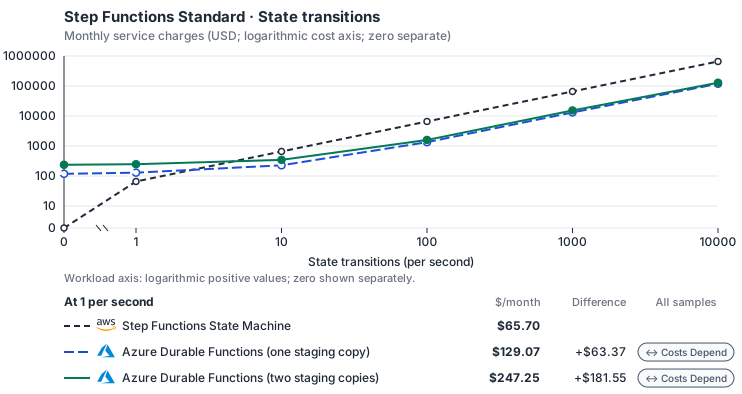
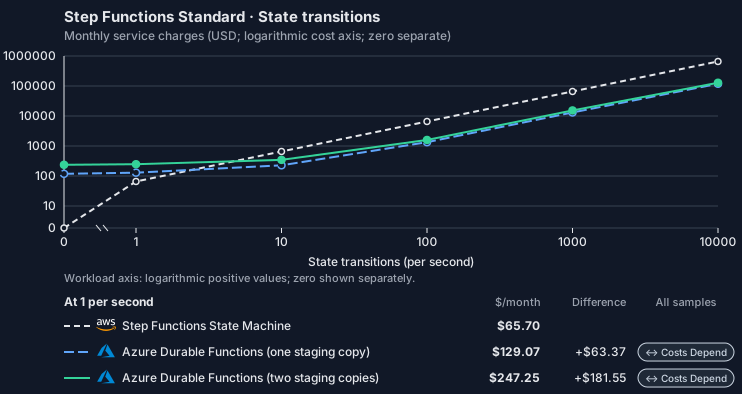
Estimated allocation, not benchmark calibrated: sized from 2 vCPU, 8 GiB memory and 100 GiB SSD at 0 per second to 96 vCPU, 624 GiB memory and 21,655 GiB SSD at 10,000 per second.
Curve assumptions
- Includes source retries; target amplification is applied only once. Other native meters and workload assumptions retain their explicitly displayed default quantities. Workload translation and capacity assumptions are not benchmark measurements.
- Native monthly usage priced at the cited provider list prices; listed target allowances apply where present, excluding invoice credits, taxes and negotiated discounts. Rates as of 2026-10-22: us-east-1 → East US, USD/month.
- Source prices are reference charges, not an invoice. Target lines cover selected service usage/configuration only; adapter hosting and Tensor9 fees are excluded.
- Samples of explicit prices are not performance measurements or capacity qualification. No interpolation or break-even guarantee is implied.
- Variant assumptions show the first axis sample; any axis-dependent configuration is described by this curve’s workload note.
- Rates are cited provider list prices, editable for discounts, commitments or another region. Workload translation and capacity coefficients remain editable planning assumptions, not benchmark measurements or a commercial quote.
- Default-zero rates are explicit assumptions, not evidence that the deployed service or resource is free.
- Provisioned-unit minimums use an editable approximate allocation floor. Modeled target service cost is max(usage/allocation, minimum), with billable network, durable staging and dependent sinks added separately; actual RU/TU sizing, scaling increments and throughput remain unqualified.
- Durable staging is priced once: provisioned targets include adapter state in their selected allocation; native targets add a separate staging allocation when required. Adapter hosting is a separate allocation and must exclude resources already priced as staging, workers or target capacity.
- A declared adapter mapping and cost model do not establish implementation availability or service equivalence.
- This is a declared directed mapping; a planning estimate does not establish deployment or request-serving support.
- Authored planning assumptions, not measured adapter capacity. Origin rates are cited first-tier list prices, before free allowances and discounts.
- A cost scenario does not establish backend availability, protocol fidelity or production readiness. Registry serving status remains independent.
- Managed steps, worker CPU and durable history are distinct target cost components. Internal/external step split needs target-specific assumptions.
- Standard-only origin profile; no inference of Express duration, memory or task execution cost.
- Azure Durable Functions has no orchestration charge of its own: with the default Azure Storage provider it bills the function executions that run orchestrator and activity steps plus the queue and table transactions that persist their messages and history in the customer’s storage account. The step rate is that composite on Flex Consumption. Execution GB-seconds (USD 0.000026 per GB-second on Flex Consumption), idle queue polling (a few hundred thousand transactions a month per app) and table storage (USD 0.045 per GB-month) are not modeled, and the family’s worker CPU is not a Durable Functions charge. The Durable Task Scheduler (Dedicated USD 0.684932 per capacity-unit hour) is an alternative backend and is not selected.
- Row-store throughput (capacityOpsPerVcpuSecond, default 1500) is measured-by-tensor9 as a lower bound: the DynamoDB adapter on Cloud SQL db-custom-2-7680 (2 vCPU, PostgreSQL 16, us-west1) served 2,974 ops/s of YCSB-A at 16 threads without recorded saturation (src/main/kotlin/t9/prime/equiv/generated/eval/CloudsqlPostgresqlYcsbAT16GoYcsbV1_0_0.kt). Published CPU-bound pgbench reaches 3,101 read-write transactions and 20,289 point reads per vCPU-second (AWS z1d.2xlarge, PostgreSQL 14.5), so actual capacity is likely higher. Reads and writes share one coefficient: at the same adapter version, read-only YCSB-C was not faster than 50%-update YCSB-A.
- Log-broker throughput (capacityStreamMiBPerVcpuSecond 20 at 0.5 utilization, 4 GiB RAM per vCPU) is provider-documented by Google Managed Service for Apache Kafka sizing (https://docs.cloud.google.com/managed-service-for-apache-kafka/docs/plan-cluster-size): write-equivalent bytes are replicated writes plus a quarter of reads. Producer batches below 10 KB lower per-CPU throughput; that penalty is not modeled.
- Disk utilization 0.8 is provider-documented headroom below Cloud SQL automatic storage increase, which triggers near 91-95% full (https://docs.cloud.google.com/sql/docs/postgres/instance-settings). The 20 GiB reserve exceeds PostgreSQL’s 1 GB default max_wal_size; the remainder of that reserve is unmeasured.
- CPU tiers double from 2 vCPUs to the target’s largest node at 4 GiB per vCPU; each target’s documented largest node bounds CPU, RAM, RAM per vCPU and disk, and the durable staging database uses Cloud SQL Enterprise (96 vCPU, 6.5 GiB per vCPU, 624 GiB, 64 TiB). Targets billed per capacity unit or throughput unit are sized by their backend instead.
- No public evidence: peak/mean work (2) and the RAM working-set fraction (0.1). Proposed measurements: the p99 one-minute rate over the monthly mean from customer CloudWatch metrics; the buffer hit ratio while stepping RAM under a fixed YCSB-B load.
- Node bounds: Cloud SQL Enterprise allows 1-96 vCPUs at 0.9-6.5 GB per vCPU and up to 64 TB with a dedicated vCPU (https://docs.cloud.google.com/sql/docs/postgres/instance-settings).
- Stored GiB already includes the origin family’s physical footprint assumptions; no second storage amplification is applied.
- The operations/vCPU coefficient supplies the compute requirement alongside explicit resource-hour minima.
- Copies and allocation fractions change cost only; they do not increase modeled primary capacity.
- AWS Price List API, AmazonStates offer: https://pricing.us-east-1.amazonaws.com/offers/v1.0/aws/AmazonStates/current/us-east-1/index.json
- Azure Retail Prices API: https://prices.azure.com/api/retail/prices
- Additional network transfer, backups, KMS, one-time migration and operational labor unless an explicit meter includes them.
- Destination application execution and separately billed downstream services; supply those allocations separately.
- Taxes, discounts, credits and free-tier allowances not explicitly listed by this model.
- Unmodeled dependent services, task execution and operations outside the selected workload family.
plan-b44eea033c349a8f21b56cb8f9cca7198297c072 / 2026-10-22.planning.2. Curve: workload-1.
Sources: AWS Price List API, AmazonStates offer, Azure Retail Prices API.
Step Functions Standard → Azure Durable Functions: Authored native-usage planning example. Native monthly usage priced at the cited provider list prices; listed target allowances apply where present, excluding invoice credits, taxes and negotiated discounts.
Scenario source region: us-east-1. Scenario target region: East US. Currency: USD.
Estimated allocation, not benchmark calibrated: sized at 2 vCPU, 8 GiB memory and 100 GiB SSD for this scenario.
Unestimated components: Adapter hosting, Tensor9 fees. A modeled adapted total and savings require these costs.
Cost scope: Modeled target native service and explicitly modeled state allocation; hosting and Tensor9 fees only when supplied.
Excluded costs and workload features:
- Additional network transfer, backups, KMS, one-time migration and operational labor unless an explicit meter includes them.
- Destination application execution and separately billed downstream services; supply those allocations separately.
- Taxes, discounts, credits and free-tier allowances not explicitly listed by this model.
- Unmodeled dependent services, task execution and operations outside the selected workload family.
- Translated reads: 0 operations.
- Translated writes: 0 operations.
- Translated resident physical data: 0 GiB-month.
- Native provider operations: 0 operations.
- Published payload: 0 GiB.
- Delivered payload: 0 GiB.
- Allocated execution CPU: 0 vCPU-hour.
- Allocated execution RAM: 0 GiB-hour.
- Independent resource allocation: 0 resource-hour.
- Independent inventory: 0 resource-month.
- Input tokens: 0 tokens.
- Output tokens: 0 tokens.
- Billable network: 0 GiB.
- Dependent object sink retained data: 0 GiB-month.
- Dependent object sink writes: 0 writes.
- Rates are cited provider list prices, editable for discounts, commitments or another region. Workload translation and capacity coefficients remain editable planning assumptions, not benchmark measurements or a commercial quote.
- Default-zero rates are explicit assumptions, not evidence that the deployed service or resource is free.
- Provisioned-unit minimums use an editable approximate allocation floor. Modeled target service cost is max(usage/allocation, minimum), with billable network, durable staging and dependent sinks added separately; actual RU/TU sizing, scaling increments and throughput remain unqualified.
- Durable staging is priced once: provisioned targets include adapter state in their selected allocation; native targets add a separate staging allocation when required. Adapter hosting is a separate allocation and must exclude resources already priced as staging, workers or target capacity.
- A declared adapter mapping and cost model do not establish implementation availability or service equivalence.
- This is a declared directed mapping; a planning estimate does not establish deployment or request-serving support.
- Authored planning assumptions, not measured adapter capacity. Origin rates are cited first-tier list prices, before free allowances and discounts.
- A cost scenario does not establish backend availability, protocol fidelity or production readiness. Registry serving status remains independent.
- Managed steps, worker CPU and durable history are distinct target cost components. Internal/external step split needs target-specific assumptions.
- Standard-only origin profile; no inference of Express duration, memory or task execution cost.
- Azure Durable Functions has no orchestration charge of its own: with the default Azure Storage provider it bills the function executions that run orchestrator and activity steps plus the queue and table transactions that persist their messages and history in the customer’s storage account. The step rate is that composite on Flex Consumption. Execution GB-seconds (USD 0.000026 per GB-second on Flex Consumption), idle queue polling (a few hundred thousand transactions a month per app) and table storage (USD 0.045 per GB-month) are not modeled, and the family’s worker CPU is not a Durable Functions charge. The Durable Task Scheduler (Dedicated USD 0.684932 per capacity-unit hour) is an alternative backend and is not selected.
- Row-store throughput (capacityOpsPerVcpuSecond, default 1500) is measured-by-tensor9 as a lower bound: the DynamoDB adapter on Cloud SQL db-custom-2-7680 (2 vCPU, PostgreSQL 16, us-west1) served 2,974 ops/s of YCSB-A at 16 threads without recorded saturation (src/main/kotlin/t9/prime/equiv/generated/eval/CloudsqlPostgresqlYcsbAT16GoYcsbV1_0_0.kt). Published CPU-bound pgbench reaches 3,101 read-write transactions and 20,289 point reads per vCPU-second (AWS z1d.2xlarge, PostgreSQL 14.5), so actual capacity is likely higher. Reads and writes share one coefficient: at the same adapter version, read-only YCSB-C was not faster than 50%-update YCSB-A.
- Log-broker throughput (capacityStreamMiBPerVcpuSecond 20 at 0.5 utilization, 4 GiB RAM per vCPU) is provider-documented by Google Managed Service for Apache Kafka sizing (https://docs.cloud.google.com/managed-service-for-apache-kafka/docs/plan-cluster-size): write-equivalent bytes are replicated writes plus a quarter of reads. Producer batches below 10 KB lower per-CPU throughput; that penalty is not modeled.
- Disk utilization 0.8 is provider-documented headroom below Cloud SQL automatic storage increase, which triggers near 91-95% full (https://docs.cloud.google.com/sql/docs/postgres/instance-settings). The 20 GiB reserve exceeds PostgreSQL’s 1 GB default max_wal_size; the remainder of that reserve is unmeasured.
- CPU tiers double from 2 vCPUs to the target’s largest node at 4 GiB per vCPU; each target’s documented largest node bounds CPU, RAM, RAM per vCPU and disk, and the durable staging database uses Cloud SQL Enterprise (96 vCPU, 6.5 GiB per vCPU, 624 GiB, 64 TiB). Targets billed per capacity unit or throughput unit are sized by their backend instead.
- No public evidence: peak/mean work (2) and the RAM working-set fraction (0.1). Proposed measurements: the p99 one-minute rate over the monthly mean from customer CloudWatch metrics; the buffer hit ratio while stepping RAM under a fixed YCSB-B load.
- Node bounds: Cloud SQL Enterprise allows 1-96 vCPUs at 0.9-6.5 GB per vCPU and up to 64 TB with a dedicated vCPU (https://docs.cloud.google.com/sql/docs/postgres/instance-settings).
- Stored GiB already includes the origin family’s physical footprint assumptions; no second storage amplification is applied.
- The operations/vCPU coefficient supplies the compute requirement alongside explicit resource-hour minima.
- Copies and allocation fractions change cost only; they do not increase modeled primary capacity.
plan-b44eea033c349a8f21b56cb8f9cca7198297c072 / 2026-10-22.planning.2. Scenario: planning-example.
Sources: AWS Price List API, AmazonStates offer, Azure Retail Prices API.
Costs
Estimated monthly service charges for each backend with a published cost model, at one sampled workload from that model’s cost curve. Adapter hosting and Tensor9 fees are excluded. How Tensor9 estimates costs explains the method, what the estimates include and how to read their qualifications.
Difference means backend minus origin; a positive difference means the backend costs more. Workloads and target configurations differ by model, so compare each row’s difference at its stated workload rather than charges across rows.
Cost curves across workload sizes, with every assumption and exclusion: Step Functions costs, Step Functions State Machine costs.
Service level agreements
Listed terms cover requests sent through this service adapter. They do not cover direct connections to the target service or replace the cloud provider’s own SLA. Each origin-to-target pair has its own terms or an explicit pending status. See the SLA tables, measurement rules, and scaling conditions.Step Functions to Azure Durable Functions
Adapter-added latency. A + prefix marks time added by the adapter, not the total time your application waits. Total request time includes adapter processing, backend service time and network time. The backend provider’s SLA applies independently. Only separately measured target-service wait may be subtracted, and only when your agreement permits it; internal metadata, coordination and retry processing still count. For one request, 12 ms of adapter processing plus 90 ms waiting for the backend means at least 102 ms total. This example does not add monthly p99 values.
What Tensor9 covers. These service levels cover the adapter between the origin API and target API. They do not replace the target provider’s SLA.
How latency is counted. Adapter work, including metadata and coordination, counts. Only separately measured permitted target waits are excluded.
Which terms apply. Your signed agreement names the covered operations, workload limits, remedies, and final service levels for your deployment.
What this adapter does
Control calls validate and durably record state-machine definitions, versions and aliases. Execution calls admit work, evaluate ASL transitions and coordinate activities or azure::1.0.0::durable-functions. Time inside invoked customer services is separately observed; interpreter work, durable transition logging, retry decisions and response conversion remain covered.How the latency targets were chosen
Workflow and execution reads: +8 ms monthly p99 (adapter-added).DescribeActivity, DescribeExecution, DescribeMapRun, DescribeStateMachine, DescribeStateMachineAlias, DescribeStateMachineForExecution, GetExecutionHistory, ListActivities, ListExecutions, ListMapRuns, ListStateMachineAliases, ListStateMachineVersions, ListStateMachines, ListTagsForResource. Bounded durable-log or definition-state response mapping.
Definition, version, alias and tag mutation: +15 ms monthly p99 (adapter-added). CreateActivity, CreateStateMachine, CreateStateMachineAlias, DeleteActivity, DeleteStateMachine, DeleteStateMachineAlias, DeleteStateMachineVersion, PublishStateMachineVersion, TagResource, UntagResource, UpdateStateMachine, UpdateStateMachineAlias, ValidateStateMachineDefinition. ASL validation and serialized durable metadata mutation.
Execution and task coordination: +12 ms monthly p99 (adapter-added). RedriveExecution, SendTaskFailure, SendTaskHeartbeat, SendTaskSuccess, StartExecution, StopExecution, TestState, UpdateMapRun. Durable transition admission and bounded workflow evaluation.
Activity poll processing: +5 ms monthly p99 (adapter-added). GetActivityTask. Authorization, bounded task lookup and response conversion around the documented long poll.
Bounded synchronous workflow processing: +25 ms monthly p99 (adapter-added). StartSyncExecution. Durable admission, bounded transition evaluation and final response conversion.
Your signed agreement sets the terms for your deployment. A target does not add an operation or option that the compatibility tables mark unavailable.
What counts toward latency
For a request-response row, measure from the agreed ingress boundary to dispatch of the complete response. A row that explicitly names a first response chunk ends at that chunk; its number does not cover the rest of the stream. A long-poll row names the intentional wait and when adapter delay starts. Include parsing, authorization, admission, translation, serialization, adapter-owned storage and coordination, retries and response handling. Subtract only separately measured target-workload waits and external network segments allowed by the measurement rules. The adapter’s own response handling and dispatch remain covered. A database used for adapter metadata is still adapter work, even if a cloud provider hosts it. For concurrent calls, exclude the union of permitted wait intervals, not the sum of overlapping spans. Calculate each request’s adapter duration first, then the monthly p99. Do not subtract one service’s p99 from another’s. Known adapter timeouts are over-budget samples; failed or incomplete requests cannot disappear to improve the percentile. Missing measurements do not become zero latency. An SDK call span alone does not prove how much of its duration can be excluded.Endpoint reachability and request failures
The endpoint-reachability target measures adapter health checks. Correctly forwarding a target quota or permission error is different from producing that error because the adapter sent the wrong request. Adapter-caused failures remain Tensor9’s responsibility even when the target is healthy. Correctness and data-integrity requirements apply to every supported request. Endpoint reachability does not measure request correctness or grant an allowance for incorrect results.Scaling and target-service capacity
Executions shard by execution identity; ordered transitions within one execution remain serialized. Qualification fixes definition size, history events, payload bytes, map concurrency, activity waiters and execution mix. Lists and histories are bounded pages, and a hot execution cannot monopolize unrelated workflows. Tell Tensor9 the expected steady rate, bursts, concurrency, payload sizes and operation mix. Tensor9 sizes and scales the adapter for the agreed load; you choose and monitor the target service’s capacity with Tensor9’s help. A latency budget is not a requests-per-second rating. Larger requests and higher rates need explicit terms, not silent inheritance of a small-request SLA.Data and behavior guarantees
Accepted transitions and task outcomes are durable and idempotent, retries follow the definition, aliases resolve consistently, and redrive never skips required history. Unsupported ASL or target integrations fail before execution rather than being silently ignored.Example and diagnosis
StartExecution durably creates one execution and returns its stable ARN. A three-state workflow then records each transition; Lambda or cloud-workflow execution time is external, while ASL evaluation and log commits remain covered. GetExecutionHistory returns one bounded page from that durable sequence. Usetensor9 explain and the documented explain headers to understand the selected adapter and its behavior. Correlate available request diagnostics with the target provider’s latency, throttling and capacity metrics. An explain report helps diagnose a request; it is not by itself a qualified SLA timing measurement. Share the operation, request shape, timestamps and request identifiers with support, with credentials and customer payloads removed.
Step Functions to Cloud Workflows
Adapter-added latency. A + prefix marks time added by the adapter, not the total time your application waits. Total request time includes adapter processing, backend service time and network time. The backend provider’s SLA applies independently. Only separately measured target-service wait may be subtracted, and only when your agreement permits it; internal metadata, coordination and retry processing still count. For one request, 12 ms of adapter processing plus 90 ms waiting for the backend means at least 102 ms total. This example does not add monthly p99 values.
What Tensor9 covers. These service levels cover the adapter between the origin API and target API. They do not replace the target provider’s SLA.
How latency is counted. Adapter work, including metadata and coordination, counts. Only separately measured permitted target waits are excluded.
Which terms apply. Your signed agreement names the covered operations, workload limits, remedies, and final service levels for your deployment.
What this adapter does
Control calls validate and durably record state-machine definitions, versions and aliases. Execution calls admit work, evaluate ASL transitions and coordinate activities or google::1.0.0::workflows. Time inside invoked customer services is separately observed; interpreter work, durable transition logging, retry decisions and response conversion remain covered.How the latency targets were chosen
Workflow and execution reads: +8 ms monthly p99 (adapter-added).DescribeActivity, DescribeExecution, DescribeMapRun, DescribeStateMachine, DescribeStateMachineAlias, DescribeStateMachineForExecution, GetExecutionHistory, ListActivities, ListExecutions, ListMapRuns, ListStateMachineAliases, ListStateMachineVersions, ListStateMachines, ListTagsForResource. Bounded durable-log or definition-state response mapping.
Definition, version, alias and tag mutation: +15 ms monthly p99 (adapter-added). CreateActivity, CreateStateMachine, CreateStateMachineAlias, DeleteActivity, DeleteStateMachine, DeleteStateMachineAlias, DeleteStateMachineVersion, PublishStateMachineVersion, TagResource, UntagResource, UpdateStateMachine, UpdateStateMachineAlias, ValidateStateMachineDefinition. ASL validation and serialized durable metadata mutation.
Execution and task coordination: +12 ms monthly p99 (adapter-added). RedriveExecution, SendTaskFailure, SendTaskHeartbeat, SendTaskSuccess, StartExecution, StopExecution, TestState, UpdateMapRun. Durable transition admission and bounded workflow evaluation.
Activity poll processing: +5 ms monthly p99 (adapter-added). GetActivityTask. Authorization, bounded task lookup and response conversion around the documented long poll.
Bounded synchronous workflow processing: +25 ms monthly p99 (adapter-added). StartSyncExecution. Durable admission, bounded transition evaluation and final response conversion.
Your signed agreement sets the terms for your deployment. A target does not add an operation or option that the compatibility tables mark unavailable.
What counts toward latency
For a request-response row, measure from the agreed ingress boundary to dispatch of the complete response. A row that explicitly names a first response chunk ends at that chunk; its number does not cover the rest of the stream. A long-poll row names the intentional wait and when adapter delay starts. Include parsing, authorization, admission, translation, serialization, adapter-owned storage and coordination, retries and response handling. Subtract only separately measured target-workload waits and external network segments allowed by the measurement rules. The adapter’s own response handling and dispatch remain covered. A database used for adapter metadata is still adapter work, even if a cloud provider hosts it. For concurrent calls, exclude the union of permitted wait intervals, not the sum of overlapping spans. Calculate each request’s adapter duration first, then the monthly p99. Do not subtract one service’s p99 from another’s. Known adapter timeouts are over-budget samples; failed or incomplete requests cannot disappear to improve the percentile. Missing measurements do not become zero latency. An SDK call span alone does not prove how much of its duration can be excluded.Endpoint reachability and request failures
The endpoint-reachability target measures adapter health checks. Correctly forwarding a target quota or permission error is different from producing that error because the adapter sent the wrong request. Adapter-caused failures remain Tensor9’s responsibility even when the target is healthy. Correctness and data-integrity requirements apply to every supported request. Endpoint reachability does not measure request correctness or grant an allowance for incorrect results.Scaling and target-service capacity
Executions shard by execution identity; ordered transitions within one execution remain serialized. Qualification fixes definition size, history events, payload bytes, map concurrency, activity waiters and execution mix. Lists and histories are bounded pages, and a hot execution cannot monopolize unrelated workflows. Tell Tensor9 the expected steady rate, bursts, concurrency, payload sizes and operation mix. Tensor9 sizes and scales the adapter for the agreed load; you choose and monitor the target service’s capacity with Tensor9’s help. A latency budget is not a requests-per-second rating. Larger requests and higher rates need explicit terms, not silent inheritance of a small-request SLA.Data and behavior guarantees
Accepted transitions and task outcomes are durable and idempotent, retries follow the definition, aliases resolve consistently, and redrive never skips required history. Unsupported ASL or target integrations fail before execution rather than being silently ignored.Example and diagnosis
StartExecution durably creates one execution and returns its stable ARN. A three-state workflow then records each transition; Lambda or cloud-workflow execution time is external, while ASL evaluation and log commits remain covered. GetExecutionHistory returns one bounded page from that durable sequence. Usetensor9 explain and the documented explain headers to understand the selected adapter and its behavior. Correlate available request diagnostics with the target provider’s latency, throttling and capacity metrics. An explain report helps diagnose a request; it is not by itself a qualified SLA timing measurement. Share the operation, request shape, timestamps and request identifiers with support, with credentials and customer payloads removed.
Step Functions to Temporal Cloud (Managed)
Adapter-added latency. A + prefix marks time added by the adapter, not the total time your application waits. Total request time includes adapter processing, backend service time and network time. The backend provider’s SLA applies independently. Only separately measured target-service wait may be subtracted, and only when your agreement permits it; internal metadata, coordination and retry processing still count. For one request, 12 ms of adapter processing plus 90 ms waiting for the backend means at least 102 ms total. This example does not add monthly p99 values.
What Tensor9 covers. These service levels cover the adapter between the origin API and target API. They do not replace the target provider’s SLA.
How latency is counted. Adapter work, including metadata and coordination, counts. Only separately measured permitted target waits are excluded.
Which terms apply. Your signed agreement names the covered operations, workload limits, remedies, and final service levels for your deployment.
What this adapter does
Control calls validate and durably record state-machine definitions, versions and aliases. Execution calls admit work, evaluate ASL transitions and coordinate activities or temporalio::1.0.0::managed. Time inside invoked customer services is separately observed; interpreter work, durable transition logging, retry decisions and response conversion remain covered.How the latency targets were chosen
Workflow and execution reads: +8 ms monthly p99 (adapter-added).DescribeActivity, DescribeExecution, DescribeMapRun, DescribeStateMachine, DescribeStateMachineAlias, DescribeStateMachineForExecution, GetExecutionHistory, ListActivities, ListExecutions, ListMapRuns, ListStateMachineAliases, ListStateMachineVersions, ListStateMachines, ListTagsForResource. Bounded durable-log or definition-state response mapping.
Definition, version, alias and tag mutation: +15 ms monthly p99 (adapter-added). CreateActivity, CreateStateMachine, CreateStateMachineAlias, DeleteActivity, DeleteStateMachine, DeleteStateMachineAlias, DeleteStateMachineVersion, PublishStateMachineVersion, TagResource, UntagResource, UpdateStateMachine, UpdateStateMachineAlias, ValidateStateMachineDefinition. ASL validation and serialized durable metadata mutation.
Execution and task coordination: +12 ms monthly p99 (adapter-added). RedriveExecution, SendTaskFailure, SendTaskHeartbeat, SendTaskSuccess, StartExecution, StopExecution, TestState, UpdateMapRun. Durable transition admission and bounded workflow evaluation.
Activity poll processing: +5 ms monthly p99 (adapter-added). GetActivityTask. Authorization, bounded task lookup and response conversion around the documented long poll.
Bounded synchronous workflow processing: +25 ms monthly p99 (adapter-added). StartSyncExecution. Durable admission, bounded transition evaluation and final response conversion.
Your signed agreement sets the terms for your deployment. A target does not add an operation or option that the compatibility tables mark unavailable.
What counts toward latency
For a request-response row, measure from the agreed ingress boundary to dispatch of the complete response. A row that explicitly names a first response chunk ends at that chunk; its number does not cover the rest of the stream. A long-poll row names the intentional wait and when adapter delay starts. Include parsing, authorization, admission, translation, serialization, adapter-owned storage and coordination, retries and response handling. Subtract only separately measured target-workload waits and external network segments allowed by the measurement rules. The adapter’s own response handling and dispatch remain covered. A database used for adapter metadata is still adapter work, even if a cloud provider hosts it. For concurrent calls, exclude the union of permitted wait intervals, not the sum of overlapping spans. Calculate each request’s adapter duration first, then the monthly p99. Do not subtract one service’s p99 from another’s. Known adapter timeouts are over-budget samples; failed or incomplete requests cannot disappear to improve the percentile. Missing measurements do not become zero latency. An SDK call span alone does not prove how much of its duration can be excluded.Endpoint reachability and request failures
The endpoint-reachability target measures adapter health checks. Correctly forwarding a target quota or permission error is different from producing that error because the adapter sent the wrong request. Adapter-caused failures remain Tensor9’s responsibility even when the target is healthy. Correctness and data-integrity requirements apply to every supported request. Endpoint reachability does not measure request correctness or grant an allowance for incorrect results.Scaling and target-service capacity
Executions shard by execution identity; ordered transitions within one execution remain serialized. Qualification fixes definition size, history events, payload bytes, map concurrency, activity waiters and execution mix. Lists and histories are bounded pages, and a hot execution cannot monopolize unrelated workflows. Tell Tensor9 the expected steady rate, bursts, concurrency, payload sizes and operation mix. Tensor9 sizes and scales the adapter for the agreed load; you choose and monitor the target service’s capacity with Tensor9’s help. A latency budget is not a requests-per-second rating. Larger requests and higher rates need explicit terms, not silent inheritance of a small-request SLA.Data and behavior guarantees
Accepted transitions and task outcomes are durable and idempotent, retries follow the definition, aliases resolve consistently, and redrive never skips required history. Unsupported ASL or target integrations fail before execution rather than being silently ignored.Example and diagnosis
StartExecution durably creates one execution and returns its stable ARN. A three-state workflow then records each transition; Lambda or cloud-workflow execution time is external, while ASL evaluation and log commits remain covered. GetExecutionHistory returns one bounded page from that durable sequence. Usetensor9 explain and the documented explain headers to understand the selected adapter and its behavior. Correlate available request diagnostics with the target provider’s latency, throttling and capacity metrics. An explain report helps diagnose a request; it is not by itself a qualified SLA timing measurement. Share the operation, request shape, timestamps and request identifiers with support, with credentials and customer payloads removed.
Step Functions to Temporal (Self-Hosted)
Adapter-added latency. A + prefix marks time added by the adapter, not the total time your application waits. Total request time includes adapter processing, backend service time and network time. The backend provider’s SLA applies independently. Only separately measured target-service wait may be subtracted, and only when your agreement permits it; internal metadata, coordination and retry processing still count. For one request, 12 ms of adapter processing plus 90 ms waiting for the backend means at least 102 ms total. This example does not add monthly p99 values.
What Tensor9 covers. These service levels cover the adapter between the origin API and target API. They do not replace the target provider’s SLA.
How latency is counted. Adapter work, including metadata and coordination, counts. Only separately measured permitted target waits are excluded.
Which terms apply. Your signed agreement names the covered operations, workload limits, remedies, and final service levels for your deployment.
What this adapter does
Control calls validate and durably record state-machine definitions, versions and aliases. Execution calls admit work, evaluate ASL transitions and coordinate activities or temporalio::1.0.0::self-hosted. Time inside invoked customer services is separately observed; interpreter work, durable transition logging, retry decisions and response conversion remain covered.How the latency targets were chosen
Workflow and execution reads: +8 ms monthly p99 (adapter-added).DescribeActivity, DescribeExecution, DescribeMapRun, DescribeStateMachine, DescribeStateMachineAlias, DescribeStateMachineForExecution, GetExecutionHistory, ListActivities, ListExecutions, ListMapRuns, ListStateMachineAliases, ListStateMachineVersions, ListStateMachines, ListTagsForResource. Bounded durable-log or definition-state response mapping.
Definition, version, alias and tag mutation: +15 ms monthly p99 (adapter-added). CreateActivity, CreateStateMachine, CreateStateMachineAlias, DeleteActivity, DeleteStateMachine, DeleteStateMachineAlias, DeleteStateMachineVersion, PublishStateMachineVersion, TagResource, UntagResource, UpdateStateMachine, UpdateStateMachineAlias, ValidateStateMachineDefinition. ASL validation and serialized durable metadata mutation.
Execution and task coordination: +12 ms monthly p99 (adapter-added). RedriveExecution, SendTaskFailure, SendTaskHeartbeat, SendTaskSuccess, StartExecution, StopExecution, TestState, UpdateMapRun. Durable transition admission and bounded workflow evaluation.
Activity poll processing: +5 ms monthly p99 (adapter-added). GetActivityTask. Authorization, bounded task lookup and response conversion around the documented long poll.
Bounded synchronous workflow processing: +25 ms monthly p99 (adapter-added). StartSyncExecution. Durable admission, bounded transition evaluation and final response conversion.
Your signed agreement sets the terms for your deployment. A target does not add an operation or option that the compatibility tables mark unavailable.
What counts toward latency
For a request-response row, measure from the agreed ingress boundary to dispatch of the complete response. A row that explicitly names a first response chunk ends at that chunk; its number does not cover the rest of the stream. A long-poll row names the intentional wait and when adapter delay starts. Include parsing, authorization, admission, translation, serialization, adapter-owned storage and coordination, retries and response handling. Subtract only separately measured target-workload waits and external network segments allowed by the measurement rules. The adapter’s own response handling and dispatch remain covered. A database used for adapter metadata is still adapter work, even if a cloud provider hosts it. For concurrent calls, exclude the union of permitted wait intervals, not the sum of overlapping spans. Calculate each request’s adapter duration first, then the monthly p99. Do not subtract one service’s p99 from another’s. Known adapter timeouts are over-budget samples; failed or incomplete requests cannot disappear to improve the percentile. Missing measurements do not become zero latency. An SDK call span alone does not prove how much of its duration can be excluded.Endpoint reachability and request failures
The endpoint-reachability target measures adapter health checks. Correctly forwarding a target quota or permission error is different from producing that error because the adapter sent the wrong request. Adapter-caused failures remain Tensor9’s responsibility even when the target is healthy. Correctness and data-integrity requirements apply to every supported request. Endpoint reachability does not measure request correctness or grant an allowance for incorrect results.Scaling and target-service capacity
Executions shard by execution identity; ordered transitions within one execution remain serialized. Qualification fixes definition size, history events, payload bytes, map concurrency, activity waiters and execution mix. Lists and histories are bounded pages, and a hot execution cannot monopolize unrelated workflows. Tell Tensor9 the expected steady rate, bursts, concurrency, payload sizes and operation mix. Tensor9 sizes and scales the adapter for the agreed load; you choose and monitor the target service’s capacity with Tensor9’s help. A latency budget is not a requests-per-second rating. Larger requests and higher rates need explicit terms, not silent inheritance of a small-request SLA.Data and behavior guarantees
Accepted transitions and task outcomes are durable and idempotent, retries follow the definition, aliases resolve consistently, and redrive never skips required history. Unsupported ASL or target integrations fail before execution rather than being silently ignored.Example and diagnosis
StartExecution durably creates one execution and returns its stable ARN. A three-state workflow then records each transition; Lambda or cloud-workflow execution time is external, while ASL evaluation and log commits remain covered. GetExecutionHistory returns one bounded page from that durable sequence. Usetensor9 explain and the documented explain headers to understand the selected adapter and its behavior. Correlate available request diagnostics with the target provider’s latency, throttling and capacity metrics. An explain report helps diagnose a request; it is not by itself a qualified SLA timing measurement. Share the operation, request shape, timestamps and request identifiers with support, with credentials and customer payloads removed.
Step Functions State Machine to Azure Durable Functions
Adapter-added latency. A + prefix marks time added by the adapter, not the total time your application waits. Total request time includes adapter processing, backend service time and network time. The backend provider’s SLA applies independently. Only separately measured target-service wait may be subtracted, and only when your agreement permits it; internal metadata, coordination and retry processing still count. For one request, 12 ms of adapter processing plus 90 ms waiting for the backend means at least 102 ms total. This example does not add monthly p99 values.
What Tensor9 covers. These service levels cover the adapter between the origin API and target API. They do not replace the target provider’s SLA.
How latency is counted. Adapter work, including metadata and coordination, counts. Only separately measured permitted target waits are excluded.
Which terms apply. Your signed agreement names the covered operations, workload limits, remedies, and final service levels for your deployment.
What this adapter does
Control calls validate and durably record state-machine definitions, versions and aliases. Execution calls admit work, evaluate ASL transitions and coordinate activities or azure::1.0.0::durable-functions. Time inside invoked customer services is separately observed; interpreter work, durable transition logging, retry decisions and response conversion remain covered.How the latency targets were chosen
Workflow and execution reads: +8 ms monthly p99 (adapter-added).DescribeStateMachine, DescribeStateMachineAlias, DescribeStateMachineForExecution, ListStateMachineAliases, ListStateMachineVersions, ListStateMachines, ListTagsForResource. Bounded durable-log or definition-state response mapping.
Definition, version, alias and tag mutation: +15 ms monthly p99 (adapter-added). CreateStateMachine, CreateStateMachineAlias, DeleteStateMachine, DeleteStateMachineAlias, DeleteStateMachineVersion, PublishStateMachineVersion, TagResource, UntagResource, UpdateStateMachine, UpdateStateMachineAlias, ValidateStateMachineDefinition. ASL validation and serialized durable metadata mutation.
Your signed agreement sets the terms for your deployment. A target does not add an operation or option that the compatibility tables mark unavailable.
What counts toward latency
For a request-response row, measure from the agreed ingress boundary to dispatch of the complete response. A row that explicitly names a first response chunk ends at that chunk; its number does not cover the rest of the stream. A long-poll row names the intentional wait and when adapter delay starts. Include parsing, authorization, admission, translation, serialization, adapter-owned storage and coordination, retries and response handling. Subtract only separately measured target-workload waits and external network segments allowed by the measurement rules. The adapter’s own response handling and dispatch remain covered. A database used for adapter metadata is still adapter work, even if a cloud provider hosts it. For concurrent calls, exclude the union of permitted wait intervals, not the sum of overlapping spans. Calculate each request’s adapter duration first, then the monthly p99. Do not subtract one service’s p99 from another’s. Known adapter timeouts are over-budget samples; failed or incomplete requests cannot disappear to improve the percentile. Missing measurements do not become zero latency. An SDK call span alone does not prove how much of its duration can be excluded.Endpoint reachability and request failures
The endpoint-reachability target measures adapter health checks. Correctly forwarding a target quota or permission error is different from producing that error because the adapter sent the wrong request. Adapter-caused failures remain Tensor9’s responsibility even when the target is healthy. Correctness and data-integrity requirements apply to every supported request. Endpoint reachability does not measure request correctness or grant an allowance for incorrect results.Scaling and target-service capacity
Executions shard by execution identity; ordered transitions within one execution remain serialized. Qualification fixes definition size, history events, payload bytes, map concurrency, activity waiters and execution mix. Lists and histories are bounded pages, and a hot execution cannot monopolize unrelated workflows. Tell Tensor9 the expected steady rate, bursts, concurrency, payload sizes and operation mix. Tensor9 sizes and scales the adapter for the agreed load; you choose and monitor the target service’s capacity with Tensor9’s help. A latency budget is not a requests-per-second rating. Larger requests and higher rates need explicit terms, not silent inheritance of a small-request SLA.Data and behavior guarantees
Accepted transitions and task outcomes are durable and idempotent, retries follow the definition, aliases resolve consistently, and redrive never skips required history. Unsupported ASL or target integrations fail before execution rather than being silently ignored.Example and diagnosis
StartExecution durably creates one execution and returns its stable ARN. A three-state workflow then records each transition; Lambda or cloud-workflow execution time is external, while ASL evaluation and log commits remain covered. GetExecutionHistory returns one bounded page from that durable sequence. Usetensor9 explain and the documented explain headers to understand the selected adapter and its behavior. Correlate available request diagnostics with the target provider’s latency, throttling and capacity metrics. An explain report helps diagnose a request; it is not by itself a qualified SLA timing measurement. Share the operation, request shape, timestamps and request identifiers with support, with credentials and customer payloads removed.
Step Functions State Machine to Cloud Workflows
Adapter-added latency. A + prefix marks time added by the adapter, not the total time your application waits. Total request time includes adapter processing, backend service time and network time. The backend provider’s SLA applies independently. Only separately measured target-service wait may be subtracted, and only when your agreement permits it; internal metadata, coordination and retry processing still count. For one request, 12 ms of adapter processing plus 90 ms waiting for the backend means at least 102 ms total. This example does not add monthly p99 values.
What Tensor9 covers. These service levels cover the adapter between the origin API and target API. They do not replace the target provider’s SLA.
How latency is counted. Adapter work, including metadata and coordination, counts. Only separately measured permitted target waits are excluded.
Which terms apply. Your signed agreement names the covered operations, workload limits, remedies, and final service levels for your deployment.
What this adapter does
Control calls validate and durably record state-machine definitions, versions and aliases. Execution calls admit work, evaluate ASL transitions and coordinate activities or google::1.0.0::workflows. Time inside invoked customer services is separately observed; interpreter work, durable transition logging, retry decisions and response conversion remain covered.How the latency targets were chosen
Workflow and execution reads: +8 ms monthly p99 (adapter-added).DescribeStateMachine, DescribeStateMachineAlias, ListStateMachineAliases, ListStateMachineVersions, ListStateMachines, ListTagsForResource. Bounded durable-log or definition-state response mapping.
Definition, version, alias and tag mutation: +15 ms monthly p99 (adapter-added). CreateStateMachine, CreateStateMachineAlias, DeleteStateMachine, DeleteStateMachineAlias, DeleteStateMachineVersion, PublishStateMachineVersion, TagResource, UntagResource, UpdateStateMachine, UpdateStateMachineAlias, ValidateStateMachineDefinition. ASL validation and serialized durable metadata mutation.
Your signed agreement sets the terms for your deployment. A target does not add an operation or option that the compatibility tables mark unavailable.
What counts toward latency
For a request-response row, measure from the agreed ingress boundary to dispatch of the complete response. A row that explicitly names a first response chunk ends at that chunk; its number does not cover the rest of the stream. A long-poll row names the intentional wait and when adapter delay starts. Include parsing, authorization, admission, translation, serialization, adapter-owned storage and coordination, retries and response handling. Subtract only separately measured target-workload waits and external network segments allowed by the measurement rules. The adapter’s own response handling and dispatch remain covered. A database used for adapter metadata is still adapter work, even if a cloud provider hosts it. For concurrent calls, exclude the union of permitted wait intervals, not the sum of overlapping spans. Calculate each request’s adapter duration first, then the monthly p99. Do not subtract one service’s p99 from another’s. Known adapter timeouts are over-budget samples; failed or incomplete requests cannot disappear to improve the percentile. Missing measurements do not become zero latency. An SDK call span alone does not prove how much of its duration can be excluded.Endpoint reachability and request failures
The endpoint-reachability target measures adapter health checks. Correctly forwarding a target quota or permission error is different from producing that error because the adapter sent the wrong request. Adapter-caused failures remain Tensor9’s responsibility even when the target is healthy. Correctness and data-integrity requirements apply to every supported request. Endpoint reachability does not measure request correctness or grant an allowance for incorrect results.Scaling and target-service capacity
Executions shard by execution identity; ordered transitions within one execution remain serialized. Qualification fixes definition size, history events, payload bytes, map concurrency, activity waiters and execution mix. Lists and histories are bounded pages, and a hot execution cannot monopolize unrelated workflows. Tell Tensor9 the expected steady rate, bursts, concurrency, payload sizes and operation mix. Tensor9 sizes and scales the adapter for the agreed load; you choose and monitor the target service’s capacity with Tensor9’s help. A latency budget is not a requests-per-second rating. Larger requests and higher rates need explicit terms, not silent inheritance of a small-request SLA.Data and behavior guarantees
Accepted transitions and task outcomes are durable and idempotent, retries follow the definition, aliases resolve consistently, and redrive never skips required history. Unsupported ASL or target integrations fail before execution rather than being silently ignored.Example and diagnosis
StartExecution durably creates one execution and returns its stable ARN. A three-state workflow then records each transition; Lambda or cloud-workflow execution time is external, while ASL evaluation and log commits remain covered. GetExecutionHistory returns one bounded page from that durable sequence. Usetensor9 explain and the documented explain headers to understand the selected adapter and its behavior. Correlate available request diagnostics with the target provider’s latency, throttling and capacity metrics. An explain report helps diagnose a request; it is not by itself a qualified SLA timing measurement. Share the operation, request shape, timestamps and request identifiers with support, with credentials and customer payloads removed.
Step Functions State Machine to Temporal Cloud (Managed)
Adapter-added latency. A + prefix marks time added by the adapter, not the total time your application waits. Total request time includes adapter processing, backend service time and network time. The backend provider’s SLA applies independently. Only separately measured target-service wait may be subtracted, and only when your agreement permits it; internal metadata, coordination and retry processing still count. For one request, 12 ms of adapter processing plus 90 ms waiting for the backend means at least 102 ms total. This example does not add monthly p99 values.
What Tensor9 covers. These service levels cover the adapter between the origin API and target API. They do not replace the target provider’s SLA.
How latency is counted. Adapter work, including metadata and coordination, counts. Only separately measured permitted target waits are excluded.
Which terms apply. Your signed agreement names the covered operations, workload limits, remedies, and final service levels for your deployment.
What this adapter does
Control calls validate and durably record state-machine definitions, versions and aliases. Execution calls admit work, evaluate ASL transitions and coordinate activities or temporalio::1.0.0::managed. Time inside invoked customer services is separately observed; interpreter work, durable transition logging, retry decisions and response conversion remain covered.How the latency targets were chosen
Workflow and execution reads: +8 ms monthly p99 (adapter-added).DescribeStateMachine, DescribeStateMachineAlias, DescribeStateMachineForExecution, ListStateMachineAliases, ListStateMachineVersions, ListStateMachines, ListTagsForResource. Bounded durable-log or definition-state response mapping.
Definition, version, alias and tag mutation: +15 ms monthly p99 (adapter-added). CreateStateMachine, CreateStateMachineAlias, DeleteStateMachine, DeleteStateMachineAlias, DeleteStateMachineVersion, PublishStateMachineVersion, TagResource, UntagResource, UpdateStateMachine, UpdateStateMachineAlias, ValidateStateMachineDefinition. ASL validation and serialized durable metadata mutation.
Your signed agreement sets the terms for your deployment. A target does not add an operation or option that the compatibility tables mark unavailable.
What counts toward latency
For a request-response row, measure from the agreed ingress boundary to dispatch of the complete response. A row that explicitly names a first response chunk ends at that chunk; its number does not cover the rest of the stream. A long-poll row names the intentional wait and when adapter delay starts. Include parsing, authorization, admission, translation, serialization, adapter-owned storage and coordination, retries and response handling. Subtract only separately measured target-workload waits and external network segments allowed by the measurement rules. The adapter’s own response handling and dispatch remain covered. A database used for adapter metadata is still adapter work, even if a cloud provider hosts it. For concurrent calls, exclude the union of permitted wait intervals, not the sum of overlapping spans. Calculate each request’s adapter duration first, then the monthly p99. Do not subtract one service’s p99 from another’s. Known adapter timeouts are over-budget samples; failed or incomplete requests cannot disappear to improve the percentile. Missing measurements do not become zero latency. An SDK call span alone does not prove how much of its duration can be excluded.Endpoint reachability and request failures
The endpoint-reachability target measures adapter health checks. Correctly forwarding a target quota or permission error is different from producing that error because the adapter sent the wrong request. Adapter-caused failures remain Tensor9’s responsibility even when the target is healthy. Correctness and data-integrity requirements apply to every supported request. Endpoint reachability does not measure request correctness or grant an allowance for incorrect results.Scaling and target-service capacity
Executions shard by execution identity; ordered transitions within one execution remain serialized. Qualification fixes definition size, history events, payload bytes, map concurrency, activity waiters and execution mix. Lists and histories are bounded pages, and a hot execution cannot monopolize unrelated workflows. Tell Tensor9 the expected steady rate, bursts, concurrency, payload sizes and operation mix. Tensor9 sizes and scales the adapter for the agreed load; you choose and monitor the target service’s capacity with Tensor9’s help. A latency budget is not a requests-per-second rating. Larger requests and higher rates need explicit terms, not silent inheritance of a small-request SLA.Data and behavior guarantees
Accepted transitions and task outcomes are durable and idempotent, retries follow the definition, aliases resolve consistently, and redrive never skips required history. Unsupported ASL or target integrations fail before execution rather than being silently ignored.Example and diagnosis
StartExecution durably creates one execution and returns its stable ARN. A three-state workflow then records each transition; Lambda or cloud-workflow execution time is external, while ASL evaluation and log commits remain covered. GetExecutionHistory returns one bounded page from that durable sequence. Usetensor9 explain and the documented explain headers to understand the selected adapter and its behavior. Correlate available request diagnostics with the target provider’s latency, throttling and capacity metrics. An explain report helps diagnose a request; it is not by itself a qualified SLA timing measurement. Share the operation, request shape, timestamps and request identifiers with support, with credentials and customer payloads removed.
Step Functions State Machine to Temporal (Self-Hosted)
Adapter-added latency. A + prefix marks time added by the adapter, not the total time your application waits. Total request time includes adapter processing, backend service time and network time. The backend provider’s SLA applies independently. Only separately measured target-service wait may be subtracted, and only when your agreement permits it; internal metadata, coordination and retry processing still count. For one request, 12 ms of adapter processing plus 90 ms waiting for the backend means at least 102 ms total. This example does not add monthly p99 values.
What Tensor9 covers. These service levels cover the adapter between the origin API and target API. They do not replace the target provider’s SLA.
How latency is counted. Adapter work, including metadata and coordination, counts. Only separately measured permitted target waits are excluded.
Which terms apply. Your signed agreement names the covered operations, workload limits, remedies, and final service levels for your deployment.
What this adapter does
Control calls validate and durably record state-machine definitions, versions and aliases. Execution calls admit work, evaluate ASL transitions and coordinate activities or temporalio::1.0.0::self-hosted. Time inside invoked customer services is separately observed; interpreter work, durable transition logging, retry decisions and response conversion remain covered.How the latency targets were chosen
Workflow and execution reads: +8 ms monthly p99 (adapter-added).DescribeStateMachine, DescribeStateMachineAlias, DescribeStateMachineForExecution, ListStateMachineAliases, ListStateMachineVersions, ListStateMachines, ListTagsForResource. Bounded durable-log or definition-state response mapping.
Definition, version, alias and tag mutation: +15 ms monthly p99 (adapter-added). CreateStateMachine, CreateStateMachineAlias, DeleteStateMachine, DeleteStateMachineAlias, DeleteStateMachineVersion, PublishStateMachineVersion, TagResource, UntagResource, UpdateStateMachine, UpdateStateMachineAlias, ValidateStateMachineDefinition. ASL validation and serialized durable metadata mutation.
Your signed agreement sets the terms for your deployment. A target does not add an operation or option that the compatibility tables mark unavailable.
What counts toward latency
For a request-response row, measure from the agreed ingress boundary to dispatch of the complete response. A row that explicitly names a first response chunk ends at that chunk; its number does not cover the rest of the stream. A long-poll row names the intentional wait and when adapter delay starts. Include parsing, authorization, admission, translation, serialization, adapter-owned storage and coordination, retries and response handling. Subtract only separately measured target-workload waits and external network segments allowed by the measurement rules. The adapter’s own response handling and dispatch remain covered. A database used for adapter metadata is still adapter work, even if a cloud provider hosts it. For concurrent calls, exclude the union of permitted wait intervals, not the sum of overlapping spans. Calculate each request’s adapter duration first, then the monthly p99. Do not subtract one service’s p99 from another’s. Known adapter timeouts are over-budget samples; failed or incomplete requests cannot disappear to improve the percentile. Missing measurements do not become zero latency. An SDK call span alone does not prove how much of its duration can be excluded.Endpoint reachability and request failures
The endpoint-reachability target measures adapter health checks. Correctly forwarding a target quota or permission error is different from producing that error because the adapter sent the wrong request. Adapter-caused failures remain Tensor9’s responsibility even when the target is healthy. Correctness and data-integrity requirements apply to every supported request. Endpoint reachability does not measure request correctness or grant an allowance for incorrect results.Scaling and target-service capacity
Executions shard by execution identity; ordered transitions within one execution remain serialized. Qualification fixes definition size, history events, payload bytes, map concurrency, activity waiters and execution mix. Lists and histories are bounded pages, and a hot execution cannot monopolize unrelated workflows. Tell Tensor9 the expected steady rate, bursts, concurrency, payload sizes and operation mix. Tensor9 sizes and scales the adapter for the agreed load; you choose and monitor the target service’s capacity with Tensor9’s help. A latency budget is not a requests-per-second rating. Larger requests and higher rates need explicit terms, not silent inheritance of a small-request SLA.Data and behavior guarantees
Accepted transitions and task outcomes are durable and idempotent, retries follow the definition, aliases resolve consistently, and redrive never skips required history. Unsupported ASL or target integrations fail before execution rather than being silently ignored.Example and diagnosis
StartExecution durably creates one execution and returns its stable ARN. A three-state workflow then records each transition; Lambda or cloud-workflow execution time is external, while ASL evaluation and log commits remain covered. GetExecutionHistory returns one bounded page from that durable sequence. Usetensor9 explain and the documented explain headers to understand the selected adapter and its behavior. Correlate available request diagnostics with the target provider’s latency, throttling and capacity metrics. An explain report helps diagnose a request; it is not by itself a qualified SLA timing measurement. Share the operation, request shape, timestamps and request identifiers with support, with credentials and customer payloads removed.